

Triple Fatality — Single Fixed Piton Pulled
Washington, North Cascades, Washington Pass, LIberty Bell Group, North Early Winter Spire
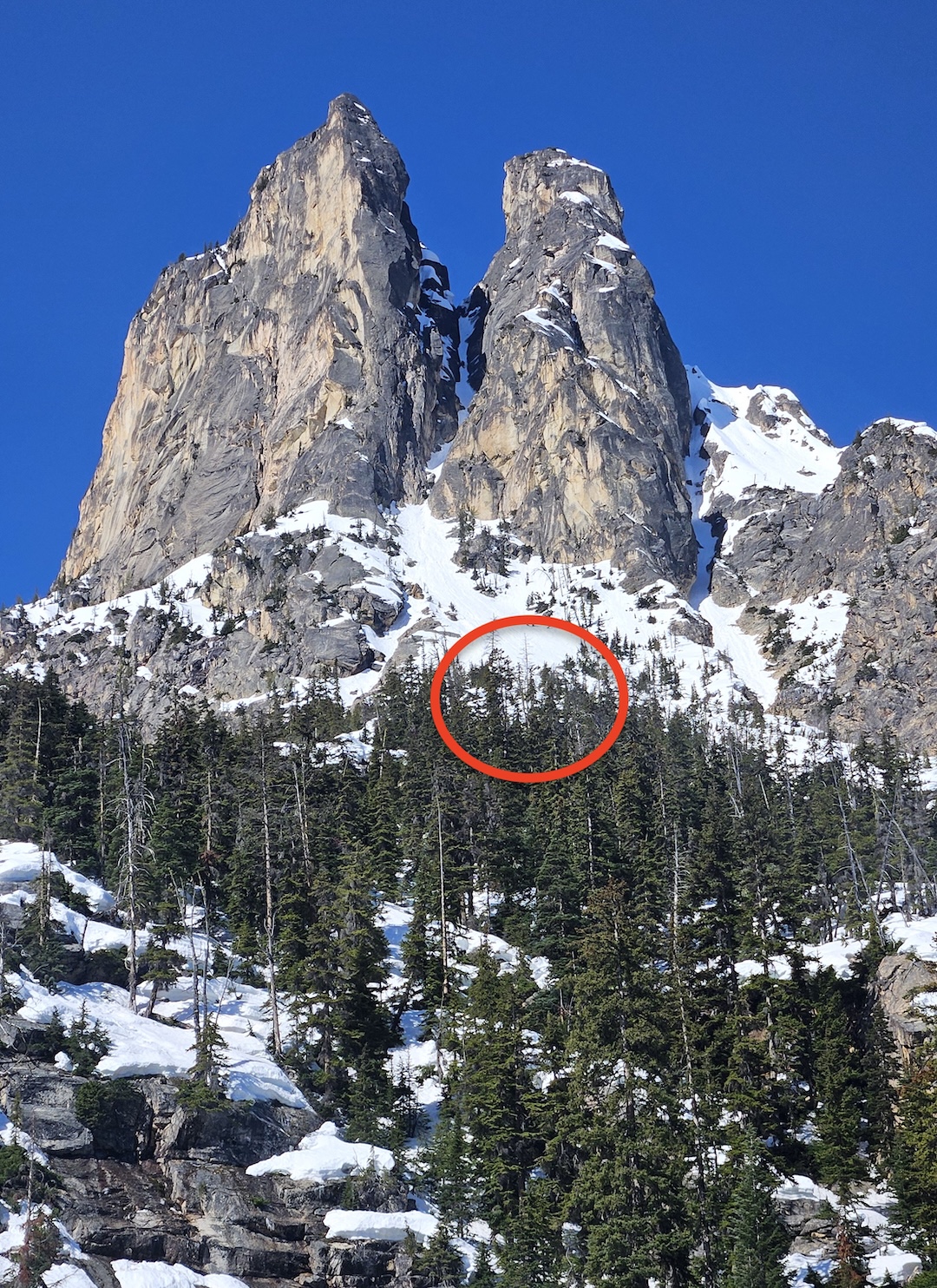
On May 10, four Seattle-area climbers began an ascent of Early Winter Couloir (1,000’, AI 2/3 M4+) on North Early Winter Spire (7,760 feet). They left their vehicle at 6:10 a.m. The party consisted of Vishnu Irigireddy (48), Tim Nguyen (63), Oleksander Martynenko (36), and Anton Tselykh (38). The route has six mixed pitches on rock, snow, and ice. They all wore helmets and crampons. They carried ice tools, a rack of cams and nuts, at least one ice screw, and two snow pickets. They used two 8.5mm 60m ropes that were approved as single, half, or twin ropes.
After climbing for 11 hours, the party was still one technical pitch from the summit. It was 5:30 p.m., it had begun to snow, and daylight was fading. They sent a message to a friend via inReach sharing that they were turning back.
If they’d made it to the summit, their descent would have been down the opposite side—down the Southwest Couloir on the spire’s west facet, via five or six rappels from fixed anchors. (Early Winter Couloir faces roughly east.) From their turnaround point, there were no established rappel stations. The foursome started rappelling as a single team back down the way they’d come, using their two 60m ropes, with each team member rapping individually. The first anchor was a slung horn or block; the second was built with nuts and a sling; the third combined a fixed piton and a bolt.
Reports do not identify the climbers in the sequence of events that followed, but the first climber rappelled from the third station and could not locate an anchor. A second climber joined the first. The details are not clear, but it can be assumed that they had a stance in the snow or on a ledge. The third climber to come down crossed the couloir and found a single fixed piton (or pin) in the rock. The fourth climber joined the first two, and then they all crossed to the single-piton anchor, using the ropes to safeguard themselves. All four clipped into two slings that they had attached to the piton. Tselykh, who was the only survivor, estimated that the team had been moving for 12 hours. He later said there was no discussion about the adequacy of the single piton as an anchor. As one of the less experienced members of the group, Tselykh also assumed that one of the more experienced climbers had assessed it.
The first climber began to rappel off this fourth anchor, and almost immediately the piton pulled from the rock. All four climbers fell 100 to 200 feet onto a snow ramp and then tumbled an additional 400 to 500 feet down steep snow and rock before coming to rest just below treeline at 6,148 feet. The piton did not break; it pulled out intact. Irigireddy, Nguyen, and Martynenko died of massive traumatic injuries.
Tselykh lost consciousness a few seconds into the fall after attempting to self-arrest. He regained consciousness about three and a half hours later. He found the bodies of two companions beside him but could not locate the third. He had no cell service, and his headlamp had been lost in the fall. Despite broken ribs, a skull fracture, internal bleeding, and a traumatic brain injury, Tselykh hiked nine hours back to the car. He then had to replace a flat tire before driving 40 miles to Newhalem, where he found a phone. He called 911 at 11:30 a.m. on May 11.
ANALYSIS
Tselykh later told investigators that none of the four had a high level of technical experience on mixed alpine terrain—Irigireddy and Nguyen were the most experienced. One of the deceased had used alpine ski-touring boots, while the others had alpine climbing boots. This indicates the team’s mixed level of winter climbing experience. While some probably had ice and mixed cragging experience, Tselykh later mentioned that none of them had previous experience with multi-pitch alpine climbing in the big mountains.
This party lacked the technical expertise demanded by the route in spring conditions. When they made the decision to descend, it was already 5:30 p.m. They’d been climbing more slowly than anticipated, and it had started to snow. One climber did not have an adequate jacket and was getting cold.
On a route with objective hazards, four climbers is considered a large group. Each member increases the potential for dislodged snow, rock, and ice, and large teams move more slowly, leading to delays and prolonged exposure to hazards. Unlike their ascent, on which they operated as two rope teams, they chose or probably needed to descend as a single team of four to combine their two ropes. This configuration required that each climber rappel one at a time, taking at least twice as long as with two independent parties. A solution might have incorporated bringing two additional ropes—while this would have increased each team’s load, that factor could have been slightly offset by using ultralight twin ropes.
The urgency created by cold, fatigue, and approaching darkness appears to have prevented the search for alternative anchors or rigging a longer rappel in the third station’s vicinity to reach the snow ramp below, and thus skip a fourth anchor. It isn’t known how much extra rope was available to facilitate this option.
The depth of rock climbing experience within the group is not known. Their familiarity with pitons was probably close to none. Several months after the accident, Adam Butterfield—who had previously climbed Early Winter Couloir—posted on Mountain Project, of the route, “It’s worth having an extensive rock background…as well as good pin craft and knowledge of snow anchors.”
Fixed pins are not to be implicitly trusted. Two other accidents in this book involve the failure of single fixed pitons (see p.95 and p.110). In alpine terrain, these can remain in place for decades. Some pins, especially the thinner models, derive additional holding power by being driven into a constriction. This particular piton was a small, hard-steel angle type that drew its holding power almost exclusively through the spring action of compressed steel hammered into a crack. It takes very little rust and very few freeze-thaw cycles to reduce the steel’s compression force. A telling fact is that the piton pulled versus breaking; this means that the compromised piece was likely not originally hammered into a pronounced constriction.
Four climbers loading a single piece breaks a fundamental principle of anchoring: redundancy. Additional gear would probably have prevented this accident, but the snow picket and ice screw were not options, and one can assume that a nut or cam placement was either too difficult to unearth or unavailable. Had the team carried and placed a piton, they might all still be alive. The same could perhaps be said had they “re-seated” the pin through hammering. A USFS report also cited the “expert halo” cognitive bias as a likely contributing factor: Less experienced team members deferred to the more experienced without any explicit assessment of the anchor.
The group’s GPS data, shared by a friend, enabled rescuers to locate the accident site; without it, recovery in the remote terrain would have been significantly more difficult. Carrying a two-way satellite communicator and sharing the track with a designated contact is a sound practice on any remote alpine objective. (Sources: USFS/Okanogan County Search & Rescue Association Report, Methow Valley News, and the Editors.)
Media Gallery