
Seventy-Two 14ers in One Month by Foot and Bike
United States
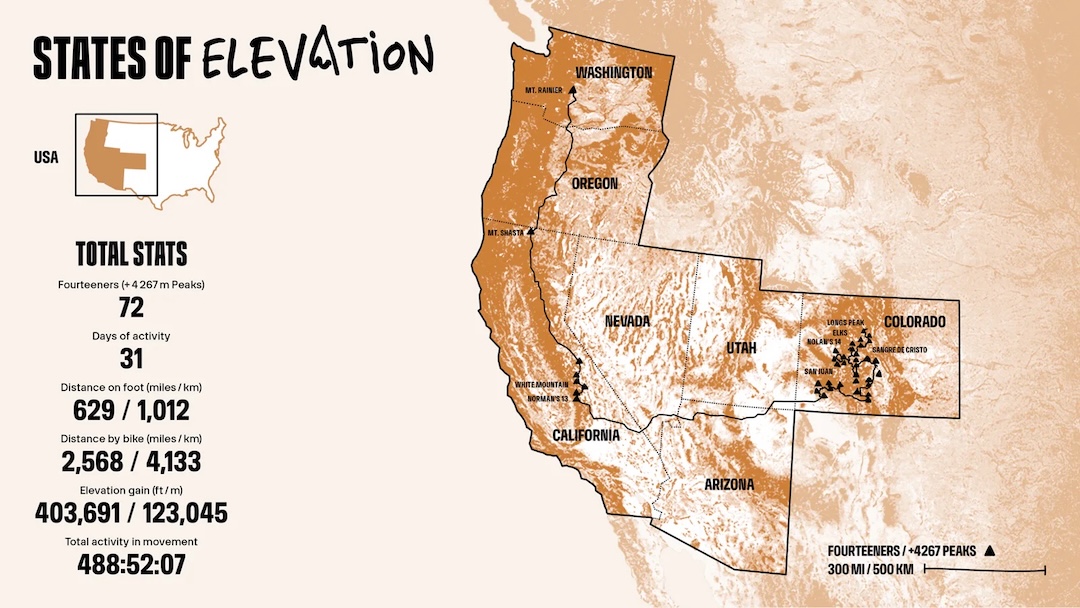
Over a 31-day period from September 3 to October 4, 2025, Spanish ultrarunner and mountaineer Kilian Jornet, age 37 at the time, completed a gargantuan running, cycling, and climbing project that he dubbed “States of Elevation.” Jornet traveled across six Western U.S. states on foot and bicycle, from Colorado’s Longs Peak to Washington’s Mt. Rainier, with ascents of 70 other 14ers en route.
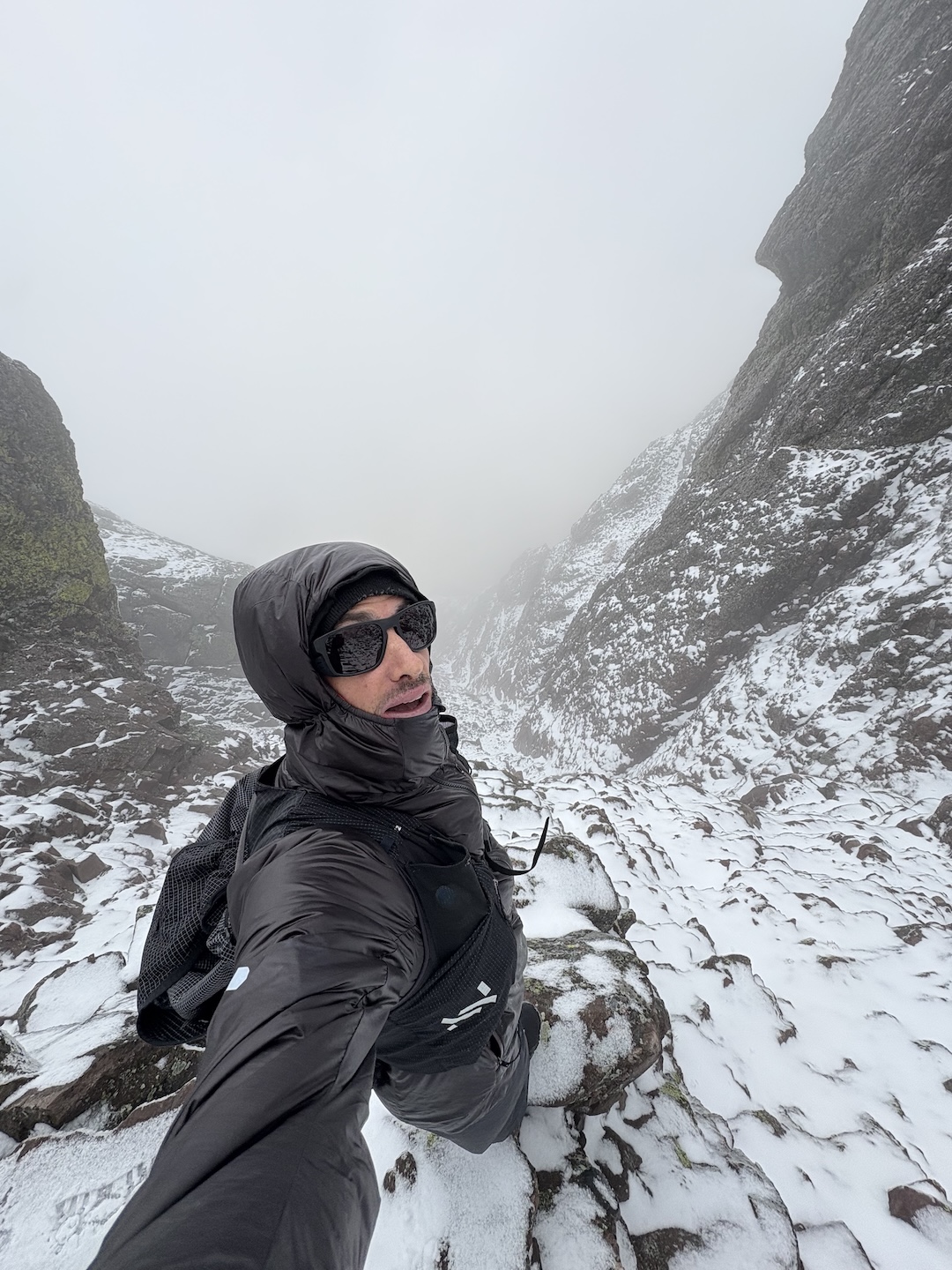
Jornet’s accomplishment was largely nontechnical—only a handful of the 14ers require fifth-class climbing—but it entailed a monumental amount of movement. In all, Jornet covered 3,198 miles—629 miles on foot and 2,568 on bike—and ascended 403,691 vertical feet (more than 13,000 feet a day on average). He moved an average of 15 hours every day for a month. He told the AAJ there was no single crux, but that instead the obstacle was the sheer mileage, coupled with foul weather—during 10 of his 16 days in Colorado, for example, he dealt with either snowstorms, rain, or thunder. “The hardness of the project wasn’t a section, but to do it day after day after day,” Jornet explained.
States of Elevation was a natural progression from previous Jornet projects. In 2023, he summited all 177 peaks in the Pyrenees higher than 3,000 meters (9,842’) in an eight-day push, traveling only by foot and bicycle. In 2024, he scaled all 82 summits above 4,000 meters (13,123’) in the Alps in 19 days (see AAJ 2025). Jornet said that after his link-up in the Alps, he “wanted more of that continuous motion in alpine terrain, but with less objective risks compared to the Alps.”
“A summit link‑up felt like the right way to explore both the U.S. and my own long endurance capacities,” he said. “I knew some long link-ups, especially of Colorado 14ers, but I wanted to explore other places like the volcanoes, the desert, and the Sierra.”
Others have attempted similar 14,000-foot peak enchainments in the U.S. In 2014, Justin Simoni linked every 14er in Colorado by bicycle, self-supported, over 34 days; Joe Grant managed the same feat slightly faster two years later. (Jornet, unlike Simoni and Grant, was supported by a small team.)
Jornet completed roughly half of the summits alone and half with local friends. “I like both experiences,” he explained. “Alone there is more route-finding, introspection and connection to nature, and with companions, you learn more about what makes those mountains special to them and the history of each mountain and its routes.”
During his journey, Jornet set the fastest known time on Norman’s 13, a link-up of the 14,000-foot peaks in California’s Sierra Nevada. He finished the route in just two days and eight hours, about 18 hours faster than the previous record. At this point, he’d already climbed 56 14ers in Colorado and cycled nearly 1,000 miles to California. After leaving the Sierra, Jornet cycled on to Mt. Shasta in Northern California and Mt. Rainier in Washington.
Jornet did not link every ranked 14,000-foot peak in the Lower 48. He skipped Colorado’s southernmost 14er, Culebra Peak, which is on private land and requires a permit; he also avoided Mt. Bross, another Colorado summit with a history of access issues. Jornet said he avoided these peaks out of a desire to make the project repeatable. Finally, he did not summit Liberty Cap, a subpeak of Mt. Rainier, because of concerns about the conditions on the upper mountain.
Jornet said that, in the case of Culebra and Bross, his avoidance was out of a desire to make the project repeatable. “I believe in public access to natural spaces,” he said. “The whole thing about private summits is kind of weird from a European perspective.” On Liberty Cap, he was undecided about whether to make an attempt until the day of his Rainier climb. “There was lots of fresh snow and very strong winds on the summit plateau,” he explained. “Thinking about opening the track and enduring the wind didn’t seem very fun, and probably a big risk to have frostbite on my toes.”
Jornet completed about half of the summits alone and half with local friends. “I like both experiences,” he explained. “Alone, there is more route-finding, introspection, and connection to nature, and with companions, you learn more about what makes these mountains special.”
—Owen Clarke, AAJ
Media Gallery