
Peak 5,710', First Ascent
Colorado, Black Ridge Canyons Wilderness
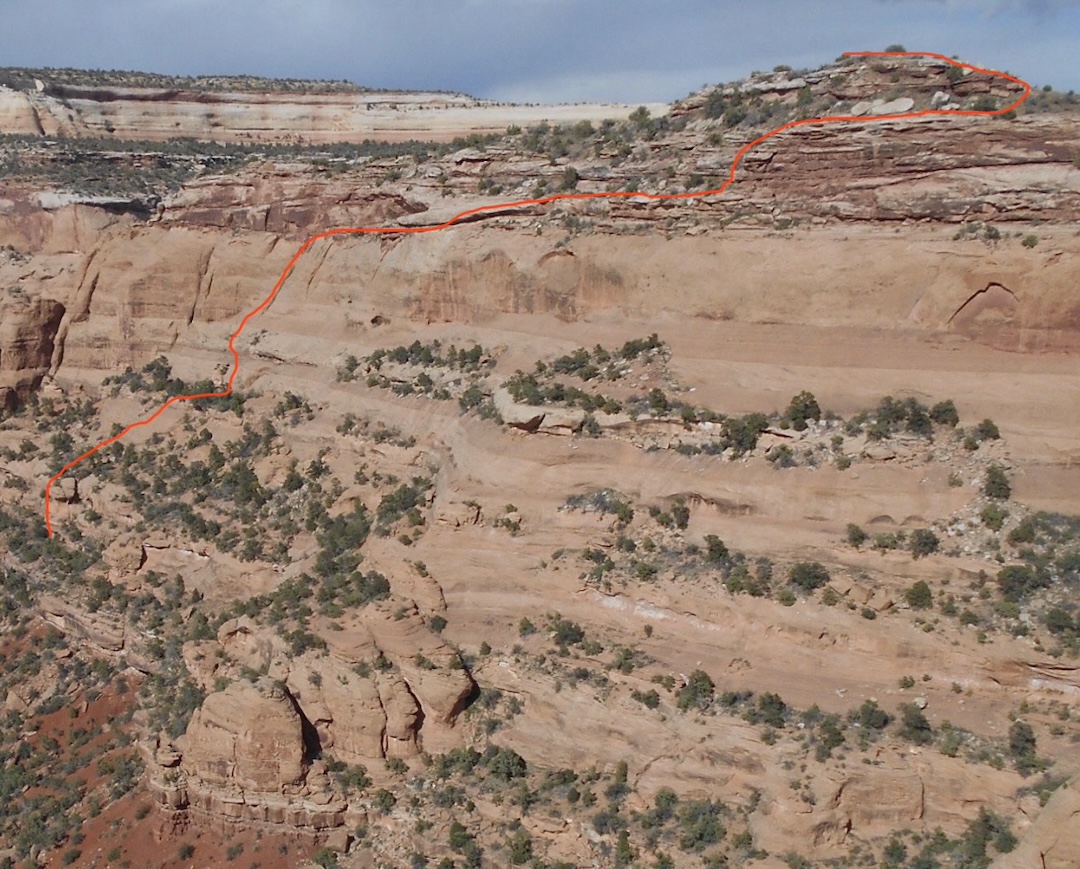 Peak 5,710’, a sandstone butte rising from the floor of Knowles Canyon, in the Black Ridge Canyons Wilderness west of Grand Junction, has been a long-standing challenge for a few Colorado climbers, partly due to its location in a remote, beautiful canyon, but also because it held some cheeky allure: It was said to be the lowest-elevation unclimbed and ranked summit in Colorado. On March 28, Paul Barish and I completed the likely first ascent.
Previous attempts on 5,710 had included combinations of free and aid climbing on various lines, as well as an unsuccessful attempt to use a ladder on the north side. While the northern and southern aspects of Peak 5,710’ appear to have good lines, poor rock and blank headwalls had foiled all parties. Tom Pierce had made at least eight attempts over a decade. This time, Tom led us to a potential aid line on the west face. (He played a crucial role in guiding us to the route, although he did not summit due to leg pain.)
We began the approach from a vehicle pullout near a gate at 39.04545, -108.93348, reachable by passenger cars. We hiked an old jeep road across open mesa and eventually descended into Knowles Canyon on a well-defined unofficial trail and made camp. The following morning, we continued west-northwest, contouring a bit over two miles around the peak to its west side, losing an additional 330 feet of elevation. In all, the approach to Peak 5,710’ covers about five miles and loses 1,000 feet.
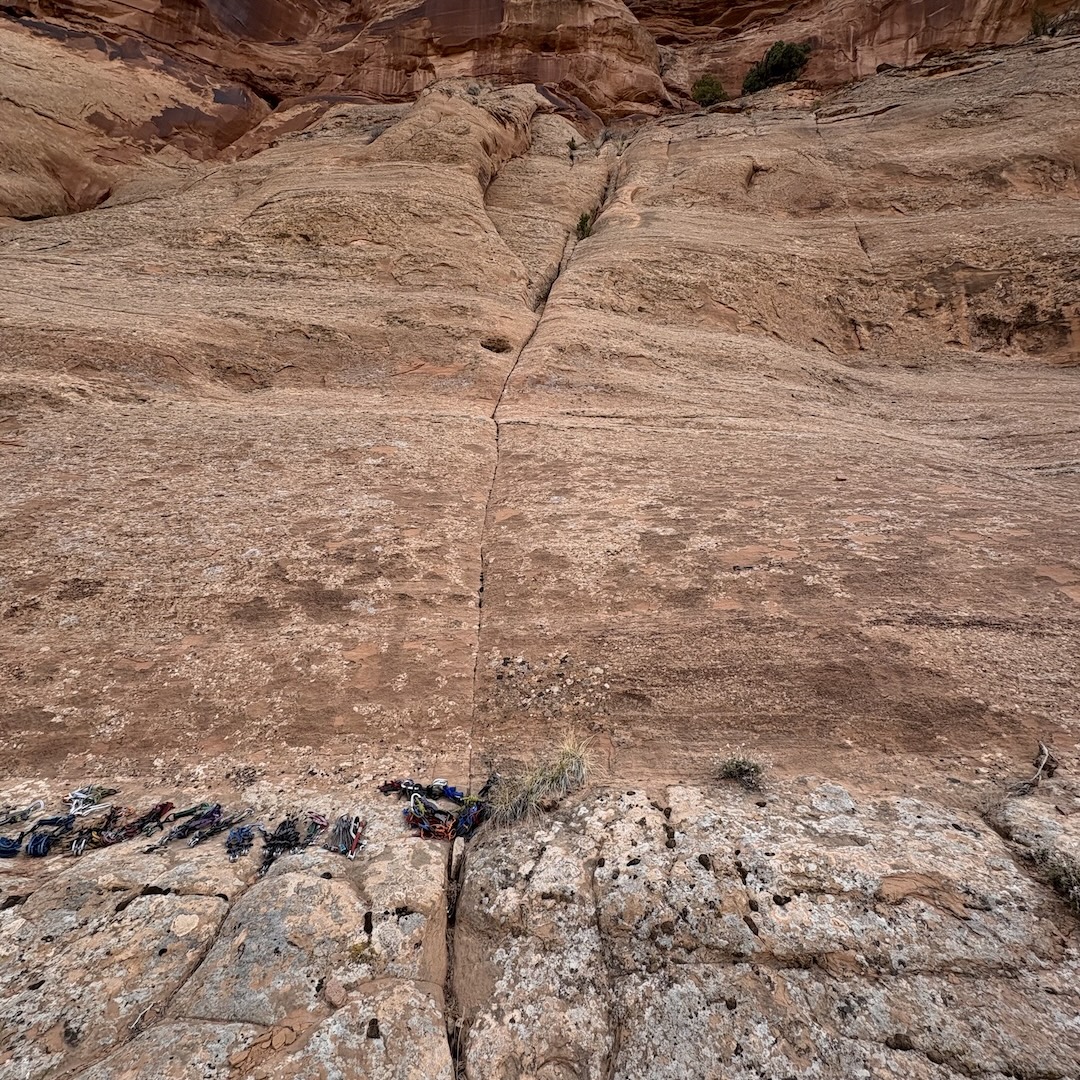
The first pitch was a friction slab traverse with no protection (5.7 X). The second was a low-angle A3+ seam, requiring beaks and Spectres, among other implements. From a wide ledge, Paul and I soloed unprotected 5.5 terrain to the north summit. As it was unclear which was taller, we made our way to the south top via 1,400 feet of rambling class 3; the north summit was indeed the high point.
We downclimbed from the summit to the top of pitch three, and from here rapped off a scrub oak tree to the ground. We camped another night at the same spot as on the way in, and drove out on the third day. We named the route, which had 500 feet of technical terrain from base to summit, White Whale (III 5.7 A3+ X) in honor of Tom’s decade-long pursuit.
—Any Gray-Smith
Media Gallery