
The Diamond in Winter: Two Novel Ascents
Colorado, Rocky Mountains, Rocky Mountain National Park
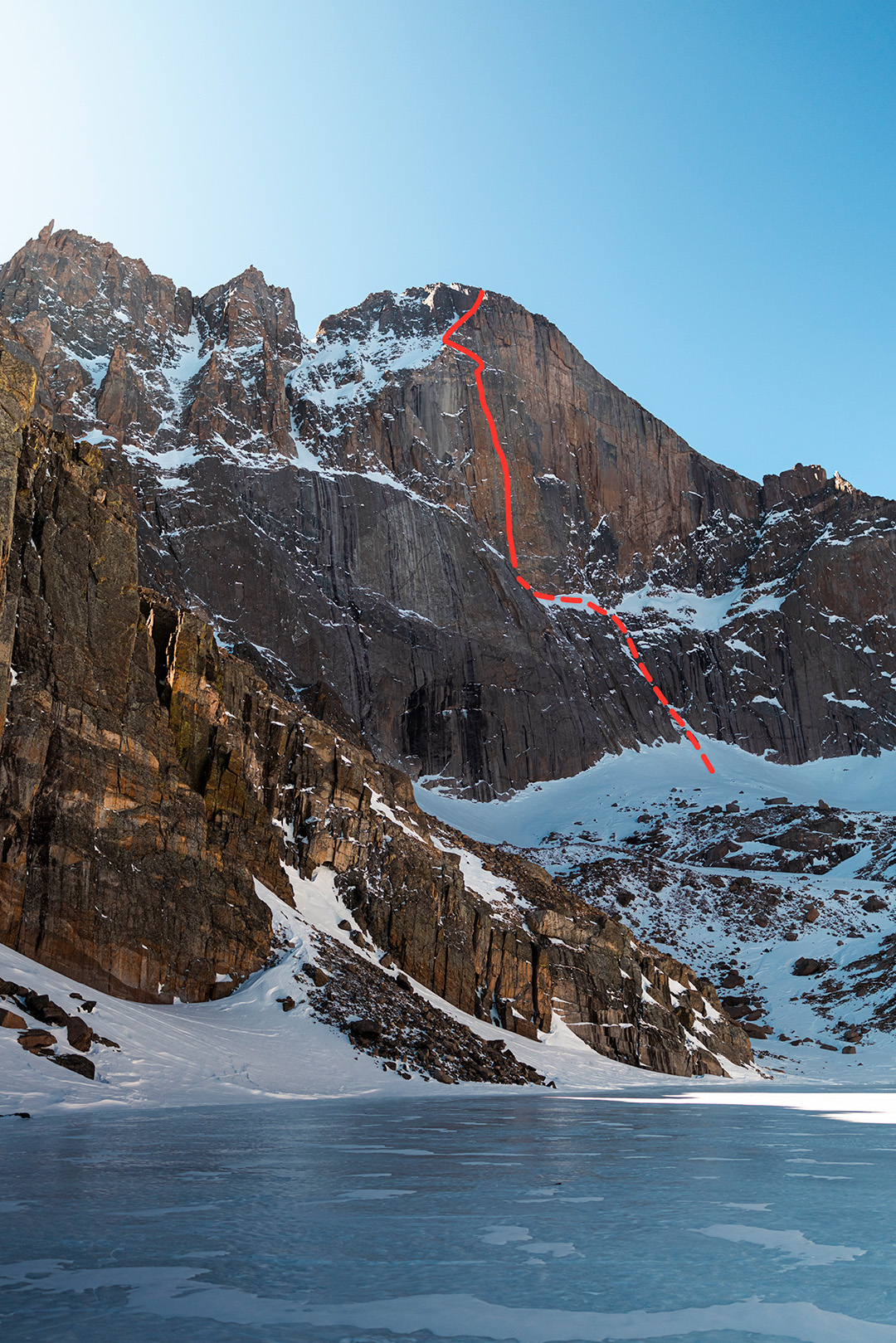
The Diamond on the northeast face of Longs Peak is one of North America’s most famous alpine walls, rising entirely above 13,000 feet (ca 4,000m). The face was first climbed in winter in 1967, and it has seen one-day and solo winter ascents. But it had never been free climbed in winter.
On December 21, 2024, Colorado climber Chris Deuto made a rope-solo ascent of The Casual Route (IV 5.10a), for the Diamond’s first free winter ascent, climbing barehanded on mostly dry rock with some snow patches. He descended from Longs’s summit by the north face Cables Route. Deuto’s round trip from the car took 21 hours.
Near the end of the same winter, in March 2025, three climbers made a “mixed free” ascent of D7 (V 5.11c), climbing in rock shoes but using ice tools. Below is Quentin Roberts’s description of their climb.
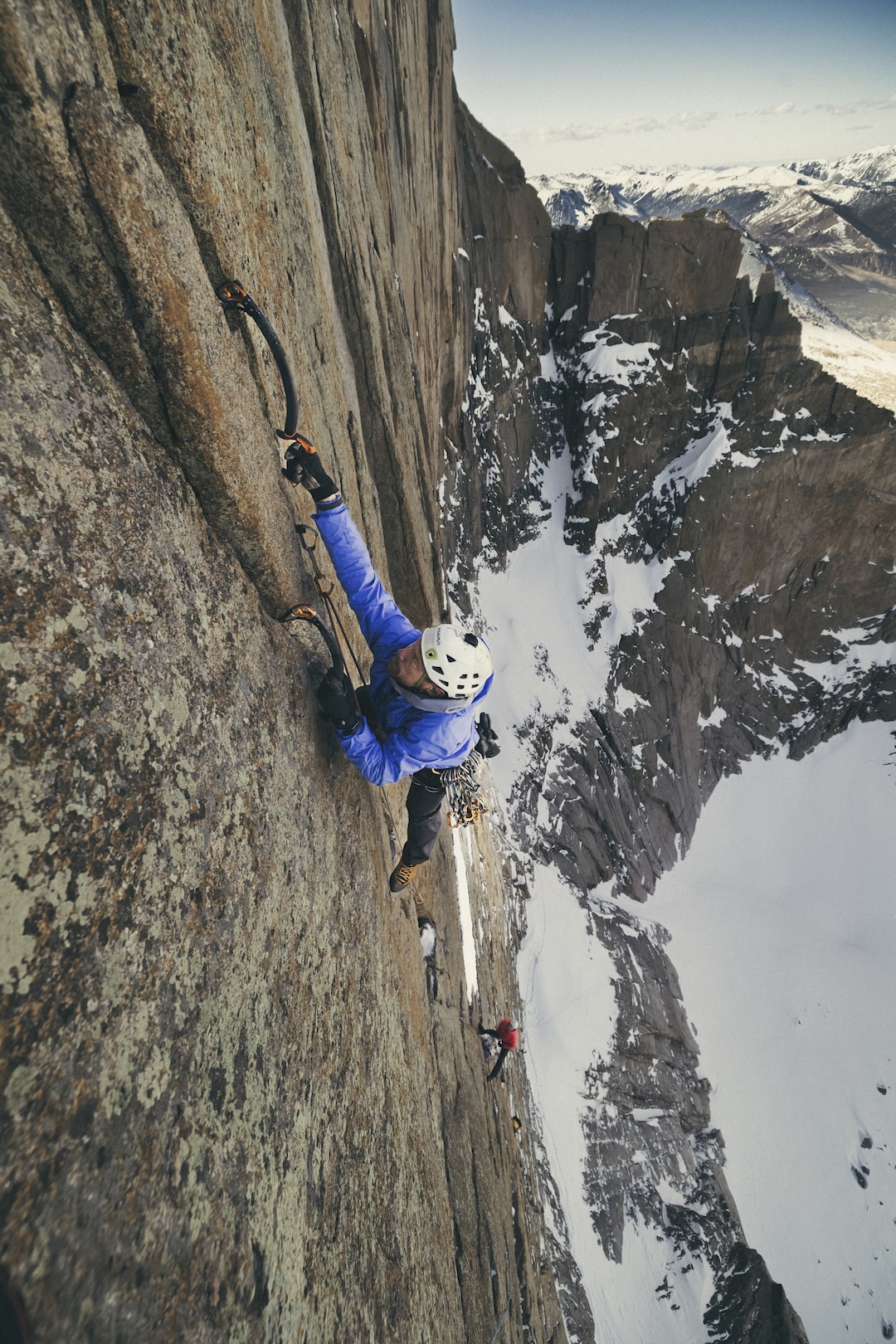
At the tail end of winter, Jesse Huey, Matt Segal, and I, accompanied by filmmaker Jon Glassberg, set off to climb D7 (Dalke-Goss-Hurley, 1966; freed by John Bachar in summer 1977). We called our ascent a free climb, never weighting the rope. However, we leaned on the full winter kit—boots, gloves, ice tools, crampons—along with a less-usual combination of down booties and insulated rock shoes for smearing and jamming.
Jesse and Matt had experience with this strategy; I was used to crampons in such conditions, and my rock shoes felt about as grippy as ice cubes. My feet were a roadrunner blur on the opening pitches until I figured out the unusual techniques.
The team had fixed several hundred meters of static rope on previous missions, so Jon could jumar to our camp on Broadway (the ledge at the base of the Diamond), as well as a few pitches higher to capture photos. It was far from the deep adventure we chase in more remote ranges, but it felt closer to that spirit than anything else I’ve done in Colorado. This was my first time on the Diamond, and as an alien from the north, I didn’t think Colorado could dish out such convincing winters. Think numb toes, -20°C nights, and endless tasks in blowing snow.
During our March 11–13 ascent, the climbing was what you’d expect: cold, steep, time-consuming, tenuous, and thoughtful—and also unnerving because a fall high on a pitch would have cost us dearly in time during the short winter days. But our partnership was locked in. Laughter, shared suffering, and the quiet trust of good friends carried us to the top of Longs Peak. That trust was the root of why we were there in the first place.
Our climb stirred plenty of opinions online. Some saw it as a long-overdue success and gave credit where it was due. Others worried about damage to the stone, or split hairs about whether using ice axes is or isn’t free climbing. We weren’t completely blind to these concerns: We deliberately climbed in rock shoes to avoid creating crampon damage and kept tool placements precise and away from the free climbing holds as much as possible. I’ve never believed that tool-freeing is the same as summer free climbing, but it isn’t aid either. Anyway, to me, these things don’t matter so much as simply telling the truth about your ascent.
Our truth? We climbed D7 in winter, laughed a lot, and staggered down with a monstrous tangle of rope.
Because of its direct line, D7 had been by far the most popular choice for previous winter ascents of the Diamond, using aid, but in hindsight I would have preferred to attempt one of the less traveled, steeper, harder, and longer lines out right, instead of this heavily traveled classic. It’s a shame that our ascent on D7 might have threatened some people’s support for winter climbing on Longs Peak altogether, because I personally think the Diamond is one of the most badass training grounds for real alpinism in the Lower 48.
—Quentin Roberts, Canada
Media Gallery