Begguya, North Buttress, French Connection Solo; Denali, Slovak Direct, Solo Ascent
Alaska, Alaska Range
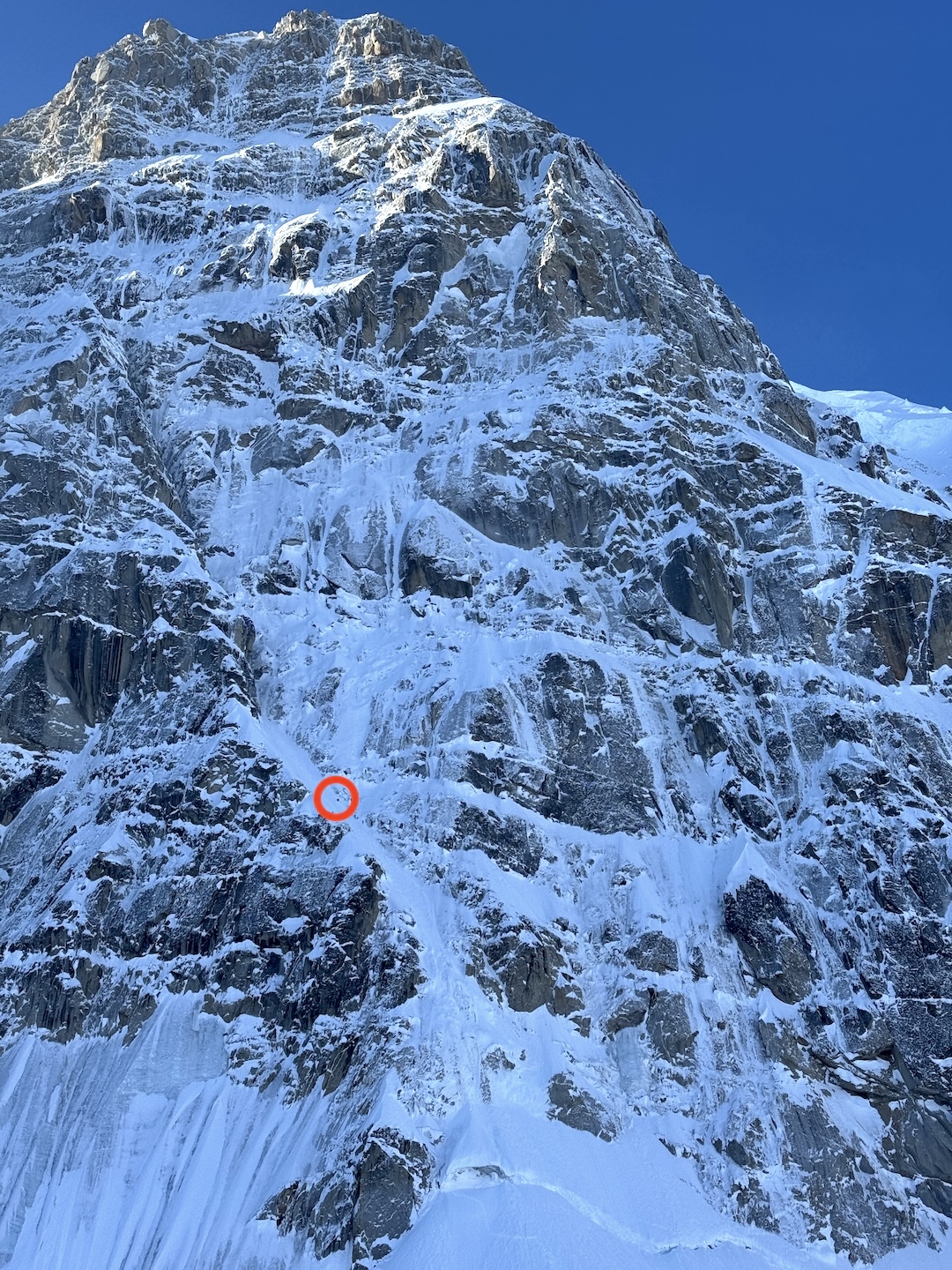
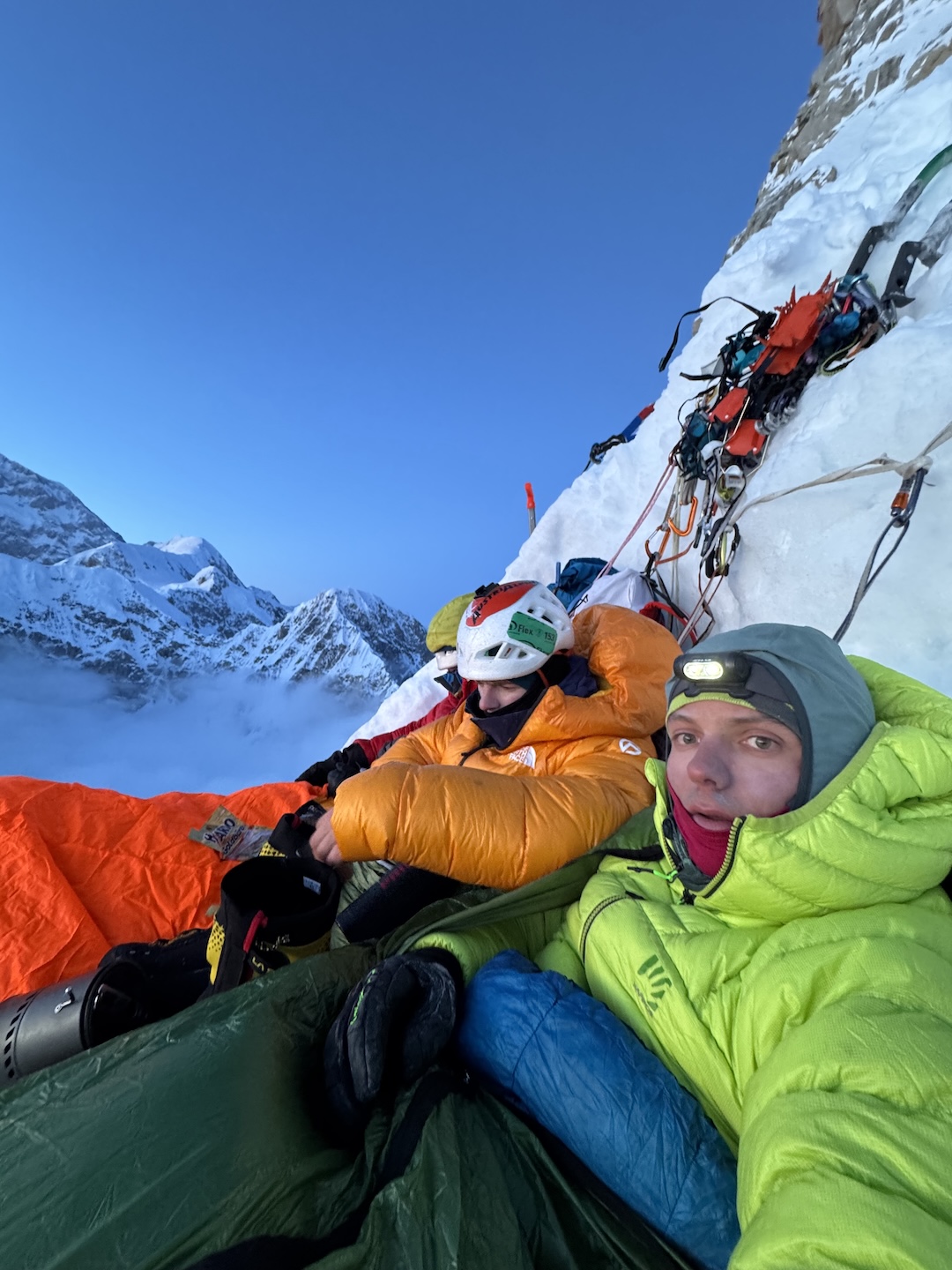
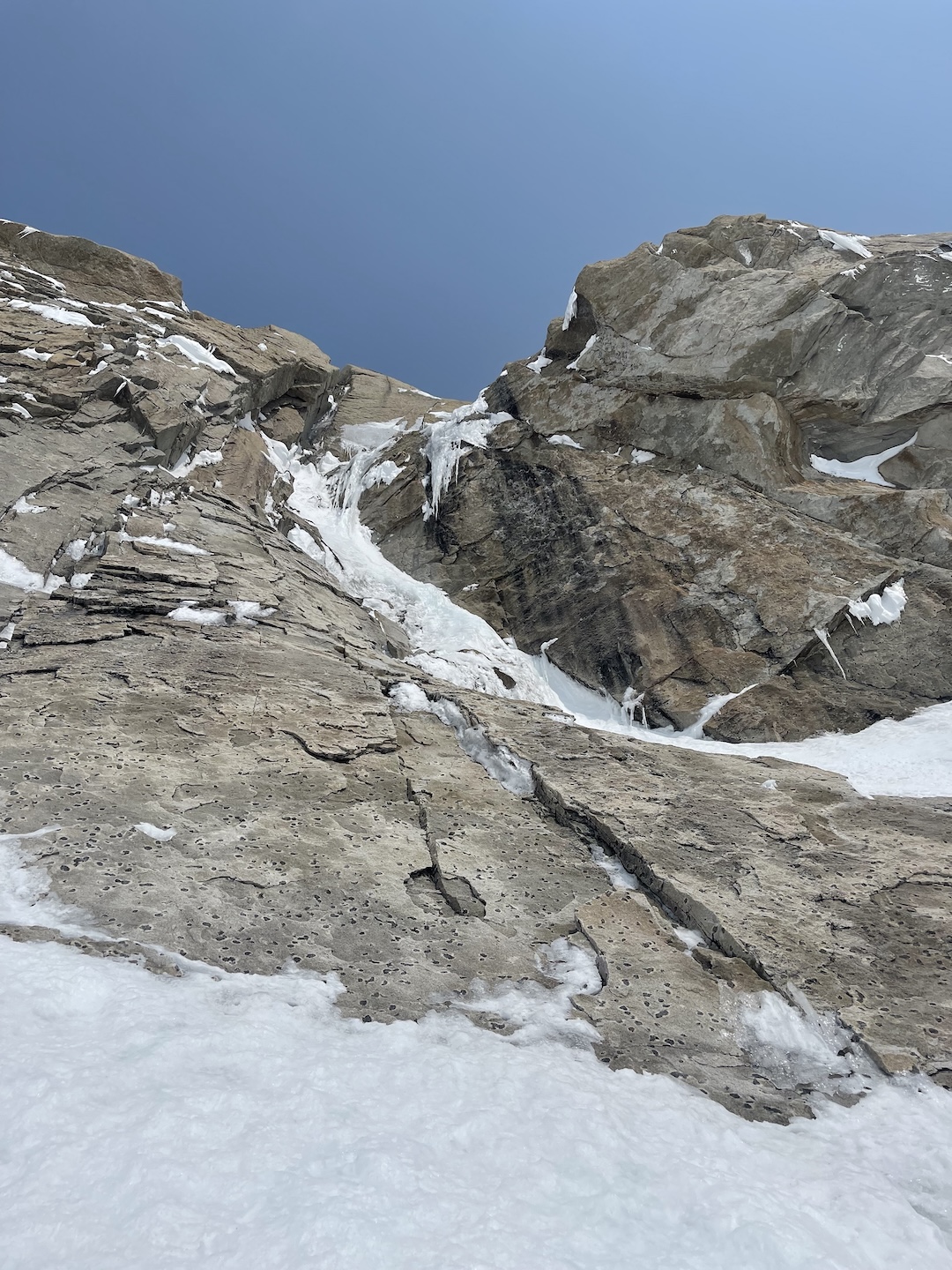
Whooooosh. A stream of spindrift pours onto my face and wakes me up. I attempt to pull more of the two-person bivy sack over my face to block the elements. Snuggled beside me, David Hechl (Austria) and Vincent Landry (Canada) don’t seem fazed. With our legs partially hanging off our tiny chopped ledge and the bivy sack filling up with snow, I am not psyched. The next morning, when we wake on the third ice band of the North Buttress of Begguya (Mt. Hunter, 14,573’), we decide to forgo the summit and rappel.
David, Vincent, and I (Alaska) flew to Kahiltna base camp on April 23 during a spell of high pressure, aiming to try Deprivation (Backes-Twight, AAJ 1995) on the North Buttress. Since I had never met David before this trip and had only briefly talked to Vincent during the previous year on Denali, we were a kind of international climbing meet and greet.
On our first attempt on Deprivation, we bivouacked on the third ice band, where spindrift poured onto our faces and into our bivy sack, and we decided to bail. After this, we hunkered down at base camp for two weeks. We were all alone on the glacier and substantial snow fell, but the temperatures were mild for the season.
The next window was set to arrive on May 10. David had to catch a plane back to Austria, so it was just Vincent and me for the second try on Deprivation. We made great time to the Cornice Bivy on top of the buttress, with fantastic conditions. We summited Begguya the next day and rappelled down the Bibler-Klewin Route (AAJ 1984), getting back to a much more crowded base camp that night.
Throughout the previous year, I had thought about soloing the North Buttress of Begguya, quietly disclosing these schemes to my good friend Ethan Berkeland. I was already having a particularly productive year. [In the span of one week in early January, after repeating the Ragni Route on Cerro Torre and Exocet on Aguja Standhardt in Patagonia with partners, the author soloed the California Route on Cerro Chaltén (Fitz Roy), flew to Canada, then soloed Virtual Reality (4 pitches, WI6) and the second ascent of Reality Bath (rated WI5+/6- by Miller; this route was first climbed in 1988 by Randy Rackliff and Mark Twight, who did it in 11 pitches).] Deprivation is the easiest route on the North Buttress, but having essentially climbed it twice already that season, I was over the idea of doing it again.
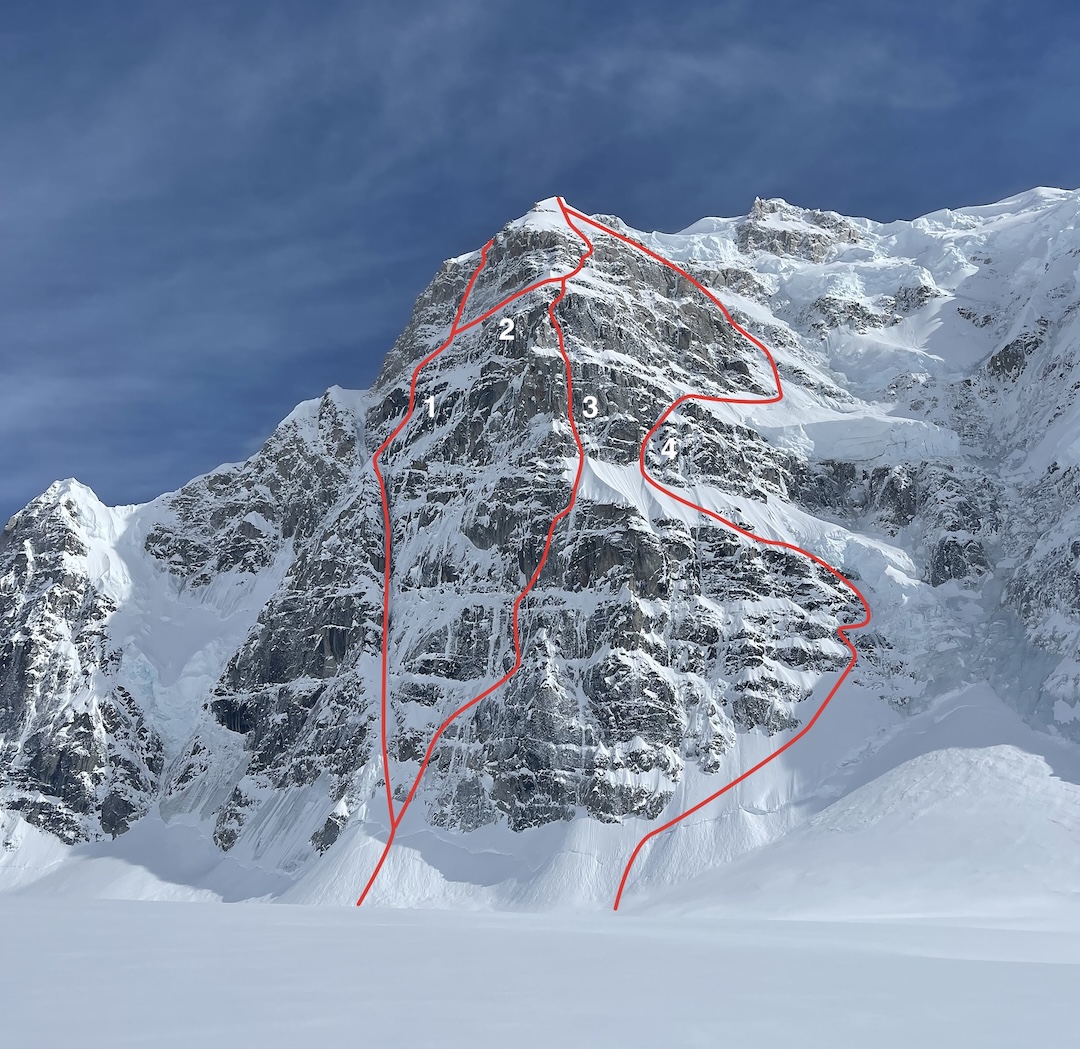
I turned my attention to the French Route (Grison-Tedeschi, AAJ 1985), specifically the “French Connection” variation, which traverses the third ice band rightward to join the Bibler-Klewin to the top. This would involve only two pitches of mixed climbing in the Bibler Come Again Exit (WI4 M5) versus the four pitches of mixed climbing, up to M6, on the French Route headwall. [Kelly Cordes and Scott DeCapio completed this variation in 2002, then retreated below the top of the North Buttress. The connection was completed to the summit by a Japanese party in 2022.]
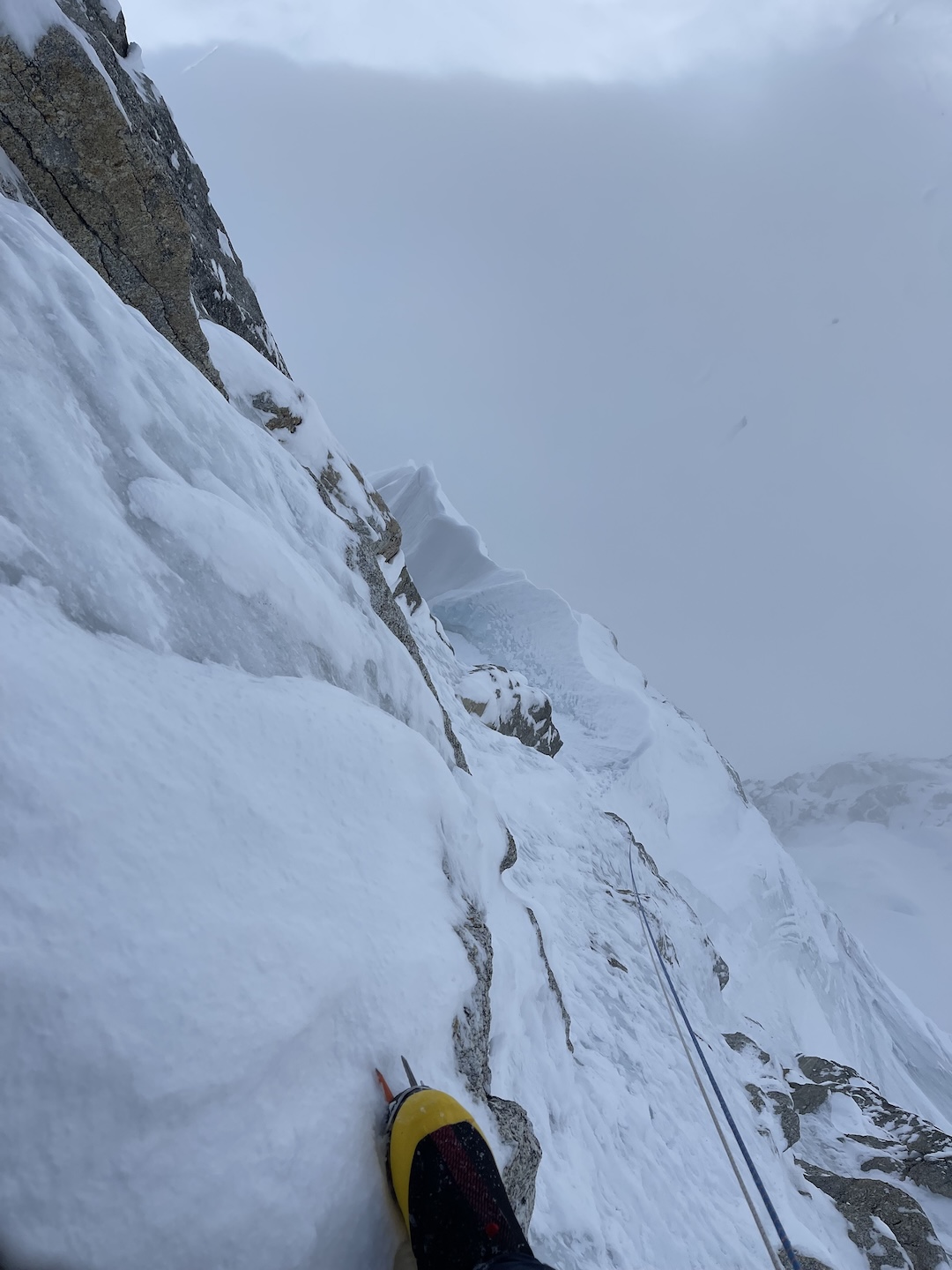
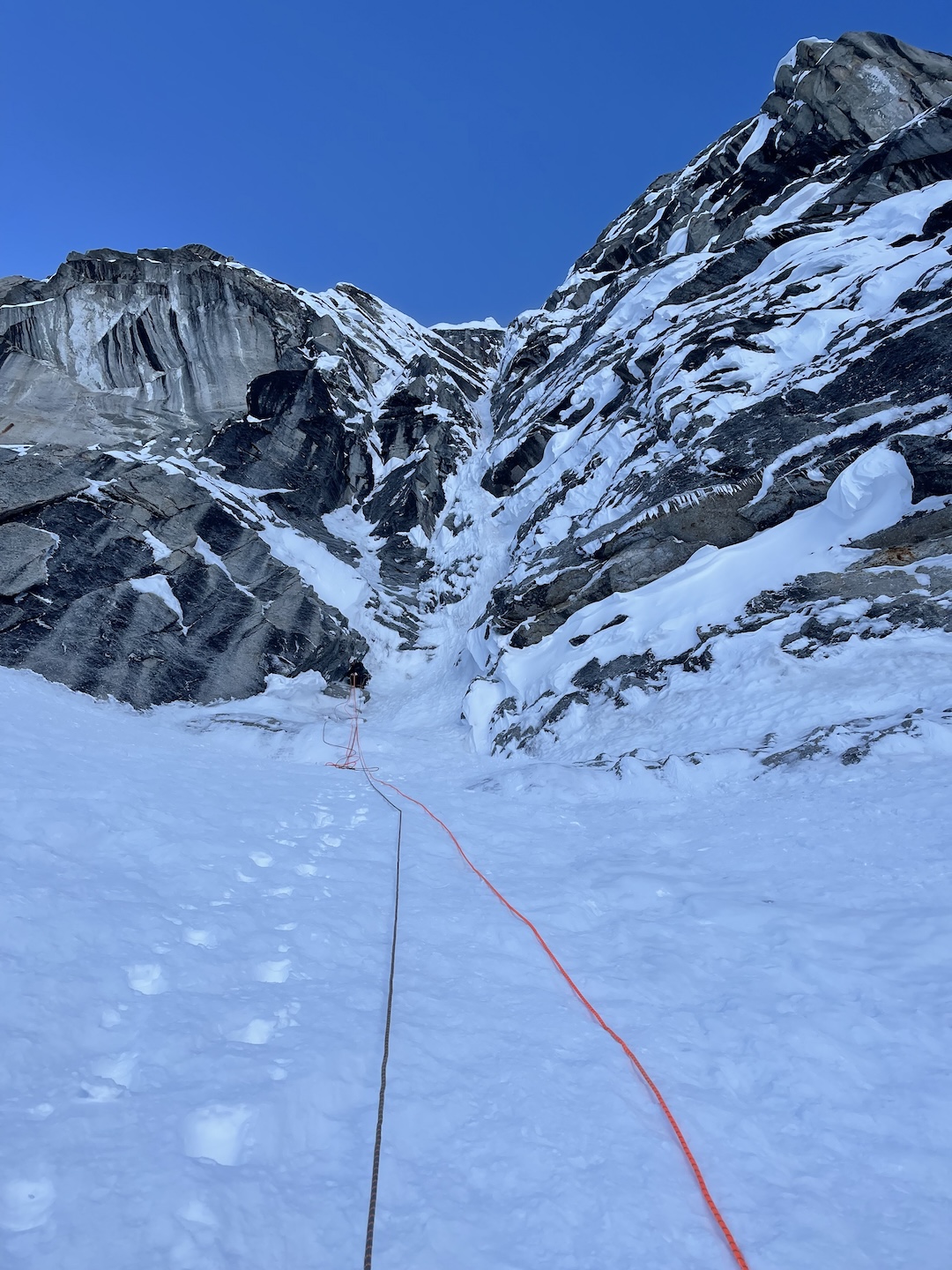
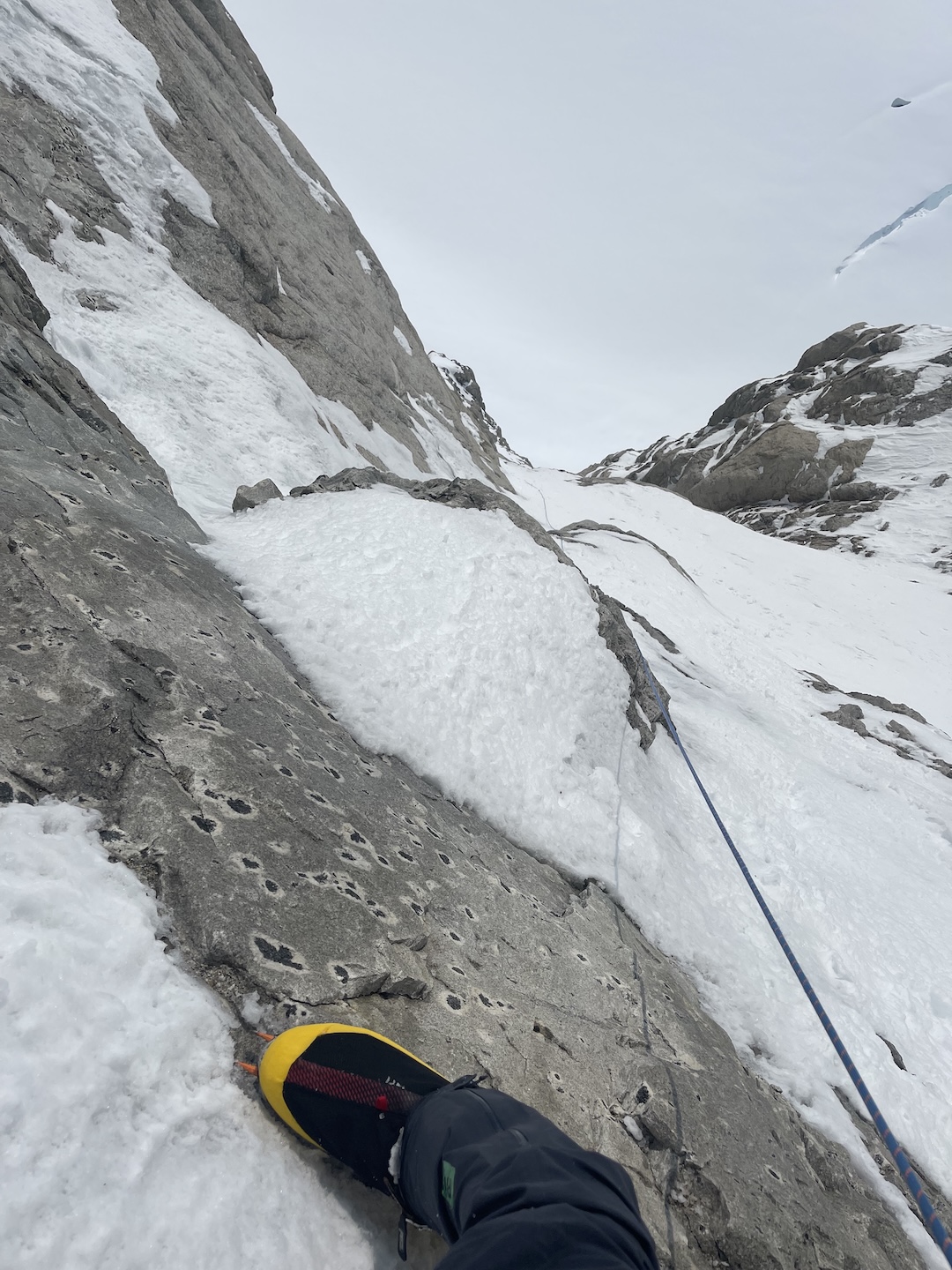
On May 14, I started back up the North Buttress, this time alone. I brought no bivy kit, no stove, a small rack, and two light ropes. On the approach, I said a quick hello to Sam Hennessey, who was guiding a client, David Leibrandt, up Deprivation. (To my knowledge, this was the first guided ascent of the North Buttress to the summit.) My climb went pretty smoothly, other than the bergschrund, which had overhanging rotten ice under several feet of snow. It felt similar to a rime pitch in Patagonia, but if I had biffed it, I would have just decked into waist-deep powder only a few body lengths below me. I also got blasted by a few large spindrifts in the couloir; I put my hood up and head down while waiting them out.
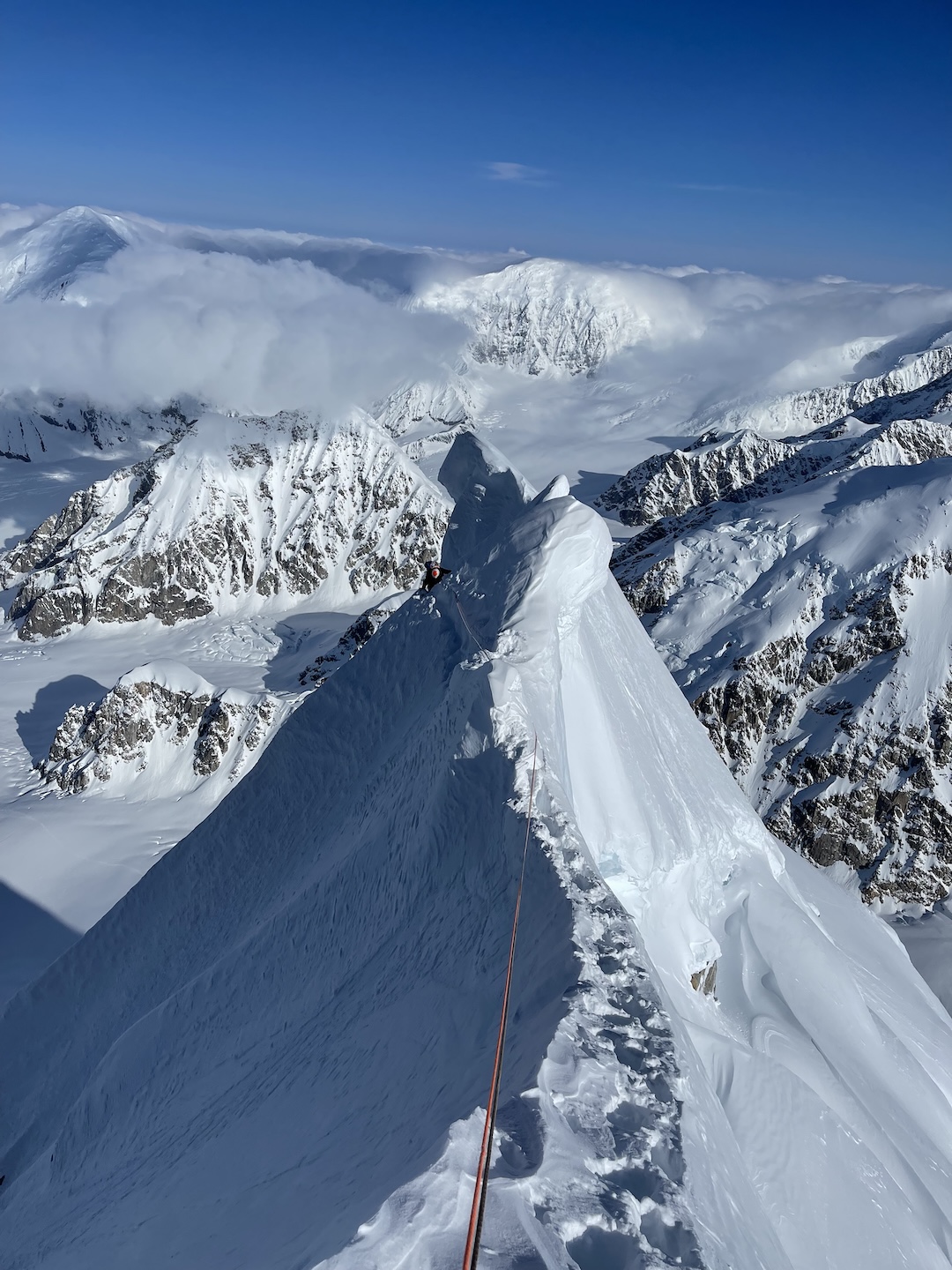
I reached the top of the North Buttress in roughly six hours; the link-up was just as I had hoped—essentially all ice climbing. I continued to the summit of Begguya in a few more hours, then descended the Bibler-Klewin for a third time. The round trip from base camp was about 17 hours and 30 minutes. [Editor’s Note: Colin Haley completed the first solo ascent of the North Buttress to the summit of Begguya in 2017, via a different link-up on the right side of the buttress; see AAJ 2018.]
I had plans to climb the Cassin Ridge on Denali (Mt. McKinley, 20,310’) with two friends, but by the time I got to the 14,000-foot camp on the West Buttress, they had already launched for the Cassin. I wasn’t disappointed—I was excited to put more solo plans into action.
Back in February, I had texted Matt Cornell for some beta about the Slovak Direct (usually rated WI6 M6+ A2; Adam-Korl-Križo, 1984; see AAJ 2023) on the south face of Denali. Without knowing my plans, he assumed that I would solo it. Before this conversation, I had never seriously thought about soloing the Slovak. But the more I envisioned myself up there alone, the more it felt like a reasonable thing to do.
On June 5, I returned to Kahiltna Base after climbing the West Buttress for acclimatization. I was fairly tired, as I had been on the glacier for 40-something days. There were rumors of a big weather window coming sometime the following week, but even so I was debating flying home. Many friends had just flown out of the range, and my tent was the last one standing on the hill above base camp. My biggest fear about the Slovak was the approach of more than 10 miles from base camp up the East Fork of the Kahiltna. I could easily be swallowed by a big, black hole and never be seen or heard from again.
In the end, the idea didn’t seem crazy, and when the splitter window arrived, I left Kahiltna Base at noon with a pair of borrowed skis. Blisters, climbing skins that were duct-taped on, the heat of the day, and an incredibly uncomfortable pack made the ten-mile approach up the East Fork of the Kahiltna take three times longer than it should have.
Waking up below the south face on June 11, I felt knackered and decided to rest a bit before climbing. I crossed the bergschrund at about 11:30 a.m. and chugged up snow slopes and gullies. The lower part of the route is fairly easy by modern standards, with only a few pitches of real climbing. At the crux of the lower wall, I debated roping up but decided to just trail my 65m half rope to lighten my pack. The topo described the crux as a pitch of WI5/6 M5, but I felt confident. However, my rope got stuck right as I was trying to pull the crux move and, beyond frustrated, I had to downclimb a few body lengths to make an anchor, rap down, climb back up, and finish the pitch. The other pitches were smooth sailing, and I reached the hanging glacier in only four hours from the bergschrund.
Since I had started so late and was at such a nice bivy, I decided to stop after half a day of climbing and try to recover from my sufferfest of an approach. Alpinists usually don’t have this luxury, but with five or six days of high pressure in the forecast, I wasn’t too concerned. I laid down my three-quarter-length foam pad and rope for insulation and got under my down quilt and an aluminum blanket Vincent had given me.
One of the best parts of climbing in Alaska in summer is the infinite sunlight, and I didn’t have to worry about an alpine start—I got up at 9 a.m. The second day involved the meat of the climb, including the crux and several pitches of moderate to hard mixed and ice climbing. I felt good and free soloed everything but the crux headwall pitch, which has gone free at M7/8—I self-belayed and pulled on cams on this pitch. It felt silly to haul nearly a double rack of cams, along with two pins, nuts, a few screws, and a rope all the way up there for one 80-foot section of rock, but I was glad I did.
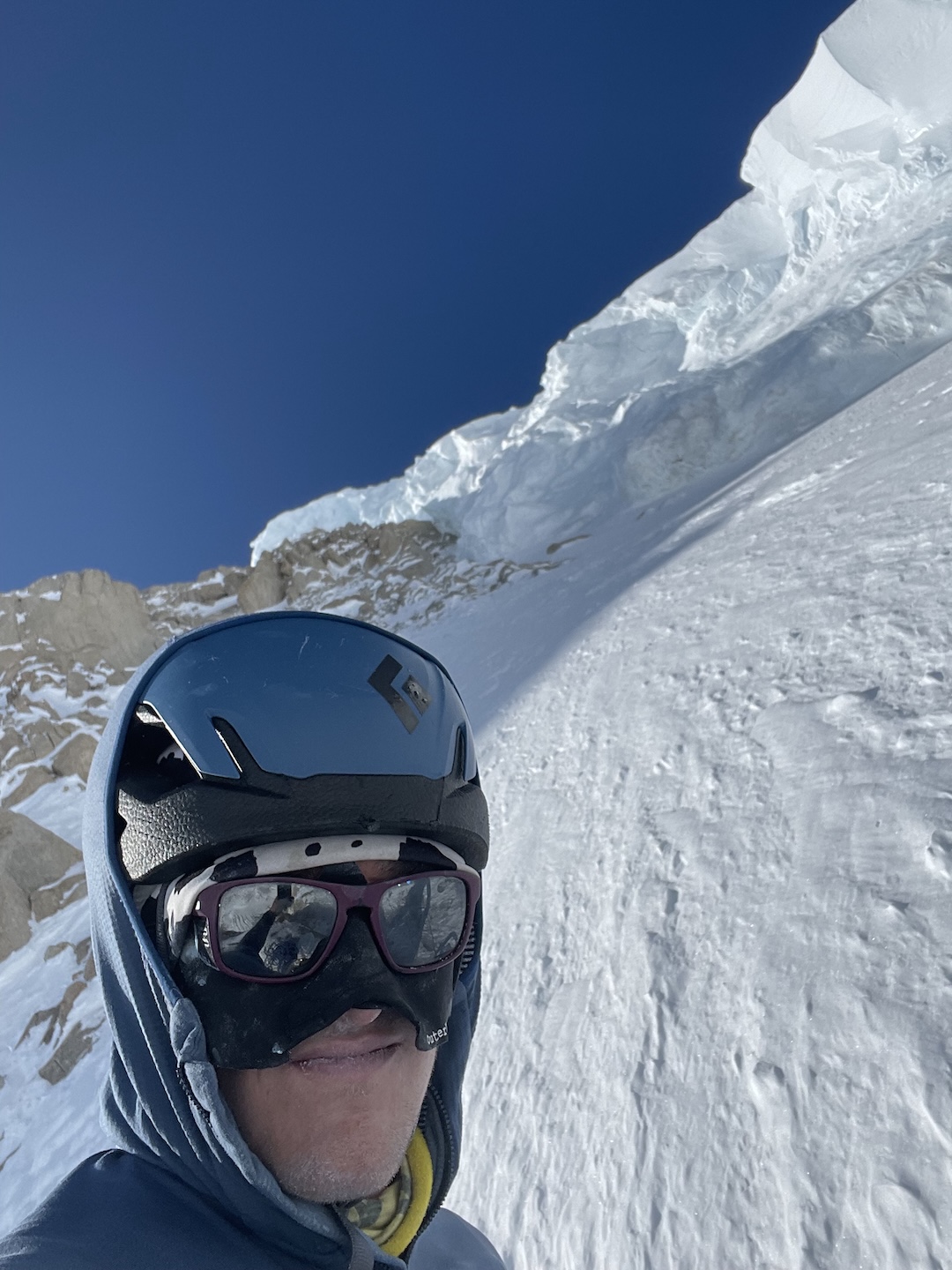
After the crux, there was one more mixed section before the route joined the Cassin and turned into a hike. I considered pushing to the summit that day, but once I stopped moving I got extremely nauseous. I threw up a couple of times and worried that I had altitude sickness that would worsen by morning. I chopped a bivy site under a boulder and managed to choke down some freeze-dried biscuits and gravy before bundling up in my quilt and aluminum blanket.
I woke again at 9 a.m. and felt better, fortunately. Just as I was leaving my boulder, a team on the Cassin climbed up to me, and we stayed mostly in earshot distance for the rest of the climb. Another party on the Cassin had already broken trail, so the slogging was minimal. I hit Kahiltna Horn at the top of the face roughly 56 hours after starting the climb. Oh, what a relief it was to drop my pack and jog up the summit ridge.
Back at 14 camp, some friends gave me some of their food. Feeling high stoke from completing a dream—and from finally being able to go home—I started the walk down to base camp at midnight. I had a magical evening hiking down the glacier alone and watching a beautiful Alaska sunset.
The mental crux of this entire expedition was retrieving the skis and tent I had left at the base of the Slovak. The initial approach had given me terrible heel blisters, and I was still fried from the climb. I contemplated paying someone to retrieve my things, but I dug deep and marched back up on my other set of skis. On the way down, I had a bittersweet moment, knowing I was leaving the Alaska Range. It had been my home for almost two months. A root beer was waiting for me in Talkeetna.
—Balin Miller
Editor’s Note: The first solo ascent on the south face of Denali was in 1976, by Charlie Porter, who soloed the Cassin Ridge, climbing from the top of the Japanese Couloir, at 13,400 feet, to the summit in 36 hours. In 1982, Mark Hesse spent eight days soloing the Scott-Haston Route (1976), to the right of the Slovak Direct on the main south face.
On October 1, 2025, after reaching the top of Sea of Dreams on El Capitan in a solo ascent, Balin Miller, 23, died in a rappelling accident as he attempted to retrieve a stuck haulbag.
Media Gallery