
Mt. Moffit, Enthalpy Ridge (Northeast Ridge)
Alaska, Hayes Range
I sat upright in our tent with my back pressed against the wall. Cody Winckler, lying on his back, braced the other side with his legs, our world a dark maelstrom of flapping fabric and constant roaring. We’d spent the last two days shuttling loads from where the tiny Super Cub had dropped us, skinning alongside bear and wolf tracks to a base camp beside the lower Trident Glacier. Not long after we were cozily ensconced, four miles short of where we’d hoped to be, the gale came out of nowhere. An all-night struggle ensued, but by morning the storm had died and we crawled out, bleary-eyed, to find the wind had stolen one of our sleds from beneath the heavy bags holding it down.
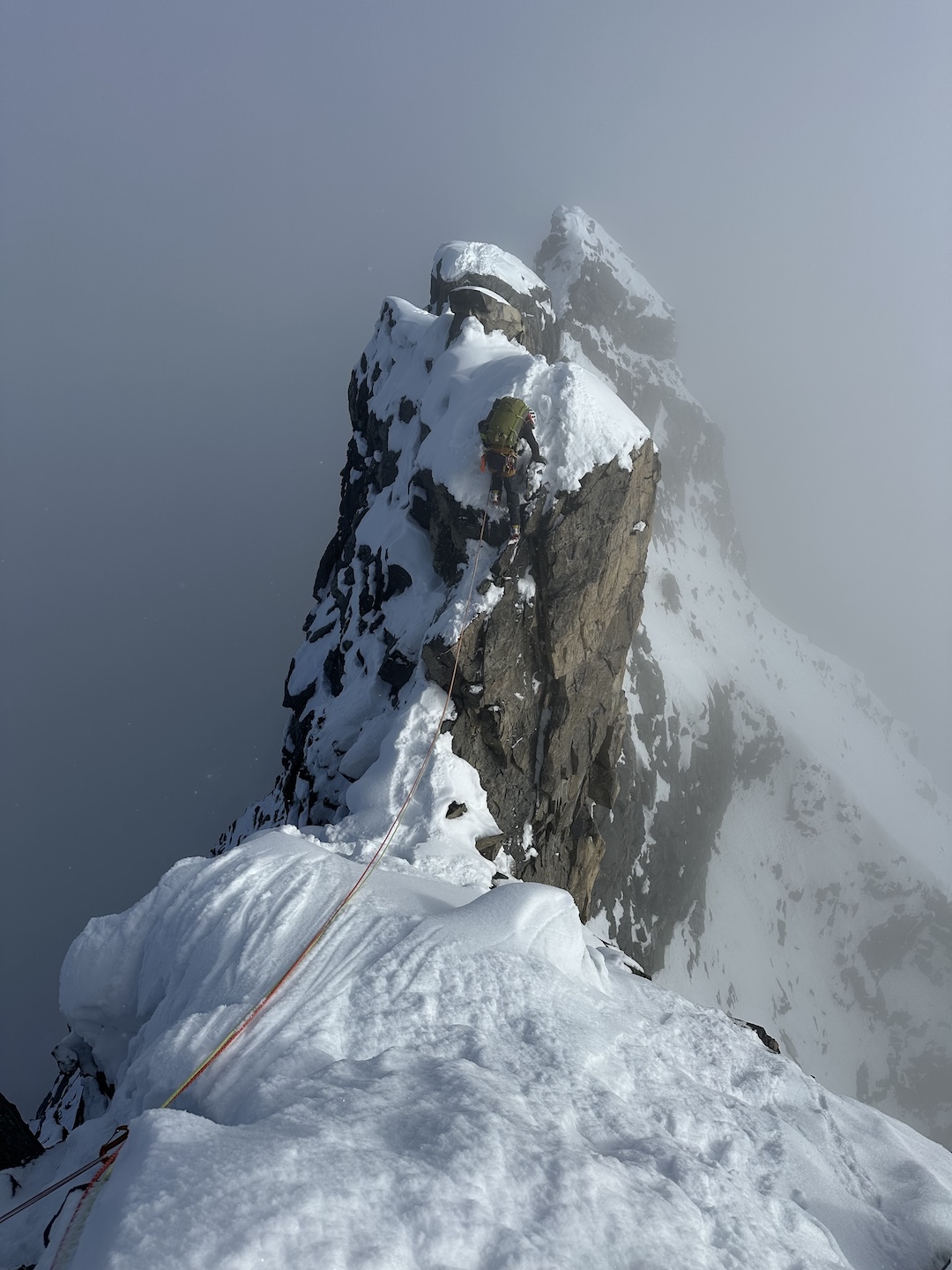
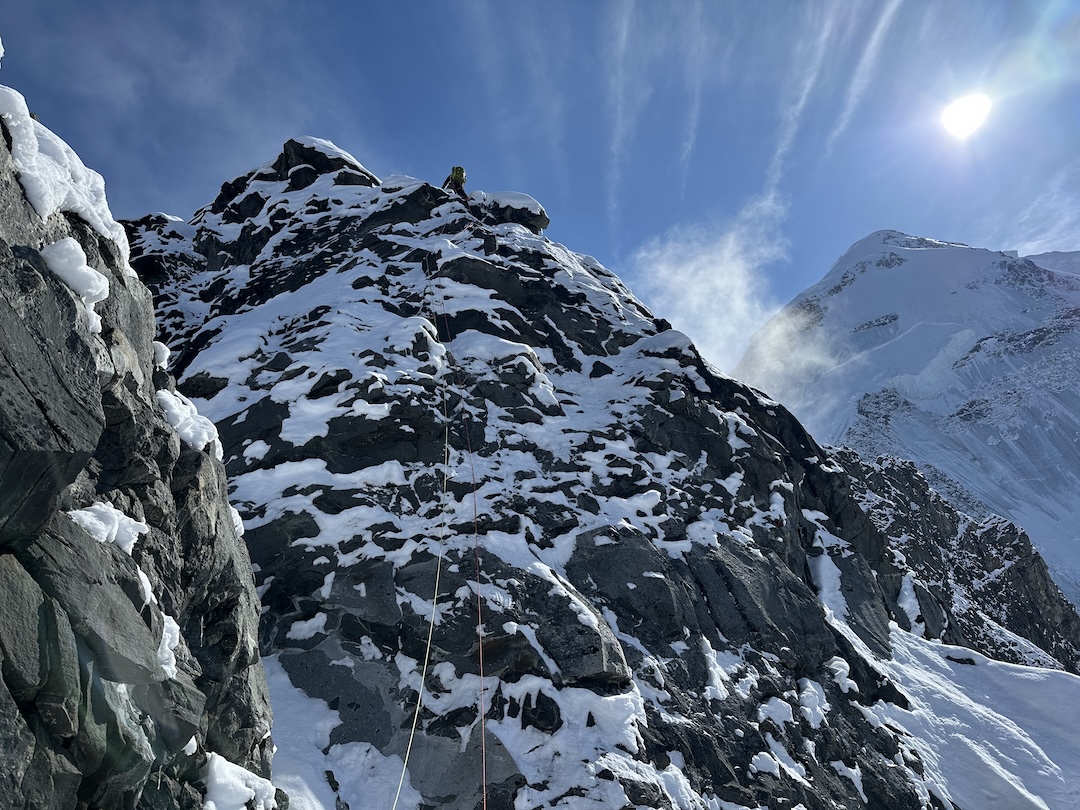
Cody Winckler descending a rock tower on the crux section of the Enthalpy Ridge. Photo: Dane Steadman
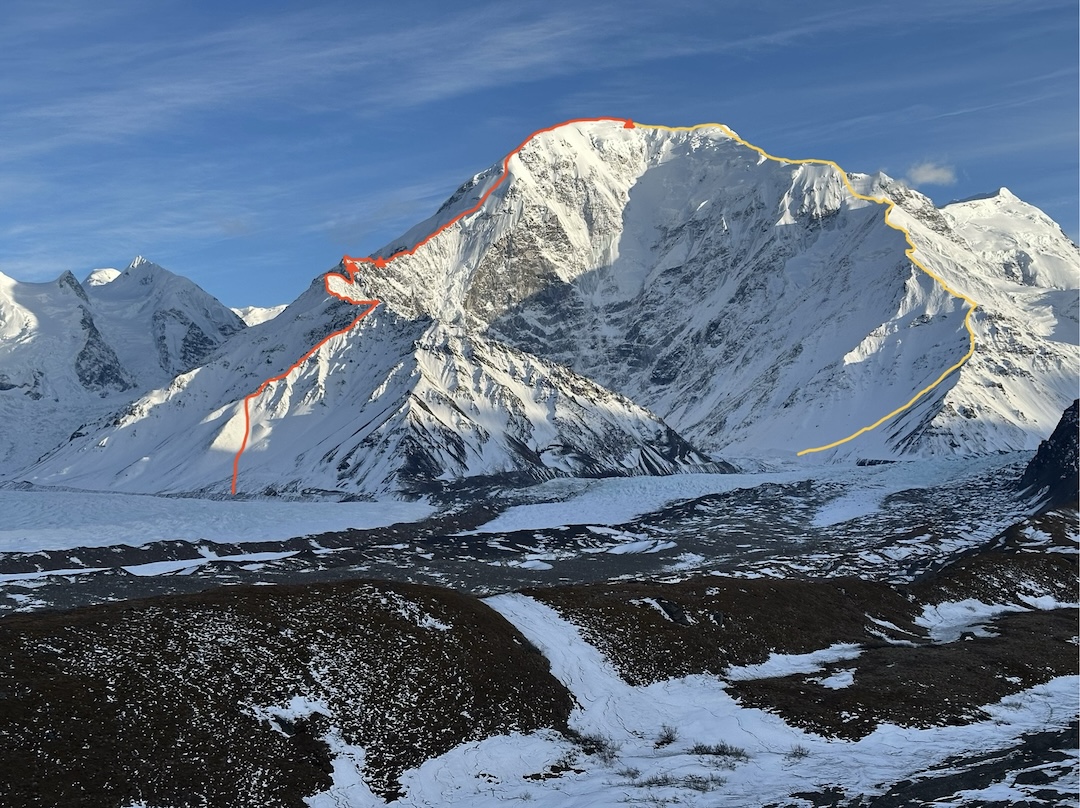
After two days of fortifying camp, we hiked across the wind-scoured glacier and finally got a close-up view of our objective: the 2,300-meter north face of Mt. Moffit (3,969m), near the east end of the Hayes Range. The face is home to The Entropy Wall, a spectacular, Eiger-esque panel nearly a mile high, carved from the dark, swirling gneiss that makes up Moffit’s core. The Entropy Wall had been climbed once (Brown-Haley, 2006; see AAJ 2007), 19 years earlier and in July. We’d chosen April, hoping for abundant snow and ice. We had guessed wrong.
A vertical mile of steep dry-tooling didn’t seem logical, and the easier lines we’d considered elsewhere on the north face were equally dry, so we shifted toward “Plan E,” Moffit’s unclimbed northeast ridge.
Five days later, we stared, baffled, at wolverine tracks 1,000 meters up the mountain on the first day of our climb. We’d been following them for some time, up steep snow and slate-y scrambling, before they finally dropped off the backside of the ridge. Like us, the wolverine seemed intent on conquering the useless.
After a quick break to dry our sleeping bags, which had gotten soggy from a misty night at advanced base camp, we continued up the narrowing ridge. The shattered slate that flanked the hard-rock core of Moffit was veiled by a blanket of powder from the recent heavy snowfall, making progress slow. We broke out the ropes at the first of the jagged towers that stretch for nearly a mile across the middle of the ridge, where the slate turns to compact gneiss. After two blocks of simul-climbing, we pitched our tent atop that first tower and watched the sun dip behind Mt. Hayes.
A day later, as the sun approached the horizon again, Cody called back to me: “I don’t know about this, dude!” It had taken most of the day to surmount the second and largest tower, and the way forward looked complex. The sneak-around we’d hoped for on the west side of the ridge—the side we could see from below—wasn’t going to work. At the rate we were going, we’d need days more to follow the rest of the crest directly to the hanging glacier at the end of the towers. We were also beginning to feel the commitment of our position, thanks to the bulging seracs that loomed over our remaining means of direct escape. It would either be over the top or back the way we came, neither of which seemed too appealing.
“Can you get to that snow ledge below you?” I yelled. “That one might connect!”
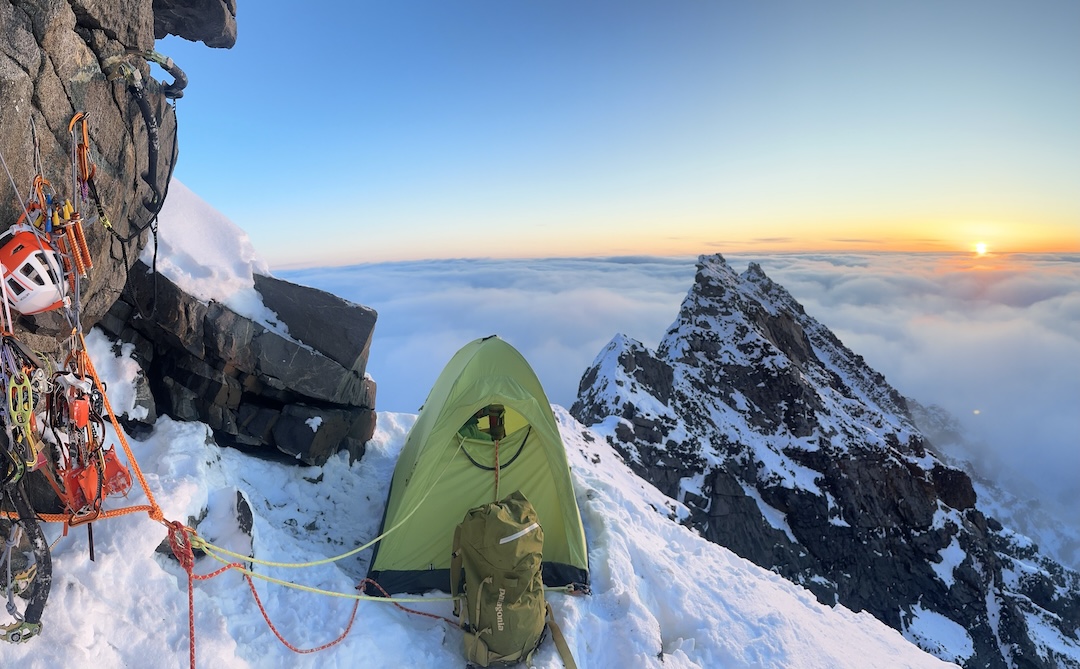
Two hours later, we crawled into the tent, hardly able to believe our change in fortune. We’d found a sneak that had worked spectacularly, a hidden ledge system on the east side of the ridge that had allowed us to bypass one tower after another. We regained the crest at a good bivy spot, with only two towers left between us and the hanging glacier. From there, a thousand meters remained to the summit, entirely on snow and glacial ice.
Dawn brought a spectacular sunrise above low-hanging clouds. The jagged towers we’d crossed stretched behind us like a line of ships at sea, and waves of mist lapped at the seracs spilling from the icy bulk of Moffit above. Soon we were engulfed in the murk, but by midday we’d made it off the towers and onto the hanging glacier. The powder consolidated and our calves rejoiced as we simul-climbed up steep névé above the bergschrund. Eventually the angle eased and we crunched up the broad summit ridge.
At 7 p.m. we stood on top. A gentle breeze stung our cheeks as we gazed at the icy giants of the Hayes Range, towering above a silky blanket of cloud obscuring the great glaciers at their feet. Just below the summit, a faint scoop of snow blocked the wind, and we settled in there for a cold night.
At daybreak, we started down the northwest ridge (the route of the peak’s first ascent in 1941) for the 2,600-meter descent. The next nine hours were a blur of crevasses, foot-numbing blue ice arêtes, kicking and swinging down slopes of slate, and charging down scree back to the Trident Glacier. Wet, heavy snow began to fall as we trudged along the trench between the glacier and the toe of the ridge we’d climbed, the clatter of rocks down every small gully giving us one last boost of energy. When we finally crossed the moraine, the shrill cry of a ptarmigan reassured us that we had safely returned to the land of the living.
—Dane Steadman
Media Gallery