
The Monolith, Northeast Face, Children of the Sun
Wyoming, Wind River Range
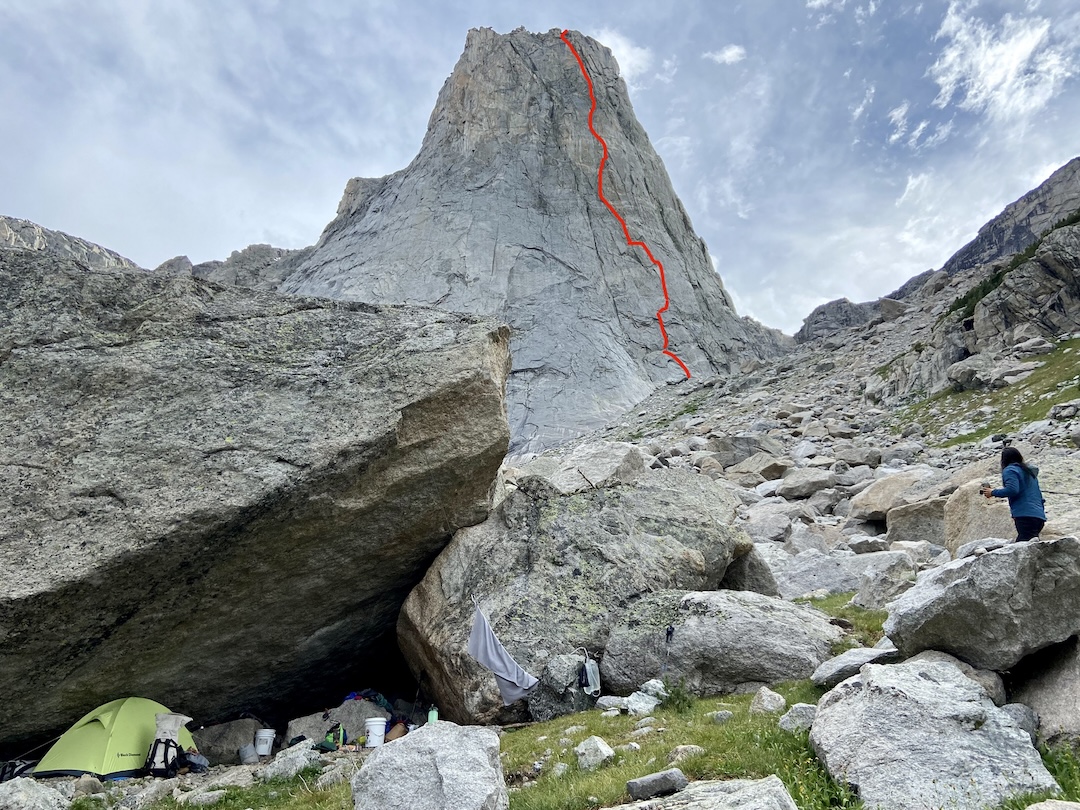
As the crow flies, the Monolith sits just a few miles south of the busy Cirque of the Towers. Despite its proximity, the Monolith Cirque has remained comparatively overlooked by climbers, probably because of the slightly more involved approach and the lure of other great faces on peaks like Mt. Hooker. After visiting the Monolith once in July 2021 to try the route Discovery (15 pitches, IV 5.13a, Bridgewater-Lightner-Lilygren-Vail, 2018), I became enamored with this area. A year later, in August 2022, I recruited friend and talented aid climber Keiko Tanaka to venture there with me in hopes of a first ascent.
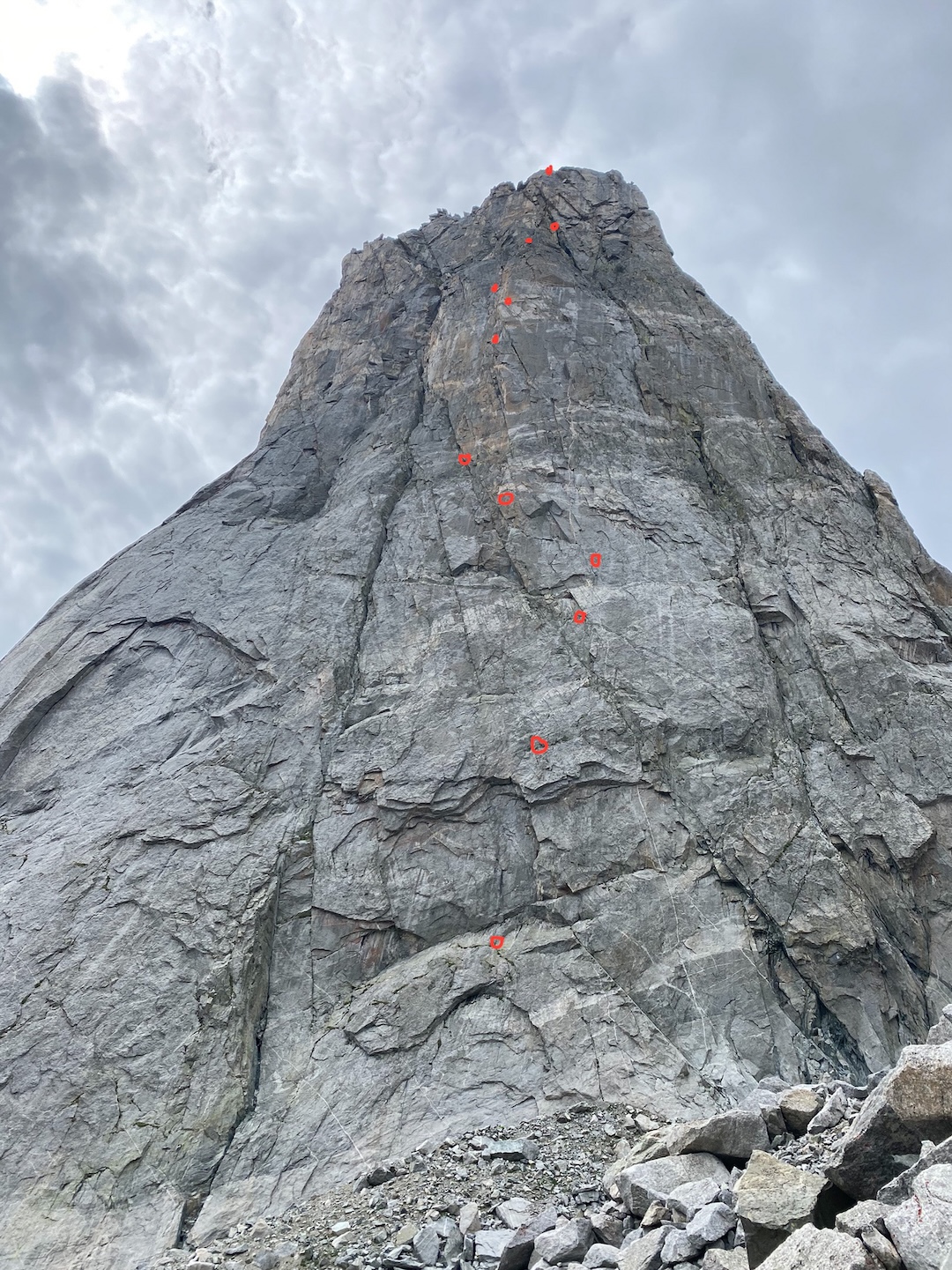
Keiko and I horse-packed into Papoose Lake with two weeks of food and a massive amount of gear, ranging from copperheads to wide cams. Several days of rain greeted us upon arrival. We spent this time shuttling back-aching loads closer to the wall. From a base camp sheltered under a massive boulder, we picked out a line through the clouds on the Monolith’s northeast face, well to the right of Discovery. [The first ascent of the Monolith was made in 1963 by Art Gran, John Hudson, and Douglas Tompkins, via a chimney system they described as being on the north face—the northeast face is more accurate. Fred Beckey and Jerry Fuller climbed the northwest face in 1966. Both routes go free in the 5.9/9+ range.]
Once the weather cleared, we committed to an inobvious line connecting incipient crack systems through several roofs and blank sections. I led the easier free climbing, while Keiko aided through the thinner and cryptic sections. I then re-led each aid pitch to try to free it (after placing bolts, if necessary). Together we made steady progress, fixing lines back to the ground each evening. We eventually committed to a portaledge camp at the top of pitch seven, where another bout of rain drenched us.
When I finally led off on pitch eight, I onsighted a striking steep, broken crack system, passing a nut that was fixed in the crack. (After research, we were unable to determine when this was left or by whom.) Immediately following this pitch, we moved left out onto a face of golden granite split by a seam that jogged up and left toward easier-looking terrain. Keiko nailed up this seam at roughly A3, and I unsuccessfully attempted to free the pitch while following on a Mini Traxion. While I had hoped to free everything, our primary goal was simply reaching the summit by a new route, so we continued on.
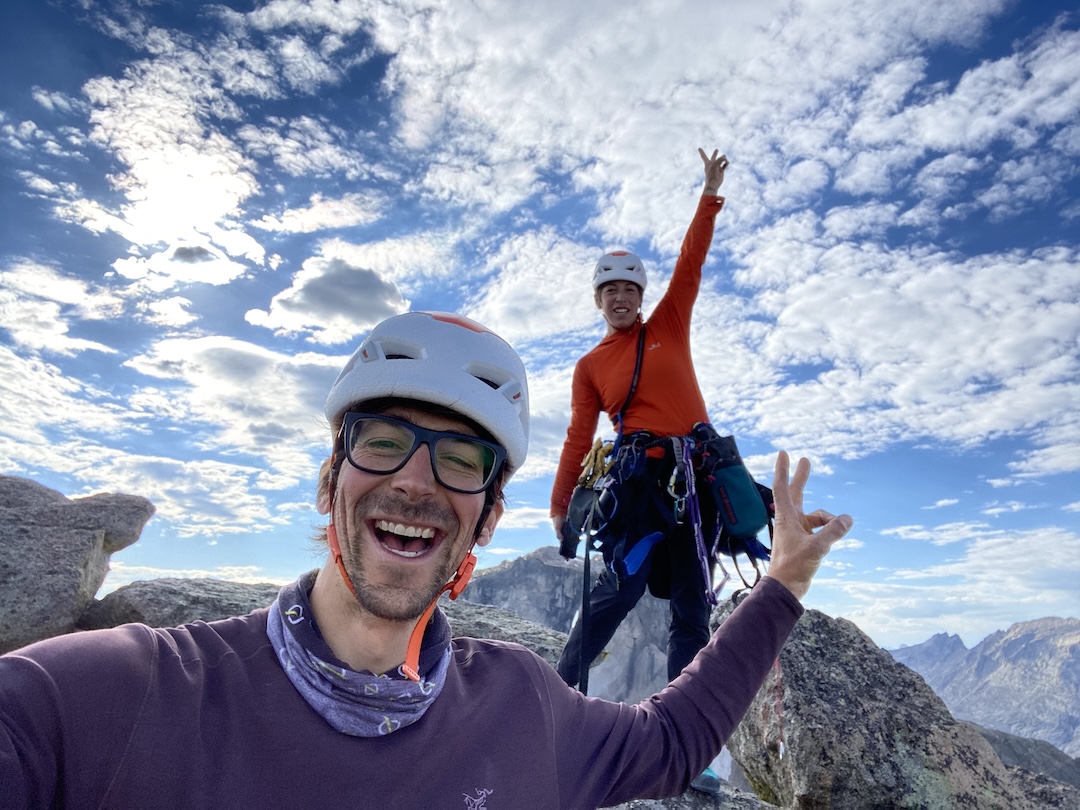
After one more tough pitch and a few moderate ones via the path of least resistance, Keiko and I stood on the summit atop our new route: 1988 (14 pitches, VI 5.12+ A3). After a quick celebration, we began our descent to the portaledge camp, equipping rappels into the night. The next day, I made another unsuccessful attempt to free the crux ninth pitch on top-rope. With just that pitch left un-freed, we packed our gear and continued down the wall.
Two years later, in early September 2024, I hiked into the Monolith alongside Maury Birdwell and Alton Richardson. With only eight days for the trip, we had little time to spare and got straight to work fixing lines up toward the crux beak seam. After two days of effort, the weather deteriorated, and we waited out a storm of heavy graupel that plastered the valley.
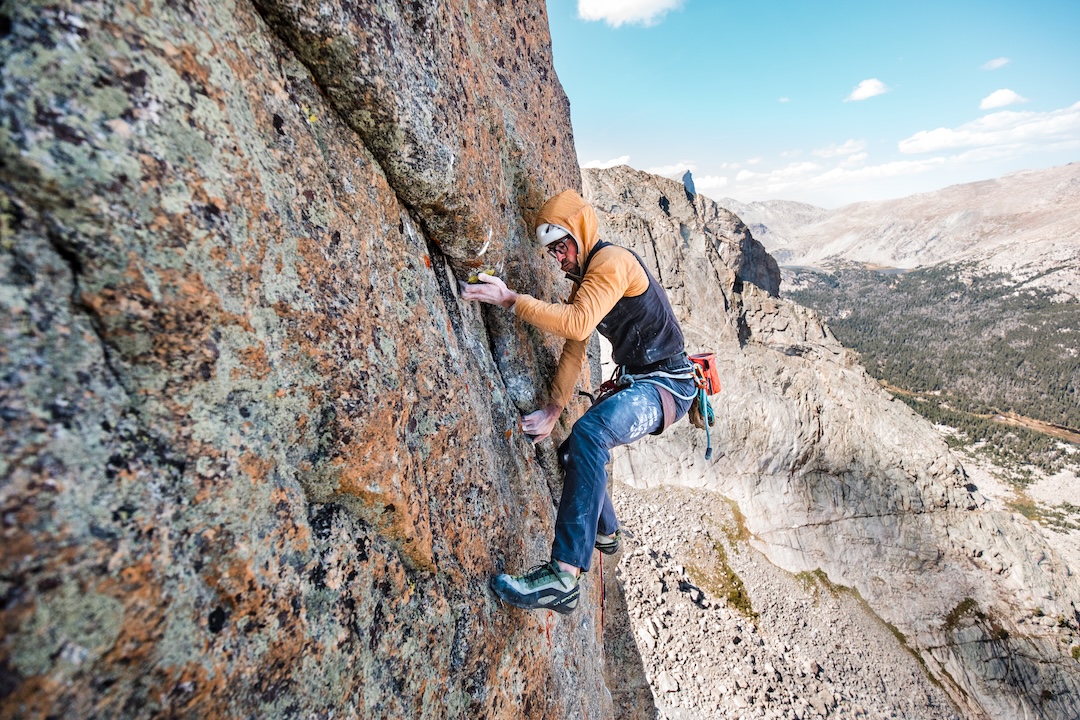
Following another two days of chatting around a cave fire among the boulders by Papoose Lake, we hiked back up to the wall, where we discovered our gear cache at the base had been buried under four feet of accumulated graupel. With only three days left to climb, and still several pitches away from the crux, we ascended our fixed lines to our high point and stashed water for a two-day push on the wall. Wet, slimy, lichen-covered rock slowed our progress substantially.
When I pulled over the lip onto the bivy ledge Keiko and I had used in 2022, my spirits were high. But about halfway through hauling a load up to the ledge, I felt something shift on the rope and the load lightened significantly. I looked down to see a haulbag crash into the talus 1,000 feet below. I sank into my harness and waited for Alton and Maury.
Now without the provisions necessary to grind out a full free ascent over two days, we decided to spend our remaining time and effort trying to free the ninth pitch. The crux looked quite wet, but I aided up, did my best to clean it, and placed a few bolts. We then rappelled, returning to our base camp late that night.
On our last day before packing out, we jugged back up. The thought of walking out empty-handed loomed in my mind. After brushing off more lichen around the still-damp seam, with Maury and Alton patiently waiting below, I tried the pitch on Mini Traxion and—what do you know—climbed it clean. Shortly after, I led the pitch free on my first attempt.
I felt a sense of relief at having completed the final piece of the puzzle of Children of the Sun (14 pitches, VI 5.13-), the free version of 1988. The name is a tribute to my daughter Anya Ines Barlerin, born on the summer solstice in 2024. An integral free ascent of the route remains up for grabs.
—Maximilian Barlerin
Media Gallery