
Committed on Yerupajá
A New Route and Bold Traverse in Peru's Cordillera Huayhuash
For Rubén Sanmartín, Marc Toralles, and me, climbing Nevado Yerupajá Grande (6,634m) was not a random choice, but a dream that had been brewing for almost a decade. During our expeditions to Jirishanca in 2017 and 2018, then to Siula Grande in 2019 and 2022, Yerupajá was always there, guarding its neighbors as the absolute giant of the Cordillera Huayhuash.
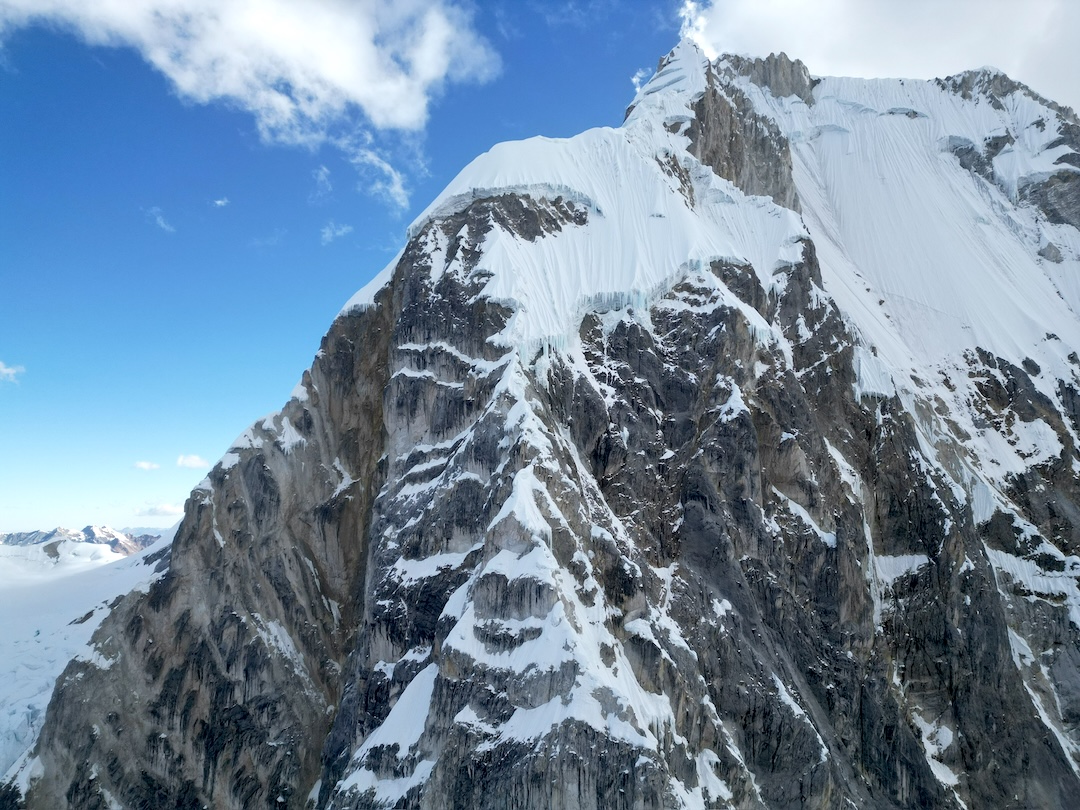
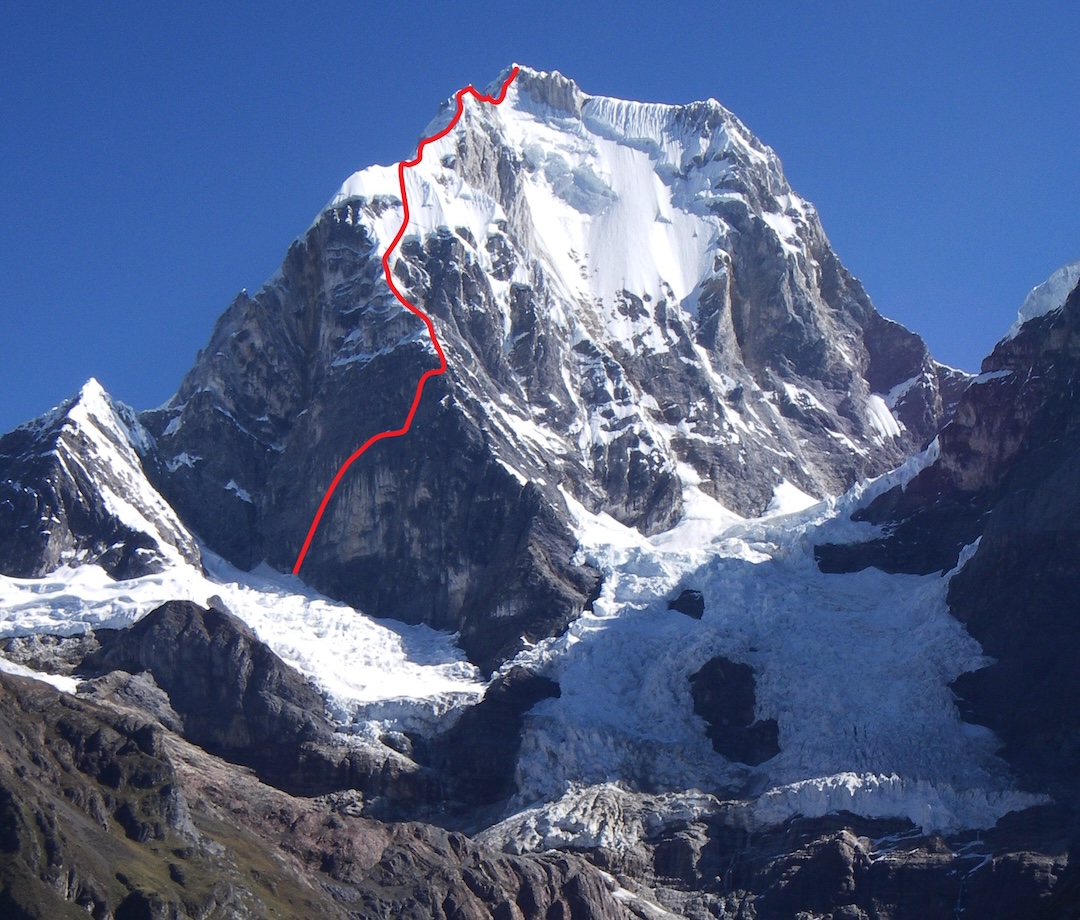
There is a magical moment on the approach to these mountains, right when you reach Laguna Carhuacocha. As you admire the view from the lake, spanning from Siula Grande to Jirishanca, your gaze inevitably stops at the east spur of Yerupajá. It is, without a doubt, one of the most aesthetic and challenging mountain routes one can imagine: a line of rock, ice, and snow that rises from the reflection of the lagoon up to the highest summit of the range.
For us, the attractions of this line were accompanied by great doubts. Our project was riddled with uncertainties, the most critical being the descent. We knew the east ridge did not offer an easy retreat and that, once on the summit ridge, the commitment would be total. Images from previous expeditions and old accounts did not clarify the safest options.
It was only once we were in Peru that this puzzle piece clicked into place. In conversations with Beto Pinto, a local mountain guide who knows the recent changes in the glaciers and the secrets of these mountains, we were able to outline our primary descent plan: reach the main summit, descend via the south ridge to Yerupajá’s south peak (ca 6,480m), then descend directly to the glacier to the southeast. With that settled, but with the weight of knowing we were facing one of the most committing climbs of our lives, we launched our adventure.
We divided the acclimatization phase into two parts. The first took place throughout the month of July, as all three expedition members are mountain guides, and we took advantage of our work in the Alps to sleep at altitude and activate the acclimatization process.
The second part was in Huaraz, where we arrived on July 22. We didn’t want to spend too many days acclimatizing before heading to the Huayhuash, as we knew a lot of exploration work awaited us. We decided to sleep at 5,000 meters and the next day climb Vallunaraju (5,686m), very close to Huaraz. Marc, who flew to Peru a couple of days before Rubén and me, did this twice. After completing all the logistics necessary for life at base camp, on July 26 we quickly set off for the Huayhuash.
This year we had an unexpected surprise: The road toward the mountains from Queropalca has advanced, and now you can take a car to a point only one hour’s walk from Laguna Carhuacocha. At this point, we loaded burros to help transport our equipment up to 4,500 meters. It was hard work for the animals, especially the final steep slope.
Once the load was deposited, the real “ant work” began. We had 180 kilograms of gear that we had to carry ourselves to a base camp right below the mountain. At around 4,900 meters, we were lucky to find a site with running water. We made several trips, and after a couple of days of physical effort, we closed the logistics stage and switched our mindset: It was time to focus exclusively on exploring the descent route and reaching the rock wall at the foot of the east spur.
Our top priority was to decipher the labyrinth of the descent glacier, which flows out of the huge basin between the east sides of Yerupajá and Siula Grande. It appeared extremely crevassed, but, using a drone, we were able to trace a safe line. We managed to ascend to 5,400 meters on the glacier, positioning ourselves just below the 65° ramp that drops directly from the south summit. From that privileged position, we took good photographs of the ridge and identified the second half of the traverse between the summits as the most exposed and difficult part. We also confirmed that once we were on the ridge, any attempt to retreat toward the glacier would be a death trap, due to the large number of seracs.
Beto’s suggestion about traversing the mountain now made total sense. The traverse didn’t look at all easy; from afar, we could make out a large, cracked mushroom that promised to be a very complex passage. On the other hand, the direct descent from the south summit to the glacier looked quite clear. We assessed the option of descending to the west, but logistically it was a mess: It would leave us with three days of walking back to base camp, and we didn’t have reliable information about snow conditions on that side of the mountain.
With Plan A confirmed, we saved the track in the GPS and descended to base camp in about three hours from the end of the ramp.
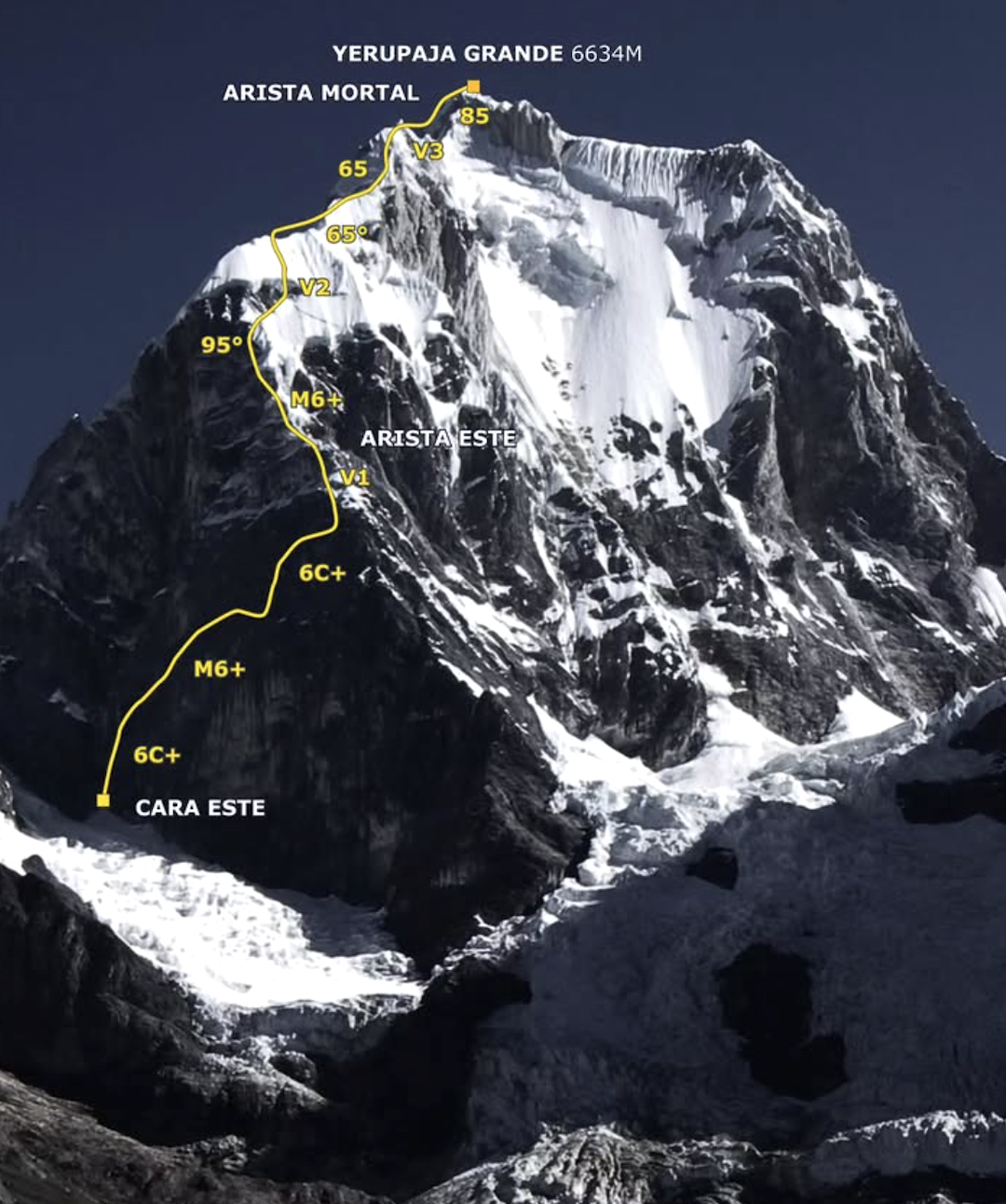
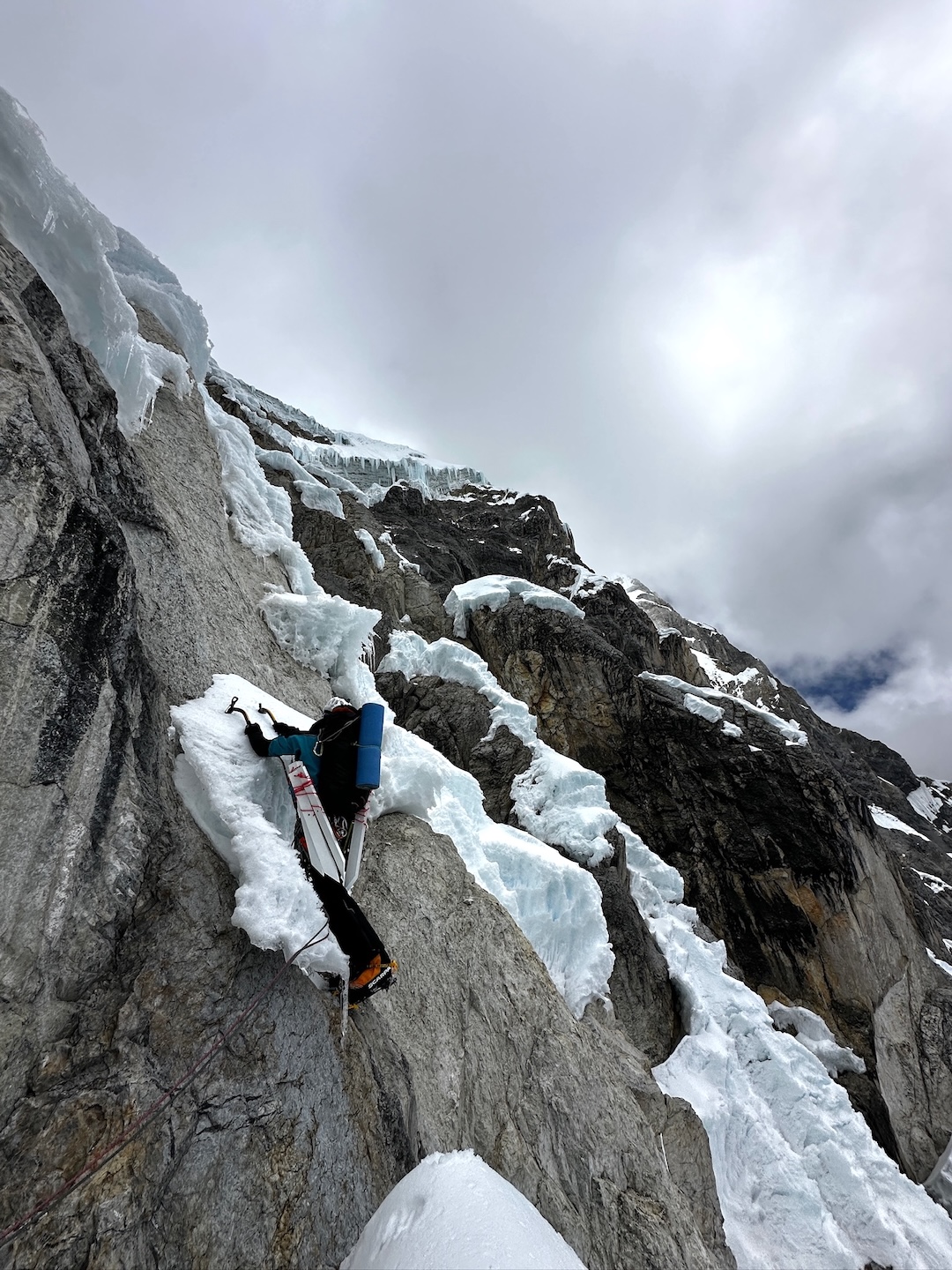
Having explored the descent, we headed up to check out the rock wall, crossing an easy glacier that brought us to the foot of the route in just over an hour. The left side of the big limestone wall is split by a large dihedral. To reach it, we had to climb two technical pitches of about 6c+. To our surprise, we discovered the dihedral was actually a spectacular ice goulotte. We left two ropes fixed, right to the start of the dihedral, and returned to base camp to wait for an expected weather window.
The wait lasted two days. Our friends from home sent us Meteoblue forecasts via inReach, confirming that an opportunity was opening up.
During those days, I was assaulted by many doubts about whether to accept the commitment of this route. What we had seen from the glacier left no room for doubt: Descending from anywhere high on the climb before reaching the south summit would be almost impossible or suicidal. However, once we made the decision to go, the doubts disappeared. There was no longer room for anything but “focus mode.”
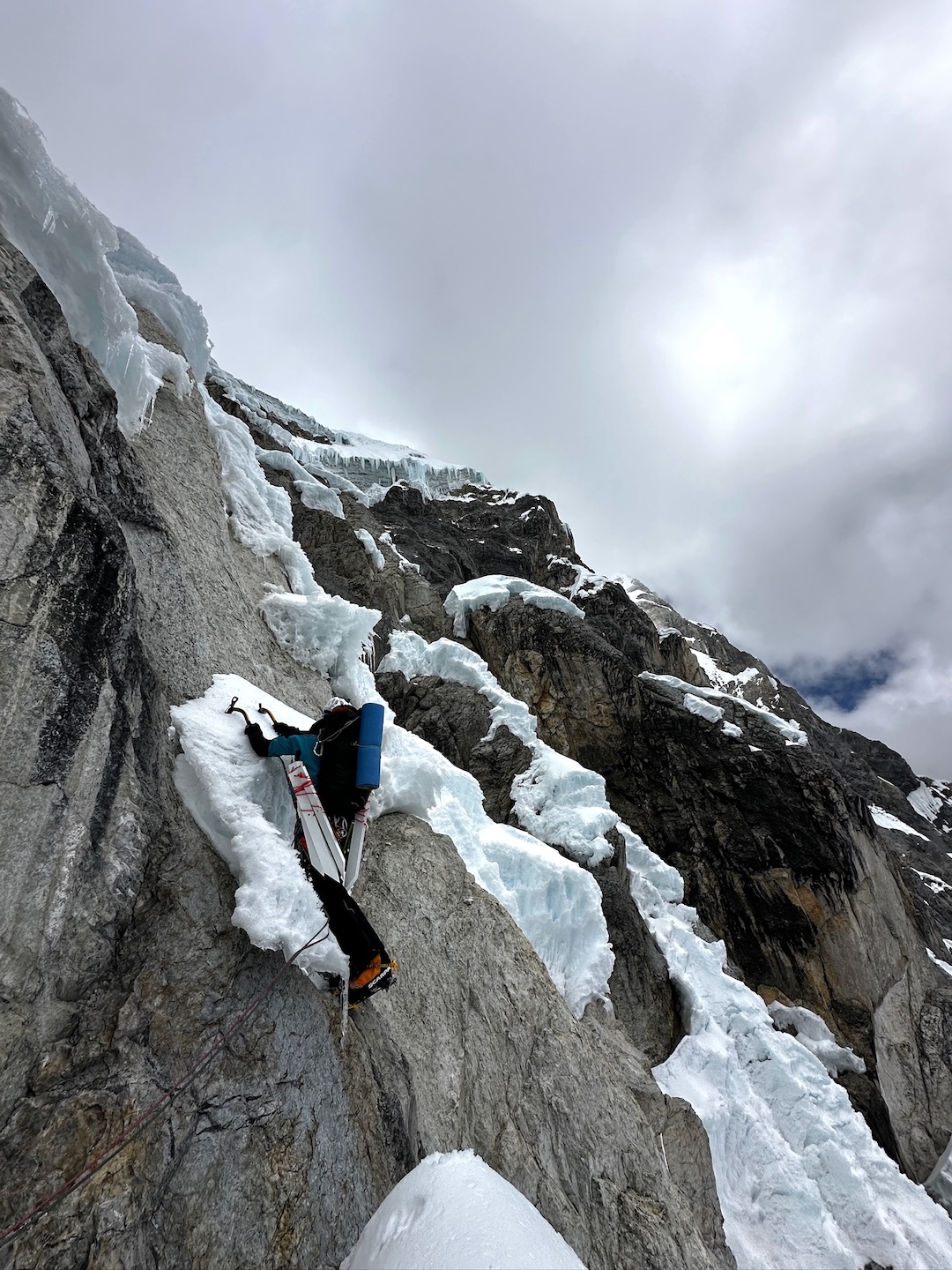
On August 4, we wake at 5 a.m., and before the sun rises we are already walking toward the wall. In less than an hour we are at the foot of the route, where we pick up the gear we had cached and prepare to jumar the two ropes we had fixed. Ascending the ropes is tiring—the wall is very steep, and we are carrying too much weight.
At the base of the goulotte, Marc ties into the ropes and starts climbing. Four pitches of WI5, with some mixed moves up to M6+, bring us far up the wall. It costs us a lot of effort due to the weight we are carrying. Even so, we soon stand below the last rock wall before the east ridge. Here we find an elegant dihedral that, exiting via a slab on the right (with difficulties up to 6c+), gets us past the roof rising in front of us. After a couple of additional 60-meter pitches, we stand on the east ridge. In the last light of the day, we find a very good ledge to set up the bivouac. It seems as if we are too tired for it to be only the first day of the climb; nonetheless, we are happy and excited for what is to come.
In the morning we have a big shock: We cannot find the ice screws! Without them, we cannot continue. We soon realize that Rubén’s gear loop has broken. He remembers that he still had the screws at our last belay, so we fix a rope and he rappels down in the somewhat desperate hope of finding the screws. From above, we hear him shout, “I have them!” He had found them poised above the abyss, caught just before they fell the 500 meters we had climbed the day before.
After this delay, it is already 9 a.m., but we maintain the conviction that we will be able to continue. The first mixed pitches on the ridge have decent snow, yet it is very hard to protect. It is difficult to orient oneself among so many snow mushrooms, but little by little Rubén guides us up toward the ice roofs guarding the upper slopes.
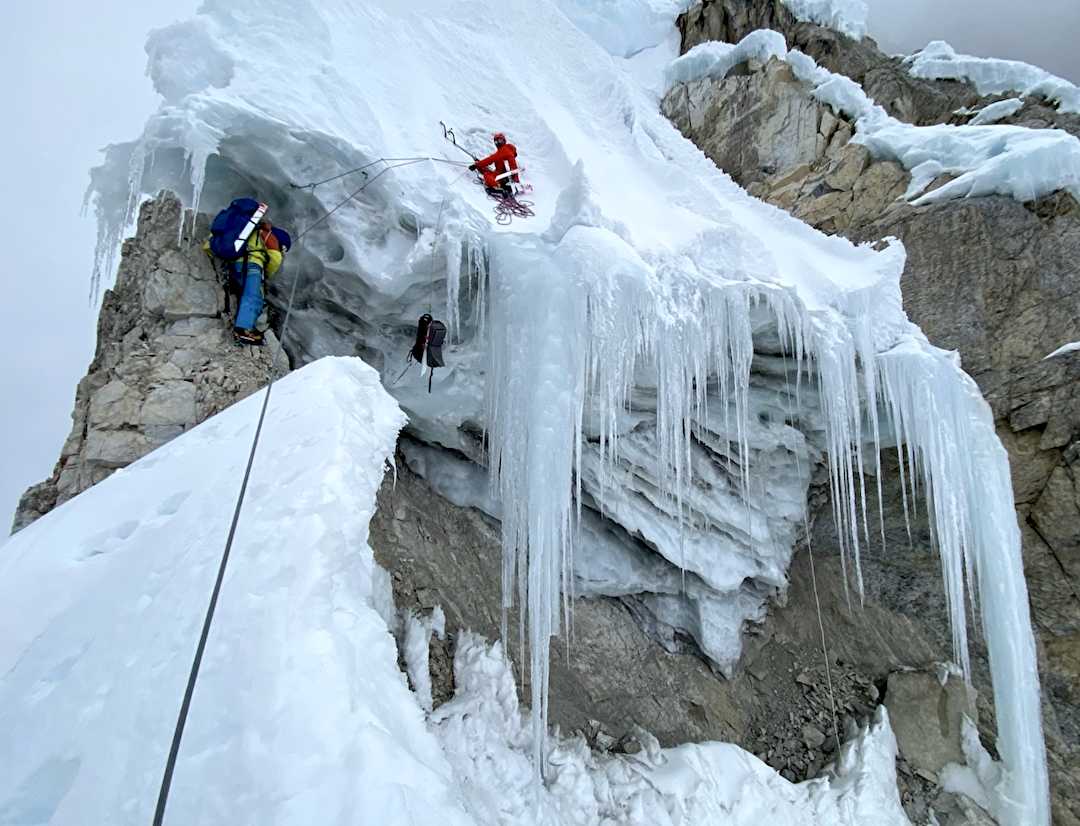
Now it is Marc’s turn. To reach the first of the east spur’s characteristic hanging glaciers, we must surmount an ice overhang. Marc overcomes this roof with aid, and Rubén, on second, climbs it free—he is an animal! Winding pitches follow, very difficult to interpret and to protect. In the day’s last light, it’s my turn to lead the party. We have to climb onto the second glacier with an 80° ice pitch, which we overcome more easily than expected.
We need to stop for the night, but the glacier is much too steep. We still have about 300 meters to go before reaching the upper ridge, and the climbing is exhausting—a 65° ramp with hard snow, where the calves are left destroyed. Luckily, as we are dodging to the right around a serac, we find an ice cave with a flat floor where we can set up our bivouac. Furthermore, we are sheltered from the freezing wind. We have been very fortunate to find such a good site to camp. We’ve only been climbing two days, and we are already exhausted.
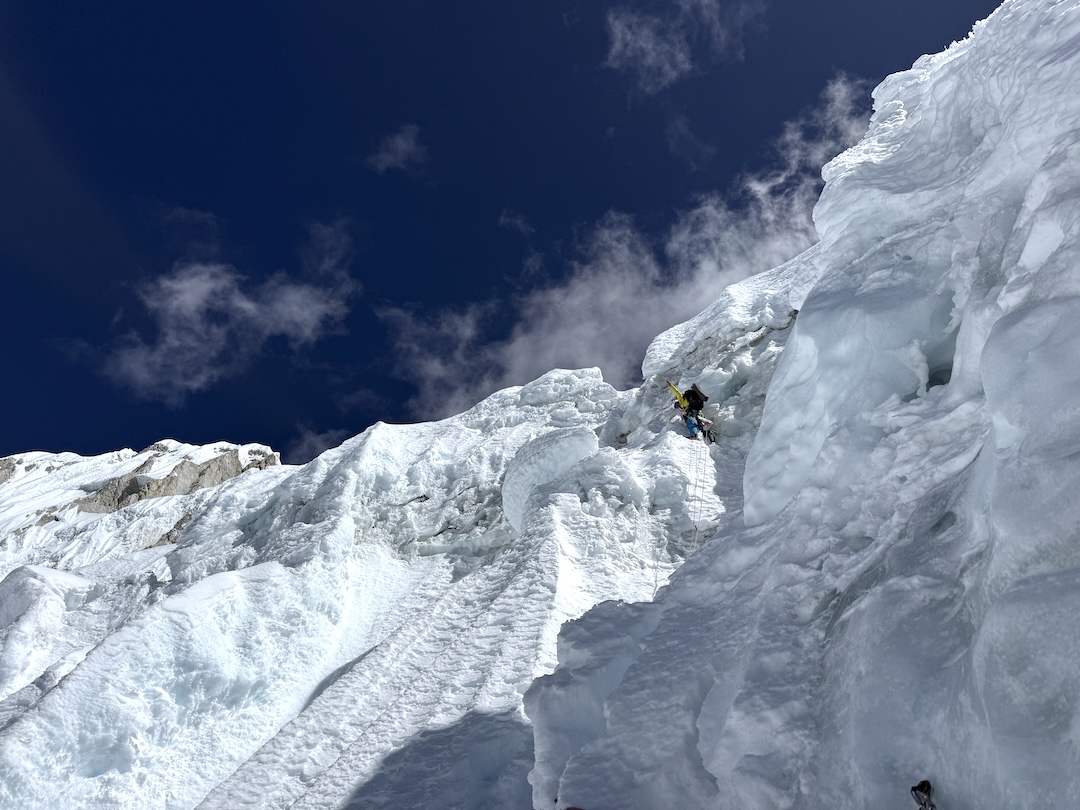
On August 6, the sunlight wakes us—later than planned, but we needed to rest. When the packs are ready, we continue up the infernal ramp in search of the main ridge. We are able to place pickets, but the snow surface is very firm and tiring to climb. After 200 meters of simul-climbing, we finally reach the ridge. The weather is good, overall, but the wind is strong and feels very cold.
From this point on, we assume we have no way to retreat by the same route; we are carrying only eight pickets—not nearly enough to rappel all the steep snow we have climbed—and any other alternatives would expose us to much falling ice and rock. We can see what awaits us: first, a stretch of snow mushrooms, then another 65° slope similar to the one we just climbed, a very long, corniced ridge full of mushrooms, and a final steep wall before the summit.
In the first part, the mushrooms are quite stable; we sink to our knees in the snow but don’t knock much off the ridge. Quite quickly we reach the 65° slope. Physically, we’re struggling with the altitude, as we must be at about 6,100 meters. Around 3 p.m. we finish the steep snow slope, and despite finding a good place to sleep on top, we decide to continue along the sharp ridge, with the hope of being able to pitch the tent somewhere.
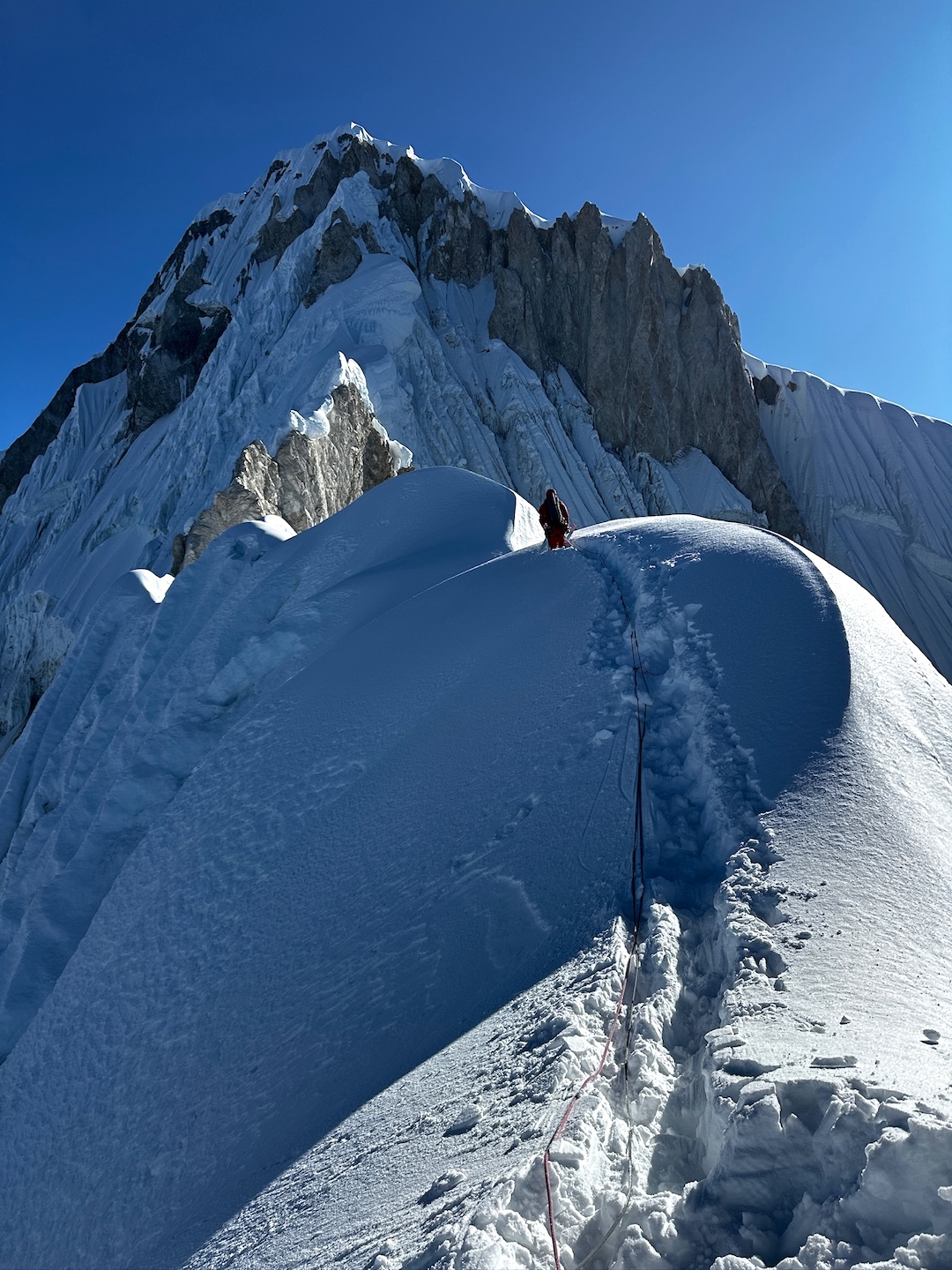
With Marc in front, we start the most committed part of the climb: a ridge with nearly vertical sides, topped with many fragile snow formations. We advance slowly and our mood is very gloomy, as every step feels very delicate and difficult. The snow is like sugar, and pickets do not give us any confidence. Our only source of protection is to keep a climber on either side of the ridge in case of a fall, but of course any such fall would be very dangerous.
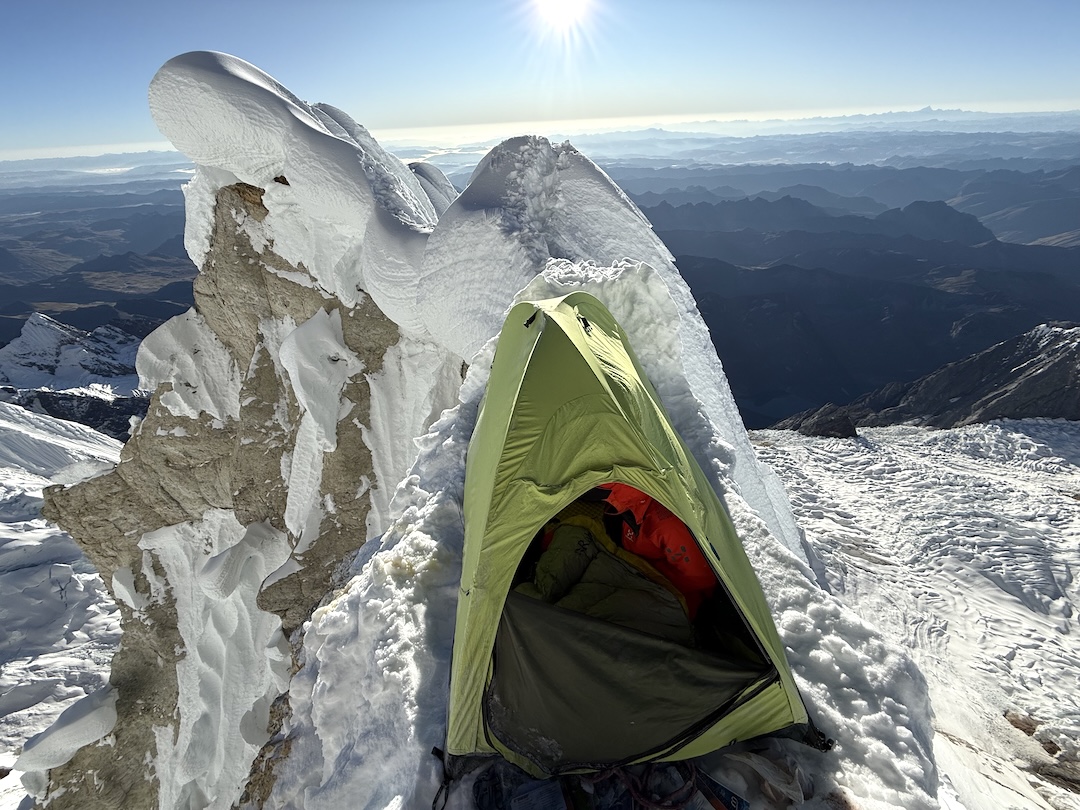
When we’re in the middle of the ridge, amid the most complex terrain, night quickly descends. It seems impossible we will find a place to sleep, but after more than an hour of dismantling a snow mushroom, we manage to create a tiny ledge. The tent barely fits, but once inside we happily prepare freeze-dried meals and fall sound asleep.
On the morning of day four, once again rising later than we would like, we prepare breakfast and pack up to start toward the summit. First, though, we have to finish the most complicated stretch of the route. We advance slowly, crossing the characteristic fluted gullies of Peruvian summits. The snow continues to be very difficult to protect, and falling would have very serious consequences—it is not an option. I switch into ultra-focus mode and try to climb as well as I can along these three pitches.
The ridge eventually broadens and eases, but suddenly we realize all three of us are standing on a wind slab. There is no alternative to crossing it, so there’s a real feeling of joy when I reach the final headwall and set up a good belay.
With motivation through the roof, I continue leading us through a couple of M5/M6 pitches. Rubén surmounts the final mushroom and summits first, and at 5 p.m. we are all on top of Yerupajá, celebrating with tears and hugs. Marc keeps a clear head and wakes us from our dream: A convection cloud is moving in, and we are losing visibility for the descent. The moment feels very uncertain, but we stick with Plan A and head south.
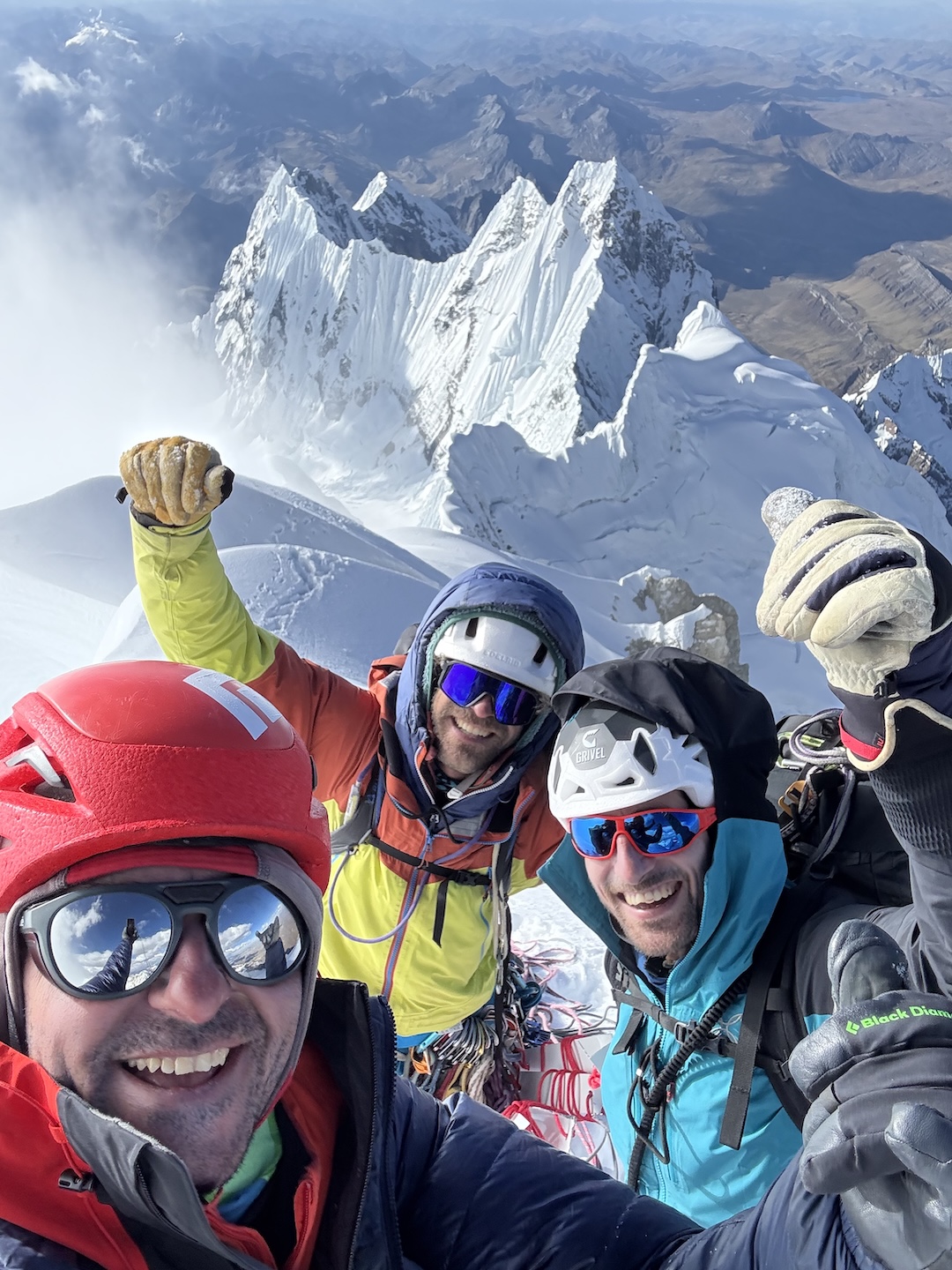
In about 60 meters, in the middle of the fog, we sense a good gully for rappelling off the summit pyramid. Given the unstable snow, we are forced to use a pair of rather poor pickets for an anchor—now we have two fewer pickets for the rest of our long descent. With great delicacy, we descend the entire rope along the east side of the summit tower, still very close to the ridge. We are fortunate to have enough rope to pass a large crevasse at the bottom, then we make a short traverse to a flat, safe area where, already in darkness, we pitch the tent again.
On August 8, our fifth day on the climb, the morning is radiant. Yesterday we had not been able to see where we were or the path we had to follow. Now we can see the entire traverse we need to cover.
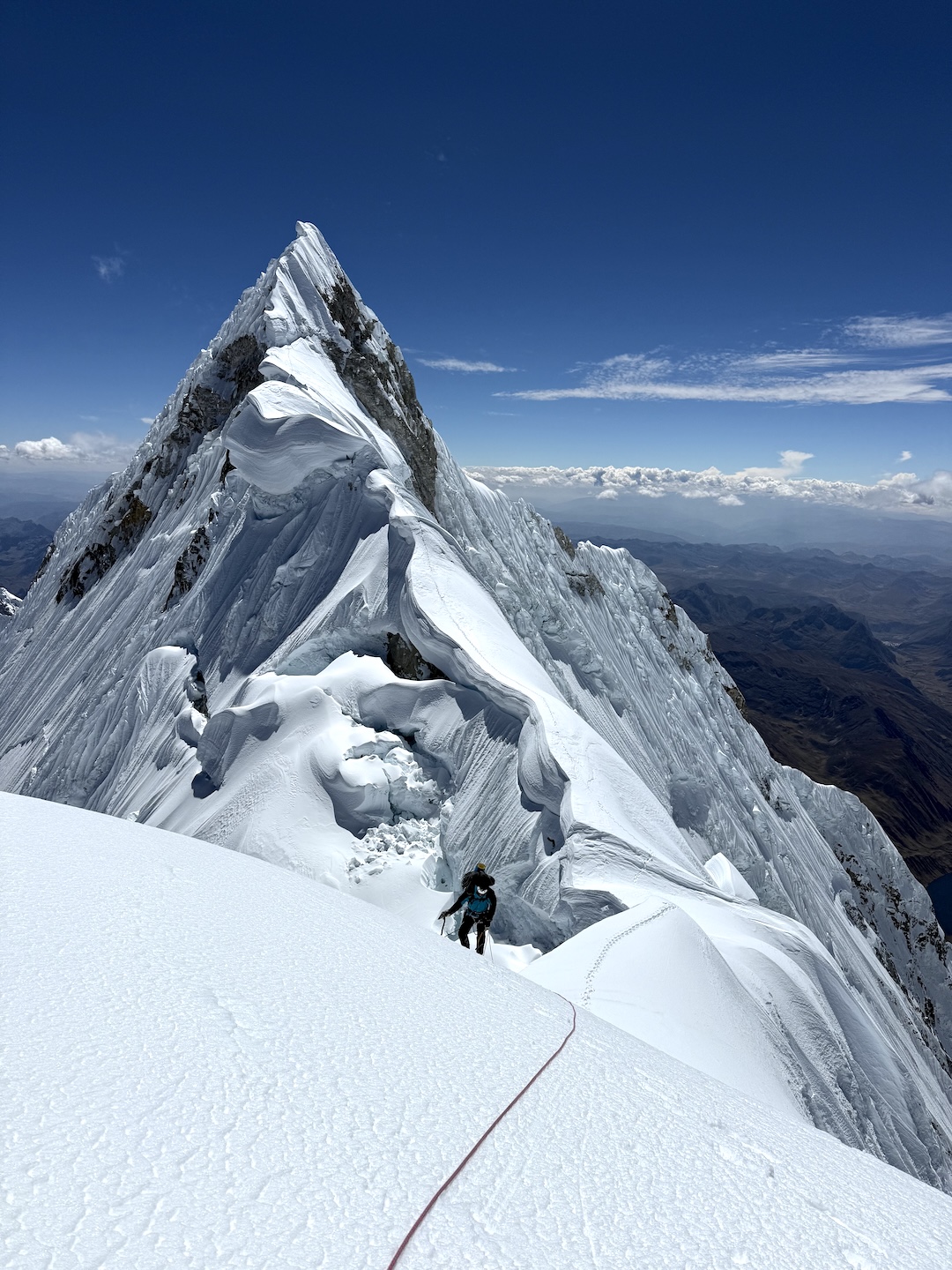
The day’s climbing begins by passing the cracked mushroom that was visible from below. At first, we don’t know how to do it, but then we realize we can pass inside of the crack and not put ourselves on top. Once past this, we advance quickly, and before noon, we are already on the south summit. It is very impressive to look back and see the route we have climbed during the last four days.
From the south summit, the drop is nearly 1,000 meters at an average of 65°. We make countless Abalakov and snow picket anchors for rappels. During our final rappels, snow starts to fall heavily. With so many meters above us, we’re hit with considerable sluffs, which makes the atmosphere tense again. With little energy left, we perform the necessary maneuvers as fast as we can to safely exit the face.
Back on the glacier, wet from the falling snow, we cross a labyrinth of crevasses to reach the path we had scouted, leading us toward home. In the tents at base camp, immensely full from the adventure we have lived, we close our eyes to start the rest we so deserve.
SUMMARY: First complete ascent of the east spur and east ridge of Nevado Yerupajá Grande (6,634m), followed by a traverse to Yerupajá Sur and descent to the southeast, by Bru Busom, Rubén Sanmartín, and Marc Toralles from Spain. The climb and descent took five days (August 4–8, 2025). The route is called L’essència del compromís (“The Essence of Commitment”). It gained about 1,400 meters from the foot of the rock wall and was graded M6+ 6c+ 95°.
ABOUT THE AUTHOR: Based in Terrassa, Catalonia, Bru Busom strives to balance his family and daily life with the world of mountain guiding and committed alpinism. He wrote about the first ascent of the east face of Siula Grande in Peru in AAJ 2023.
This story was translated by Julian Dreiman.
YERUPAJA FROM THE EAST: CLIMBING HISTORY
Yerupajá was first climbed by the west face and upper south ridge, in 1950, by David Harrah and James Maxwell on a Harvard Mountaineering Club expedition. Ever since, much of the attention on this mountain has gone to the northeast and east sides.
The steep northeast face (to the right of the east spur) was first climbed by Americans Paul Dix and Chris Jones, who followed a direct line to the summit in July 1968. One year later, an expedition organized by the Austrian Alpine Club climbed two new routes. The first was another line on the northeast face, left of the 1968 route, climbed by Peter Habeler and Reinhold Messner, stopping just below the summit. Meanwhile, Sepp Majerl and Egon Wurm launched up the east spur, starting from the glacier to the right of the lower rock wall. (This spur had already been attempted twice by Scottish teams.) Majerl and Wurm followed the spur to the east ridge and on to the top, with two bivouacs.
The 600-meter rock wall at the base of the east spur was an early target as well. In 1982, an Italian expedition climbed the rock face and continued up the spur. On their second attempt, Fabrizio Badone, Mauro Penasa, and Ugo Vialardi climbed for six days, with extensive fixed rope, to join the upper east ridge at 6,300 meters, where deep snow and cornices turned them back. They reported finding old rope and bolts of unknown origin on the spur. In July 2023, Dani Arnold (Switzerland) and Alexander Huber (Germany) climbed the rock face by another line, topping out the face after 20 pitches, but retreated because of poor snow and ice conditions on the upper spur. (See report here.) Both of these attempts climbed the rock face well to the right of the 2025 line.
Media Gallery