
Leader Fall — Stuck Rope, Fell Re-Leading Pitch in the Dark
Nevada, Red Rock Canyon National Conservation Area, Oak Creek Canyon, Solar Slab
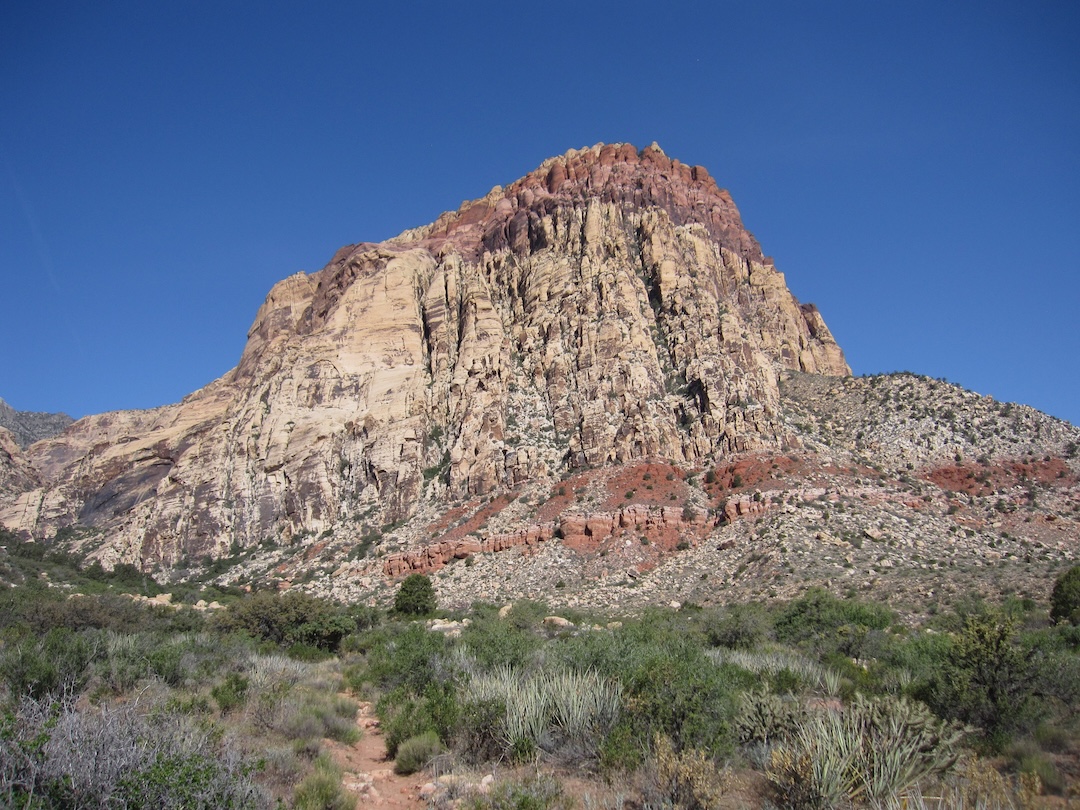
On December 28, my partner Micah (male, 21) and I (Opal; female, 20), along with another pair of climbing friends, set out to climb Solar Slab (1,500’, 9 pitches, 5.6). Micah and I approached via Johnny Vegas (480’, 4 pitches, 5.7), while the other pair climbed Solar Slab Gully (500’, 5.3). Micah and I reached the top of pitch seven (where the technical climbing essentially ends) on Solar Slab at 1 p.m. and began rappelling at 1:30 p.m., hoping to return to the car before the park closed at 5 p.m. Then we waited over an hour on top of the Johnny Vegas rappels for the other half of our team—we had one rope, they had another, and we wanted to use double ropes to make the final three rappels to the ground. We ended up starting these rappels together at 3:50 p.m.
Rappel one was uneventful. But after the second rappel the rope ends got stuck somewhere below on pitch one of Johnny Vegas. Micah went down to free them, and then jugged back up. When we pulled the ropes, one got stuck again and we couldn’t free it. Given the time pressure, we split up: Our friends would do a single-strand rappel on the free rope, return to the car, and post our late exit permit, while Micah and I stayed behind to deal with the stuck rope.
I tied into the end of the stuck rope and began re-leading pitch two—this time in the dark, though I did wear a headlamp. I placed a No 0.3 and a No. 0.75 Wild Country Friend before reaching a sparsely protected section. At some point, my foot popped and I fell, ending up inverted just below Micah. We estimated the fall at 80 to 100 feet. I had a significant head impact. Micah got me into the anchor, untied me from the lead rope, cleaned unnecessary gear, and set up a tandem rappel on the fixed single strand. We briefly tried to pull the lead rope, but it was still stuck and we didn’t need it to get down. We rappelled to the base, leaving behind both ropes, the anchor, and the gear on the route.
Our friends, still near the base and having heard what happened, had called 911. One member of that team came back to us; the other went to meet SAR at the parking lot. We attempted to hike out, but my condition worsened. SAR met us, and I was airlifted by Las Vegas Metropolitan Police Department to an ambulance and then on to the UMC Trauma Center.
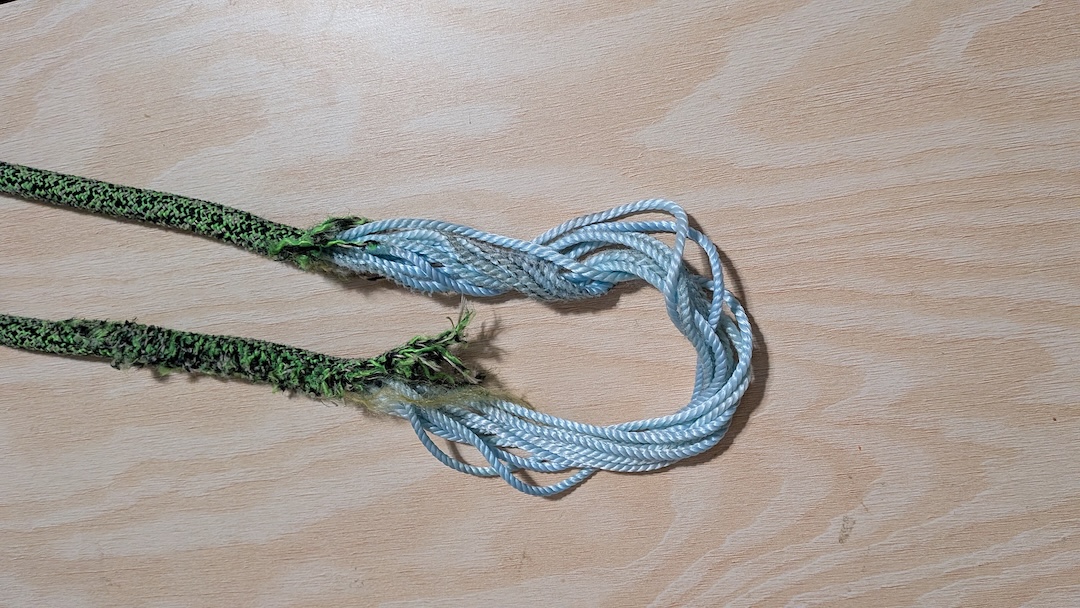
The following day, the other rope team retrieved our gear. Our brand-new 8.9mm rope—this was its first climb—was found de-sheathed approximately 14 meters from the end, near the No. 0.75 cam that had held my fall.
ANALYSIS
Time Pressure
We had not obtained a late-stay permit, assuming we could finish in our allotted time. This created urgency as the day ran long. In the dark, re-leading a pitch I had climbed easily in daylight, I found myself unsure whether I was on route. A late-stay permit is inexpensive insurance on a long objective.
Re-Leading vs. Downleading
My partner and I had discussed whether it would be more prudent to lead the full pitch or climb only to where the rope was stuck and then downlead back to the pitch-one anchor. The choice to complete the pitch contributed to the accident, but downleading carried its own hazards, including a possible factor 2 fall onto the belay after I removed the last piece. Neither option was appealing once the rope was stuck.
The Rope
Finding the rope de-sheathed 14 meters from the end was a shock. This was its first climb. Whether the slender 8.9mm diameter contributed to the failure or whether the rope’s sheath prevented something worse is hard to know. It’s worth considering your rope’s diameter and construction when attempting a route with high-friction rappels and stuck-rope potential.
Helmets and Headlamps
I was wearing a helmet. Despite an estimated 80- to 100-foot fall with significant head impact, I escaped with a concussion, bruising, and abrasions. My helmet showed almost no visible damage afterward and it saved my life. Wear a helmet every time. We both carried headlamps, which was critical in the dark. We also packed extra layers, so the dropping temperatures didn’t affect us much. (Sources: Opal and Micah.)
*Editor’s Note: Earlier in 2025, the reporting climber Micah had had another accident, on Mt. Whitney. He wrote ANAC saying, “Having this happen twice in a year seems crazy. I/we didn’t do anything particularly egregious, but I don’t like that I am the common denominator!” Despite feeling a bit jinxed, he was reassured that suffering two accidents within months is nothing but coincidence and that building a base of experience sometimes entails experiencing mishaps.
Media Gallery