

Loose Rock — Off-Route, Finger Fracture
California, Sierra Nevada, Mt. Whitney, East Buttress
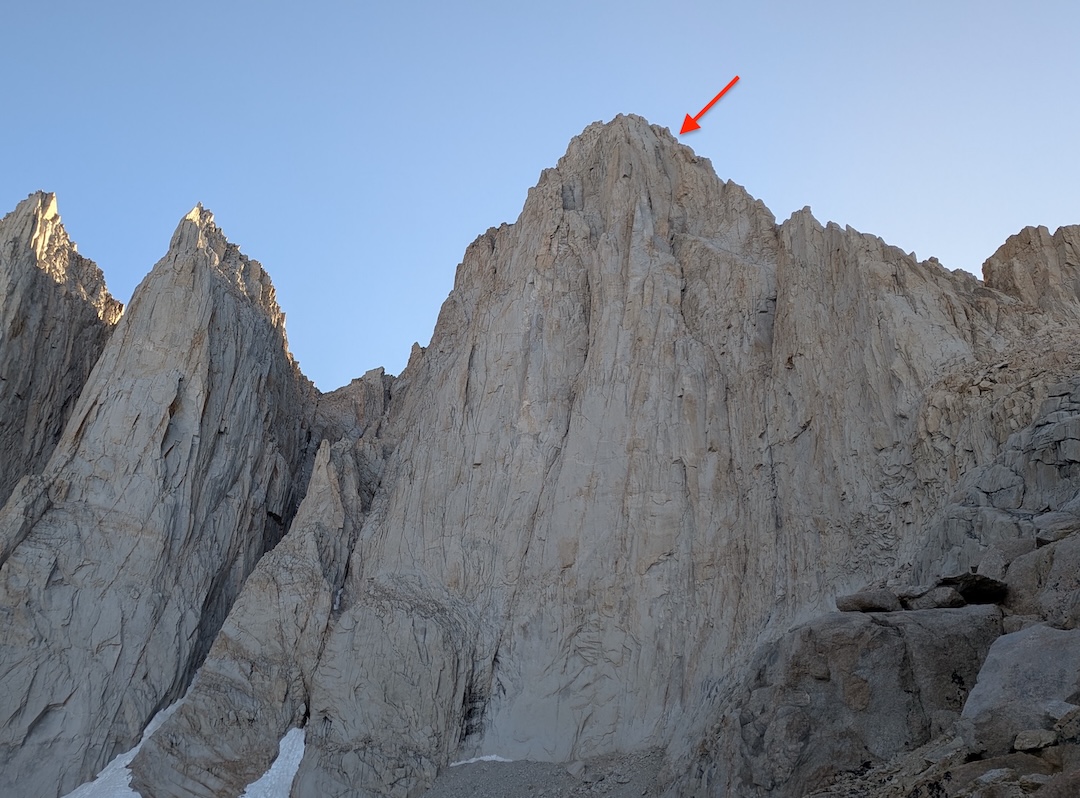
My partner and I (Micah) planned to climb the standard East Buttress (III 5.7) on August 3: camp day one, climb and descend the Mountaineers Route day two, hike out day three. We started at 5:30 a.m. and were roping up by 7. By the top of pitch six (of 11) we were moving well, behind one other party. Near the Peewee feature, that party went right. We followed somewhat blindly, trusting they knew the route. The correct line goes left—we should have checked the topo, the one time we hadn’t. Now off-route, the climbing stayed mostly lower fifth class with occasional 5.7 moves.
Around noon, I led what I thought was pitch eight—a class 3 traverse, then a short technical move onto a scree field of melon-sized blocks with smaller chunks mixed in, roughly 50 meters long. I built an anchor using a fixed offset nut at the end of the scree field before the climbing again became fifth class. I brought my partner up. Partway through the scree, a block came loose and crushed her right ring finger—later confirmed as a displaced fracture. I heard her cry out; I sent tape down and she made her way up. At the belay, we buddy-taped the finger. We called SAR at 12:30 p.m. to report our situation and our plan to self-rescue—we wanted a backstop if things got worse.
We were now at the top of what turned out to be pitch nine. Bailing down would have meant multiple rappels leaving gear, with rockfall hazard on the way. Going up was the better option. I took both packs and all the gear, and shortened the rope to half-length for 30-meter pitches, carrying the remainder in a kiwi coil. I led four more half-pitches of fourth class with occasional fifth-class moves to the summit. Though off the standard route, there was clear evidence of prior traffic—a fixed Tricam, chalk on the holds. Our rack was light (Nos. 0.5 to 3, double No. 0.75, a set of nuts), so I placed sparingly and saved gear for anchors. The anchors were all good enough but spread across distant pieces and difficult to equalize. We summited at 2:30 p.m.
We descended the Main Trail rather than the Mountaineers Route, which would keep us near other people should things deteriorate. We reached the parking lot at 8:30 p.m. and discovered the car keys were back at Iceberg Lake. It took about an hour to access the spare keys locked inside the car. We were at the emergency room by 10 p.m. and in a motel by 1 a.m. The following day, I hiked back in with other hikers who’d offered to help retrieve the camp gear, and we brought our gear out.
ANALYSIS
We had the requoired gear to safely get up or go down. This included a rack and personal climbing gear, with enough miscellaneous lockers, slings, and cordelette to make anchors. We had jackets, one bivy sack, tape, a med kit with painkillers, water tablets, and duct tape. We made logical, thought-out choices—the first was to bail up instead of down. We also decided to descend the Main Trail, though this meant more hiking.
The clear mistake was when we blindly following another party instead of sticking to the topo. We had a contingency plan if we absolutely needed to descend from pitch nine, but I am not sure we could have managed it safely given the abundant loose rock.
We also initiated a self-rescue, and informed SAR without triggering a rescue response. And we did an after-climb analysis to review and learn from this adventure. (Source: Micah.)
Media Gallery