
Rappel Error — Complacency
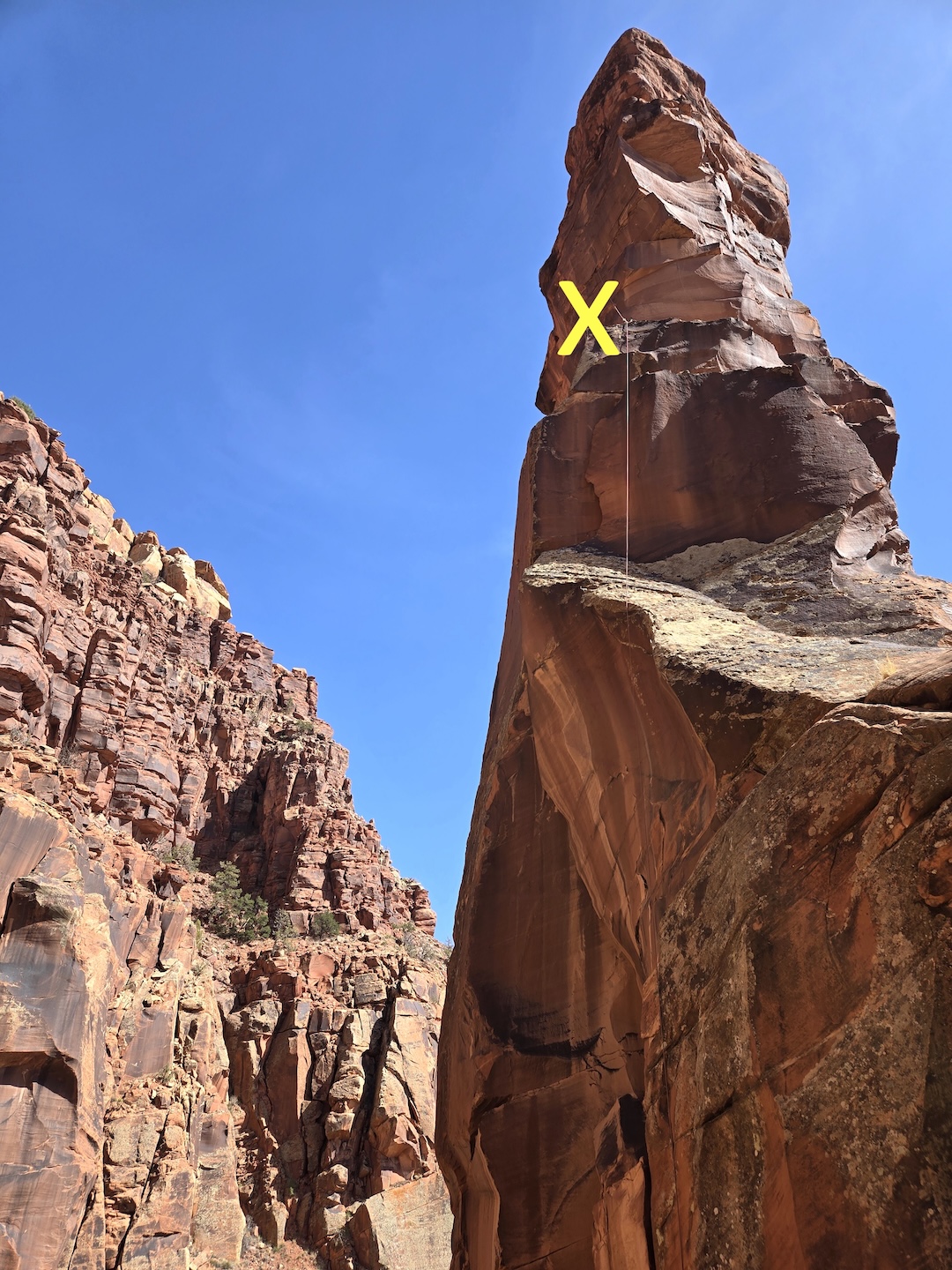
Colorado, Dolores River Canyon, Psycho Tower
In all honesty, this should have been a memorial post, and y’all would now be speculating on how I made a dumb and fatal mistake. I’m blessed to be able to write this account myself.
I had been working on rope-soloing systems, and on April 10, I rope-soloed Psycho Tower in the Dolores River Canyon via Psycho-Path (3 pitches, 5.9). My ascent, one of my first times using these skills in the wild, went flawlessly. After summiting, I hung out to enjoy the view before preparing for the descent. I chose to do a series of three single-rope rappels using a carabiner block on a doubled 9.5mm 70m rope.*
The first rappel was 60 or 65 feet, ending with a swing to the right to reach the bolts at the second rappel station. There, I tethered in and took myself off rappel. I then fed the end of the rope’s pull strand through the anchor chains, pre-threading it for the next rappel.
There was now 45 to 55 feet of rope tail threaded through the anchor. I tied a stopper knot in the end. While doing this, I accidentally dropped the rappel strand, which went 15 feet around the corner to my left. No worries, I thought, I’ll just get back on rappel, swing over, and grab it. I do not know why I didn’t realize that I had the pull strand of the rope in front of me, NOT the rappel strand. I cannot explain this lapse in thinking.
I am normally religious about testing rappels/lowers before committing, but on that day I wasn’t. I threaded the rope in front of me into my Grigri, with the tail still threaded through the chains, and then pulled the slack out of my device and gave the “rappel side” a tug. There was enough friction in the system for there to be resistance when I pulled, so I untethered, leaned back—and instantly toppled backward off the ledge.
I free-fell upside down. I have a vivid memory of knowing that I’d fucked up—of realizing that I was on the wrong strand and that it was pulling through the top anchor—and that I was going to die. But somewhere in my monkey brain, I overcame my aversion to grabbing the rope and snagged the tail side with my bare right hand. I immediately felt the rope burn, but I’d arrested my fall.
I transferred the rope to my left hand, grabbed a carabiner, and clove-hitched myself into the tail/pre-threaded side of the rope. I swung over to a nearby crack, placed some gear, went in direct, and…just sat there. I couldn’t believe I was still alive. I wasn’t even hurt, though I had fallen 20 to 30 feet. After thirty minutes, I found my composure, reconfigured the ropes, and jugged back up to the anchor. There, I pulled the rope, refixed it, and descended safely to the ground.
ANALYSIS
I should have died. Had I left the rope’s tail stacked on the ledge instead of free-hanging—conveniently there for me to grab when I fell—I’d be dead. And had I not grabbed the tail before I shot past—there was just 10 to 15 feet of tail left—and managed to hang on, I’d be dead. This accident would not have happened had I been doing traditional, non-Reepschnur rappels. I feel like while bi-pattern ropes are largely a gimmick, had I been using one, the pattern difference might have alerted me that something was wrong.
I was new to multi-pitch rope-soloing at the time, and I put a lot of focus into doing it right. When that mentally taxing part of the day was done, I got complacent on the rappels.
There’s also a risk with anchors installed at waist height above good ledges. Had this been a hanging anchor or been positioned at head height, I would have fully weighted the system before committing to it, but with the anchor at waist height, it was easy to skip that step. I know this was potentially a contributing factor in a few recent accidents. (Source: Marcel Such.)
*Editor’s Note: The advanced technique called a carabiner block is also called a knot block, a rope block, or a Reepschnur; see diagram in this report. It uses one strand of a doubled rope blocked with a carabiner and knot/clove hitch so that the rope can’t pull through the anchor. This allows the rappeller to descend one side of the rope using a single-strand device such as a Grigri or ATC-Pilot, and then use the rope’s other end to retrieve the cord. This technique lets you use a single device (in this case, a Grigri+) both for solo self-belaying and rappelling.
Media Gallery