
Pedra Riscada, Northwest Face, Folia do Divino
Brazil, Minas Gerais
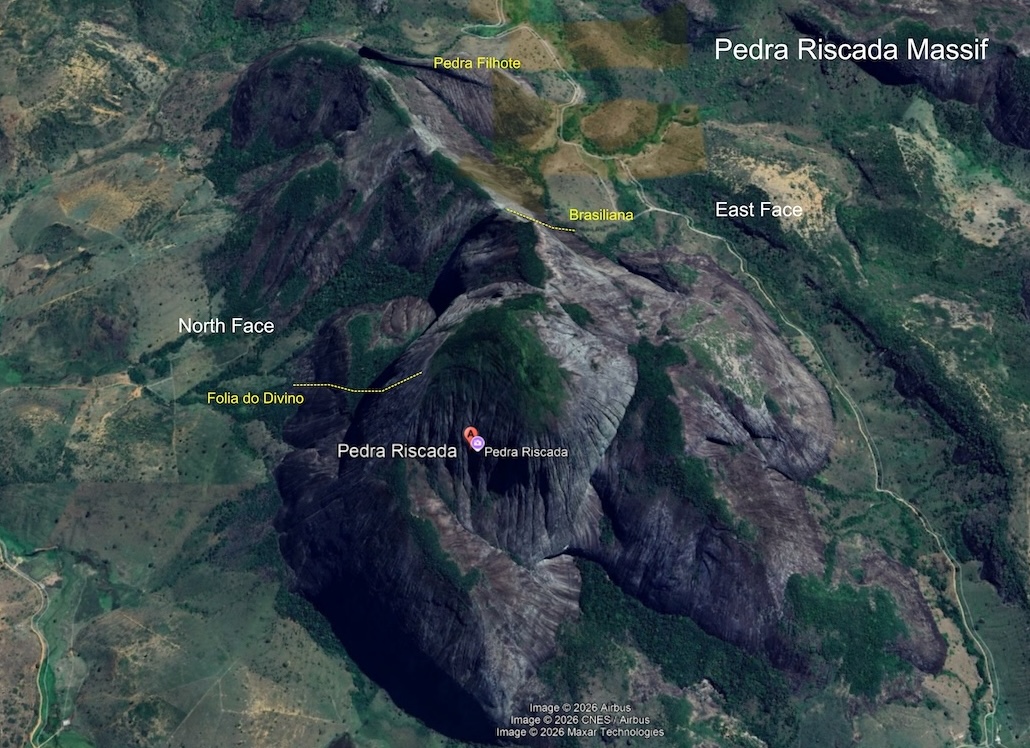
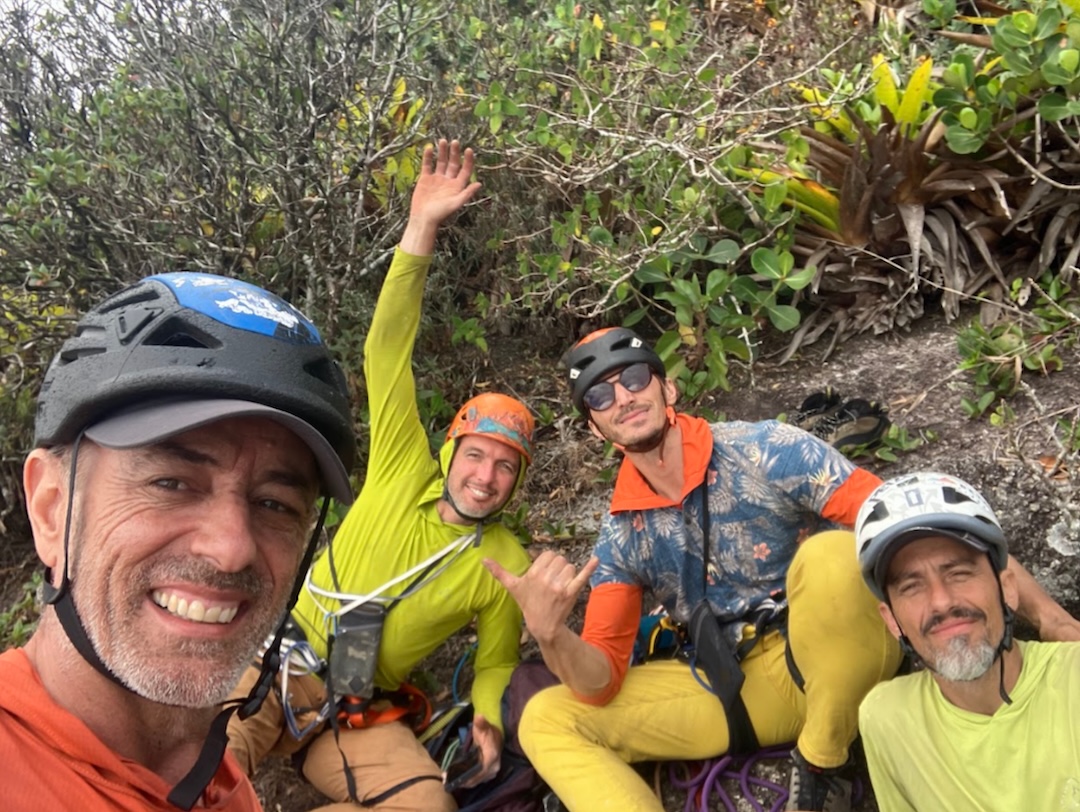
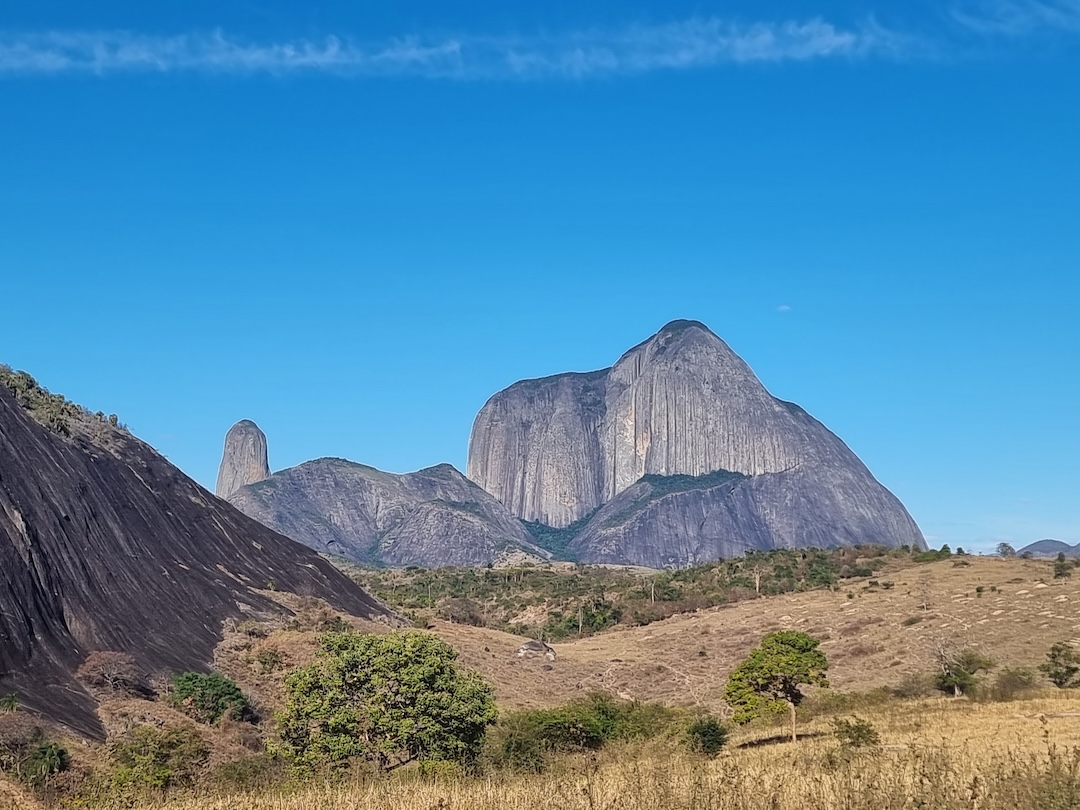
On August 16, 2025, Willian Lacerda, Valdesir Machado, Elcio Muliki, and I departed from Curitiba, in the Brazilian state of Paraná, bound for Minas Gerais, a 1,500-kilometer journey. After a day and a half of driving, we arrived below the beautiful northwest face of Pedra Riscada (18°21’58.3”S, 41°20’09.5”W), in the rural municipality of São José do Divino.
With a total circumference of 11 kilometers and a height of roughly 1,000 meters from base to summit, Riscada (1,409m) is truly massive, more than earning its nickname “Yosemite of Brazil.” According to a rumor, the local residents, who are not climbers, made the formation’s first ascent via the southeast face in 1996. They supposedly used polypropylene rope, and one cold night they made a bonfire and the rope caught fire. Nobody believed them, but in 2008, climbers found a piece of burnt rope four pitches up. I don’t know if these locals reached the summit, but they surely climbed quite a bit of the wall!
This rumor aside, the key figure in opening early routes here was Eduardo Azevedo, a climber from Minas Gerais. In 1997, Azevedo, along with Emerson Azeredo and Leonardo Caiaffa, made the first ascent of Pedra da Boca (17°55’36.5”S, 41°11’12.7”W), a formation around 50 kilometers north, via Bocaliente Canabrava (630m, 6c A3).
From the summit, they could see Pedra Riscada, and Azevedo was enthralled. Two years later, in 1999, he established Riscada’s first documented route, Bodífera Ilha (1,500m, 5c), with Azeredo and fellow Brazilians Edgardo Abreu, Leandro Maciel, and Susan Strickland. Bodífera Ilha meanders up the dome along low-angle terrain from the southeast, combining rock climbing and hiking. In 2001, Azevedo, Azeredo, Abreu, and André Coutinho opened a second Riscada route, Diedro Peladeira (1,055m, 6c A2), which passes through a beautiful dihedral on the northwest face of the mountain.
Pedra Riscada began to be known worldwide when the international team of Marius Bagnati, Bernardo Gimenez, Martín Molina, Matías Mut, Erick Vigouroux, and Pere Vilarasau established Planeta dos Macacos in 2005 on Pedra Filhote, a subformation to the north of the massif. When this 630-meter route was fully freed, by Felipe Camargo and Sasha DiGiulian (AAJ 2017), it went at 8a.
My first route on Riscada was Place of Happiness (850m, 7c), on the east face (AAJ 2010). Now there are three more routes in the same area on the right side of the east face, the most recent climbed in 2025 (see report here). In all, Riscada today has more than 20 routes. For this trip in 2025, our target was a new line on the northwest face, to the right of both previous routes on that face: Diedro Peladeira and Vogelmensch (26 pitches, 7a+), established by two German climbers in 2011.
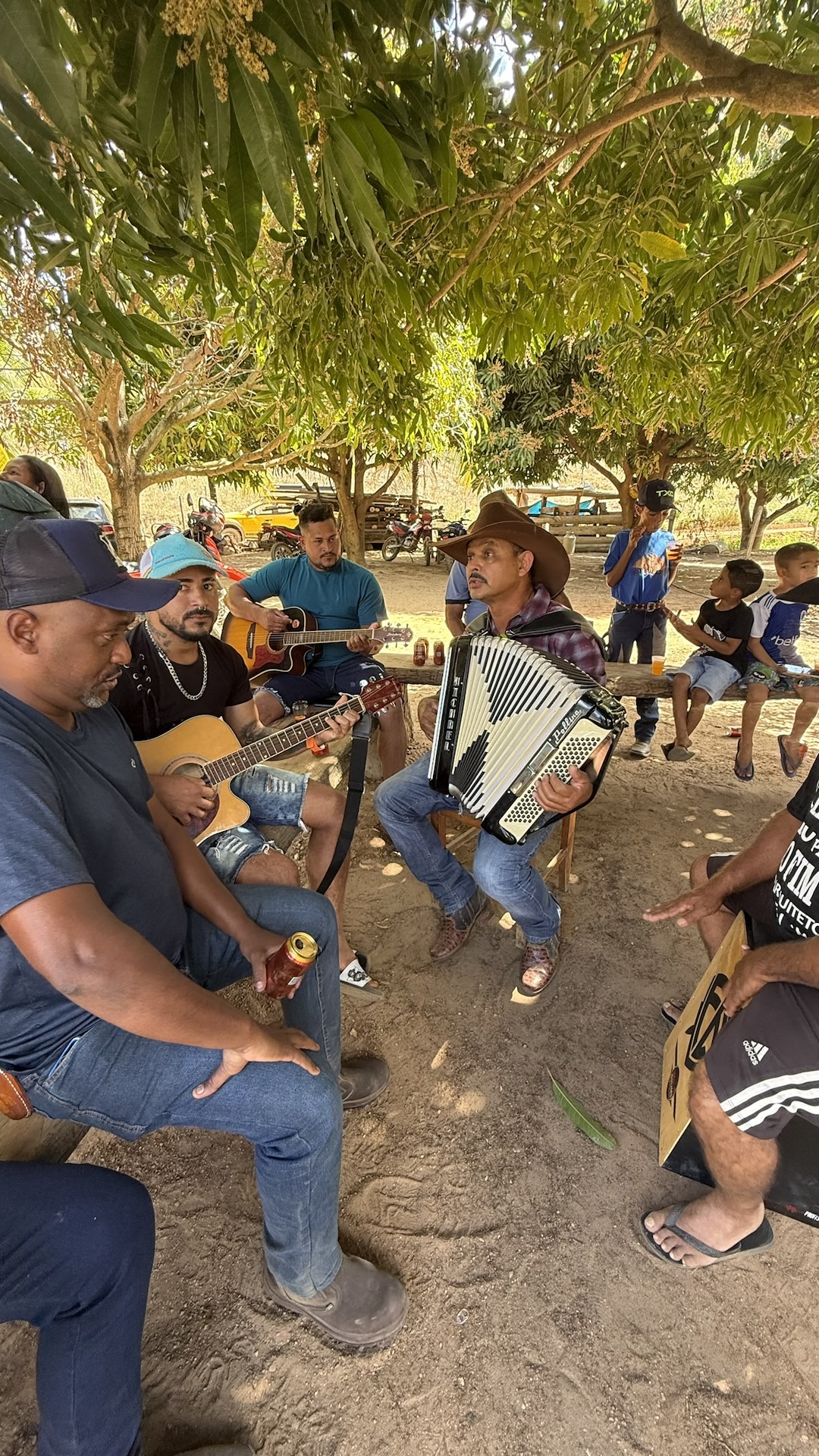
We were received with great hospitality by the man who owns the parcel of land we needed to pass through to access the wall. In fact, a religious festival called Folia do Divino was taking place at his house, and we were invited to participate. After much beer, barbecue, and socializing with those festive people, we were able to set up camp at the base of the rock, in a pristine grove of trees traversed by a river of potable water.
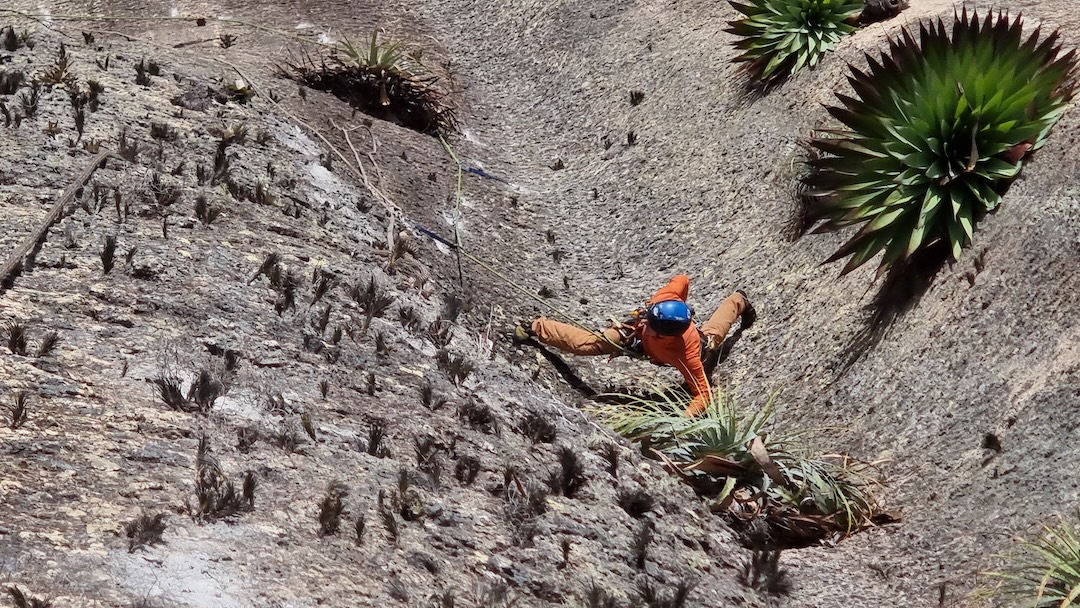
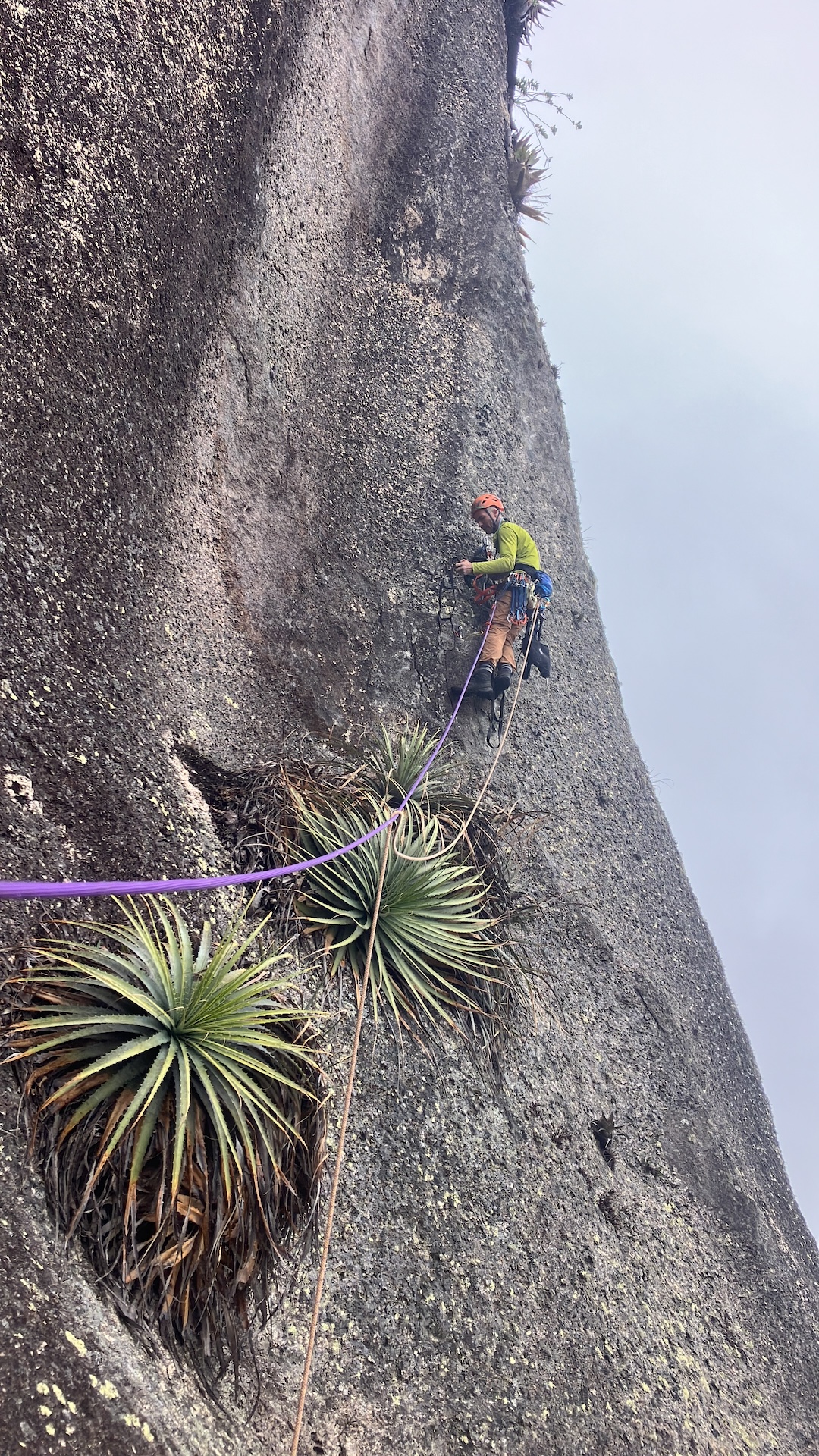
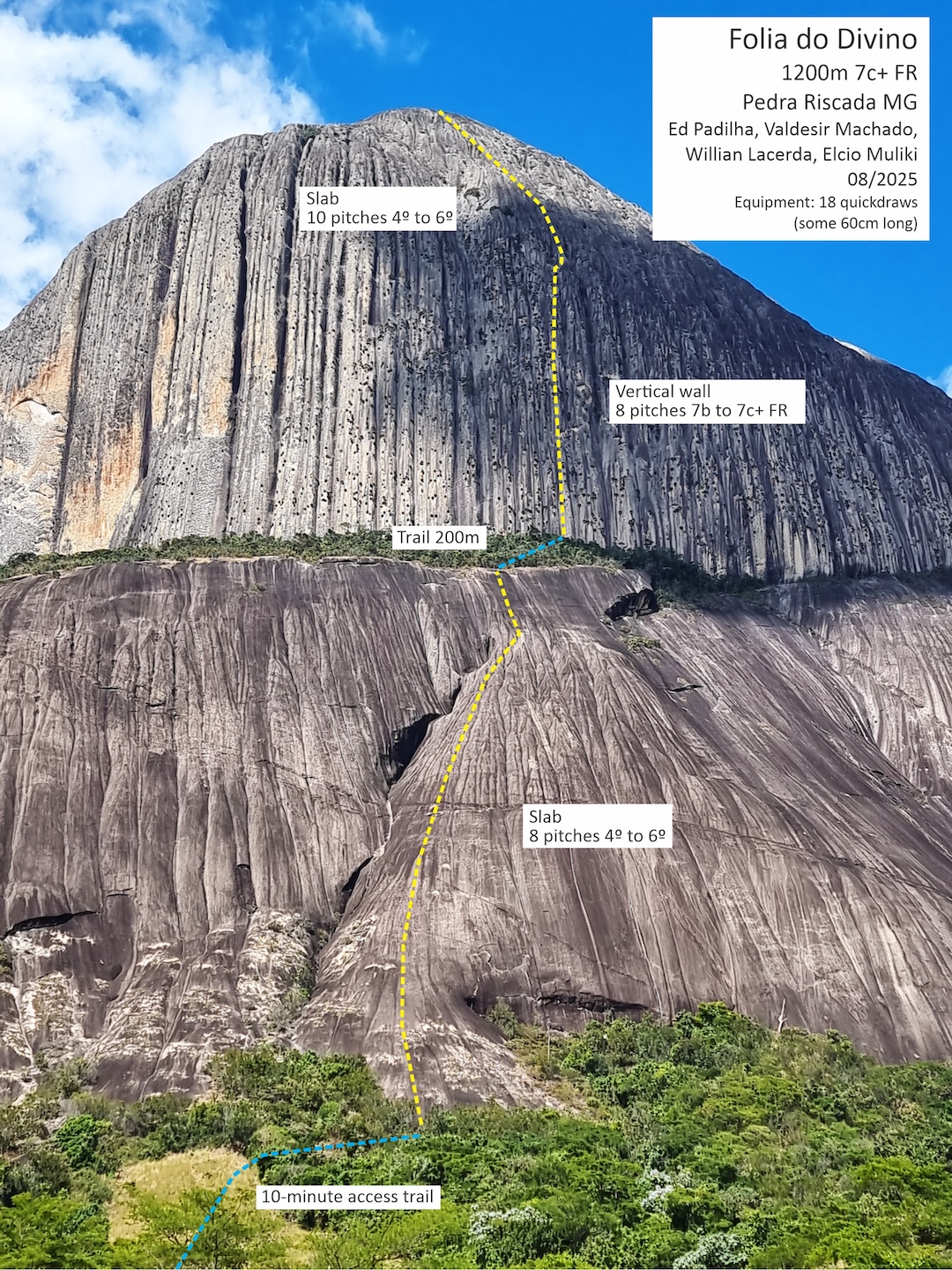
The following day, we began opening our route with an easy ramp, with difficulties up to 6b. We covered almost 500 meters on that first day, bolting ground-up, until we reached a large plateau with a beautiful forest. On the following two days, we stored water and equipment for a camp on the plateau and began tackling the difficult vertical stretches above.
We took the fourth day to rest and went to the city of São José do Divino, which is 30 kilometers from the rock, to buy supplies. We also left the drill batteries to charge at the farmer’s house. We had already opened more than 600 meters of climbing.
On the fifth day, we climbed our fixed ropes up to the plateau. In the middle of the climb, the rain caught up with us, and we arrived at the plateau soaked. At the high camp, we had a bad surprise: Our freeze-dried food was spoiled, and we had to ration food heavily to last until the end of the climb.
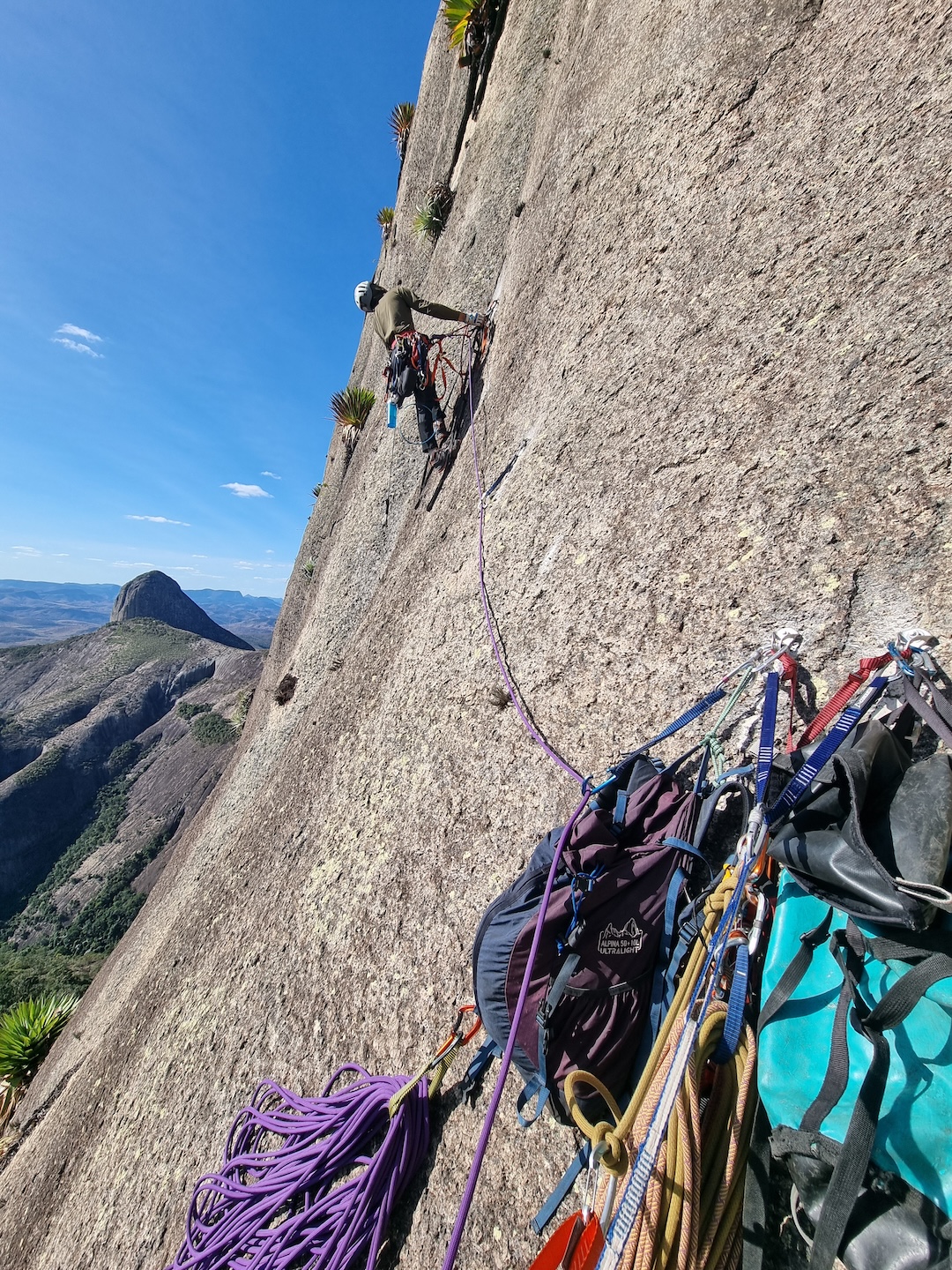
There were eight difficult pitches above the large plateau, with difficulties ranging from 7b to 7c+. As one pair opened the line, the other free climbed the pitches. There were several very laborious pitches, crimpy and vertical.
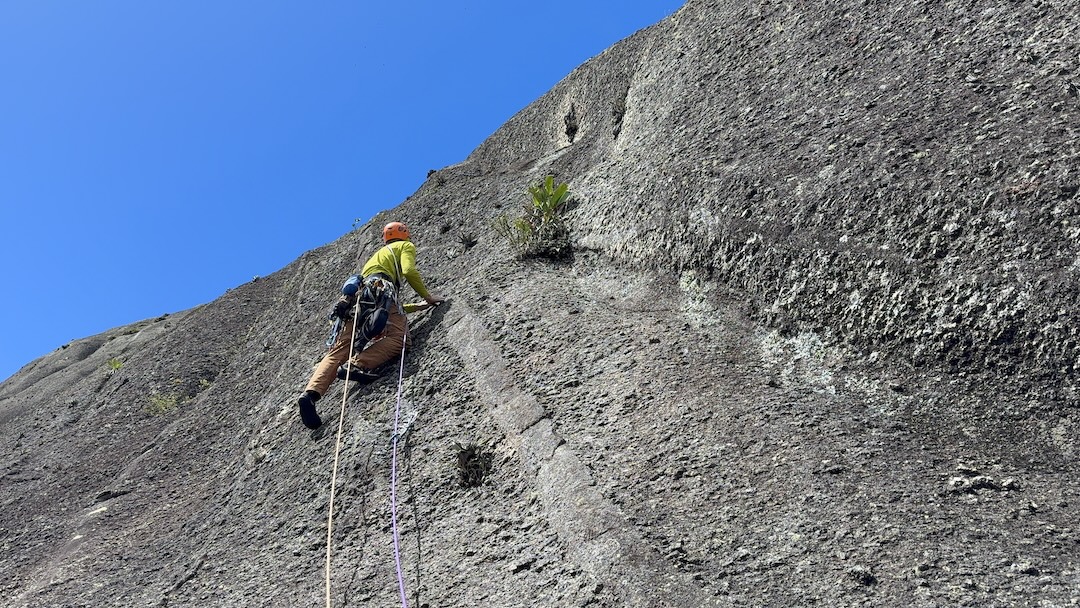
On August 24, the third day of this second stage on the wall, we began climbing with all of our gear, as it was getting too far to jumar every morning. That day we managed to overcome the last vertical part of the wall, and the pitches became easier. We spent a horrible night on a sloping plateau about 800 meters off the ground, and the next day dawned with a thick fog. We followed our intuition, progressing up a very beautiful wall, with several “scars” formed by a different type of rock. As we progressed, the clouds dissipated. When we reached the top, the sky was almost completely clear, and we could see the surrounding landscape. In total, we spent seven days climbing, from August 18 to 25, with one rest day, and hammered in 300 stainless-steel bolts (there are no cracks in the wall).
We celebrated and named the route Folia do Divino in honor of our hosts. It took us seven hours to rappel the 1,200-meter route, and we arrived happily at our campsite to drink our last beers. The next day, we had a good coffee, a good shower, and said good-bye to this magical place called Pedra Riscada.
To climb our route, teams should bring 60m ropes and at least 18 quickdraws. The nearest airport to Pedra Riscada is at Belo Horizonte, a roughly seven- to eight-hour drive from the wall, which is best accessed from the west.
—Ed Padilha, Brazil
Media Gallery