The Big Pointy One
A Big Year for Mozambique Walls
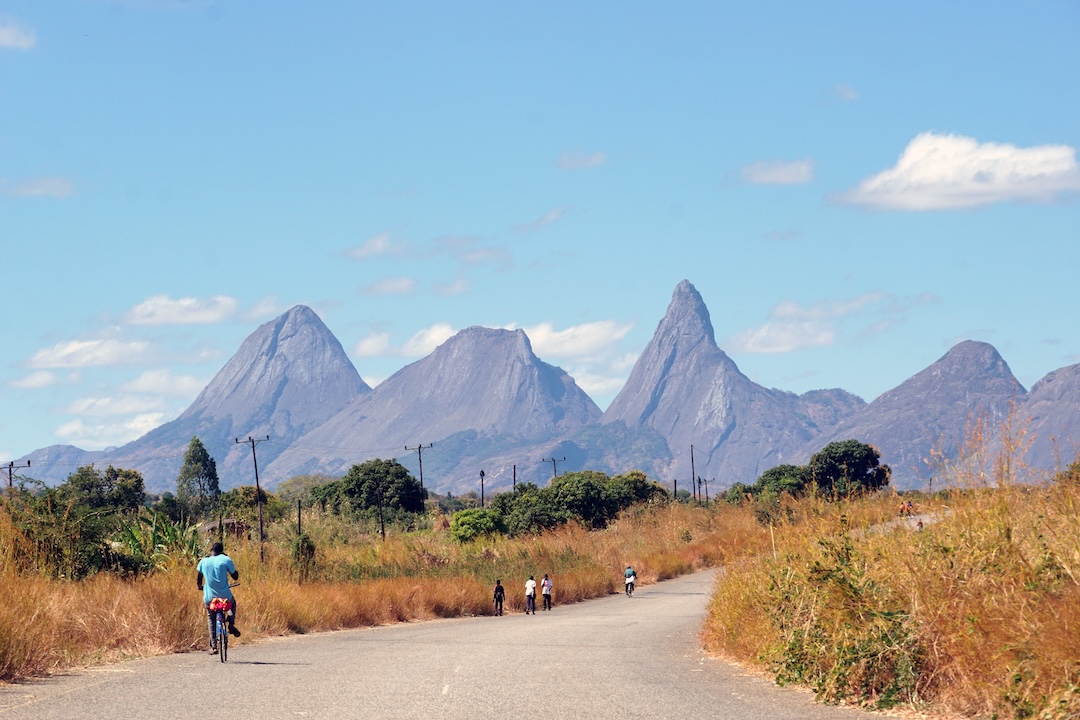
Mozambique is a land of unclimbed walls. Granite domes grow wild on every distant horizon of the savanna. If one had the patience to count, they might tally a hundred of these monoliths ripe for climbing. However, the nation’s political instability, sectarian violence, and economic hardship make it a difficult place to visit and explore. Outbreaks of diseases such as cholera and monkeypox are nearly annual. Transportation is expensive, unreliable, or both. Portuguese is required to communicate effectively, and there are little to no international tourism resources outside the coastal cities. If none of that scares you away, then, as the locals say, Estamos juntos (“We are together”)!
When Bosco Bonilla, a Spanish friend and climbing gym builder, asked me to go with him to Moz, I had to admit I didn’t know anything about the country, climbing or otherwise. After seeing a photo he shared of the Malema massif, I told him, “I’ll go if we can open a route on this big pointy one.” He replied, “Oh yes. We must climb that.”
It was challenging to find others willing to take on the trip. We weren’t sponsored, so every expense was coming out of our own pockets. However, I managed to rope in a gung-ho, 21-year-old Yosemite dirtbag, Owen McGinness, to round out the team. The three of us would go for the big pointy one, Malema One. Unfortunately for us, more than 20 meetings with officials, AK-47s, detentions, and days of severe diarrhea stood between us and Malema’s tower-like summit.
My pretrip research revealed the lion’s share of Mozambique’s big walls reside in the northern provinces of Nampula and Zambezia. Few climbing teams have visited the country. The first expedition was, of course, to Malema One (1,272m, 14°57’10.0”S, 37°35’20.2”E). In 1998, South Africans Alard Hüfner and Mark Seuring opened Whites Must Be Crazy (705m, 6a+) on the north face. Two years later, they returned to the massif, this time to the steeper east face of Malema Three (1,337m, 14°56’24.6”S, 37°36’31.7”E), where they climbed African Light (710m, 6b+ A1; see AAJ 2001). Afterward, they visited the Ribaue area, 80 kilometers to the east, to open Delayed Gratification (645m, 6c A1).
Over a decade later, in 2011, a Polish team led by Artur Magiera visited a steep wall closer to the city of Malema, Mt. Inago (1,722m, 15°01’21.7”S, 37°23’09.9”E). Their route, Clockwork Orange (700m, 7a+ C0), is said to potentially go free at around 8a+. In 2013, a Spanish and South African team returned to Malema Three to open Vertisub en el Diedro del Angelo (800m, 6c A2). Finally, in 2014, Americans Majka Burhardt and Kate Rutherford climbed Mt. Namuli via Majka and Kate’s Science Project (600m, IV 5c+; see AAJ 2015). Their trip spawned a nonprofit, Legado, that works to empower indigenous communities in developing countries like Mozambique.
A few less significant ascents were made, and there definitely have been more climbs or attempts than I could find in my research, as evidenced by rusty bolts we found on a tower we expected to be the first to climb, outside of Nampula city. Every report I read mentioned two huge non-climbing cruxes in Mozambique: grass and bureaucracy. Both proved to be formidable for us as well.
First, the grasses. A remarkable characteristic of these domes is their overwhelming population of grasses and lichens. The tussock grasses, Coleochloa setifera, form sturdy tufts that adhere to blank cliff faces of otherwise high-quality granite. Imagine Nalgene bottles of tough dirt sticking out of a cliff, covered in two-foot-long strands of grass. They are so prolific that we found ourselves picking lines based not on obvious weaknesses in the rock, but rather on how many pitches we could avoid “cabbage climbing.” Before we could be so lucky as to yard on clumps of grass, though, we had to figure out how to get permission to do so. We built in a couple of extra days on the front end of our trip for this. However, it ended up taking over a week.
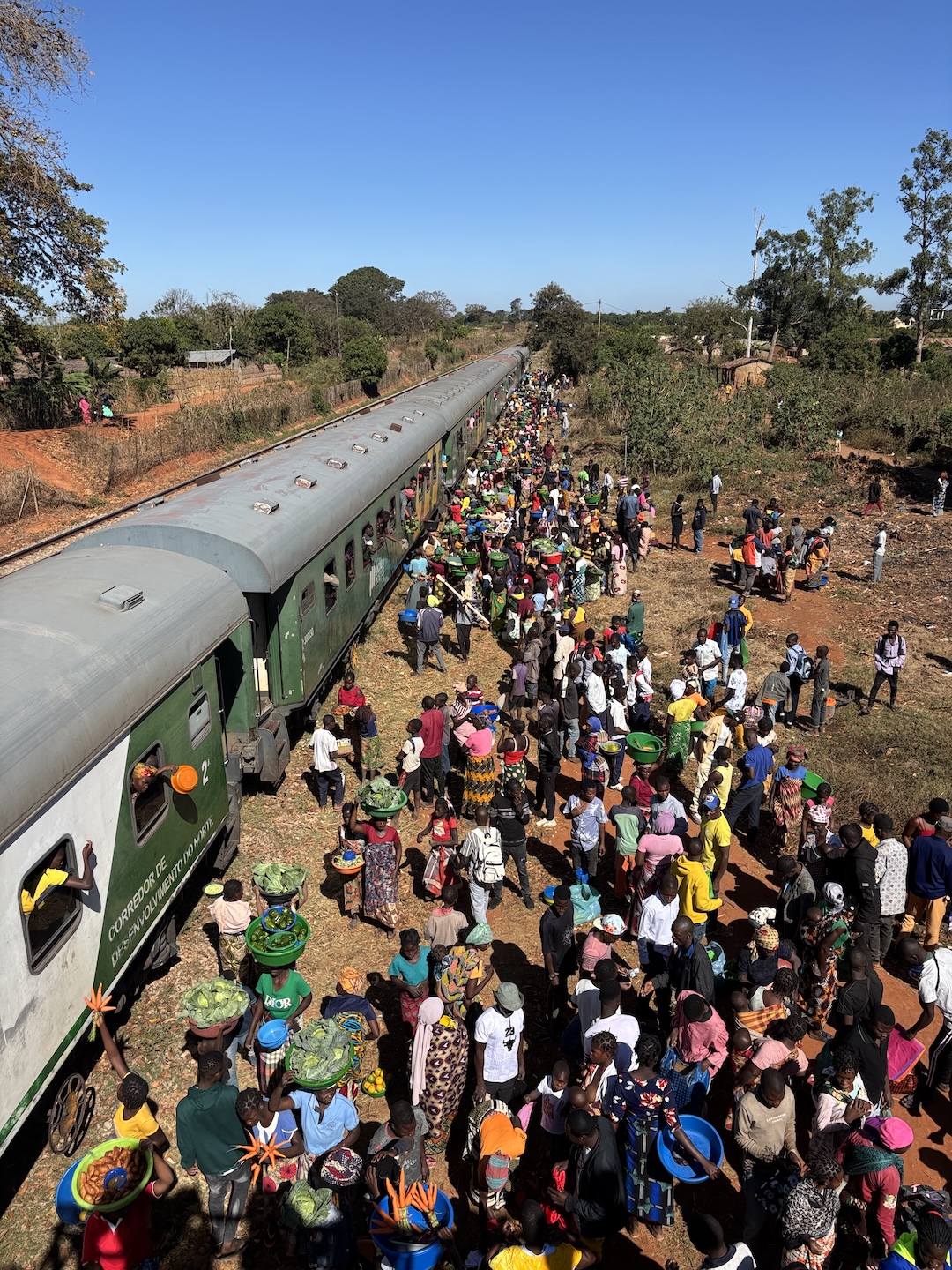
Our team arrived in Nampula, home to the nearest international airport, in early July. After an eight-hour train ride west to Malema, we met with the chief of police and got a document from the district governor stating we had permission to climb. Bosco did all the talking, as he was the only one of us who spoke Portuguese.
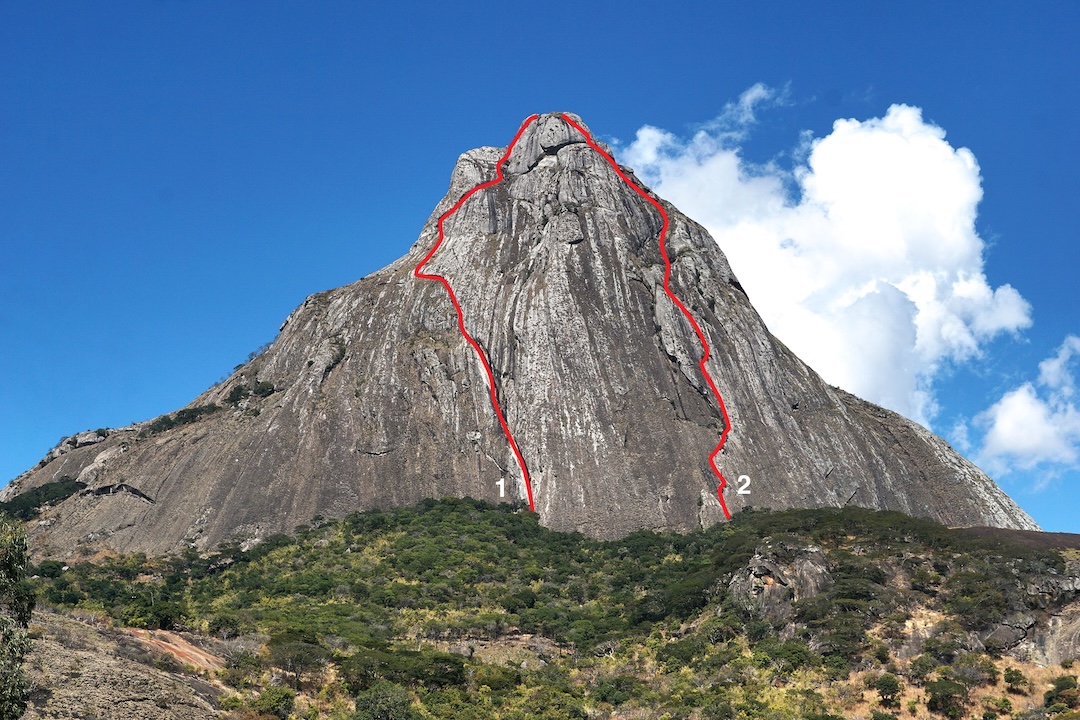
We hitchhiked to the Malema range and set up camp at a nearby farm, but then learned we had to return to the city to speak with the police again. It was unclear why, but we tore down camp and headed back. There, we were told that two criminal detectives wished to join us to see where we would climb. We agreed to bring them with us on our scouting day. As luck would have it, the approach up the forested apron of Malema One was pleasant and shaded, following trails used to farm the nearby hillside, with incredible views and fresh water sources. During the trek, we built a rapport with the detectives and local farmers, gaining their trust and support. It was settled. We would be allowed to climb. Or so we thought.
The next morning, we were packing our haulbags for five days on the mountain when a truck came ripping down the dirt farm road. In the bed were six men holding AK-47s and mean-mugging us. They demanded another meeting. I didn’t need to know Portuguese to understand this meeting was different. They were very aggressive, and Bosco wasn’t getting many chances to speak. They forced us to pack up camp again and load into their truck. At the nearest village, they threw us back on the train to the city of Nampula!
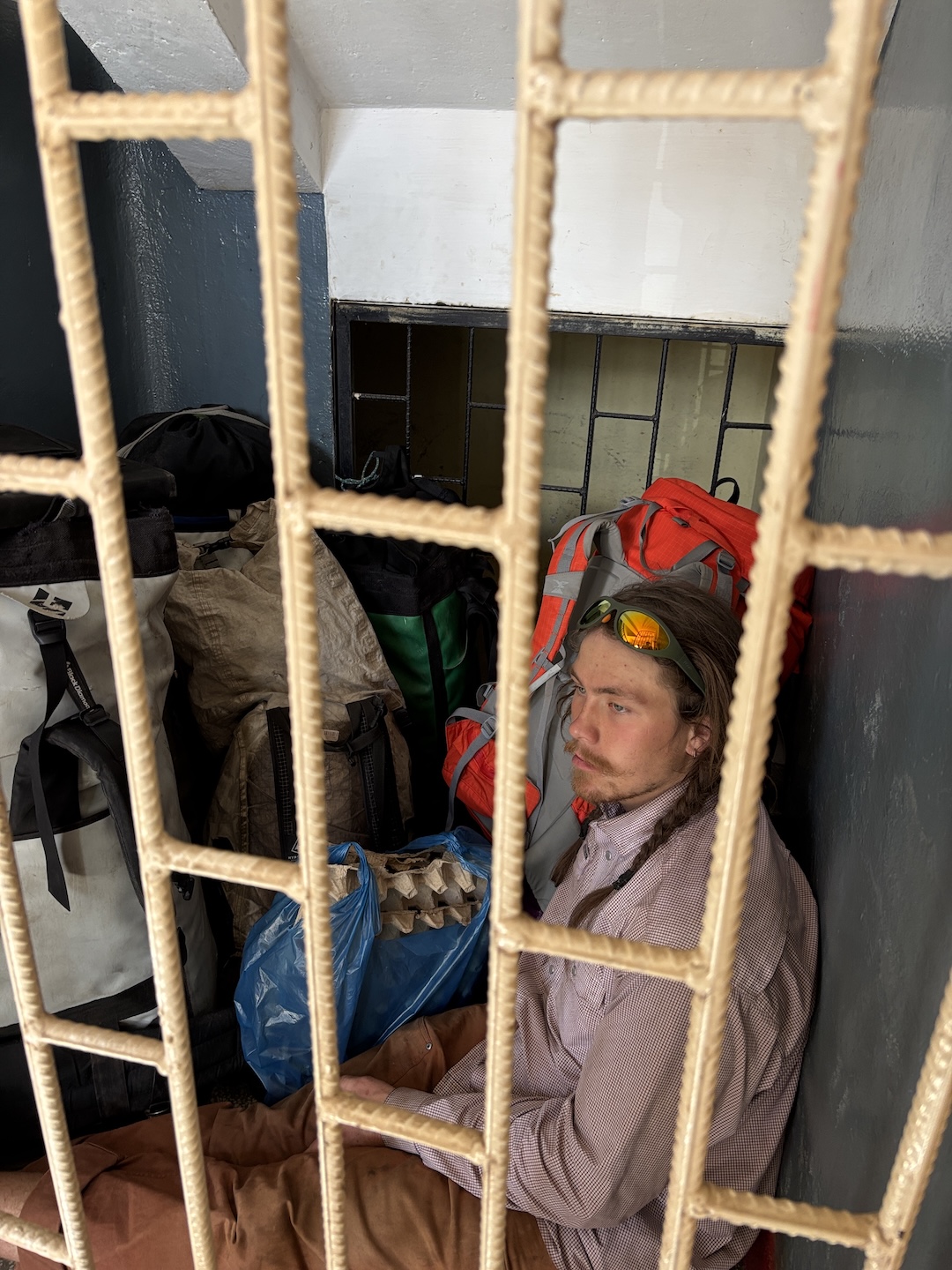
It was after sundown when we got off the train. There, another armed man told us to follow him to the police station. Exhausted, and not seeing another option, we complied. The three of us, carrying a total of over 400 pounds of gear, followed him for five blocks. After arriving, we discovered that, for reasons never communicated to us, we were going to be held overnight. The next day, after threatening to call our respective embassies, we were taken to an immigration office across town and finally released later that afternoon. We immediately took our things to the local administrator, got a second signed and stamped document of approval, and bought train tickets to head straight back to Malema One.
During those long train rides and intimidating encounters just to get a piece of paper, I caught myself feeling fed up with the local authorities. Why did it seem like they were toying with us? During previous expeditions to developing countries, I’ve never had such a difficult time with bureaucracy. On a trip to Chad’s Ennedi massif, we climbed in a different tribal territory nearly every day (AAJ 2025). We may have had six meetings with leaders. Here? Over 20! Why?
For one, we had no outfitter or fixer running interference. It was up to the three of us to figure it all out in-country. In Chad, our outfitter and a translator took care of all the non-climbing stuff. A trip to the Karakoram was similar (AAJ 2023). Due to logistic and bureaucratic demands, we utilized fixers, guides, and porters, and I wasn’t responsible for much until it came time to tie into the sharp end. Those both were big adventures, but Moz seemed to be on another level.
The second reason we were running into so much friction was a bit more sobering. The Mozambicans are dealing with real issues in their country, the kind that leave actual scars and little room for trust. The 2024 presidential election was widely contested. Subsequent protests turned violent throughout the country, leading to hundreds of dead and thousands injured. Even worse, the provinces neighboring Nampula—Cabo Delgado and Niassa—have seen increased ISIS activity. Since 2017, an estimated 4,000 have been killed and a million displaced.
Imagine all of this happening nearby while it’s your job to keep your family and community safe. Now imagine being asked to believe that a group of comparatively wealthy foreigners flew across the globe for no other reason than to play on a mountain. Would you trust us? When I thought about it, seven days of meetings and detention really didn’t seem like a big deal. In fact, during that long train ride back to the Malema range, I came to feel pretty damn lucky.
The next day, our team was finally back at the foot of Malema One’s north face, some 250 meters east of the start of Whites Must Be Crazy. This time, we were fully racked with all the gear and paperwork needed to climb.
After establishing camp, we fixed the first 70 meters on a beautiful golden slab completely free of the tussock grasses. There were nearly no obvious weaknesses for protection, so I ran it out as much as I could on the slab, between placing bolts from stances. This would become our standard style, as the triple rack of crack gear that we brought proved to be overkill.
On day two, we fixed 210 meters more, continuing the slabby trend of clean rock on faces and corners. Our line followed a massive, left-gaping chimney dihedral that, for some reason, created a ten-meter gap of clean rock between it and the sea of golden tufts. Perhaps the huge corner protected it from the rain and sun? Whatever the reason, we weren’t complaining.
Just as we ran out of rope to fix, the wall provided us with a decent bivy ledge, with a pair of disinterested lanner falcons as neighbors. Before committing to the wall, we hitchhiked to town to get more water jugs. That night we hauled and slept on the Falcon Roost Bivy.
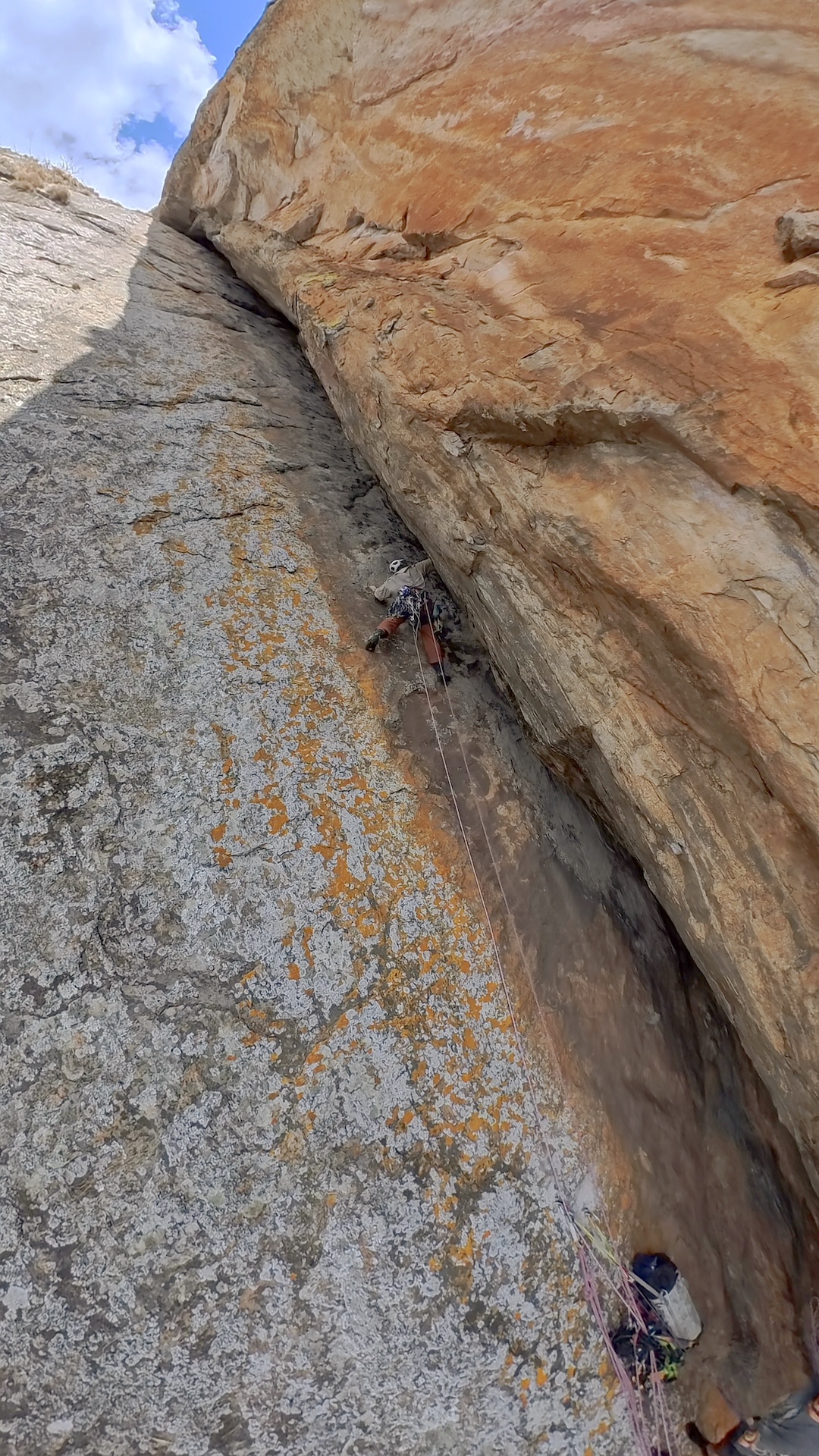
To this point, the hardest pitch had been 6b, but the next one was a real bear. Not only was it nearly vertical, but it also was covered in tussocks and cactus. I did my best to avoid both by hucking a difficult sideways dyno to a suspect jug. While I did manage to free the 70-meter pitch, I did so by yarding on trees and diving into a chossy chimney.
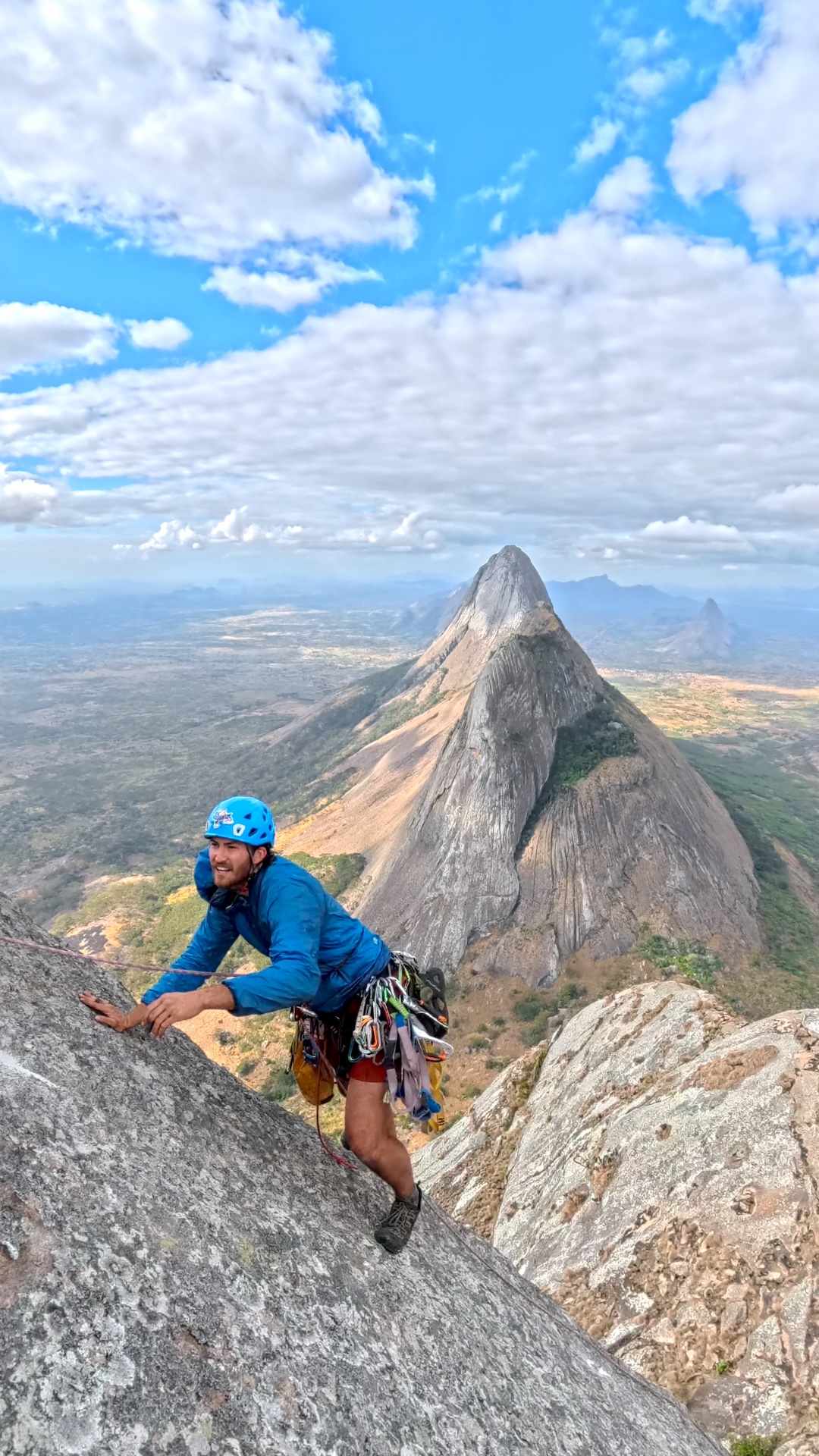
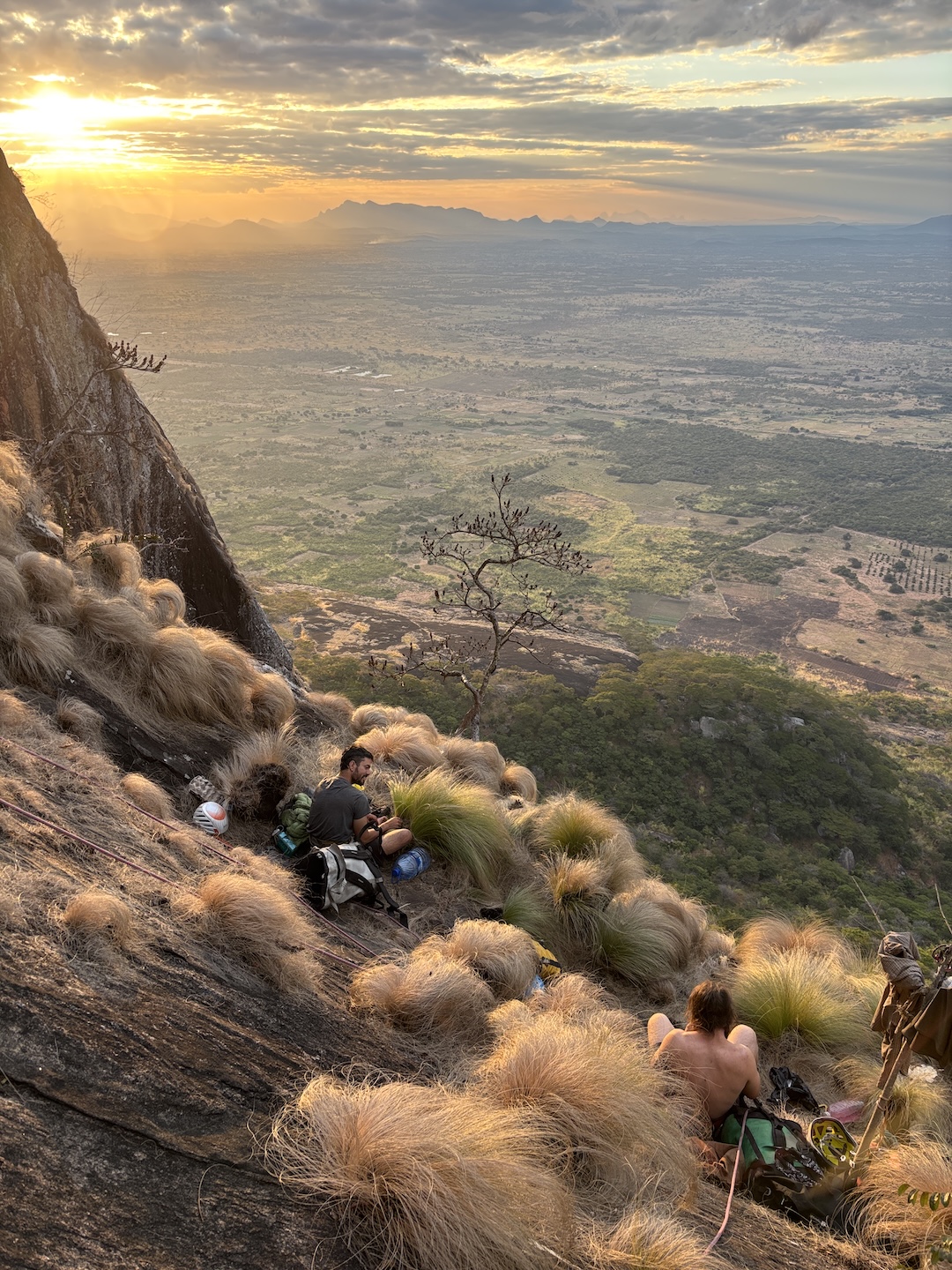
Then it was young gun Owen’s turn to get us out of that dirt hole I had dug us into. He jammed, squeezed, and thrutched through dirt and cascading millipedes to escape the chimney and get us back to clean rock. Next, Bosco got an easy money pitch, traversing 30 meters of clean 5a under a roof. That day, we fixed a total of 200 meters of rope and rappelled back to the Falcon Roost Bivy, where we enjoyed another incredible African sunset casting amber beams over the plains and distant domes.
Day five was the summit push. It was Bosco’s turn to get a rough pitch, as he had to weave and crawl around trees, traversing a jungle sidewalk for 60 meters. Otherwise, the last 225 meters were mostly on clean rock, romping up 5c terrain. The grand finale came as we pulled onto the narrow ridge leading to the north summit. After days of being on a vast slab, the exposure of a huge drop to either side was wild. The summit itself was so small, compared with the rest of the mountain, that it was akin to topping out a tower. We high-fived, danced, and ate the most satisfying off-brand gummy worms I’ve ever had.
We were amazed at how good the route ended up being—it was just a shame that those few pitches in the middle were so hard, dirty, and awkward. On the way down, we discussed the option of coming back to straighten the line out of the dirty chimneys, remove vegetation, and add some bolts to eliminate wild runouts. As a team, we decided that, although the current state of tourism in Mozambique was bleak, it may not always be that way. Who’s to say that adventure tourism can’t someday become a valuable arm of the economy? We had already put in all those days building relationships with the local authorities. Why not continue that effort and set up our route so that it might be better enjoyed by future parties?
We planned four days to complete this task. But then we all came down with a severe stomach bug, after celebrating our ascent with soft-serve ice cream at the Dia da Vila festival going on in town. So instead of working on the route, we spent the first three days we’d set aside at base camp, withering away as everything we ate came out the back as clear water. I lost nearly 15 pounds.
Nearly out of food, water, and days on our visa, we had only a single day to finish the work and climb the variation pitches. We straightened three chimney pitches onto clean faces by adding bolts to the face and clearing vegetation. The sideways dyno remained, but when I roped up to complete the new variation, the jug exploded in my hand, sending me for a nice whip. What remained was a sidepull about a pad and a half deep. After a few tries, I was able to make it work. It’s hard to estimate the difficulty, given how ill I felt, but I doubt the dyno or the following crux sequence is harder than 7a+ (6c obl.).
In the end our route, Capulana (725m, V 7a+), is quite approachable for adventurous climbers, with 17 pitches of mostly 5b to 6a climbing, generally on well-protected, clean slabs. There are some casual runouts on 5b and easier terrain. Only a light rack of single cams to a No. 5, 12 quickdraws, and two 60m ropes are needed. Every belay and rappel is bolted (tat will be useful for replacing rap gear). The approach from the nearest paved road is three kilometers with 388 meters of vertical gain, and only the last half kilometer requires bushwhacking.
Future parties climbing here or anywhere else in Mozambique are advised to communicate with immigration, tourism administrators, and police in a top-down fashion. For example, start with offices in a province’s capital, then the nearest city to the cliffs, and then the nearest village. Avoid even a hint of bribery.
We chose the name Capulana in homage to the ubiquitous cultural garment of the women of Mozambique. They’re used as dresses, to carry goods, and to show an individual’s heritage, and nearly every Mozambican was carried in one as a child. Plus, Owen used one as a sleeping pad every night, including while on the wall.
This was a big year for big walls in Mozambique—an Italian expedition climbed three new routes in another part of the country soon after we finished ours (see report here)—and we hope there will be many more years like this in the future. We’d like to thank the administrators, police, and people of Nampula, Malema, Namacuna, and Cuamba for giving us their time, consideration, and trust.
Future teams should have a much easier time than us, provided they come equipped with the lessons we learned. Speak Portuguese. Follow the proper administrative channels from the start. Be aware they will scan your social media channels to corroborate that you’re there for climbing and not mercury mining. Haggle with everyone: They are charging you double. Don’t walk through the “mad beans.” Buy groceries in the city while you can. Have a small team or be able to afford a car and driver. People are staring only because they are curious. And most critically, do not eat the ice cream!
SUMMARY: First ascent of Capulana (725m, 17 pitches, V 7a+) on the north face of Malema One (1,272m), Nampula Province, Mozambique, by Bosco Bonilla (Spain), Owen McGinness (USA), and Dakota Walz (USA), over five days in July 2025.
ABOUT THE AUTHOR: Dakota Walz is an American climber and first ascensionist focused on remote exploration across the globe. He documents these expeditions through journals, self-published work, and visual media, blending adventure with thoughtful observation.
Following this expedition, Walz researched and designed Moz: Rock Climbs of Mozambique, a 68-page guidebook, available to download at Dakotawalz.com.
Media Gallery