Crevasse Fall — Fall into Crevasse
Washington, Mt. Baker, Squak Glacier
On May 23 at 3 a.m., my longtime friend Daton Nestlebush (26) and I, Manny Pacheco (27), set out to ski Mt. Baker via the Squak Glacier route. I’m experienced in ski mountaineering and crevasse rescue and hold an AIARE Level 1. Daton at the time had limited high-alpine experience—this was his first time on a glacier attempting to summit a Cascade volcano.
Our team had thinned from four to two, but I consciously accepted the risk of glacier travel with an inexperienced partner on a familiar route. At 5:15 a.m., we arrived at the toe of the Squak Glacier and put on harnesses. I quickly taught Daton how to bury a picket and fix a rope to it—the minimum skill needed for self-rescue in a crevasse fall.
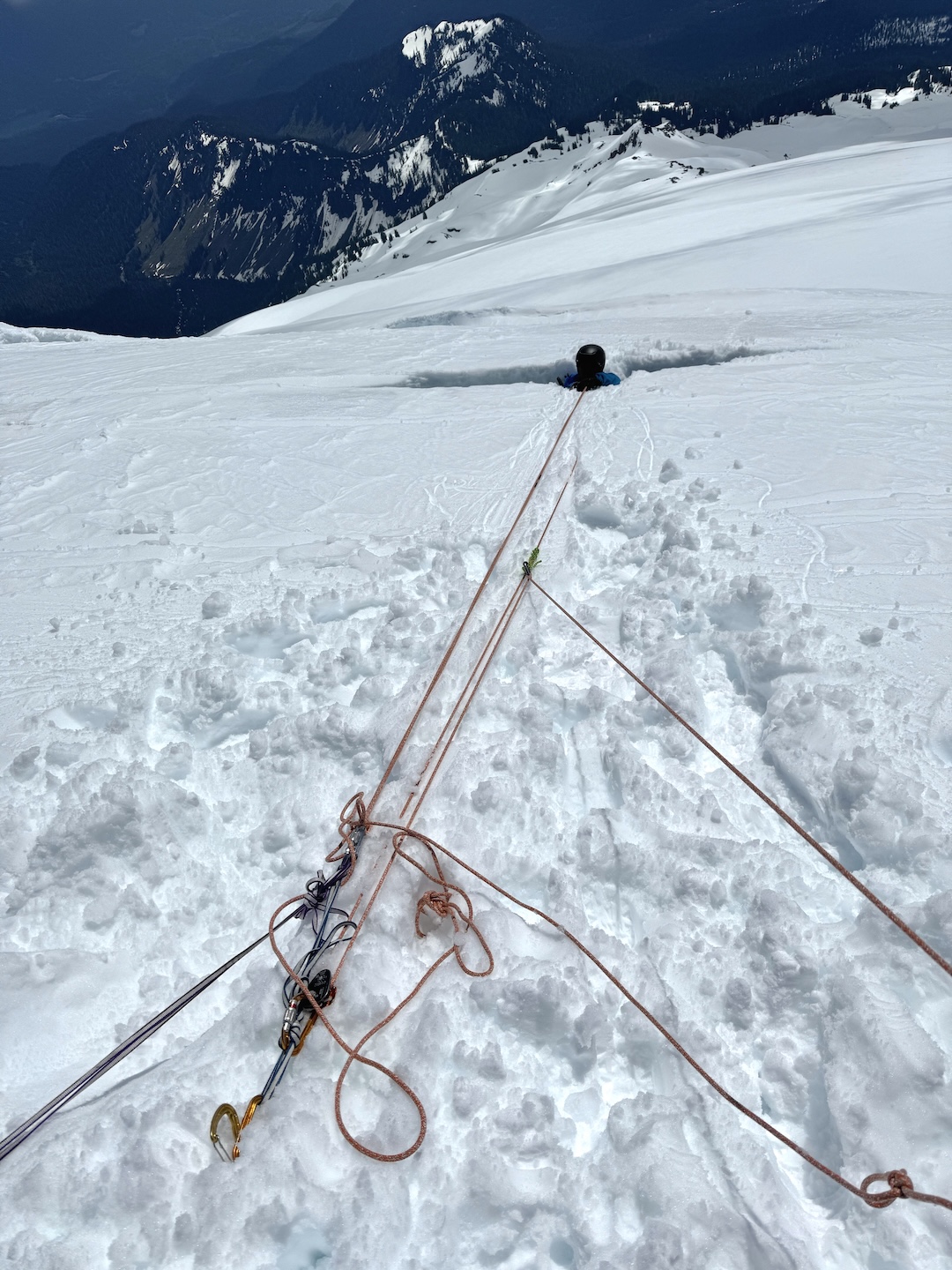
We reached the top by noon and skied back onto the Squak Glacier. At 1:15 p.m., at 7,950 feet, I stopped when I saw large crevasses 100 feet ahead. I radioed Daton to pass above me, and we began a 300-foot descending traverse to bypass the hazardous convex terrain. As I followed, Daton collapsed a thin snow bridge and dropped into a large crevasse. He raised his arms into a T, catching himself between the uphill and downhill lips. I immediately redirected, stationing myself 20 feet uphill and probing for crevasses with my pole. I told him not to move and that I’d throw him a rope in 60 seconds. My immediate goal was to anchor Daton, who was holding himself up primarily by rapidly fatiguing arms while the rest of his body levitated above a 60-foot-deep crevasse.
I made a trench with my ice-axe adze, buried a picket deadman-style one foot deep, and backfilled. The late-spring snow was perfect. I attached a figure-eight on a bight to the picket and, in a split-second decision, tied another figure-eight on a bight 20 feet from the anchor. I threw the loop to Daton, who grabbed it with his right hand. I knew the clock was ticking but stayed methodical. Slow is smooth, and smooth is fast.
As Daton committed to letting go of the uphill lip to clip into the knot, I attached myself to a figure-eight on a bight on the rope, becoming a secondary piece to the anchor. After what felt like ten minutes but was probably 30 seconds, Daton had dropped a couple of feet clipping in and shouted that he was attached and fully weighting the system.
I buried my ice axe deadman-style and connected it to the picket with a double sling, making a masterpoint. I took myself out of the system and reconnected with an extended prusik. The weight transfer lowered Daton another few inches; his head was now five feet under the surface. I yelled that he was going to be okay and to give me several minutes to set up a haul system.
I rigged a 3:1 haul system and threw the rope end down for Daton to clip to his belay loop. A curveball: There was likely a secondary crevasse between the anchor and Daton—I’d crossed it and didn’t want to risk falling in—so I couldn’t prepare the lip. I placed a Micro Traxion on the masterpoint and a prusik on the load line, clipped the redirected load line to my belay loop, and told Daton to expect to be raised. After double-checking the system, I bear-crawled uphill until the prusik had to be reset. A 3:1 with friction meant I was pulling 100 to 120 pounds. Bear-crawl, reset prusik, repeat.
Daton’s face appeared above the surface, but progress halted as the haul rope cut into the lip. I threw him the original rope end to clip to his pack, then told him to free a foot from the board and use it with the fixed rope to leverage himself up. With a free foot, no pack weight, and a handline, Daton climbed out.
ANALYSIS
Regardless of how “chill or filled” a glacier appears, an unlucky pressure point can create a nightmare scenario. The snow bridge was intact until it failed. Only then did it expose the hidden crevasse below.
Fortunately, Daton was in front of me and I had a visual on his fall. Had I been leading, I might not have noticed immediately, dramatically slowing reaction time. We also got lucky that Daton was the one who fell. Had I fallen and lost consciousness, we would have been relying on nearby skiers. It was critical that Daton held his position while I set up a fixed line. A 60-foot fall to the crevasse bottom would have meant potentially fatal injuries and a rappel into the depths.
In retrospect, I should have stopped Daton before he passed me. Had I looked at our position before reaching the convexity, we could have bypassed it entirely. I was caught up in the skiing.
The underlying purpose of this report is to encourage anyone recreating on glaciated terrain to gain competency in crevasse rescue. Take a course. Ski with knowledgeable mentors. Refresh these skills annually. Had I not done so, the outcome here would have been very different. (Source: Manny Pacheco.)
Watch a great Prescription video of this rescue, filmed by skier Manny Pacheco and analyzed by Jason Antin:
Media Gallery