
Fatal Fall
Canada, Alberta, Banff National Park, Moraine Lake
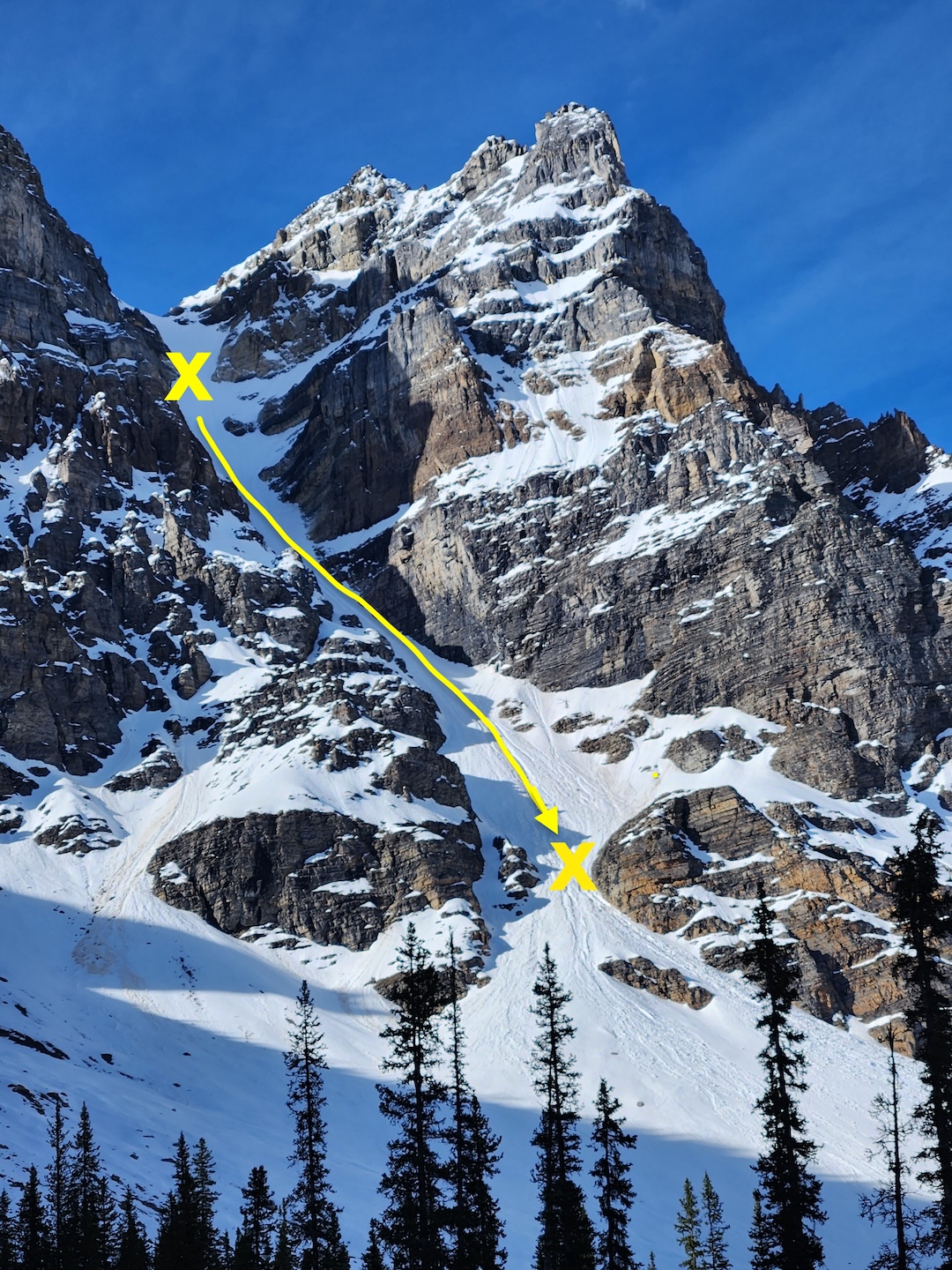
On May 27, three experienced local skiers departed early in the morning to ski the 3/4 Couloir at the back of Moraine Lake. All members were familiar with the area, and though they had looked at the couloir for many years, they had not yet skied it and were excited for the descent.
Staff at Moraine Lake Lodge observed the group’s progress. The morning weather was clear/cool, and the snow’s surface conditions appeared favorable. Although daily avalanche forecasting had concluded for the season, the regional hazard was set to Spring Conditions (firm and stable, though hazardous slip-and-fall since it’s harder to self-arrest). By 7 a.m., the team was ready to ski down. Their plan was to ski the couloir in controlled pitches, descending singly, while maintaining communication via Family Radio Service (FRS) radios.
After the first pitch, they regrouped beneath a rock band. Skier 1 then descended the longer second pitch, stopped on the side, and radioed to Skier 2 to begin their descent. Shortly after starting, Skier 2 fell and lost control. They fell for approximately 600 meters, coming to a stop in a deep snow runnel surrounded by chunks of old avalanche debris.
The fall was witnessed at Moraine Lake Lodge, where onlookers immediately called 911. The two remaining skiers descended quickly to their partner and found them unresponsive but still breathing. Within a short time, the injured skier stopped breathing and the partners began CPR.
At 7:24 a.m., Parks Canada Visitor Safety initiated a rapid response with Alpine Helicopters, Lake Louise Fire, and Banff EMS. STARS air ambulance from Calgary was also dispatched. Rescuers landed near the scene, long-lining the patient to a staging area. After assessment, the patient was pronounced deceased.
ANALYSIS
This group demonstrated strong planning, experience, and appropriate use of travel techniques, including early timing to minimize exposure to warming-induced avalanche hazard and descending one at a time with radio communication. However, steep couloirs such as the 3/4 Couloir present unavoidable fall consequences where even a minor loss of balance can result in a long, uncontrolled fall. In this case, the terrain turned a severe initial fall into a fatal fall.
While hazard management related to avalanches was well executed, the inherent risk of no-fall terrain remained the critical factor. Skiers in similar environments should carefully evaluate not only snow stability but also the consequences of a fall, and consider whether conditions, equipment, and personal margin allow for the extreme terrain. (Source: Parks Canada.)
Media Gallery