
Knee Stuck In Crack
Canada, British Columbia, Bugaboo Provincial Park, Bugaboo Spire
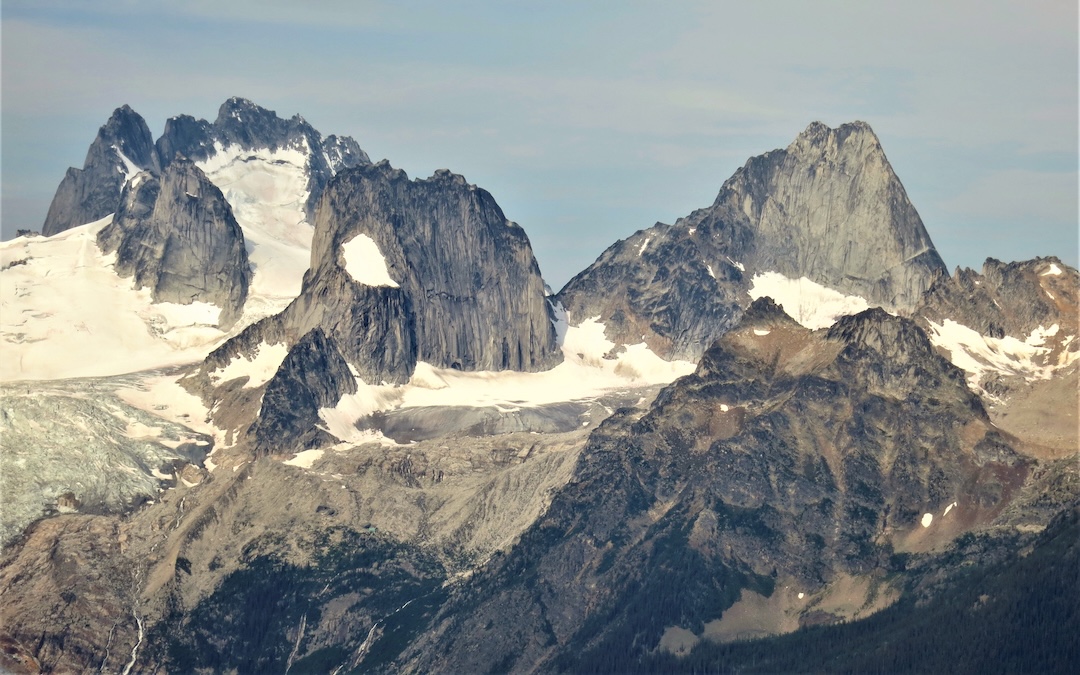
I, Nicholas Moline (26), and William Loopesko (38) were on our first trip to the Bugaboos, after having spent months prepping and scouting. As the forecast developed, we dialed back to a single objective: the Kain Route (4 pitches, III 5.6) on Bugaboo Spire. The Kain Route is the standard descent for all routes on the spire, including the 5.8 Northeast Ridge, which we hoped to do next. Familiarizing ourselves with the Kain Route made sense.
On July 18, a weather window opened. We made good time in the morning, passing most of the parties that had started ahead of us. The skies had scattered clouds and afternoon storms looked likely, but nothing of immediate concern.
We roped up for the crux Gendarme pitch, and I took the lead. The start of the climbing looked straightforward—maybe 5.4—and I set off without placing any gear. Twenty to 30 feet above the belay with no protection in yet, I encountered a section where the holds disappeared and the ramp formed a No. 5 Camalot crack. I had cams up to a single No. 3 Camalot, but I’d left my No. 5 at home. With no good placement available on a slick friction slab, and above a 2,000-foot drop, I made what seemed like a reasonable call: I thigh-jammed my left leg and began climbing using offwidth technique.
It worked until it didn’t. Somewhere in the crack, my knee got stuck in a constriction—I couldn’t go up or down nor rotate out. I tried every combination of movement for about 45 minutes. All I had for protection was a tipped-out No. 3 Camalot and a small BallNutz half-seated in a shallow crack.
Will was stuck at the belay 30 feet below, and, with no No. 5, I could not build an anchor. We were eventually helped by a climber from Spain named Julián, who happened to be rappelling the route. There was a language barrier, but he understood the situation. We tried stepping on my stuck foot to release my knee while pulling on Julián’s rope, with no result. Finally, Julián grabbed my pants behind and beside my trapped knee. Because the fabric was stretchy, this began forcing my knee into the tighter pinch at the outer edge of the crack—through the constriction. The pain was significant. At one point he stopped, worried he was making it worse. I needed him to keep going, saying, “¡Si, si!”—the only Spanish I had. A few tugs later, my leg popped free.
A quick self-assessment showed the leg was still functional—just some abrasions and swelling. We bailed, and it began pouring rain before we reached the glacier, hours ahead of the forecast—I couldn’t help thinking about what a different kind of rescue it would have been without Julián’s help.
ANALYSIS
Most of what I took away are the things that went in our favor: We dialed back our ambitions to account for the short weather window. We carried a first-aid kit, and later, as we bailed, I loaded up on Tylenol and ibuprofen to reduce swelling for the exposed descent and knife-edge traverses. And we packed emergency supplies to prolong potential survival time.
Getting stuck in an offwidth crack is not uncommon. The only way to eliminate that risk is to not climb offwidths, though some routes require it. If this had happened while cragging at Vedauwoo or Indian Creek, it would almost seem normal. Being in the big mountains with weather, exposure, and remoteness made it a potentially serious situation. A No. 5 Camalot could have helped in that crack, too, and would have given me a closer protection or anchor point to rest on while I tried to free myself. Don’t leave the big gear at home. (Source: Nicholas Moline.)
Media Gallery