Amputated Thumb — Loose Boulder
Canada, British Columbia, Glacier National Park, Rangers Pass, Uto Peak
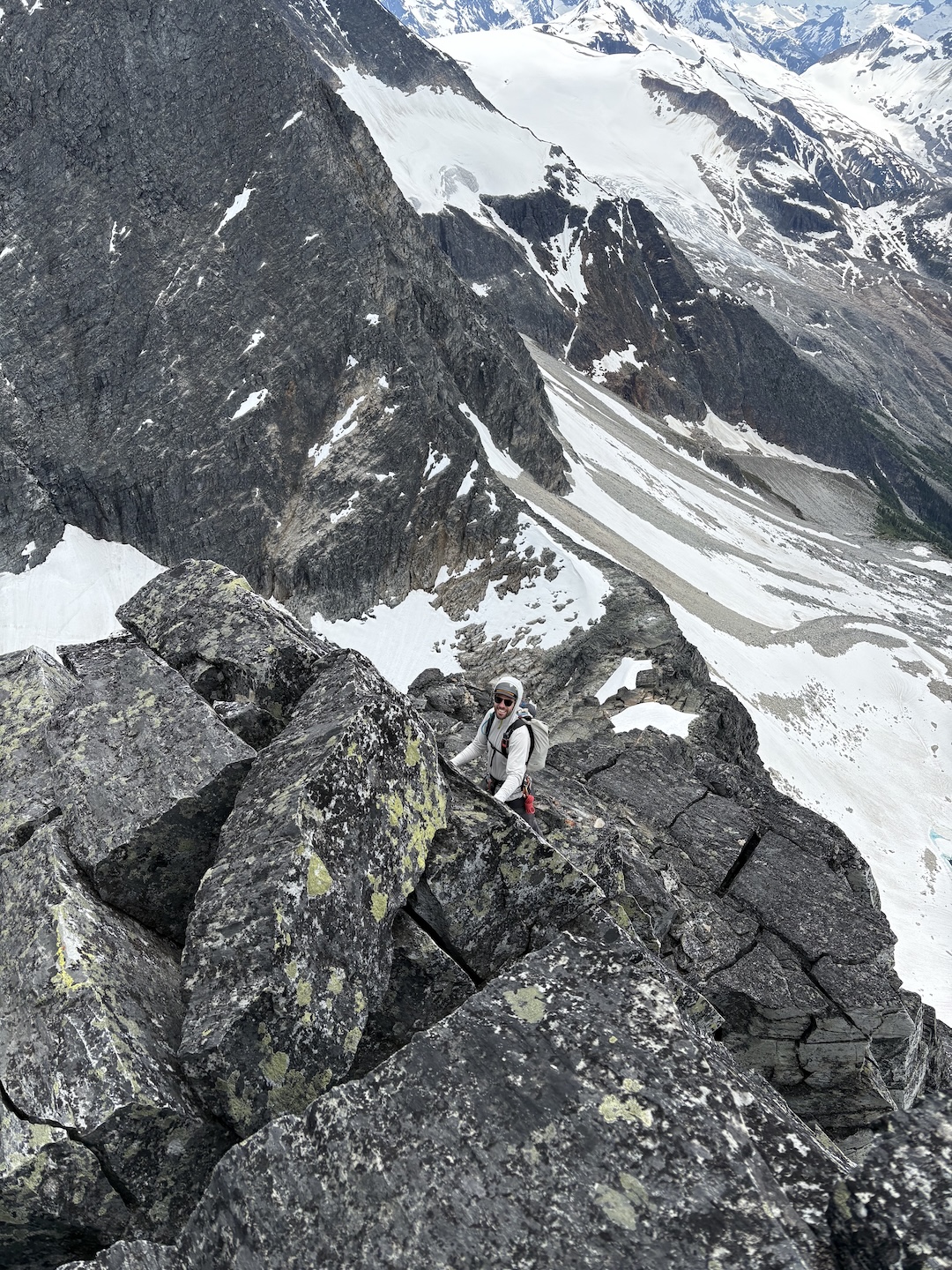
On July 5, Taylor MacLean (early 30s), Jon Goddard (early 30s), Xavier Corbeil (early 30s), and I, Matthew Speirs (25), set out to scramble the Southwest Ridge of Uto Peak in Glacier National Park. All of us had alpine experience, ranging from beginner to intermediate level. We had been discussing alpine objectives and settled on Uto—about 400 meters and either fourth class or 5.1—as within our ability. We brought a rope and harnesses primarily to rappel sections of the descent, with a plan to scramble/group-solo the climb.
While approaching the Uto-Sir Donald col, we encountered steep snow. None of us had brought ice axes, and we’d left our trekking poles at the campground. Existing steps crossed the slope, but a slip would have been serious. We discussed it as a group and agreed to use the steps, crossing without incident.
Partway up the climb, some members grew uncomfortable with the exposure but wanted to continue unroped nonetheless. About three-quarters of the way to the summit, we stopped to eat and drink. Looking at what remained, I thought we were through the crux, so we continued.
I followed the first climber; higher up, I crossed a three-foot-wide shelf with a significant drop-off to the left. As I reached the end of that shelf, a boulder to the right began to slide rapidly toward me, sped up by loose gravel that acted like ball bearings. I remain unsure if I pulled on or bumped into the block, which was roughly rectangular and about a foot and a half tall by four feet long.
I turned toward the boulder and put my hands out. My right hand was caught underneath it. As it continued sliding, I was able to pull my hand free. My right thumb had been nearly severed—hanging from a small strip of skin. I grabbed it in my other hand. Someone shouted to me to get clear; as I stepped back, the boulder went over the edge and fell hundreds of meters to the base of the mountain.
We moved to a flat area where my partners wrapped the wound. I put on extra layers and got into a bivy sack. We activated the inReach, and then discovered we had cell service to call for help. SAR determined I could not descend on my own and initiated a helicopter evacuation. On SAR’s advice, two of our team began descending so the helicopter would not need to extract all four of us. The helicopter arrived an hour and a half after our call, and the SAR responder, the remaining team member, and I were long-lined off the mountain. We were flown to the highway and a waiting ambulance. A storm moved in shortly after we landed, and the two members of the team who’d downclimbed were caught in hail on the hike out.
ANALYSIS
The primary mistake was mine: I did not test the boulder before moving past it. I had been checking for loose rock throughout the climb but grew complacent once I believed we were past the technical crux. I also assumed that a well-traveled route would have less loose rock—a reasonable assumption, but one that didn’t account for early-season freeze-thaw cycles. Later in summer, traffic and weathering clear much of the loose rock, but the combination of unfamiliar terrain, early-season conditions, and reduced vigilance teed up the accident.
We did several things well. All four of us wore helmets. We carried jackets and a bivy sack—a SAR responder noted that we were unusually well prepared for an accident at altitude. Communication within the group was consistent throughout the day. The decision to have two partners self-evacuate reduced the rescue footprint. The inReach was a useful backup, but cell service sped the response.
Crossing the early-season snow on the approach without ice axes carried a real consequence. While we assessed the hazard and made a considered decision, the calculus would have been different without steps in place. Carrying an ice axe or at least trekking poles for the approach is worth the weight. (Source: Matthew Speirs.)
Media Gallery