
Leader Fall — Broken Hold, Ledge Impact
Canada, Alberta, Banff National Park, Mt. Temple
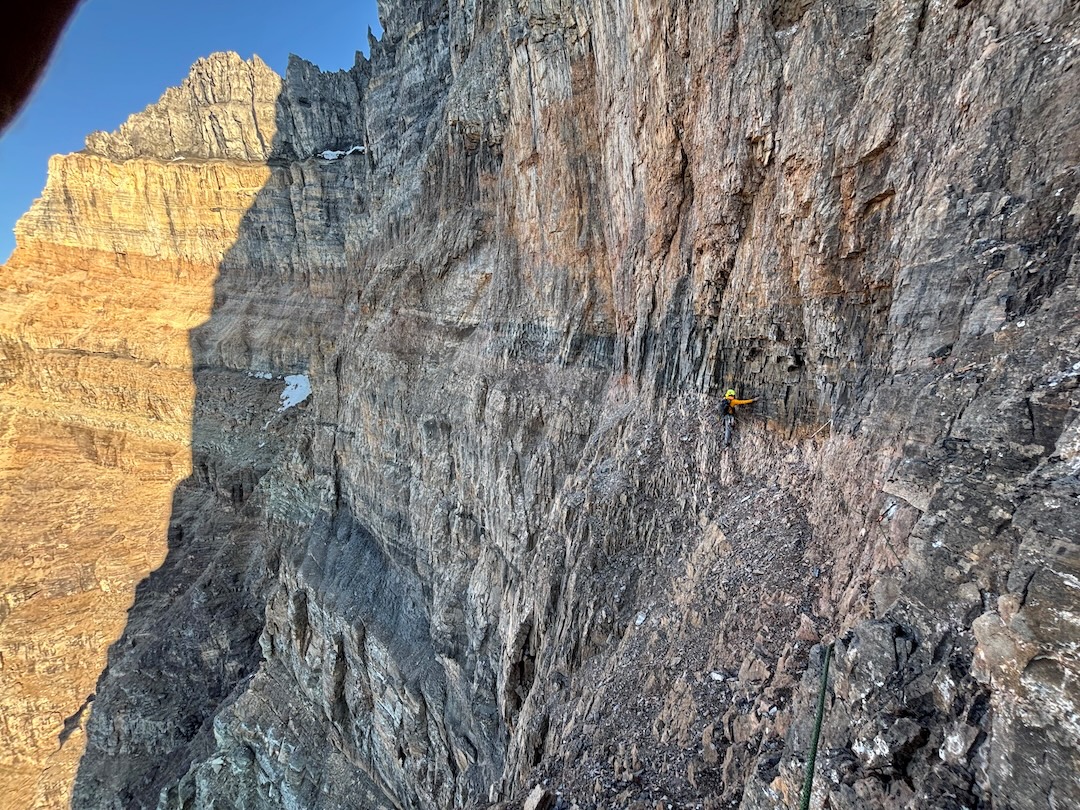
On August 24, a party of two was climbing the Greenwood-Jones (V 5.10) on the north face of Mt. Temple (3,544m). Five pitches below the top of the technical climbing, the leader broke a handhold and fell roughly five meters onto a small ledge. They sustained a broken ankle and significant bruising to their leg.
The leader attempted to build an anchor on the ledge but could not find reliable placements despite carrying pitons and a full rack. They were also uncertain whether the piece that had caught the fall—a cam placed a few meters below the broken hold—was trustworthy enough to lower from. While the leader worked the anchor problem, the belayer called for help by cell phone, and Banff Visitor Safety responded.
Overhanging rock above the rescue site blocked direct helicopter long-line access to the injured climber. The rescue team thus inserted at the top of the next pitch and traversed into position above the patient. This was a time-consuming approach. After the team established a bolted anchor, one rescuer was lowered to and secured the injured climber to the rescue system. Both were lowered approximately 50 meters to a rock outcropping accessible by long line. The patient and rescuer were flown to the staging area, followed by the belayer and a second rescuer. The patient was flown to Banff just before dark.
ANALYSIS
The Greenwood-Jones sees relatively few ascents each season, which means that holds receive less traffic testing than on popular routes. The leader checked the hold before weighting it and was surprised when it broke. Broken holds on Rockies limestone are an inherent hazard, not a product of inattention. They are more common on lightly traveled alpine rock routes; on such terrain, place protection frequently and treat all holds as provisional.
The leader noted afterward that time pressure influenced their movement on the steep section. They felt behind schedule, fatigued, and had not found water as expected. These are familiar contributors to accidents: Fatigue, dehydration, and urgency erode judgment and reduce the physical margins that make climbing manageable. Clearer communication with the belayer before committing to the crux move might have reduced the fall distance.
Several things helped the outcome: The solid cam placed just below the broken hold limited the fall to five meters. Both climbers carried cell phones and satellite devices, and called for help promptly. A VHF radio, while unable to reach dispatch directly, allowed communication with the helicopter on scene. And the team had chosen a stable weather window and carried overnight gear, though, fortunately, favorable conditions made it possible to complete a technical rescue just before dark. (Source: Parks Canada.)
Media Gallery