

Leader Fall — Dislodged Rock
Wyoming, Snowy Range, Medicine Bow Peak, Little Diamond
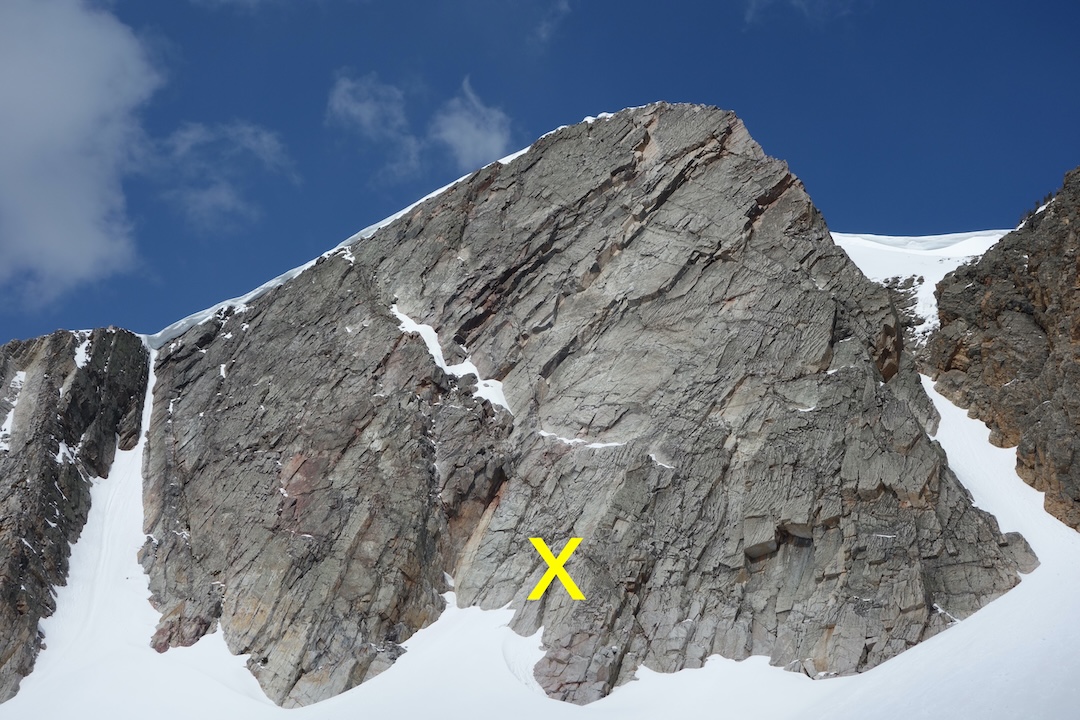
On July 9, Justin Bowen (32) and I (Mark Jenkins, 66) intended to climb Captain Morgan, a five-pitch 5.10+ runout route on the “Little Diamond” of Medicine Bow Peak. Author and climber John Harlin and I had put up the route 30 years ago, and as far as I knew, it had never seen a second ascent.
The Little Diamond is a 600-foot wall at 11,000 feet and composed of very dense, fractured quartzite. Rockfall is common, thus this small wall sees few ascents. The redoubtable Ray Jacquot (first ascent of the Black Ice Couloir and Tower One Gully in the Winds) wrote the first guidebook in 1970, which chronicled all the known routes, many of which Jacquot put up himself. I first climbed the Little Diamond in the late 1970s and started putting up routes—ranging from 5.9 to 5.11—in the ’90s. Although low angle, the rock is exceedingly slick, so careful edging is the name of the game.
Justin and I did the half-hour approach and traversed the steep snow to the base of the wall. We began delicately kitting up while balancing on the slippery lip of the bergschrund—a 15-foot-deep hole between the rock and the snow. I started leading on easy terrain at about 8 a.m., with Justin belaying well off to the left out of the fall zone. Some 25 feet up, I encountered a refrigerator-sized, one-ton block of quartzite directly above me. I tested it, banging it hard with both hands, but it didn’t budge.
When I reached for its square-cut edge and pulled up, to my horror, the block groaned ominously, then pulled out. The block and I began to fall through space. When I hit the ground, one foot plunged into the snow, the other foot smashed onto a ledge. I then fell a further 15 feet into the ‘schrund. Miraculously the block slid off to the left and did not come down on me. Instead, it lodged in a precarious position right above me. I managed to drag myself out of the fall zone, then Justin tried to push the block off with his legs but it was too heavy. He then rapped down on rock gear into the ‘schrund. Now we were both below this death block.
Justin worked swiftly, kicking steps up the snow wall of the ‘schrund, which I ascended like a ladder, using both hands, one foot and one knee. Once I was out of the ‘schrund, Justin lowered me down the 200-foot snow slope to the talus. He gathered the gear and came down to me. He had an inReach but I refused to use it. I knew my injury was serious, but I also knew we could self-rescue. Over the next three hours I crawled and crab-walked to the car holding my mangled foot in the air. Justin carried all the gear and helped me ford the river.
We were in the emergency room in Laramie an hour later. X-rays revealed that I had shattered my heel bone. The swelling was so severe I had to wait two weeks for surgery. It took a plate and ten screws to put Humpty-Dumpty back together again. I wouldn’t walk for months. It’s been almost a year now and I’m back to biking and hiking, but I still can’t climb.
ANALYSIS
I have ascended the “Little Diamond” over 50 times in the past four decades and put up many new five-pitch routes. I would describe the quartzite face as extremely chossy—one route we put up we named The Guillotine, another we named Dr. Kervorkian. Justin and I were both wearing helmets, of course, and we were using double ropes (in the past I’ve skinned open a half-dozen ropes on the razor-sharp features of the wall).
Although the grades on the Little Diamond are not difficult, the climbing is—runouts above micro-nuts and loose rock make the Little Diamond mentally challenging and also sketch. It is not a wall for novices or sport climbers. There are no bolts (descent is a half-hour walk-off to the south, so you have to carry approach shoes, puffy, windshell). To climb on the Little Diamond safely, you have to know how to multi-pitch on an alpine wall where the weather is unpredictable. I have been caught out in freezing rainstorms and many snowstorms.
Despite all the hazards, I loved climbing this wall—it prepared me for other alpine routes all around the world—until this incident. Unfortunately, the only way I could have avoided this accident was simply not to climb on the Little Diamond.
*Editor’s Note: For the less experienced, always test suspect holds by firmly tapping on them with your knuckles. A hollow sound is a warning. Prepare for alpine rock by bringing and knowing how to use the right hardware. Bring the right shells and insulated layers. Bring a satellite communication device. Wear a helmet. Most of all, take the time to learn the medium, the style, and the hazards. This might take years, depending on your ultimate goals. Do not depend on a technical grade to gauge difficulty. Grades misapplied over a variety of very different styles are a leading cause of accidents and fatalities. (Sources: Mark Jenkins and the Editors.)
Media Gallery