
Wasp Attack — Anaphylaxis
Washington, Little Si, The Woods
On July 23 at around 7:30 p.m., Ross Girshick (43) was top-roping Chode Castration (5.12a/b) at The Woods at Little Si. I (Jeni Jensen, 34) was belaying from a spot just downhill from the base. I stepped too close to a yellow jacket ground nest beneath leaf litter and moss, and without warning I began getting stung.
Yellow jackets swarmed and were stinging me everywhere. I lowered Ross safely—but unfortunately into the agitated swarm. We were both stung continuously while freeing him from his harness and then we ran to a nearby bench on the Little Si trail. By that time we’d left the wasps behind and were met by J.L., A.F., and several others who had heard our screams. We gave Ross 50mg of Benadryl and 1,000mg of Tylenol from J.L.’s first aid kit.
Ross was headed toward anaphylactic shock, though it wasn’t apparent at first. His trajectory was difficult to discern: He was light-headed, but alert, oriented, and effectively communicating that he was in extreme pain, but breathing well. J.L. was concerned about anaphylaxis, and we decided to evacuate Ross.
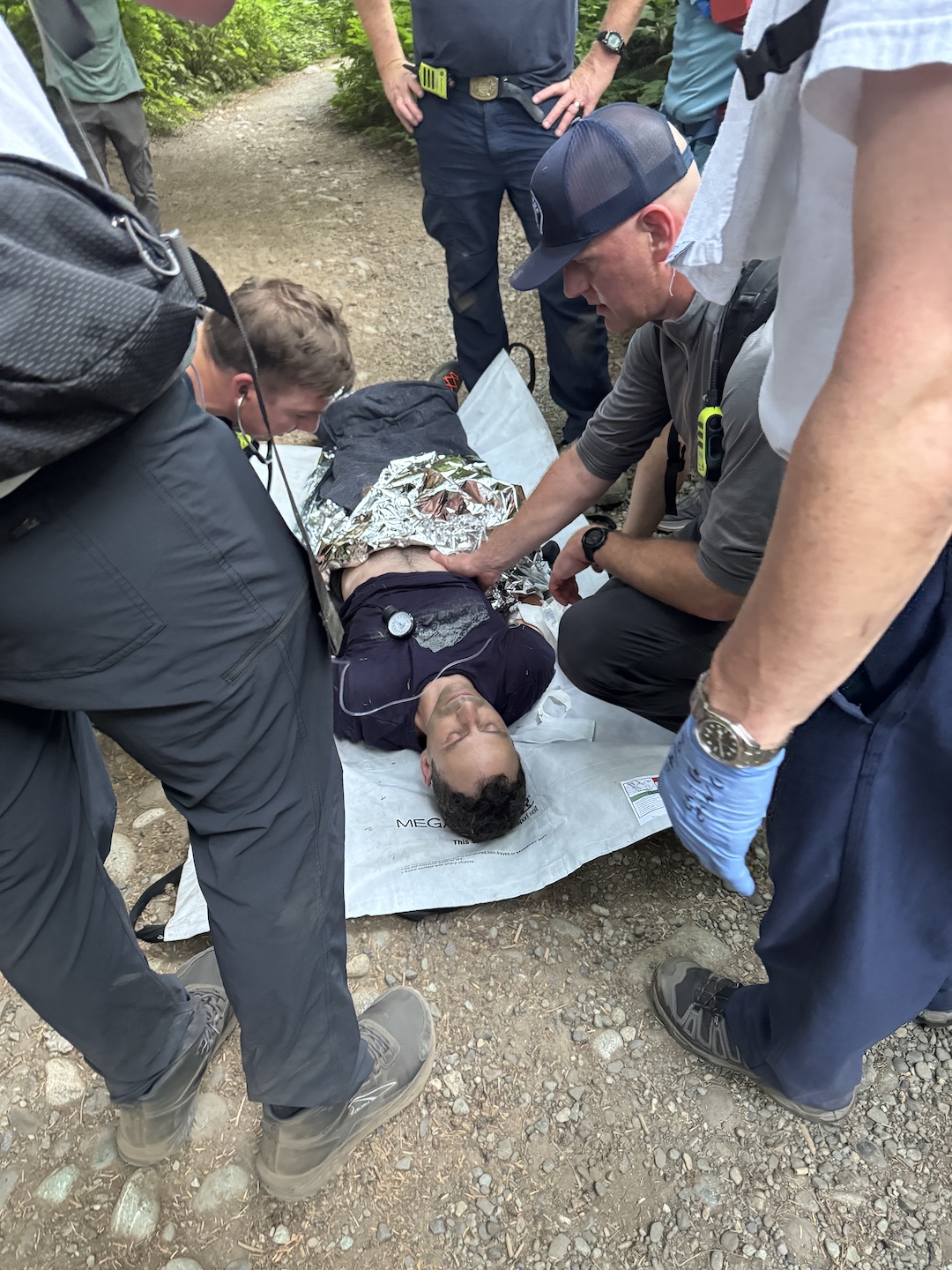
Six hikers and climbers stopped to help. They seat-carried Ross for a quarter mile. We were still a mile from the trailhead when he got worse, becoming confused and going in and out of consciousness. Though still breathing without issue, he reported a growing numbness in his upper lip.
North Bend fire crew met us 30 to 40 minutes after the 911 call. A quick set of vital signs confirmed extreme low blood pressure. They administered an EpiPen dose. Ross was carried out and required a second epipen 15 minutes later. After another quarter mile, Bellevue medics met us and placed an IV epinephrine drip. His blood pressure remained dangerously low. Seattle Mountain Rescue also met us and assisted with the carry. Ross was admitted to the ICU for IV epinephrine, fluids, and Benadryl.
Ross and I each had an estimated 100 to 150 stings. I had no allergic reaction. Ross had no prior history of anaphylaxis despite having been stung seven to ten times previously.
ANALYSIS
The belay area at The Woods is seldom traveled and obscured by leaf litter. These conditions make wasp ground nests hard to spot. Before settling into a belay at any crag, take a moment to inspect the ground, especially in areas off the main trail. If you need to run from a swarm, keep your first aid kit accessible—you won’t have time to grab your pack and find it.
A good outcome resulted from J.L.’s clinical concern and our decision to evacuate immediately. A person can go into anaphylactic shock with no prior history. We carried ropes, helmets, and first aid kits, but neither of us had EpiPens. Ross required the equivalent of six EpiPen doses to stabilize. If possible, carry multiple EpiPen, especially at remote crags, and know how to use them. Talk to your climbing partners about allergies and medications and share where your EpiPen is stored.
We also want to say plainly: Do not dismiss people running from stinging insects. A bystander told J.L. we were “just running from bees.” J.L. did not accept that, and today Ross is alive. (Sources: Jeni Jensen and Ross Girshick.)
Media Gallery