
Pendulum Fall — Poor Top-Rope Position
Virginia, Great Falls Area, Sandbox
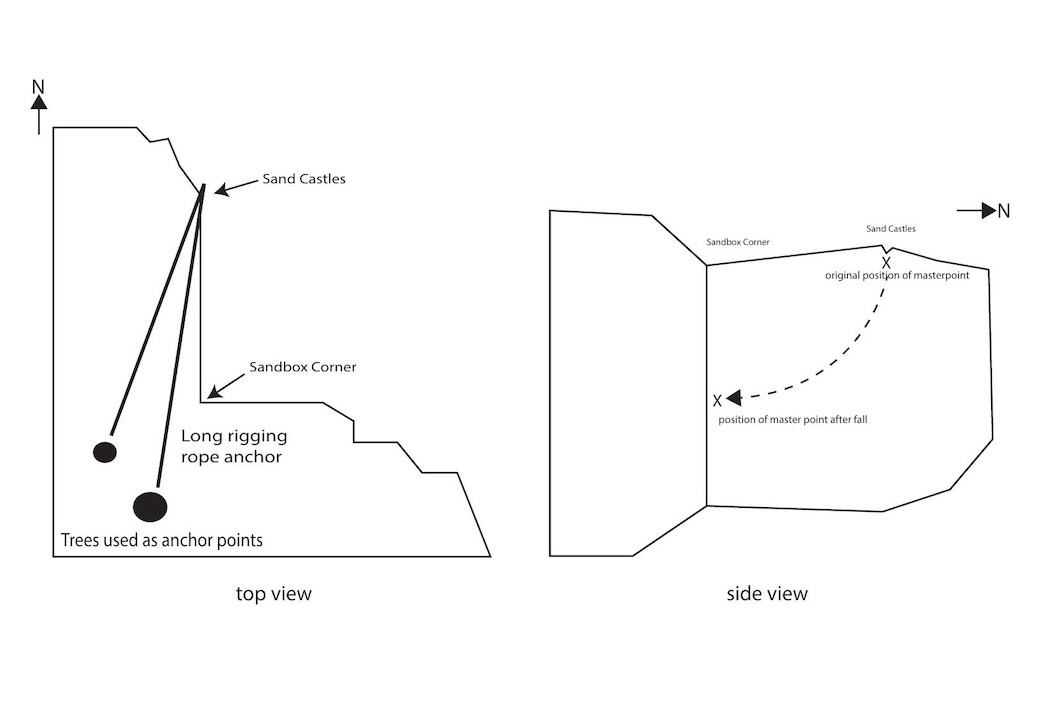
On June 8, I, Eunny Jang (40), was at the top of the Sandbox cliff pulling my ropes off Sand Box Corner (5.4) when I noticed a climber near the top of Sand Castles (5.6)—the arête 20 feet to my right. Earlier, I had watched that party climb and lower, and had noted their anchor: two trees 20 feet back from the edge, with anchor lines extending to a masterpoint lodged in a small V-notch that effectively prevented the anchor from sliding to the left. The setup was not ideal but not likely to fail when loaded from below.
My back was to the top of Sand Castles when the climber called, “Off belay.” The call was almost immediately followed by a scream and the sound of an impact.
I looked over the edge to see the fallen climber hanging about 20 feet below. He had clipped the masterpoint to his harness and leaned back, at which point the V-notch had released the masterpoint, swinging the climber leftward into the dihedral of Sand Box Corner. He complained of leg pain—I discerned a badly displaced fracture. He could not unweight the system, so I quickly set up a new anchor so I could fix a line and rappel to him. Having arrived at the cliff base, my partner Tim Murphy ascended a nearby rope and confirmed, as I’d observed, that the climber was connected via his belay loop directly to the anchor’s masterpoint.
I re-rigged to lower and sent a rope down; Tim clipped the climber in. I needed to haul from above to get the fallen climber off his top-rope anchor and onto my rope. After that, Tim lowered to the ground alongside the climber to keep his injured leg from contacting the rock.
First aid was rendered by members of both our parties, including a physician and two ER nurses. EMS arrived, first on foot, then by swift boat. The climber was evacuated by boat 45 minutes after the incident. He had sustained a shattered right leg.
ANALYSIS
At most mid-Atlantic top-rope crags, there is usually no fixed gear—top-ropes are typically clipped to long static lines anchored at or back from the cliff top using trees, boulders, or gear. This anchor had been set with a fundamental misunderstanding of the fall line and direction of load if the masterpoint migrated from the small rock notch. This V-notch had been adequate to hold the masterpoint in position while the system was loaded from below, but it was not adequate once the victim was level with the masterpoint and moving around. He had called, “Off belay,” and was clipped directly to the masterpoint when it released from the notch, swinging him 20 feet into the dihedral as the anchor line skittered along the cliff top. A more secure redirect like a piece of gear or a tie-off that pinned the masterpoint in place would have prevented this accident.
The climber seemed to be unaware of the concepts of extension and directional load in anchor design; topping out and going off belay also seemed outside his experience. Climbers should get instruction from a guide or mentor before venturing into unknown territory. (Source: Eunny Jang, AMGA Apprentice Rock Guide, Certified MPI, SPI Course Provider.)
Media Gallery