
Fatal Rockslide — Loose Rock, Scrambling Terrain
Utah, Little Cottonwood Canyon, One Peak Wilderness, Pfeifferhorn
On July 19, David Mull (49, Salt Lake City) started the Pfeifferhorn Trail from the Red Pine Lake trailhead just before sunrise, around 5:45 a.m. Two other hikers, Heather Hayes and her husband, Harland, an emergency physician, started just after 6 a.m.; they encountered Mull several times on the ascent. The goal for all parties was the summit of the Pfeifferhorn (11,326’) via the East Ridge, a class 3 alpine scramble.
Both Hayeses noted that the ground was damp and that some basketball-sized rocks embedded in dirt on the steeper sections seemed to shift more easily than on prior outings. All three reached the summit around 8 a.m. and briefly spoke about the views.
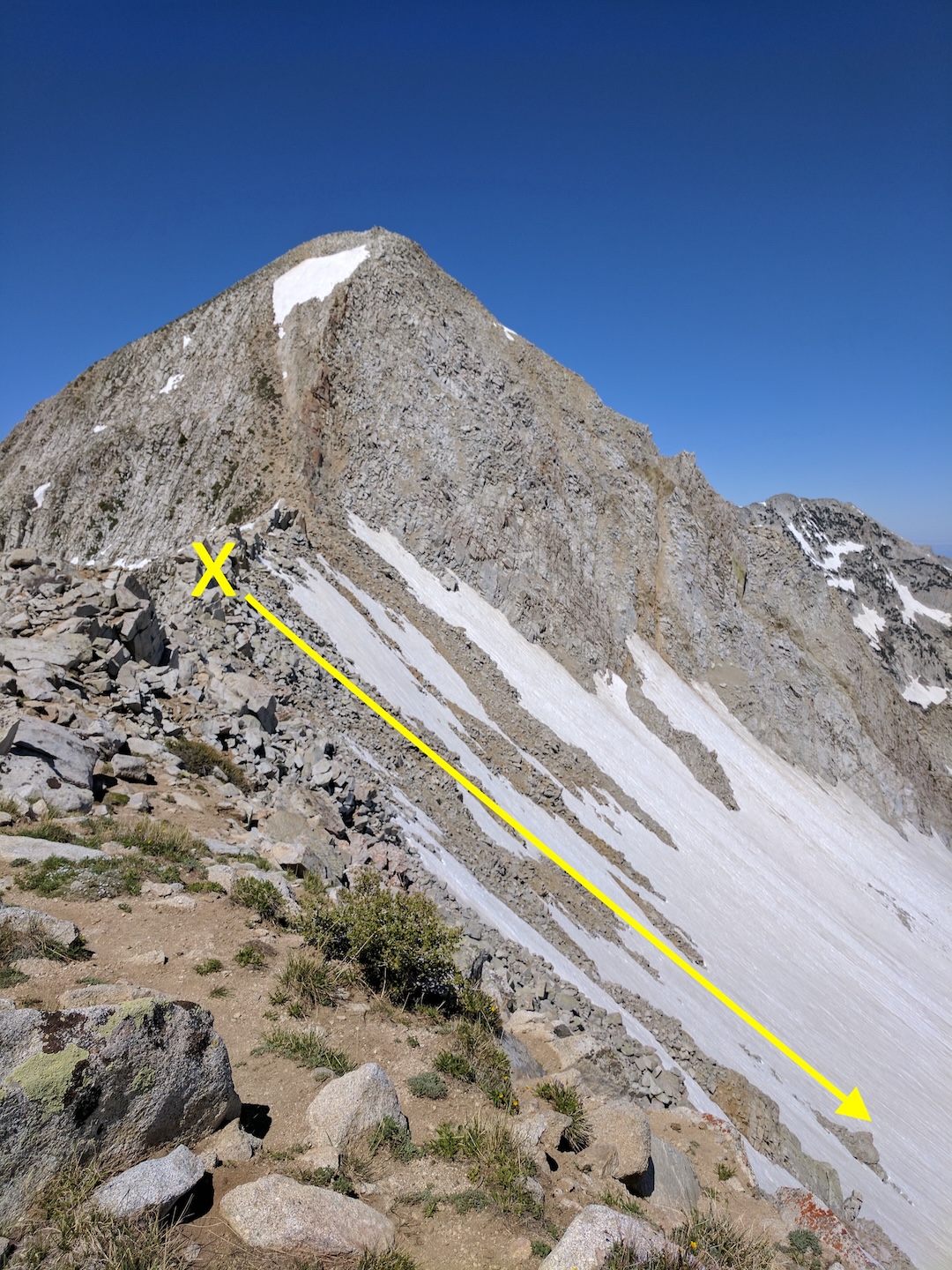
On the descent, the Hayeses downclimbed/traversed the third-class crux, a 30-foot knife-edge traverse that’s about two feet wide and connects the shoulder of the ridge to the summit. Crossing granite talus and boulders, it requires hands and presents a steep drop-off on both sides. They noted that some handholds and large boulders felt looser than usual.
As Dr. Harland Hayes wrote to ANAC, as they exited this section, they heard Mull yell something to the effect of, “Oh no, help!!!” The large boulder he was holding on to was dislodging. Wrote Hayes, “As he yelled and started falling, my wife turned toward him. He was probably only six or so feet away. He reached out for her, and she lunged for him but could not grab him…we did not realize he was literally right behind us.” Mull tipped backward, falling off-balance while clinging to a dishwasher-sized granite slab. The falling rock loosened surrounding boulders, triggering a cascade of debris that carried Mull 700 vertical feet down the slope, where he came to rest motionless.
Heather Hayes immediately called 911. Harland Hayes and a nursing student named Ben Adams, who had witnessed the accident from a separate vantage, descended the loose, moderately technical slope into the gulch. It took three to five minutes to reach Mull. He was alive but had extensive injuries, and within one to two minutes he lost his pulse and stopped breathing. After discontinuing CPR, Dr. Hayes recalled, “We heard yelling from the ridge above and could see five or ten boulders rolling toward us. We moved down the slope and had enough time to move laterally out of the line of fire, but it was clear it was not a safe location.”
A Utah Department of Public Safety helicopter arrived two hours after the initial fall and hoisted Mull off as well as extracted Dr. Hayes and Adams. Responding agencies included the Salt Lake County Sheriff’s Office, the Unified Fire Authority, and the Sandy City Fire Department.
ANALYSIS
Conditions are everything. The Pfeifferhorn via Red Pine Lake is an 11-mile round trip with roughly 3,900 feet of elevation gain. On a summer weekend, the route sees more than 100 people per day. The vast majority traverse the third-class crux section unroped and without incident.
Under normal conditions, a fall here would produce a sliding tumble of ten to 20 feet, rather than a fatality. Most people scramble confidently on a dry day and give it little thought. However, heavy rainfall the night before had loosened rocks, causing the large, catastrophic slide. Familiar terrain on heavily trafficked routes should be treated as potentially unstable. Holds that appear solid should be tested before weighting them. As Dr. Hayes experienced, an initial slide destabilized the slope and created a hazard for rescuers. (Sources: Dr. Harland Hayes, Salt Lake Tribune, and the Salt Lake County Sheriff’s Office.)
Media Gallery