Inverted Knee Jam — Stuck in Crack
Utah, Little Cottonwood Canyon, Lizard Head Wall
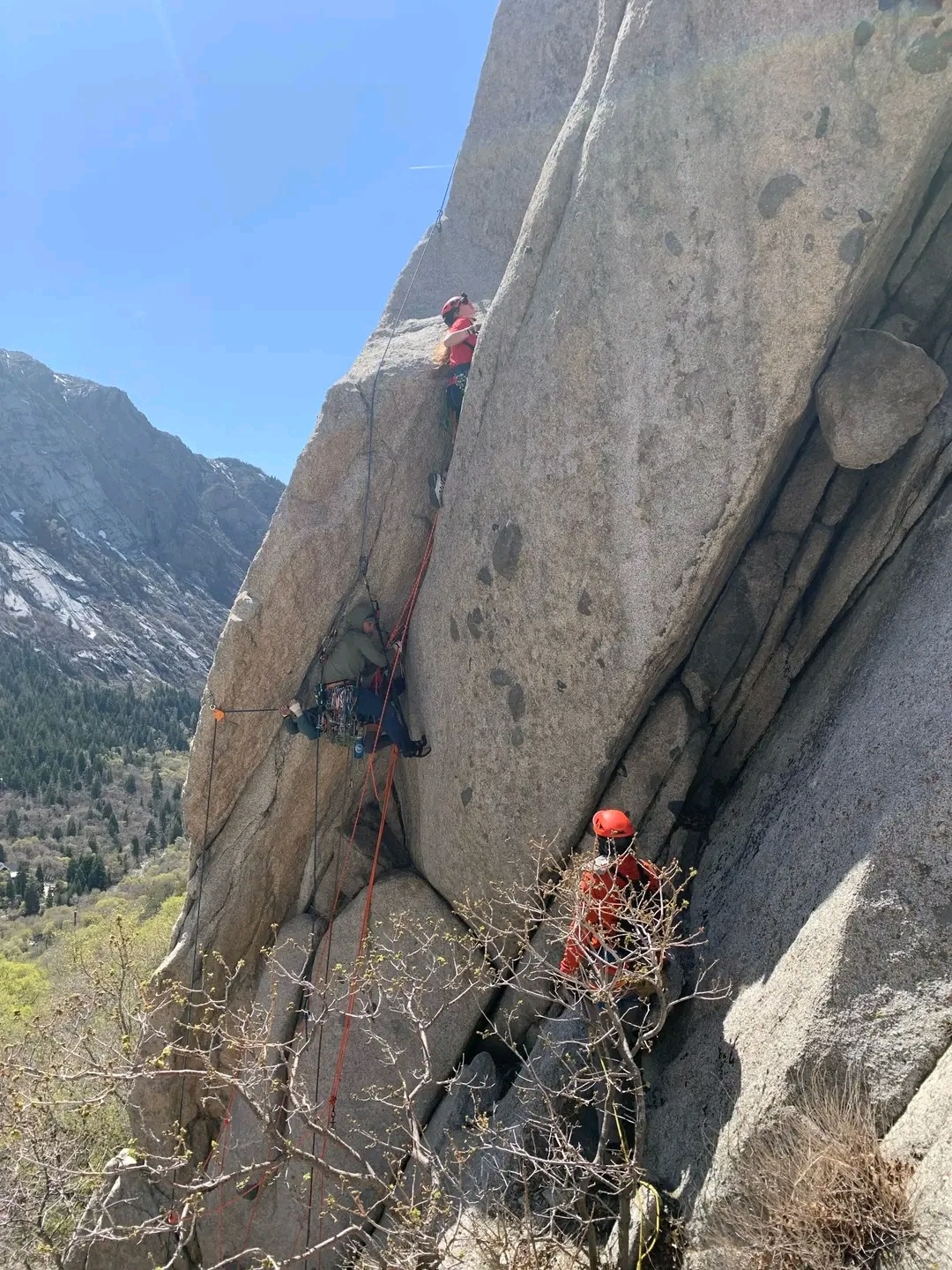
On April 13, Eric Newhart (31), our neighbor Neah, and I, Mike Ryan (28), climbed at Lizard Head Wall in Little Cottonwood Canyon. After warming up on Squeeze My Lemon (5.7), Eric led an offwidth called Cashmere Crack (5.11a/b). Where the crack went from hands to offwidth—about 30 feet off the ground—he inverted and sank his left leg and then right knee deep in the crack. The knee was bent at an acute angle with the ankle almost in contact with his butt. This technique expands the knee for a secure jam. In this case the jam was too secure as he struggled for a few moments and then became stuck.
My first thought: he’s upside down and if he stays in that position for long he’ll lose consciousness. I asked Neah to take the belay. Someone called 911 while I borrowed a rope from a nearby group and scrambled off to the side to see if I could solo to any anchors above. I couldn’t, so I rushed back down the gully and climbed Squeeze My Lemon on another party’s top-rope. I lowered off and redirected the rope through one of the protection bolts of Errant Edge (5.10a), just left of where Eric was hanging.
When I got to Eric, his face was purple, his eyes were bulging, and he was screaming. He had placed some bomber No. 3 Camalots in the hand-sized part of the crack just below. He cloved into the cams, fixing the lead rope and allowing Neah to ascend with a Grigri. Eric was pulling up on a tipped-out No. 4 Camalot while Neah pushed him up with her hands, trying to keep him from staying fully inverted.
The fire department and SAR arrived within 30 minutes of the accident. They started handing me gear: a second rope, a progress-capture pulley, a jumar, and an etrier. Neah descended out of the way. At one point, it felt like 30 people were shouting up directions. I stayed focused on Eric. SAR gave me two No. 6 Camalots, one of which I used as aid to get behind his knee. The Errant Edge bolt became the pulley point for the second rope, attached to a sling on Eric’s chest. Around then, I put an ascender on my lowering rope so I could hang and move around a bit more.
A SAR member named Darby figured out how to scramble to the Cashmere anchor about 40 feet directly above us. She ran a rope inside the chimney down to Eric. I clipped it to a sling I’d girth-hitched around his bent leg and ankle. This allowed her to pull his leg upwards, using a 3:1 ascender/descender/hauler device called The Clutch.
Now we had the fire department ready to pull Eric’s chest up from the ground via the Squeeze My Lemon anchor. Darby was at the Cashmere anchor pulling up on his leg, and I got ready to pull in whatever direction seemed useful. On my signal we began to gently test the system. The light pull caused Eric to scream in pain. I asked for pain meds, but the on-scene provider was hesitant to dispense due to concerns about his airway.
Someone sent up a Nalgene bottle filled with water mixed with dish soap. I lowered below Eric and used whatever space I had to start lathering his leg. I used up a second bottle and began cutting his pants with scissors from outside and inside the crack. After the third bottle, a Nalgene of motor oil showed up. I thought, Shit… alright, let’s give the dish soap one last go. I kept pushing soapy strips of cut fabric between granite and flesh, told SAR and fire to resume pulling—and his knee released.
ANALYSIS
I looked at Eric’s mangled, indented leg as they lowered him. His face was pale, and I could tell he was hurting. Once he touched the ground, SAR and medical personnel swarmed. Soon after that, a DPS (Department of Public Safety) helicopter picked him up.
Neah’s role holding Eric up from below while I rigged from above was critical. During the rescue, the fire department called Black Diamond Equipment (based in Salt Lake) to borrow a portaledge in the event that Eric’s leg required amputation. Apparently, a surgeon had assessed Eric through a drone camera. Eric was also treated for crush syndrome and rhabdomyolysis, in which prolonged compression and its release flood the bloodstream with potentially lethal cellular debris.
Dish soap was decisive here as in many stuck-knee rescues. I now carry a bottle of soap in my bag. Climbers attempting inverted technique should be aware of the hazard when jamming their limbs into the crack. I wished for a No. 7 Camalot because it would have fit the crack even though the rack calls for No. 6s. (Sources: Mike Ryan and the Editors.)
Editor’s Note: Inverted offwidth technique has grown popular in the last decade. This style introduces a time-critical life-safety hazard not found in conventional offwidth climbing. Recently, ANAC has reported several stuck-knee incidents, and there are two in this book (see p.130).
Hanging upside down drives blood into the head and upper body; a climber who cannot right themselves will lose consciousness—a condition called inversion syndrome that can lead to cerebral hemorrhage, cardiac arrest, or positional asphyxia. A separate hazard, suspension trauma, occurs when a motionless hang causes blood to pool in the legs, starving the heart and brain until consciousness is lost. Death can follow without immediate rescue.
Media Gallery