
Leader Fall — Pulled Fixed Piton
Utah, Little Cottonwood Canyon, Pentapitch Area
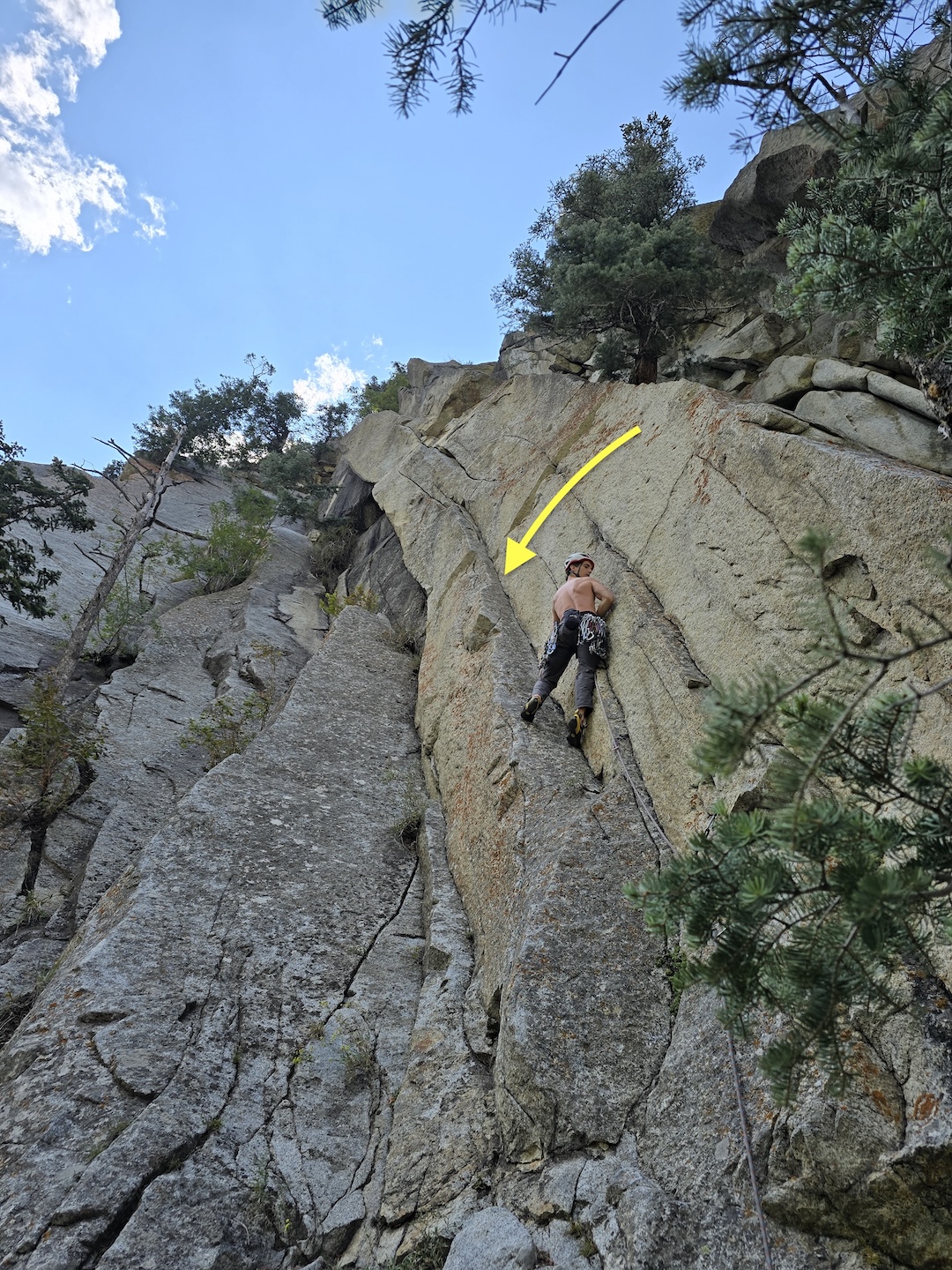
On May 2, Luke Sherman (32) and I (Adam Fleming, 31) attempted to redpoint Pudgy Gumbies (5.11d PG-13). A few days earlier, we had tried the route and had hung on it. The protection is small and difficult to place, so I’d made a note of what I used and where it went.
We used the first pitch of Pentapass (5.7) and the second pitch of Pentapitch (5.8) to access the route. To warm up a bit more, I gave a first lead attempt at Pudgy Gumbies, hanging once on a fixed piton and once just before the final difficult moves leaving the finger crack. In both sections, I took the opportunity while hanging to back up the gear with placements nearby (a gold offset DMM nut to back up the piton; a second yellow Totem to back up the yellow Totem I was already hanging on). I would consider both of these sections to be the route’s cruxes. The section just before the fixed piton, protected by a No. 0.1 BD Z4 and a green No. 5 DMM brass offset nut, is also challenging and has potential for a ledge fall if the protection fails.
I geared up for a redpoint attempt. By the time I made it to the piton, I was feeling tired. I elected to forgo the gold offset DMM nut and instead continued past the piton. My feet were a foot below the piton as I struggled to reach out right to a tight hand jam. I fell and immediately ripped the piton, hit a ramp, and then fell farther to a lower ramp—about 15 feet total. I had the wind knocked out of me and tried to gain control over my breathing as Luke supported my weight via the brass nut. After catching my breath slightly and assessing my immediate physical state, I asked Luke to lower me to the belay and give me some water. I noted that the piton and quickdraw were sitting on a ledge approximately ten below the belay, not attached to the rope. The piton had pitted rust but was fully intact.
I had rope burn wrapping around my right arm from my mid-forearm to my middle upper arm, as well as minor abrasions from the rock. My left ankle was bloodied on the outside and mildly painful, but I quickly determined it was not broken or sprained. My left wrist appeared to be sprained, but not broken; it had a lack of mobility and pain when flexed and pointed, but no pain when pressure was applied.
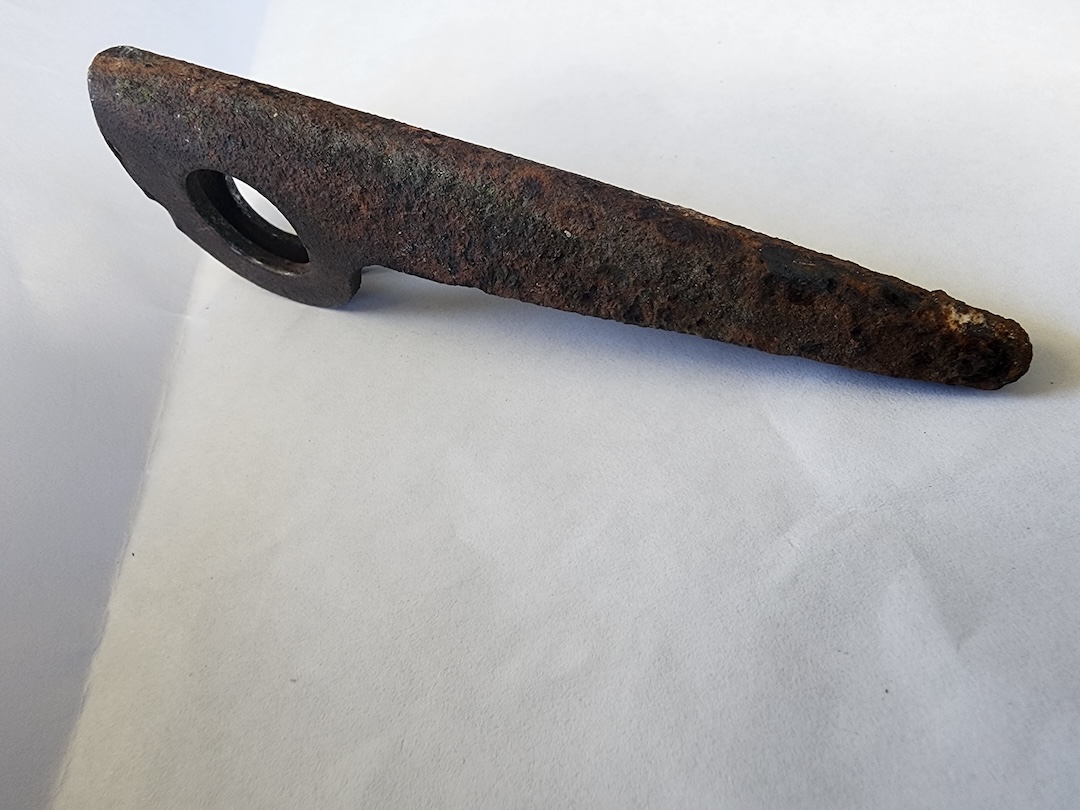
Luke retrieved the gear and rope while I packed up the gear at the anchor and returned to the Pentapitch ledge via third-/fourth-class terrain. At the ledge, I used a SAM splint, jacket, and tape to brace my left wrist and took OTC painkillers. We descended via rappelling Sasquatch (the standard descent) and hiked back to the trailhead.
ANALYSIS
The fact that I’d earlier hung on the piton likely gave me a false sense of confidence in it. When I’d rested on the piece previously, I’d gone in hard to the pin with a quickdraw on my belay loop and also rested on the rope clipped to the pin with a draw—both are scenarios that create much less force than a dynamic fall. Additionally, a piton placed in a vertical crack like this relies only on pressure and friction to hold. While this piton likely would have been strong enough to hold my fall when it was first placed, rust and dozens of freeze-thaw cycles had diminished its holding power. It is unknown if this piton is from the route’s 1983 first ascent, but I’d say that is likely. Backing up fixed pitons is a wise choice. It’s one I made on my first attempt of the route that day, though I decided to continue without backing it up during my redpoint attempt because of the extra time and energy needed to place and inspect the nut—though this could have reduced my chance of injury in a fall.
This piton protected a challenging section of the route and had likely held falls in the past. This was likely the first fall the piton experienced that year. Since the wall faces north, this side of the canyon gathers a large amount of snow and ice over the winter, which could have widened the crack the piton was in. Luke and I believe that, while the piton had deeper rust than was visible—pitting, not just surface rust—the fact that it was still intact indicates that it could have been strong enough to hold a fall had it still been fully seated. The quickdraw coming off the rope is interesting, but we do not believe it contributed to the incident. The rope clearly was in the quickdraw during the fall and must have come unclipped after the piton came out of the crack.
As for the injuries to my right arm, my hypothesis is that the sudden release of the piton likely caused the rope to oscillate, unclip the quickdraw, and then wrap around my right arm. My left arm was near my hip during the fall, but I likely reached down to brace myself during the fall as well. I was a Wilderness First Responder at the time of the accident, which helped in assessing my injuries. I’m now a W-EMT. (Source: Adam Fleming, AMGA Certified Rock Guide.)
Media Gallery