
Alone on Cerro Torre
The First Solo Winter Ascent
On September 7, 2025, near the end of the winter season in Patagonia, I kneeled by myself on the summit of Cerro Torre just before 10 p.m. In that moment I mostly felt only extremely anxious to get down the mountain safely, but it was the completion of a goal I’d had for many years.
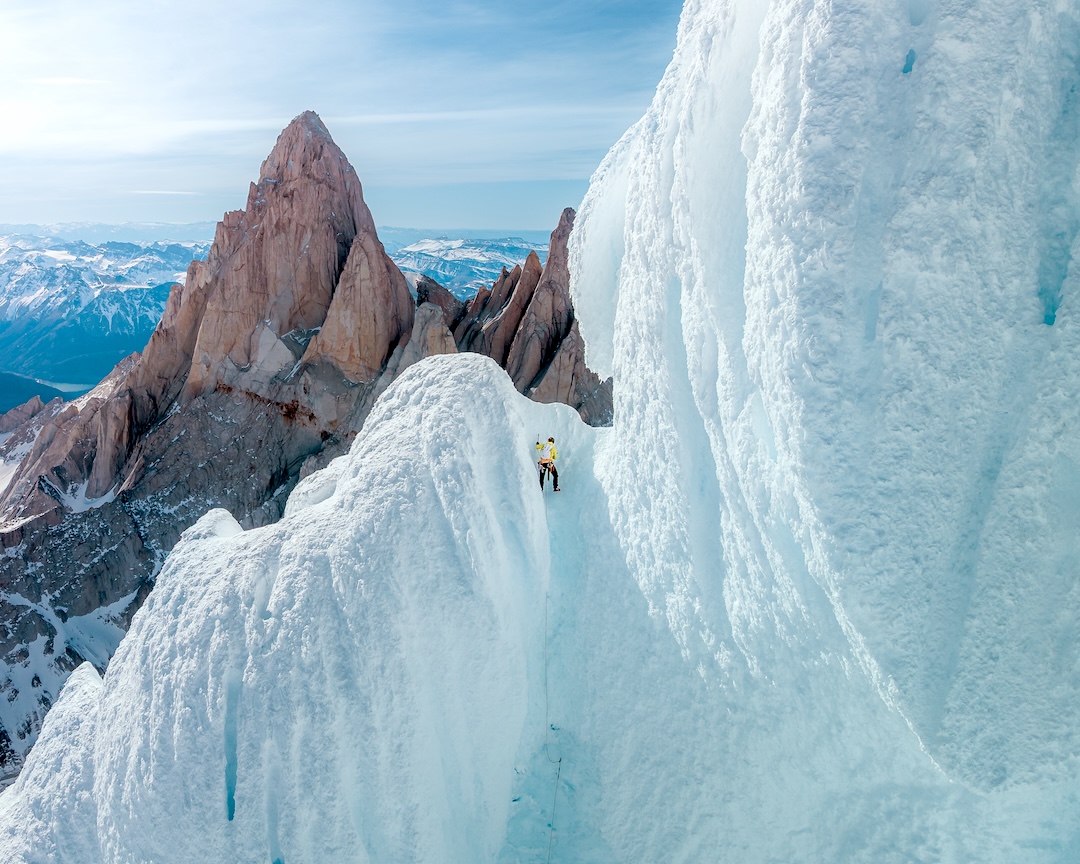
I summited Cerro Torre for the first time in January 2007 with Kelly Cordes, fulfilling a dream I’d held since I was 12 years old. We made the first complete ascent of Los Tiempos Perdidos, climbing an 800-meter ice gully on the edge of the south face to reach the Col de la Esperanza, then continuing another 600 meters up the Ragni Route to the summit. The Ragni Route up the southwest buttress—the line of the first ascent of Cerro Torre—was first climbed in 1974 by a team from Italy, and it is uniquely fantastic, with surreal ice and rime features formed by the Patagonian winds.
Nearly one year after my climb with Kelly, in late December 2007, I was camped alone on the Torre Glacier, my climbing partner having bailed a couple of days before the start of a good weather window. I had set my mind on an idea that I doubt anyone had previously considered: to solo Cerro Torre by the Ragni Route. While certainly a bold idea at the time, the route suited my skills well, as the hardest climbing is on rime and I had an extensive background of tricky snow climbing from years of winter climbing in the Cascades.
In the predawn darkness, I left camp with a heavy pack, but soon decided the goal was too ambitious, and I turned around at the bergschrund below the Standhardt Col. (At the time I had never done any solo climbing in the Chaltén Massif.) I bailed before getting close to the base of the route, but the seed had been planted.
One year later, in December 2008, a strong Swiss alpinist, Walter Hungerbühler, was in Chaltén without a partner and asked me if I wanted to climb the Ragni with him. I told him that if I were to return to that route, it would be to try it solo. I’m very confident that this idea had not occurred to Walter beforehand, but a handful of days later he made the first solo ascent of the Ragni Route. I’ve never been the slightest bit upset that Walter “took” my idea, but it was an early lesson to perhaps keep some ideas to myself, as the creative aspect of envisioning something new is a cool element of the art of alpine climbing.
Walter deserves full credit for making the first solo of the route, but it should be noted that it was climbed by ten other people on the very same day, and ten other people a few days previously. Such a lot of traffic in a short period has become commonplace in recent years. With each team’s passing, the route gets easier, as the crux rime pitches get hacked and kicked into something more solid. This taught me another lesson: If I wanted a true solo experience, I would have to avoid the best summer weather windows.
In early 2013, Austrian über-badass Markus Pucher made the second solo ascent of the route, completely free solo, in a very fast time. He repeated the incredible feat one year later.
Since my first time up Cerro Torre in 2007, I have climbed the peak many other times with partners, with some of those ascents being among the most important in my life, including the first ascent of the Torres Traverse with Rolo Garibotti (2008) and the Torres Traverse in a day with Alex Honnold (2016). However, the dream of climbing the most beautiful mountain by myself always remained in the back of my mind. A few times during spring or fall seasons, I left camp for an attempt, only to decide the weather or conditions weren’t good enough.
Eventually I decided the most enticing plan was to attempt a solo ascent of the Ragni Route in the winter. Doing so would nearly guarantee a true solo experience, and the additional difficulty of climbing in winter was an exciting challenge. So, in August 2013, I traveled to El Chaltén for my first time in the winter season. In those days, El Chaltén was still quite deserted in the wintertime, so I saw very few people in town—and zero people during any of the forays I made into the mountains.
During that winter of 2013, I made one real attempt, on September 14. This ended quite low, only a short way above the Col de la Esperanza. It was windier than I would have liked, and I was also caught off guard by a factor I hadn’t anticipated: The Ragni Route, while historically referred to as the west face, in fact faces mostly south, which at this far southern latitude means it receives almost no sun in winter. The ice becomes extremely brittle, making the climbing much more insecure. I had anticipated free soloing most of the route, using rudimentary self-belay techniques on just a couple of pitches. I now realized that in winter conditions I would need to self-belay most of the climbing, an incredibly time- and labor-intensive process.
Another crucial lesson in 2013 was that the long approach—the longest in the Chaltén Massif—was vastly more tiring and time-consuming in winter. The approach I chose, via Paso Marconi, is about 58 kilometers long, with only a small portion of that on a good trail. Most of the way is either on rough, rocky terrain or skiing along the massive ice cap that borders the western side of the massif. A typical party in summer spends two full days to reach the base of the route.
With the extra equipment needed for climbing and bivouacking in winter and no one to share the loads, I realized I would need to spend a lot of time portering in gear to place a big cache near the base of the route, before I could even start up the climb. That way, when a weather window arrived, I could do the approach quickly and not waste precious good weather.
All of these factors made the goal of climbing Cerro Torre by myself in winter feel overwhelming, and I turned away from the project for ten years.
I didn’t tell many people about my solo attempt in 2013, but I wasn’t surprised to discover that Markus Pucher, the Austrian who had already soloed the Ragni Route twice, shared the same dream.
Markus made solo winter attempts on the Ragni in September of 2015 and 2016. In 2015, he turned around just below the Elmo (“helmet” in Italian), a bulging buttress of rime that typically has the first pitch of hard climbing on the route. In the winter of 2016, however, he climbed all but the last pitch of the route! The last pitch is the definitive crux of the climb, but, nonetheless, reaching this point by oneself in winter is an incredible effort.
I made my second winter trip to Chaltén in 2019, focused on trying to solo Cerro Chaltén (Fitz Roy) by the Supercanaleta route, but I never made an attempt, due to dry conditions and not feeling psychologically ready. In 2022, I made a last-minute decision to return to wintertime Chaltén, and this time I completed the first solo, winter ascent of Cerro Chaltén (see AAJ 2023)—an intense, amazing experience.
My success on Cerro Chaltén inspired me to return in 2023 to my old dream of soloing Cerro Torre in winter. With the lessons learned ten years earlier, I arrived earlier in the winter and came prepared to self-belay the entire Ragni Route. Over several days and a lot effort, I carried all of my equipment to the base of the route. I stacked the odds in my favor as much as I could, but in alpine climbing a lot is beyond one’s control. When a good weather window for an attempt finally arrived, it was preceded by a humongous amount of deep, fresh snow, and it turned out to be a bitterly cold window. I have climbed Denali more than a dozen times, and my 2023 winter attempt on Cerro Torre was by far the coldest climbing experience of my life.
With the deep snow, cold, and rime on the route, I managed only to climb to the top of the Elmo, not even halfway up the route, yet I felt like I had given it my absolute best effort. The huge amount of hard labor required to get my gear to the base, the cold bivouacs, and the extremely time- and energy-consuming nature of rope-soloing convinced me once again to abandon this dream.
In 2025, I spent the first half of the Northern Hemisphere summer in the Karakoram with two friends from Chamonix. We had spent months planning the expedition, but extremely hot, melted-out conditions made all of our proposed objectives too dangerous, and we returned to France on August 5 without having attempted anything big.
After only three days at home, my frustration and pent-up ambition allowed me to overlook all the hardship of my 2023 attempt on Cerro Torre, and I made a last-minute decision to buy flights to El Calafate. Following a frenzy of last-minute preparation, I boarded a plane, and on August 13 I arrived in El Chaltén in wintertime once again.
I would have loved to chill out and rest in town for a few days, but the weather was excellent when I arrived, and I knew that placing a cache near the base of the route would be crucial, so I headed into the mountains the very next morning. To speed up this effort, for the first time ever in the Chaltén Massif, I hired a porter: My friend Jérémias Salinas carried some of my gear to La Playita on the western shore of Lago Eléctrico, where the hiking trail ends. After La Playita, I picked up the full load of roughly 26 kilograms and hiked and skied all the way to the entrance of the Circo de los Altares (the glacial cirque below the west faces of the Torres) that same day. That night I slept 12 hours straight.
On August 15, I climbed to the top of Filo Rosso (“Red Ridge”) and made a bivouac there, just a couple hundred meters below the bergschrund marking the start of the Ragni Route. This last part of the approach gains roughly 1,000 meters and is mostly on glacial slopes but includes a short section of technical mixed climbing, and I fixed a 6mm rope there to ease future approaches. In the morning, I left as much gear as I could possibly justify at the top of Filo Rosso, then made it all the way back to town in one very long day.
Over the next week, during short breaks in the weather, I did two one-day missions to move more gear into the mountains. After another week, a real weather window began, though it seemed the wind might be too high for a real chance of success. I decided to leave town with everything I needed for the climb, just in case, and on August 27, I traveled all the way back to Filo Rosso, picking up some cached gear along the way.
At the foot of the mountain, a weather update convinced me the winds would indeed be too strong for me to reach the summit, and so, after another bivouac, I started the 58-kilometer journey back to town.
Since my arrival in El Chaltén, I had been chatting with local photographer Ty Lekki about the possibility of filming my attempt by drone. Alpine-style climbing at a high level is extremely difficult to film well, especially in a small team, but drones have changed the equation. Over the past few years, Ty has been refining his techniques in the Chaltén Massif for this tricky art form, in locations very far from the road, and in a place known for extremely high winds. We made a plan for Ty to film my attempt from a camp at the base of Filo Rosso.
Not long after my fourth portering mission, I was relieved to see another good weather window in the forecast. At this point, nearly all of my gear was in place, so I could make the approach with a lightweight pack. With more gear to carry, Ty left town a couple of days before me, in iffy weather. On September 4, with the weather starting to improve in earnest, I departed early and caught up with Ty at the entrance of the Circo de los Altares in the early afternoon. We bivouacked next to one another at the base of Filo Rosso.
In the morning, I said goodbye to Ty and started up Filo Rosso. With a lightweight pack and the short section of previously fixed 6mm rope (which I retrieved when descending), I was at the top of Filo Rosso by 10:45 a.m. It was so early that I considered starting up the route. However, the next potential bivouac site would be at the base of the Elmo, which is drastically more wind exposed, so I just spent the afternoon chilling, only making a short excursion to carry my rope and rack up to the bergschrund for an easier start the next morning.
On September 6, I woke well before sunrise and soon started up toward the bergschrund. Snow conditions were drastically better than they had been during my 2023 attempt, and my pack was also lighter—I had refined my strategy and gear choices a bit. Above the bergschrund, I was able to kick steps in snow for a couple of rope lengths, then free soloed the first few rope lengths of ice. Roughly one pitch above the Col de la Esperanza, I started self-belaying.
A bit below the Elmo, I encountered a short, steep section of mandatory rime climbing, which took a lot of time, aiding off pickets for several moves in a row. I was carrying a pair of broad “wings” for my ice axes, designed specifically for rime climbing, but when I pulled them out of my pack, I realized I had made a careless oversight, leaving behind the wrench needed to attach them. There was nothing to do about it—I left the wings at the base of the Elmo to save a bit of weight.
It took some time to decide which line to try on the Elmo. After traversing around and making belay anchors in different places, I didn’t start up this nearly vertical pitch until about 2:30 p.m. The ice wasn’t very solid and the protection wasn’t good for a ways, but it was easier and safer than true rime climbing. Higher, the pitch turned to good ice and I climbed through a natural wind tunnel. After climbing, rappelling, and jumaring back up the pitch with my pack, I reached the top of the Elmo sometime around 4:15 p.m.
There were no bivouac options between the top of the Elmo and the top of the Headwall, roughly six pitches of hard climbing above. I had nearly three hours of daylight left, however, and good weather in Patagonia is rare, so I decided to continue.
I started up the mixed pitches below the Headwall around 5:30 p.m., acutely aware that I had a lot of difficult terrain to cover before the next bivouac site. By the time I started up the Headwall, a long pitch of sustained steep ice, it was sometime after 9:30 p.m. and daylight was long gone. The Headwall is dead vertical for about 35 meters, and the ice was very brittle, with dinner plates fracturing from almost every placement. I had been climbing and jumaring for 16 hours, and my body felt exhausted.
After rappelling and jumaring back up the Headwall with my 60-liter pack, I climbed another half pitch, made an anchor, and rappelled down to the left to make a bivouac. Constructing a decent tent platform did not take as long as I’d feared, but nonetheless it wasn’t until 1 a.m. that I finally got in my tent and started melting snow, and it was around 3 a.m. before I got to sleep.
The upside of my decision to climb the Headwall before bivying was that only three pitches remained between me and the top of Cerro Torre. The downside was that I was extremely tired after a massive day. With all the tasks associated with bivouacking in the cold, I only got five hours of sleep, and even so it wasn’t until 11 a.m. on September 7 that I was finally ready to head up again.
When I started climbing, it was somewhat windy, my hands went numb, and I could feel immediately how tired I was. Fortunately, the first pitch was mostly straightforward ice climbing, and apart from a brief break to moan in agony from the screaming barfies, I got up it reasonably quickly.
The second pitch above my bivouac was more difficult, and I soon encountered a section of steep rime. Without the wings on my tools, and after a couple of attempts at aiding off pickets, I started digging a tunnel inside the rime. As usual, the tunneling cost a huge amount of time and energy, and I started to have major doubts about making the summit. It was 4:30 p.m. before I completed this pitch, rappelled, and jumared back up.
The tunneling had sent a lot of snow and ice down into my clothes, and while building the anchor in a shaded, windy spot, I quickly started to shiver. So, rather than immediately start up the last pitch, I found some sun and took a long break to eat, finish my water, dry my clothes somewhat, and get mentally prepared for the final pitch.
The first time that I climbed the steep rime of the Ragni Route’s infamous last pitch, in January 2007, it took me three hours of intense effort to lead. The second time took me four hours. I also have climbed this pitch in less than half an hour when it was in much easier conditions.
I didn’t know what awaited me, and I was rather shocked by what I saw. Ty had mentioned a couple of weeks earlier that, while flying his drone, he had noticed that a section of Cerro Torre’s summit mushroom had broken off. I didn’t think much about this comment at the time, but now I saw that there essentially had been a humongous serac collapse on the right side of the final pitch.
The key to climbing the last pitch is typically to shoot for one of the natural wind tunnels through the rime, because they offer the easiest and safest climbing. There was a logical, concave line on the left side of the wall leading to a wind tunnel up high, but my eye was drawn to the right side. Where the serac had fallen off, I saw a lot of blue ice, which is much easier and safer to climb than rime. I saw a tunnel on the right side as well, so I decided to aim for that.
At first, the climbing was efficient because of the exposed blue ice, although I broke off very large, brittle plates. One section was noticeably overhanging, and I didn’t hesitate to start aiding. Just before
7 p.m., I arrived excitedly at the entrance of the tunnel. Only once inside did I realize my mistake—this wasn’t a wind tunnel but a crevasse in the hard glacial ice of Cerro Torre’s summit. The crevasse was very narrow, and it looked extremely improbable that I could fit through. I was devastated to have put in so much effort and get shut down only 30 meters below the summit. It briefly occurred to me to rappel to the base of the pitch and start back up the left-hand line, but I was wasted and the sun had just set. I didn’t think I had it in me to start the crux pitch all over.
I could barely see a bit of blue light filtering through the crevasse, and this gave me just enough hope to try. I accepted that I probably wouldn’t make it to Cerro Torre’s summit, but decided that I wouldn’t give up until it was 100 percent clear that I couldn’t make it through.
I spent the next two hours and 45 minutes making my way through this crevasse, which was something like the ice version of the Harding Slot in Yosemite Valley. Most of this time was spent enlarging the passage—sometimes by clearing away snow, but mostly by painstakingly chipping away the glacial ice, breaking off pieces often hardly bigger than a dried apricot. The tight squeeze resulted in contortionist positions while chipping at the ice, which was extremely difficult and gave me terrible bruises, especially on my elbows.
To squeeze through the crevasse, I had placed an ice screw at the entrance and left my helmet, extra jacket, extra gloves, the Grigri, and most of the rack clipped to the screw. I took with me just three ice screws, a few carabiners, and a rappel device. Even without my helmet, my headlamp nearly got knocked off several times. I took whatever route seemed widest, and in the process climbed up, down, right, and left.
I was very close to finally giving up, and I nearly couldn’t believe it when one more blow with my axe revealed blackness—the night sky! Amazed, I frantically chipped around this hole until I could poke my head through.
I had no idea where I might be emerging and soon realized I was still on the steep section of the last pitch. After so much time inside the mountain, feeling the void again was intimidating, but I had traced my rope through the entire crevasse, so I was extremely well protected. And, thankfully, I realized I was now just below the entrance of the natural wind tunnel on the left-hand side of the wall. I adjusted the amount of slack in the clove hitch on my belay loop and made a couple of airy moves to reach easy terrain.
It felt surreal to top out the pitch after hours of thinking that I had very little chance of success, and I was almost in disbelief—it was certainly the most bizarre and taxing pitch of climbing I’ve ever done. I climbed to the end of my rope, placed an ice screw, untied and clipped the rope to the screw, and climbed easily from there to Cerro Torre’s summit.
I arrived on top just before 10 p.m., with zero wind and a completely full moon. It was a gorgeous moment, but I only allowed a fraction of my consciousness to enjoy it. Being on the summit of Cerro Torre in winter, by myself, at night, felt like an extremely long way from safety. To be there with no backpack, no helmet, no rope, no rack, and only the clothes on my body felt outrageously exposed. I took a few pictures, shot a quick video clip, and started down.
Descending the final pitch through the narrow crevasse was a bit complicated, but it passed without incident. After two more rappels, at the top of the Headwall, I decided to use my Beal Escaper to make a single-strand rappel with my 80m rope. This turned out to be a terrible decision, because the rope never came down despite at least 200 tries of pulling and releasing it. My best guess is the system failed because of something to do with the subzero temperatures.
Reclimbing the Headwall felt out of the question in such an exhausted state, so I made the painful decision to cut my rope. Thus, from midway up the Headwall, I rappelled the rest of the route with only a 45m rope, making a ton of Abalakov ice anchors. Though I was physically exhausted, I decided to continue rappelling through the night, rather than stop anywhere to bivouac. The wind was forecast to increase the next day, and I didn’t want to postpone any portion of the descent.
At about 6:15 a.m. on September 8, I finally reached my bivouac at the top of Filo Rosso, almost exactly 48 hours after departing—and with only about five hours of sleep in that time. I communicated to Ty that I was down safely, and he departed from his camp below a couple of hours later, eager to return to civilization.
The journey back to town was never stressful, but it was a long, drawn-out affair, in part because I had so much gear to carry, but mostly because I was so physically destroyed. My hands, feet, and calves were impressively swollen, and I felt very depleted.
Friends picked me up at the Río Eléctrico bridge in the early afternoon of September 10. I had been out in the mountains for seven days. During that time, I had briefly crossed paths with a couple on the first day of the approach, spent one evening with Ty in the Circo, and briefly passed some hikers near the end of the journey back out. Otherwise, I had been alone.
This was my tenth ascent of Cerro Torre, and despite some very meaningful ascents in the past, this might be the most special. I like it when a climbing objective suits my personal skill set, and that was definitely the case with this one. Seasons of big-wall climbing in Yosemite, waterfall climbing in the Canadian Rockies, and Alaskan alpinism were all equally important preparation, as was a lifetime of ski mountaineering.
The Ragni Route had been climbed in winter 1.95 times before my ascent. In 1999, a strong Swiss-American team climbed all but the final six-meter summit mushroom. One of those climbers, Stephan Siegrist, returned in August 2013 with Dani Arnold, Thomas Huber, and Matias Villavicencio to seal the deal. Earlier, in 1985, the Compressor Route on the mountain’s southeast side was climbed in winter by Paolo Caruso, Maurizio Giarolli, Ermanno Salvaterra, and Andrea Sarchi from Italy.
My climb was the third winter ascent of Cerro Torre, and the first winter solo of the mountain by any route.
SUMMARY: First solo winter ascent of Cerro Torre in the Chaltén Massif, Argentina, by Colin Haley (USA), September 6–8, 2025. Haley climbed and descended the Ragni Route (southwest buttress). His round trip from the town of El Chaltén took seven days.
FIRST SOLO WINTER ASCENT OF AGUJA STANDHARDT: A week after returning to El Chaltén, Haley hiked to the base of the east face of Aguja Standhardt, aided on the first day by a friend, Maxi Abasto, carrying a load of equipment. On September 19, Haley broke trail through deep snow up to Standhardt Col, then started up the Exocet route at 9 a.m. Rope-soloing all but the easiest sections, he reached Standhardt’s summit just after 8:30 p.m. He rappelled during the night and returned to his bivouac at around 3:30 a.m. on September 20. This was the first solo of Aguja Standhardt during calendar winter. Haley had previously made the first non-winter solo of Standhardt, by the same route, in November 2010.
ABOUT THE AUTHOR: Colin Haley was born in Seattle and learned to climb in the Cascades, but now lives in Chamonix, France. His favorite mountains are those with no easy routes. This story was adapted from a longer account at Skagit Alpinism (colinhaley.com), with the author’s assistance.
Media Gallery