
Avalanche — Climber Triggered
New Hampshire, Franconia Notch State Park, Cannon Cliff
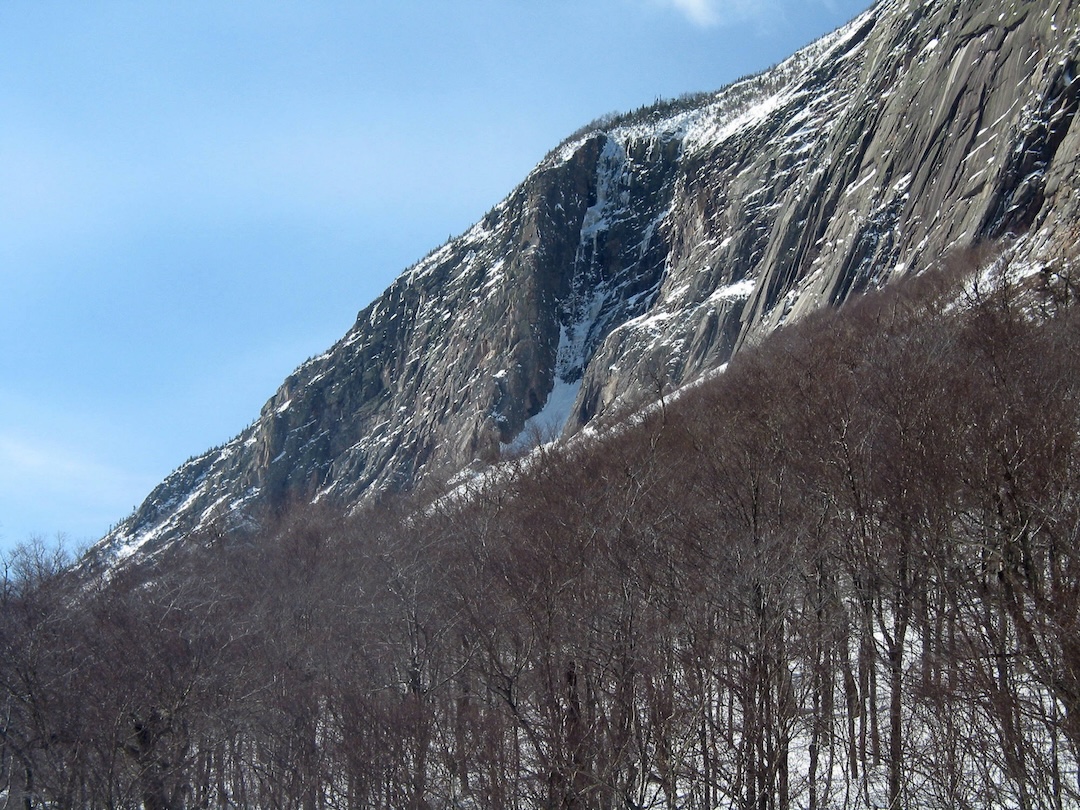
On the morning of February 16, climbers V (31, M) and Z (36, F) were approaching the Black Dike (WI4+ M3). Both were experienced but neither had climbed in winter at Cannon, a venue known for challenging weather and alpine conditions. It was snowing heavily with high winds. The snow surface was wind scoured, with isolated pockets of deeper snow. During the approach, V observed snow sluffs on the cliffs and cracks in the snow pockets. At 11 a.m., the pair reached the base of Cannon Cliff, roughly 150 feet right of the lowest slopes of the Black Dike gully. Snow was actively collecting on the slope. While Z waited, V traversed left, unroped, toward what he believed was a more protected position near the rock on the left side of the gully. The snow on the traverse was loose and knee-deep.
During the traverse, V triggered the snow beneath him; the fracture formed above him where the slope steepens at the cliff base. The avalanche was approximately 100 feet wide with a two-foot crown, and swept V more than 600 feet down the snow-covered boulder field. He attempted to arrest by digging in his feet and swimming toward the surface, but neither was effective against the force of the slide. He repeatedly impacted boulders before the snow came to rest where the talus angle eased—far below Z’s position. V was partially buried but conscious, and was able to stand and extricate himself. Z had been knocked over and carried approximately 15 feet; she was not buried and was uninjured.
Disoriented by the snowfall and wind, Z had lost sight of V, and so began searching for him in the debris at the top of the talus field. Meanwhile, V began his ascent back up the slide path and attempted to reach Z on his two-way radio, but was unable to make contact—Z’s radio was buried in her pack and may have been turned off. Partway up, V reached 911 by cell phone. When V came into visual range, Z initially mistook him for a first responder and continued digging. Only when he was close enough to identify himself did Z recognize her climbing partner. The pair assisted each other, located the approach trail, and hiked most of the way out over the following hour and a half. At 1:45 p.m., they reached Cannon Mountain Ski Patrol and Pemigewasset Valley Search and Rescue personnel, who drove them by snowmobile to the Lafayette Campground trailhead. V declined on-site medical care; friends drove both climbers to Littleton Regional Healthcare for treatment.
V’s injuries included a fractured left clavicle, separated right shoulder, fracture of the right hand, vertebral displacement, left knee injury, concussion, whiplash, and multiple contusions, punctures, and muscle tears.
ANALYSIS
V was aware of general avalanche hazard during the approach—he noted sluffs and cracks in the snow pockets—but his primary concern was overhead terrain. The pair did not consider that relatively small snow pockets on talus could produce a slide.
They were also unaware that the Mt. Washington Avalanche Center issues daily avalanche forecasts throughout winter for the region; had they checked, they would have found current hazard information applicable to Cannon. V later reflected that his emotional state and poor sleep before the climb contributed to elevated risk tolerance. Clearer communication between the pair about approach tactics might have changed their final decision.
New England avalanche hazard is less well publicized than that of the western ranges, but it is real and recurring. Any treeless slope in New England is typically open because of avalanche activity or landslide history. Ice-climbing approaches in the region, including gullies in the Presidential Range and on Katahdin, and the approach slopes at Lake Willoughby and Smugglers’ Notch, pass through avalanche-prone terrain. Most of the Cannon talus in winter is a bare snow slope at 30°–35°.
The area where this avalanche released collects snow from the Black Dike gully above and is particularly prone to loading. In New England, avalanche risk is highest during snowstorms of several inches or more and within a few days afterward. Climbers approaching ice routes in the region should check the Mt. Washington Avalanche Center forecast before venturing onto the talus in winter.
The pair was not roped together, which proved fortuitous: Had they been roped without a secure anchor, both V and Z would likely have been swept away. They were not carrying avalanche beacons, probes, or shovels. Had V been fully buried or rendered unconscious, Z would have had no reliable means of locating him. Climbers and skiers traveling through avalanche terrain should carry and be proficient with a beacon, probe, and shovel. Two-way radios, while they were not effective in this instance, are also a sound practice for parties separating on technical terrain. (Source: Climbers V and Z.)
Media Gallery