Shooting the Moon
Playing a Winning Hand on the Hidden Pillar of Ultar Sar in Pakistan
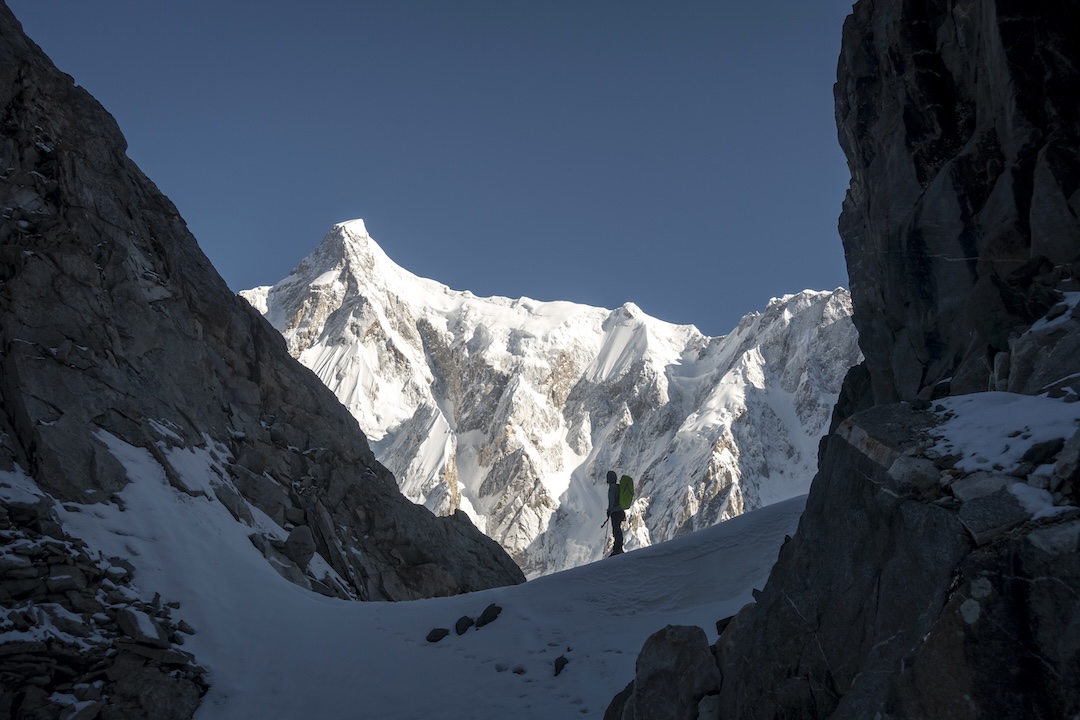
The snow broke like a wave and the world came barreling toward me. I pulled in tight against a small triangle of glacier ice, watching tiny shards of snow and ice glisten in the morning sun as they zoomed past. The blue handle of the single ice screw I’d clipped caught my gaze, and I stared at it, willing the screw to stay in place. The rope that had seconds ago run upward to Seba Pelletti now stretched tight below me. And then all was still.
One year later, on May 22, 2025, Maarten van Haeren, Seba, and I woke well before dawn and started climbing toward the col separating Batokshi (6,050m) and Batura Sar (7,795m), in the western Karakoram mountains of Pakistan. Maarten led, treading carefully, gripped by the memory of the soft slab avalanche we had triggered in this exact location the year before, sending Seba to the hospital.
This time the conditions were stable, and we crested the col at 5,900 meters without incident, midway through a week-long mission to acclimatize for our main objective. After a few more nights, pushing our way up to 6,500 meters, we practically ran down the massive glacial slopes to base camp. With the acclimatization box checked, we soon were back in the town of Aliabad in the Hunza Valley.
Between eating and sleeping, the next seven days in the valley passed quickly. I had been battling a flu ever since we arrived in Pakistan, and the acclimatization push hadn’t helped my sore head. While in Aliabad, the unusual two-week spell of sunny weather we had enjoyed finally gave way to rain. Every morning before breakfast, I poked my head outside to see if the 7,388-meter summit of Ultar Sar was still visible, 5,000 meters above us. As clouds engulfed the upper mountain, I imagined being up there and looking down at the town. Would it be comforting or unsettling to see our guesthouse from the summit, so far below?
The dramatic aesthetic of Ultar Sar’s southeast pillar—the Hidden Pillar, aptly named since you can’t see most of the route until you are standing directly below it—had quickly captured my attention when I stumbled upon a photo of it a few years earlier. The mountain—known in the past as Ultar II or Bojohagur Duanasir II—saw numerous attempts before it was first climbed in 1996, by two different routes. Attempts on the Hidden Pillar began in 1992, and despite at least half a dozen expeditions with this goal, only one team had made it high on the route: Over five days in 2011, Fumitaka Ichimura and Yusuke Sato from Japan climbed to about 6,500 meters before storms sent them down.
The alpine walls around the pillar looked ferociously steep, and I could barely imagine the scale of avalanches that would come roaring down from the numerous serac bands. Yet the magnificence of the pillar was not just its aesthetic appeal, but also how it appeared to offer a reasonable path weaving through the complexity and danger of such a massive face. I knew I wasn’t ready for such a route at that time, but the thought of Ultar would periodically visit me, a guiding beacon leading toward some future moment.
June 2, 2024, would probably be Maarten’s worst birthday ever. It was a frigid morning at 5,400 meters, and although it would have been nice to offload the weight of the surprise birthday cake I had been carrying since base camp, we hastily packed up and started trudging toward the Batokshi-Batura col. As the first rays of the sun’s warmth hit my face, we stripped layers and continued upward. Minutes later, Seba flew past me in the avalanche.
Seba rode the wave for around 80 meters, smashing into the ice face and afterward complaining of chest and rib pain. We thought it prudent to get back to base camp as soon as possible, so he could be flown out to the hospital. Before we started down, I opened my pack and pulled out Maarten’s birthday cake. There was no way I was going to carry it back down the mountain, so we each enjoyed a quiet slice, unsure whether this would be our last day up high in the Karakoram.
Thankfully, Seba’s injuries turned out to be minor, and he was in good spirits when Maarten and I made it back to Aliabad on foot. Although we were all shaken by the avalanche, we debriefed the incident and owned our mistakes. We still had much to learn about the strategy for climbing Ultar Sar, and as a group we decided to proceed with the expedition. With all expectations having already slid down the mountain, we spent the rest of the trip becoming attuned to Ultar’s hum, and much to our surprise made it halfway up the Hidden Pillar before heading back to Canada.
We had learned in 2024 that, apart from the technical difficulties of the route, the strategy for climbing Ultar Sar is deceptively complex. Although the mountain is less than ten kilometers from the urban hub of the Hunza Valley, much of the approach is too technical for porters, and therefore base camp must be farther from the mountain than ideal. The route covers more than 3,000 vertical meters of technical terrain and thus has extremely variable conditions. In particular, we would need solid spring snow and ice to climb the lower gullies, which were sure to melt out as the weeks went by, meaning the window of opportunity for a good attempt would be uncomfortably short.
We also confirmed there are no good acclimatization options near Ultar’s base camp. Bruce Normand had tipped us to the idea of acclimatizing in the adjacent Muchuwar Valley before heading to Ultar itself. Although we embraced this plan in both 2024 and 2025, it led to other difficulties: wrangling porters to multiple base camps and complicating the decisions around timing, weather, and conditions. To say nothing of the avalanche danger on the slopes of Batokshi.
Happily, in 2025, we were able to complete our acclimatization with no serious issues, and once back in Aliabad, we celebrated Maarten’s birthday in style. The next day, on June 3, we moved up to Ultar base camp, a steep, grassy slope at 4,400 meters used by the villagers from Ahmedabad for grazing yaks. The rain of the last few days hadn’t left too much snow on the mountains, and the forecast looked promising, so after just 36 hours in base camp we were already on the move, with the intent of either starting up Ultar or else caching gear on the Gurpi Glacier below the route.
The excitement was palpable as we reached the end of the sketchy approach traverse and finally got full sight of Ultar Sar for the first time this year. I traced our planned line up the Hidden Pillar: from the initial snow and ice gullies starting at 4,300 meters, to the long swoop of ice faces, to the sharp ridge of granite chiseled into the skyline and shooting straight to the summit. Throughout the last half decade of pursuing serious climbing, at home in the Canadian Rockies and in the Greater Ranges, some days I felt like I understood my passion for alpinism. Other days my deep drive felt misplaced. Staring at Ultar, it didn’t matter either way. I felt a deep sense of belonging, like I had reached a place I was meant to be.
We boot-skied down into Ultar’s inner sanctuary on June 5, guarded on all sides by towering walls of rock and ice. Once on the glacier, we sought shade under the biggest overhanging boulder we could find. When afternoon clouds obscured the sun, we moved up-glacier to the base of the mountain. The site we had nicknamed Blast Camp was located at 4,300 meters under a steep rock feature. It was tucked just out of reach of debris from serac avalanches that swept down either side of the pillar, yet more than once over the course of our attempts we had been jolted awake by wind blasts.
An updated forecast promised more than a week of good weather, and we decided to launch right away. We hoped to be back down across the bergschrund after seven days, but brought food and gas for eight. We woke at midnight, and after coffee, electrolytes, and an energy bar, we crossed the schrund and started up the snowy couloir that would encompass our first day of climbing. It was obvious at this point how little snow was on the mountain, as we discovered a three-meter-high rock pinnacle that had been buried under snow the previous year.
After a few hundred meters, we reached the initial ice pitches. Since we had made three attempts the previous year, we had climbed these pitches in every condition: wet and sticky ice, chandeliered and hollow ice, full shower ice, and, upon rappelling from our last attempt in 2024, a full-blown waterfall. This time the ice was garbage, and I led slowly, cleaning the outer layer of refrozen snow and taking time to find patches of solid ice where I could sink my tools. After two belayed rope lengths, I continued leading as we simul-climbed up to Perch Camp at 5,100 meters. It was probably only 8 or 9 a.m. when we reached our bivouac, a slim ridge of snow jutting from the top of the couloir, safe from falling rock and ice and just wide enough to dig a tent platform. The south-facing walls were already shedding debris under the heat of the Pakistani sun.
As we had learned the previous year, our window to climb each day while low on the mountain was short, due to the extreme heat, and we had to move quickly between safe spots where we could camp. We would spend the rest of the day trying not to melt in the sun, napping, nourishing ourselves, and poking our heads out of the tent whenever we heard ice collapsing and the ensuing sounds of avalanches that ran down either side of the pillar.
The relief of afternoon cloud cover finally arrived, and the upper mountain disappeared into the mist. We planned to wake at midnight again, but, as would become routine, Seba set the alarm for an hour earlier, perhaps inspired by an old Bonington adage, something along the lines of, You can never wake up too early.
Our second day on Ultar involved downclimbing from the top of the couloir to reach a long traverse across ice faces that would lead us up to a hanging glacier at 5,800 meters. We arrived at our Glacier Camp in the late morning and dug another five-star tent platform. Seba and Maarten mustered the motivation to scope the way to the ice face—the start of the upper half of the route. It was still quite hot even at this elevation, but there was a bit of cloud cover and a slight breeze.
In the evening, we received another forecast for high pressure for the next week. Now we were confident we’d be unlikely to get caught in a big storm, and there was a feeling of momentum within the team, growing steadily with each meter gained.
Another 10 p.m. wake-up... Maarten led up a snow spine to reach the ice face, after an overhanging bergschrund grunt. We had been concerned about avalanche conditions on Ultar’s upper slopes, on which we would have to climb several hundred meters to reach the base of the route’s prize feature: the 500-meter pillar of golden granite. We also carried the weight of an avalanche incident that had ended a 2018 attempt on this route by Christian Huber, Tim Miller, and Bruce Normand. The team had been waiting out a storm at about 5,900 meters when a relatively small but ultimately deadly avalanche released above their tent, killing Huber and forcing a helicopter rescue of the other two.
As I took over leading and poked my head around a bend, my concerns diminished—the terrain above was as steep as what we had just climbed and didn’t hold any snow. Of course, this also meant we’d be frontpointing on ice for a seeming eternity.
We had expected the rock pillar to start at around 6,500 meters, but when we reached the end of the ice slope, we were already at 6,650 meters. I brewed water to ease our dry throats while Maarten and Seba labored to build a bivouac. We were now higher than any of us had ever been—and higher than anyone else had been on Ultar’s Hidden Pillar. It felt surreal to be camped just below the majestic rock pillar we had dreamed of climbing for two years. After three days of relentless ice, we were looking forward to tackling the steep mixed climbing, which would challenge our technical abilities and tax our cardiovascular systems, but would finally give our calves a break.
Our initial plan had been to stay on a nocturnal schedule for the first three days on the route, when we would be most exposed to warm temperatures and overhead hazards. Then we would switch to climbing during the daylight hours on the upper pillar, using the sun to our advantage. But based on the afternoon cloud buildup we had experienced thus far on Ultar, we decided to keep waking up well before dawn, under the aura of a nearly full moon, and stop to bivouac by midafternoon, before the visibility diminished and the winds picked up.
To start our fourth day on the route, Seba traversed under a glacial wall for half a rope length before climbing a gully up to the golden granite pillar. He hollered down about how good the rock looked, and Maarten and I climbed as quickly as we could to join him at the belay.
As the sun crested the horizon, I grabbed the rack and started up the pillar, connecting low-angle rock features with bits of snow in between. Before I could even finish a pitch, however, nausea crept in—I had been nursing a sour stomach—and it felt even worse by the time Maarten and Seba reached the anchor. I reluctantly handed the gear to Maarten, disappointed not to get my leads on the section of the route I had most looked forward to climbing. Yet our team synergy left no room for ego. We were each contributing the best we could, with full reliance on one another.
The next pitch brought the first technical crux, a steep, blocky dihedral choked with ice in the back. We were at around 6,800 meters and living our dream of climbing technical ground at altitude. Despite the nausea, I marveled at the quality of the climbing as I wrapped a gloved hand around a jug and placed the pick of an ice tool in a thin crack. The conditions were excellent. Had there been more snow, it would have been laborious to clean the cracks, and had things been drier, the climbing would have been a lot more insecure.
Higher up, the terrain led us off the ridge and onto the right side of the crest, where we were able to link snow and rock features toward a series of corners we had seen from below—we thought these would be the key to passing through the upper half of the rock band. We had hoped to find a snowy ledge for a bivouac, but even off the ridge, the steep terrain had shed most of its snow, so instead we spent a couple of hours chopping ice to create a platform using our snow hammock. We were now at 7,000 meters, just under 400 meters below the summit.
We had planned to go for the top the very next day. But given the pace of the climbing and the afternoon weather, we decided that taking an extra day would increase our chances of success. We hoped to keep the next day relatively short and build a bivy after only 100 to 150 meters of climbing, then try to rest as much as possible before an early summit push.
The next morning, Seba quested off on a brilliant pitch. Off the belay, he climbed up to a hanging slab covered in snow. As he cleaned it off, he was relieved to discover a thin layer of ice. He placed a good cam in a hidden crack at the end of the slab before making a tricky mantel to a good stance. After catching his breath, Seba continued up lower-angle ice and rock to reach another crux, an open book with slabby feet and a roof requiring another testy mantel.
As I followed the impressive lead, my mind and physiology sent conflicting signals. The days of effort at altitude were building, and I felt frail from the stomach problems that had plagued me throughout the climb. On the other hand, the momentum within myself and the team kept growing. As if drawing from a bottomless well, on this mountain and with this team, I felt I could keep going forever.
Seba took another pitch, the steep rock once again gifting him good gear and a smear of ice in the back of a corner. These two difficult pitches took some time, and the cloud bank had started to rise from below. We had hoped Seba’s two leads would bring us to easier slopes, but Ultar would not relent. Above us, all we could see was steep ice and more rock, with no obvious place to bivouac.
Maarten led a couple of rope lengths of ice and steered us beneath a rock overhang, where we chopped another ledge at 7,150 meters. After a few hours of digging, we were able to pitch the tent with the help of our snow hammock. By late afternoon, we were nestled inside. I had just enough space to lie down, with my legs hanging in space beyond the ledge, the tent fabric providing just enough resistance to the gravity pulling them downward. We had now been on the go for six days—on the mountain for five. We were all knackered. Yet inside the thin tent walls, the air was buzzing. We couldn’t wait to start up the next morning, knowing we were headed for the summit—and with day packs!
We woke at 10 p.m., as usual, groggy but ready to confront the day. We began the process of exchanging down socks for boot liners, and one at a time pulled our boot shells out of our backpacks, which were clipped to the anchor outside the tent. After packing the frosty tent into a frosty stuff sack, we slowly went through our gear, clipping most of it to the anchor. We packed only the minimum we would need for the day: layers, extra gloves, a single half rope, ice screws, rock gear, and a liter of water each.
I was feeling slightly less nauseous, so I asked for the rack and tied into the end of the rope, relishing the opportunity to tackle the final question mark of the route. We left the bivy under stars and the bright beams of the moon and headlamps, anxious for a look at the final rock pitch. At around 7,200 meters, I packed my puffy and switched my hefty gloves for a thinner pair that I had been saving for this moment.
I took a deep breath and started up. A few steep pulls led to a stance, and I put in a good cam before working my way up a broken chimney for a couple of body lengths. At the base of a groove, I delicately placed a tool in thin ice at the back and slowly worked my feet up, frontpoints balancing on small edges. Once again, I was very thankful to find just enough ice in the groove to hold my weight. There wasn’t much gear, but I climbed confidently until I was standing on a block below the final overlap. In one big move, I reached high and pulled up and over, onto a solid sheet of ice. I climbed a bit higher and fired in an anchor.
As Maarten and Seba followed the pitch, I reached into my pack and pulled out my thicker gloves. Switching them out, I noticed the pad of my left ring finger’s tip was purple. Although I could feel all my fingers again, there was a numb sensation on that tip, and I immediately knew I had frostbite (though fortunately it did not cause long-term problems).
We could see the top of the ice slope 30 meters to our right and another rope length above. Maarten set off, moving out of sight as he crested the top of the face. As I followed, it felt incredible to finally see the Hunza Valley come into view on the other side of the mountain. Maarten was sitting in the snow, belaying. The sun was out now, and its warmth helped balance the wind crossing the summit plateau.
I don’t know how long we walked to reach the top. The terrain was undulating. We were digging deep. Maarten gently pulled in rope as we took the final steps to the summit. I took a deep breath and gave the guys a big hug. My watch read 9 a.m. We looked around, we looked at each other, and we felt at peace with the moment. We had fought hard, and now we were here. Yet it was harrowing to feel closer to the moon than to the guesthouse we could now see down in the valley. Better get moving! After ten minutes we started down.
We spent the rest of the day rappelling to our bivouac site at 6,650 meters, at the base of the rock pillar. The weather was changing, and clouds and wind arrived in full force by noon, blowing snow all around us. After two hanging bivouacs, we were relieved to reach the relative safety of a flat camp and to be almost 750 meters lower than the summit. We collapsed into the tent and fell asleep instantly.
We briefly woke in the morning to see that the weather had once again settled, though it was much cloudier than previous mornings had been. We decided to rest a few more hours and start down in the early afternoon. It was a mistake. The day turned stormy, the visibility dropped to nil, and snow started piling up against the walls of the tent. We contemplated starting down anyway, but decided to give it until the next morning to see if conditions would improve. That afternoon, for the first time on the route, our nerves started to unravel a bit.
It was still cloudy overnight and into the morning, but not as bad as the previous day. After 30-something hours at the 6,650-meter bivy, we finally continued down. Following a few hundred meters of rappelling, we breached the cloud floor and could see all the way to the valley below. For the rest of the day, the cloud cover worked in our favor, obscuring the sun on these south-facing slopes.
Sensing this was our opportunity, we continued rappelling all through the night. The lower couloir was a graveyard of stacked blocks and running water, completely melted out during the week since we had climbed it. As we made the last of more than 70 rappels, descending over a waterfall that was formerly a pitch of ice, we could practically smell the parathas cooking at base camp. Any thought of stopping to rest quickly fell away, and we trudged up and out of the inner valley, reversed the sketchy traverse, and made it back to base camp that afternoon, 32 hours after leaving our last camp.
At times it had felt like the cards were stacked against us. Yet with a carefully crafted strategy, a bit of confidence, and luck on our side, we managed to safely get up and down Ultar’s Hidden Pillar. It felt a bit like shooting the moon, an unlikely maneuver in the card game of Hearts, when you really go for it, and, if you play things just right, turn a bad hand into a big score.
How can I describe how I feel after Ultar Sar? I feel. That much is certain. I have never pushed so hard, for so long. The body, including the frostbite on my fingertip, has mostly recovered. The mind feels slow to let go. I can’t help but wonder: Us, such puny humans—how lucky are we to be capable of such experiences?
SUMMARY: First ascent of the southeast pillar, the Hidden Pillar, of Ultar Sar (7,388m) in the Batura Muztagh of the Pakistani Karakoram, by the international team of Ethan Berman, Sebastian Pelletti, and Maarten van Haeren. The round trip from base camp took ten days, with eight days on the mountain; they summited early on day six, June 11, 2025, and descended by the same line. The route is called Shooting the Moon (3,100m, WI4 M5).
ABOUT THE AUTHOR: Ethan Berman is based in Canmore, Alberta, where he works as a choss whisperer and geospatial scientist. He thanks the American Alpine Club’s Cutting Edge Grant, the John Lauchlan Memorial Award, and the Mazamas’ Bob Wilson Expedition Grant for supporting this expedition.
Media Gallery