
GROUND FALL FROM ANCHOR — Rappel Rope Not Properly Attached
Alabama, Blount County, Ebell Mountain, Palisades Park
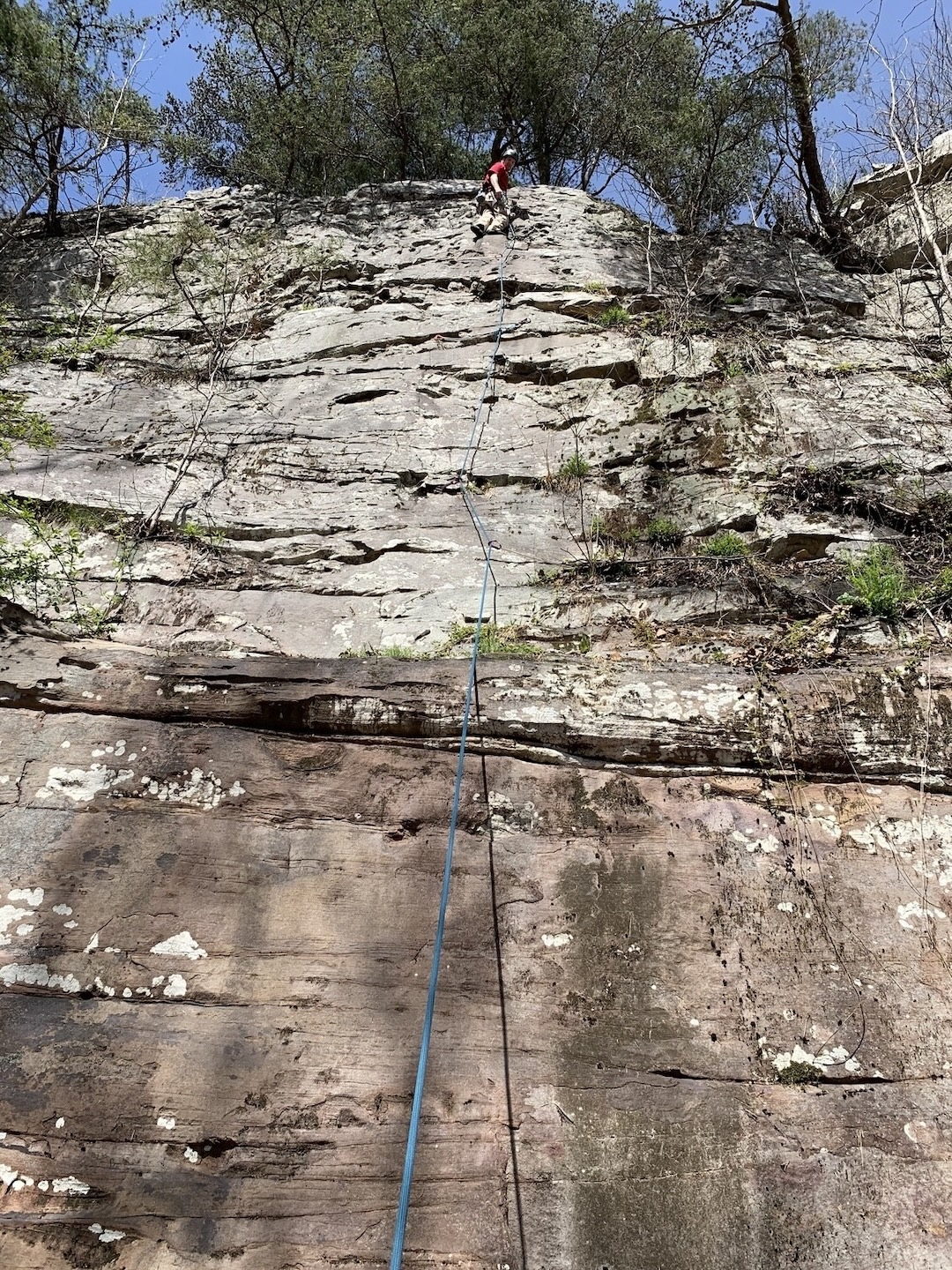
On November 16, 2024,* around 10 a.m., I arrived at Palisades Park with my partner and some newer climbers. That day, this small, approachable crag was already busy. Walking the cliff top, I passed a party setting up a top-rope anchor on the popular route Buckets (5.5). They were using a large tree, backed up with tubular webbing running to a smaller tree nine feet back. Their setup looked unnecessarily complicated, with a lot of different webbing strands and connecting carabiners.
Shortly after reaching the base, I heard screaming and looked up to see a child falling and then hitting the ground, having fallen the full length of Buckets (50 or 60 feet). I reached her moments later. The girl, around 11 years old, was conscious and alert, with no loss of consciousness, no C-spine tenderness, no pelvic instability, and no visible deformity to her extremities. She had abrasions to her left wrist and right shoulder and some minor back pain. Her helmet showed no obvious damage.
EMS arrived, determined she was stable for ground transport, and called off the inbound helicopter. She was taken to the local children’s hospital and discharged that same morning with no major injuries. Witnesses didn’t think she’d hit anything on the way down that might have slowed her fall. After the scream, I heard only one impact—when she hit the ground.
ANALYSIS
Upon arriving at the girl’s side, I had found her attached to a single strand of 11mm or 12mm static line via an ATC-type device, as if she’d been set up to rappel. The device was older and bulkier than any I had seen in 20 years of climbing. It had been threaded correctly and clipped to her belay loop with a locking carabiner, and there was no third-hand backup. The static rope still hung from the top, with no tension on the rope between the device and the top. I did not know how or if the rope was anchored at all. Slack rope lay on the ground around her and on her lap.
From bystanders, I learned that, to descend, the girl had been put on a single-strand rappel because at 60 pounds she was “too light” for a double-strand rappel. This configuration had been used with her before. Bystanders also said that someone had been providing a fireman’s belay, but this was of no help given that the rope had simply pulled through the anchor when the girl weighted the system. Her grandfather, who had prior military rappelling experience and had reportedly worked on climbing walls, had rigged the anchor.
The immediate cause of this accident was that a rope was not anchored. How it was configured remains a puzzle. First, as already noted, the anchor seemed unnecessarily complicated—more components mean more to check and more possible mistakes. Second, the rappel itself was avoidable; an easy trail reached the base. Third, the party likely failed to test the system before the girl weighted it. Finally, the first person to rappel was a child. An 11-year-old cannot reasonably be expected to discern a rigging error, much less object to it.
When the grandfather was building the anchor, he might have threaded or clipped the rope near its midpoint—appropriate for a slingshot top-rope. He might have then attached the girl’s ATC to one strand near the middle. Had he then instructed her to rappel, this single unfixed strand would have pulled through the anchor when weighted. The fix was one simple step: a knot clipped directly to the anchor. That the group intended to top-rope Buckets afterward suggests the rope was never fixed at all. (To my dismay, while the father and grandfather took the girl to the hospital, another family member built a nearby top-rope anchor and began belaying a second child. That anchor was configured so that a fall would have sent him swinging into an adjacent face.)
This weighs heavily on me—I have an eight-year-old who recently started leading outdoors. As climbing grows, the gaps in education, especially in the gym-to-crag transition, are becoming more prevalent. Anyone who takes less-experienced climbers or family members outside carries a de facto guiding responsibility. (Sources: Dylan Addis, MD, and the Editors.)
*This incident occurred late in 2024. We felt it was important enough to include in the 2026 publication (which reported accidents that took place in 2025).
Media Gallery