
Recon: Mt. Kenya
The Heart and Soul of African Alpine Climbing
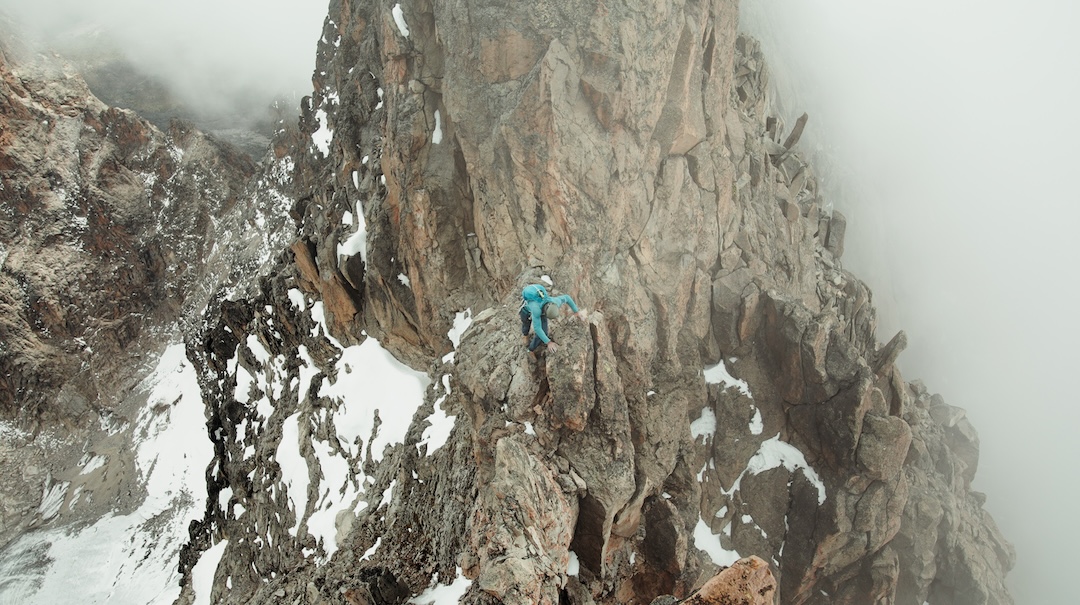
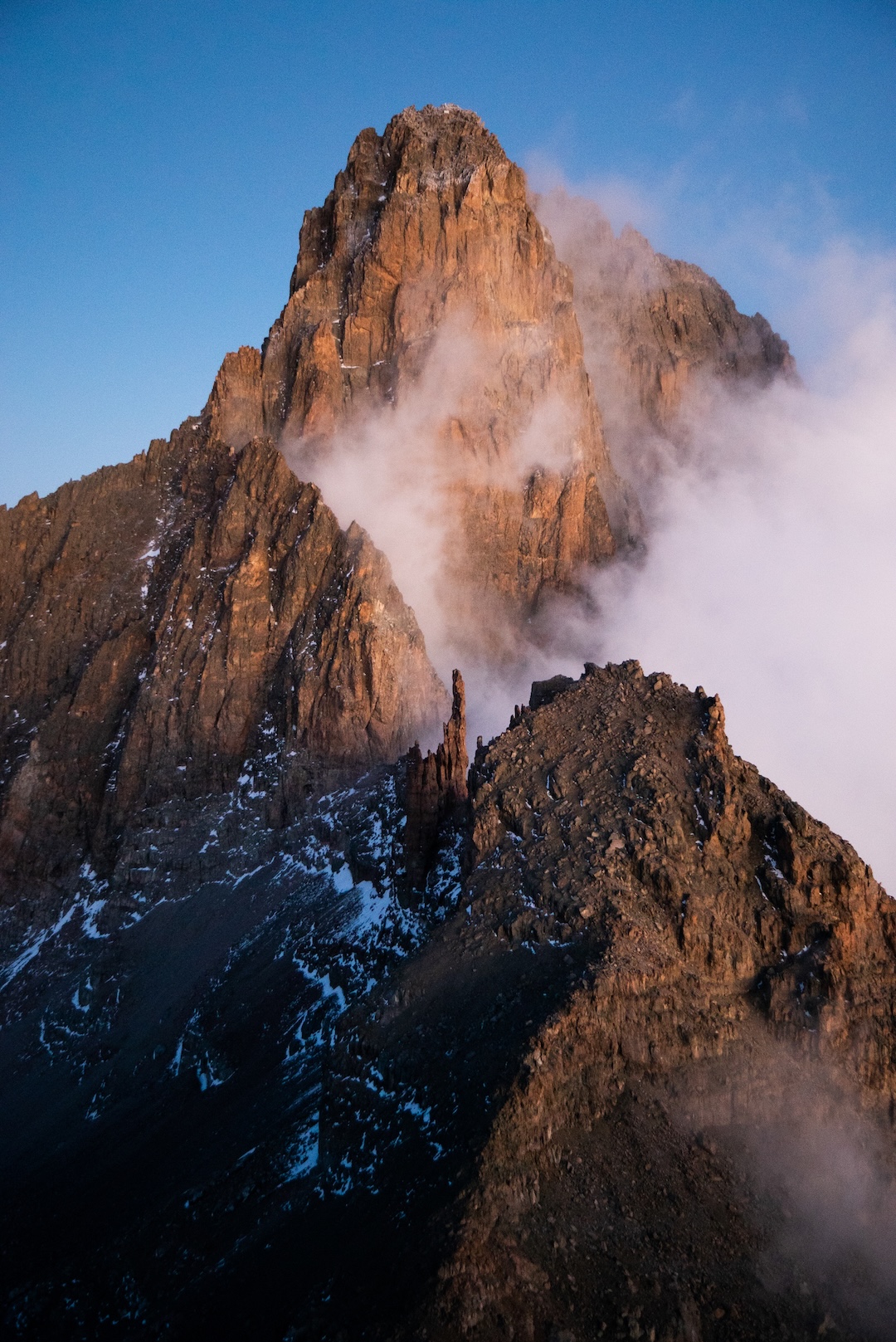
A stark silhouette of black rock and glistening ice looms over the equator: the central ridgeline of Mt. Kenya, a peak that rises to 5,199 meters from the plains below. Forming the second-highest mountain in Africa, its tallest points, Batian (5,199m) and Nelion (5,188m), are accessible only by technical routes. These summits and their satellite peaks hold an incredible collection of adventurous, high-caliber climbs above 4,000 meters—drawing experienced mountaineers from around the world.
Yet the mountain is more than an international climbing destination: Offering its name to the nation, it stands as a symbol of Kenya itself. It has borne witness to the lives of some of the earliest human beings in the Rift Valley to the west, to waves of migration of African peoples, to the tumult of colonialism and resistance, and to the efforts of local and indigenous Kenyan mountaineers to write their own stories on its flanks.
The physical history of Mt. Kenya is as turbulent as its human lore. The massif is an extinct volcano, arising millions of years ago from the lava and debris of massive eruptions triggered by the East African Rift. Its central cone once stood much higher, before glaciers carved it down and sculpted a surrounding landscape of narrow crests, deep cirques, and shimmering tarns.
The rock on the main peaks is mostly syenite and phonolite. While many sections are solid, others are becoming increasingly unstable as a result of climate change. Glaciers that formerly reached down into the valleys are now retreating, leaving heaps of loose rubble. Many ice routes, such as the famous Diamond Couloir on the southwest face, are phantoms of their former selves, thin patches of white instead of the shining continuous lines of the past. No one has climbed the Diamond Couloir since 2018, and that ascent took place 13 years after the previous one.
The mountain’s equatorial position creates unusual conditions, with large temperature swings from sunny days to cold nights, and strong winds around sunrise. The two main climbing seasons are dictated by the sun’s biannual migration over the equator: for south-facing rock routes, mid-January to February; for north-facing rock climbs, August to early September. In the past, the seasons for ice routes generally followed the opposite pattern, though even in their prime, ice conditions had little predictability.
This location also makes for a unique tropical alpine biosphere, with colossal versions of many plants flourishing under the strong sun and heavy rainfall. Agriculture thrives up the mountain’s humid lower slopes. Native forest begins around 2,000 meters, with soaring podo and red cedar trees punctuated by bamboo, hiding herds of elephants and buffalo and rafts of endemic birds. A guide is essential here, as is hiking only during the day to avoid encounters with aggressive megafauna.
From 3,000 to 3,500 meters, enormous heather shrubs grow in high-altitude heathland. By around 3,800 meters, the Afro-alpine zone begins, with otherworldly flora, in particular giant groundsel and lobelia. The most likely mammal to be encountered is the rock hyrax, resembling an angry guinea pig but most closely related to the elephant. Red-tufted sunbirds flit between flowers, their long, twin tail feathers fluttering in the breeze. Leopards, hyenas, and even lions sometimes prowl along high passes, though the mummified remains of a leopard or those of the elephant “Icy Mike,” both above 4,000 meters, serve as chilling reminders of the dangers of the mountain even for these wild beasts.
Facing Mt. Kenya
Artifacts such as blades and pots found as high as 3,200 meters testify to a long human presence on Mt. Kenya, going back to the Late Stone Age. According to Yale archaeologist Veronica Waweru, earlier human ancestors may have relied on the mountain’s favorable habitats for millions of years.
Four major ethnic groups later formed in the area, each with their own names for the mountain: Kĩrĩnyaga (“mountain of brightness” or “mountain of the ostrich,” a reference to the resemblance of the mountain’s ice to white feathers) for Gĩkũyũ (Kikuyu) and Embu people; Kîrîmaara (“mountain of patches”) for Meru; and Ol Donyo Keri (“mountain of stripes”) for Maasai. The name Kenya itself probably derives from the peak’s designation by a lowland ethnic group, the Kamba. In 1849, when German missionary Johann Ludwig Krapf became the first European to see the peak, his guide, Kamba trader Kivoi wa Mwendwa, told him it was called “Kiima Kiinyaa” (meaning either “mountain of the ostrich” or “mountain that does not dry”).
To the indigenous people living in its shadow, the mountain holds varying religious significances, which have mingled with cultural and political symbolism to give it a prominent place in the wider Kenyan public consciousness. Gĩkũyũ scholar Jomo Kenyatta—later the first post-independence president—published Facing Mt. Kenya in 1938. The first printed monograph by an African anthropologist about their own people, the book excoriates the colonialism that threatened to separate Gĩkũyũ residents from their lands and customs. Its title refers to the Gĩkũyũ practice of facing Kĩrĩnyaga during important ceremonies, and it linked the author and the mountain as emblems of the struggle for independence.
In Gĩkũyũ mythology, Kĩrĩnyaga is sacred, an abode of Ngai, or MweneNyaga (“possessor of brightness” or “possessor of the white patch of the ostrich”), whenever the deity visits the earth. Near the world’s beginning, Ngai took Gĩkũyũ, ancestral father of the Gĩkũyũ people, to the mountaintop and showed him the lands he would receive below. Then Ngai brought him back down and retreated to the misty peaks and skies—after telling Gĩkũyũ to raise his hands toward the mountain and offer sacrifices if he needed urgent help.
As Christianity became the majority religion in Kenya, indigenous beliefs intertwined with imported ones. With more rangers and planes circling the highest peaks, people began noticing that Kenyan pilgrims were venturing up the mountain to pray. Given the lack of precolonial written records, one can only guess when this practice started and how high early people got, though Gĩkũyũ creation myths suggest at least a legendary summit ascent.
The most famous recorded pilgrimage was that of Ephraim M’Ikiara, a Meru preacher, who in 1979 heard a call from God. Barefoot and carrying only a short length of hemp rope and a small satchel of belongings, he threaded through forests to avoid official entrance gates and permit requirements. As he made his way up the mountain, he slept in caves and moved at night to evade rangers. In a remarkable feat, he soloed Nelion, where the incredulous park warden Phil Snyder spotted him from a plane, reclining and reading a Bible on the sunlit summit.
Mt. Kenya’s two main summits were named in the late 19th century, at the suggestion of British geographer Halford Mackinder, after notable Maasai oloiboni, or spiritual leaders. Mbatian (which became Batian) was a powerful unifying leader who predicted the coming danger of the “great iron snake,” the colonial railway that eventually connected the coastal city of Mombasa to Lake Victoria; Mbatian guessed at the devastating consequences of collaborating with the colonizers. Nelieng (Nelion) was Mbatian’s brother, and Olonana (Lenana, the name given to the mountain’s third-highest summit) was his son, who ignored his father’s warning and became an unwitting pawn in the British conquest.
Countless other summits and features (Melhuish, Dutton, Thomson, etc.) retain the names of European missionaries, administrators, and explorers who began documenting the mountain in the late 19th and early 20th centuries. Many of their missions ended in disaster, such as when Austrian naval officer Ludwig Van Höhnel was “pounded into jelly by a wounded rhinoceros,” as British geologist John Gregory put it in an account of his own failed attempt to climb the mountain. There is now a growing push to rename some of these landmarks after local figures, especially the places named for people who had little to do with the mountain.
1895–1939: Colonial Reveries
Although travelers from the Arabian Peninsula, South Asia, coastal Africa, and other non-European regions had long visited the area, when Krapf reported his sighting of the mountain in 1849, few Western geographers believed there could be snow near the equator. Some insisted he’d only seen light reflecting off chalky earth. Not until 1883, two years after Krapf’s death, would another European explorer, Scotsman Joseph Thomson, corroborate his story.
The establishment of the British East Africa Protectorate in 1895 (this became the Kenya Colony in 1920) hastened European exploration, and the first recorded ascent of Batian duly followed. In 1899, Italian guide César Ollier and porter Josef Brocherel led Halford Mackinder up the southeast face of Nelion. They slept on the ridge below its summit before painstakingly cutting steps across the adamantine ice that Mackinder named the Diamond Glacier to reach Batian, the highest point of the mountain. Now known as Mackinder’s Route (UIAA IV), their line is seldom repeated today.
Behind this acclaimed success, a troubling story lies. After arriving in Nairobi on the train Mbatian had warned against, Mackinder hired a huge group of Swahili, Gĩkũyũ, and Maasai porters, cooks, and guards. During the approach from Nairobi, distrust and conflict persisted between colonial expedition members, African workers, and nearby villagers. Two Swahili porters were killed in a skirmish, one died of dysentery, and some deserted. Many were driven to the edge of death by forced marches on very little food, threatened with guns, or beaten for attempts to escape and other perceived infractions.
In 1910, British authorities created forest reserves around Mt. Kenya to seize control of timber resources, driving many indigenous residents from the mountain’s slopes. As colonial settlers focused on farming the nearby “White Highlands,” nearly 30 years elapsed without another recorded summit.
Then, in 1928, Eric Shipton, the son of a British tea planter in Ceylon, arrived in Kenya to begin an apprenticeship at a coffee farm in Nyeri—within sight of the mountain. After learning to climb in the Alps, he’d decided to work in East Africa because he’d noticed high peaks on the map. His first glimpse of Mt. Kenya in person left him entranced. “I was expecting something good,” he recounted in Upon That Mountain, “but the exquisite loveliness of that sunlit peak, floating high above a still sleeping world of tropical colour, was far beyond anything I could have imagined.”
A year later, with British civil servant Percy Wyn-Harris, Shipton made the first recorded ascent of Nelion, overcoming an “insecure and unpleasant-looking crack”—as Wyn-Harris’s Alpine Journal account describes it—to establish the Normal Route (UIAA IV inf.) up its southeast face and southeast ridge. Now the mountain’s classic route in the December–February season, it follows the line of least resistance, up gullies, cracks, and a couple of thrillingly airy traverses. Upon reaching Nelion’s summit, they traversed the Gate of the Mists that separates the two highest peaks to make the second ascent of Batian.
Soon thereafter, through fellow colonial mountaineer Jack Melhuish, Shipton met Harold “Bill” Tilman, a British coffee grower in Kenya. Although Tilman was only a novice climber, Shipton felt he had a “natural aptitude” for alpinism: “He had a remarkable ability to put up with—even a liking for—unpleasant conditions.” Shipton soon provided his new protégé with plenty of scope for this form of enjoyment, and the two formed a legendary partnership.
Together, Shipton and Tilman ticked most of the major unclimbed peaks on Mt. Kenya. Their adventures proved to be good preparation for future expeditions to the Himalaya, where they became known for their hallmark style of lightweight exploration and mountaineering. In an astonishing few days in July 1930, beginning with an “uneventful” ramble to their high camp, “save for a meeting with rhino and elephant”—as described in Shipton’s Alpine Journal report—they made the first recorded ascents of the West Ridge of Batian (V), as well as the satellite peaks of Point Dutton (4,885m, Grade II scrambling); Point Peter (4,757m, via the northeast gully and ridge, III); Tereri (4,714m, unknown scrambling route); Point Piggott (4,957m, via its northwest face, III); and Midget Peak (4,700m, via its south gully, IV).
The West Ridge, the first route that went solely up Batian without first climbing part of Nelion, posed the greatest challenge to the pair: They scrabbled for holds and climbed on top of one another’s shoulders to reach small edges. Despite losing an axe and suffering the consequences of a “tin of bad meat essence,” they continued through the night to complete the first full traverse of the central ridgeline. One of the duo (simply called “the first man”) slipped off an icy ledge and lost consciousness, but Shipton’s account remains characteristically understated: “Considerable complications arose, and much time was wasted before we were reunited just above the ledge where the fall occurred.”
In 1938, Ayub Muthara made the first recorded ascent of Nelion by an indigenous Kenyan. Though little is known of Muthara, it seems he might also have been the first Kenyan technical guide on the mountain, leading U.K. climber Carol Carroll to the top of Nelion; she thus became the first known woman to stand on its summit. Later in 1938, Una Cameron completed the first recorded female ascent of Batian. “Scottish in family, Scottish in speech, and firmly Scottish in drink,” as her Alpine Journal obituary has it, Cameron had achieved trailblazing ascents in the Alps and the Caucasus before traveling to East Africa, where she established her own new route on Mt. Baker (Kiyanja) in the mist-wreathed Rwenzori of today’s Uganda.
This period of calm for the colonial elite would soon end, as even the tropical loveliness of Mt. Kenya would not escape the geopolitical upheaval shuddering across the world.
WWII and the Mau Mau Uprising
When World War II arrived in the region, both Britons and indigenous Kenyans were mobilized, willingly or unwillingly, whether by joining the army, working to produce food for soldiers, or cutting firewood from Mt. Kenya’s forests to fuel the factories that created dehydrated military rations.
Recreational climbing understandably lulled during this period, though an account of an unusual wartime adventure can be found in No Picnic on Mount Kenya by Felice Benuzzi. In 1943, three Italian prisoners of war—Benuzzi, Giovanni Balletto, and Enzo Barsotti—escaped from their prison camp in Nanyuki, some 20 miles west of the base of Mt. Kenya, to attempt a summit, relying on ropes made of the thin cords that attached mosquito nets to prison beds, basic crampons and ice axes that they and an accomplice forged with scrap metal and stolen hammers, and a picture of the peak from a torn-off food-can label. After skirting rhinos, elephants, and a circling leopard, Benuzzi and Balletto were forced off the northwest ridge of Batian by a blizzard. They planted their flag on Lenana instead, then the three men broke back into the prison camp to wait out the war.
Other climbing continued as well, and an unsung but remarkable Gĩkũyũ guide emerged: Ali Mucemi. In an Alpine Journal account, British Lord Malcolm Douglas-Hamilton described Mucemi leading him up nearly every pitch up Nelion in 1941, including what sounds like strenuous dry-tooling ahead of its time: “To my horror he hooked the ice-axe into a crevice as high as he could reach up on the buttress and hauled himself up on it.” In the following years, Mucemi made what was probably the most ascents on the mountain by any indigenous Kenyan at the time. His story ended in tragedy: While guiding in 1949, he fell limp on the rope, presumably of a heart attack.
The most notable first ascent during this period was of the north face of Batian (IV sup.), by Peter Hicks and photographer Arthur Firmin, in 1944. Winding through a rock amphitheater and past the gendarmes on the west ridge, their itinerary provides the now-classic Standard Route to the summit in the July–September season.
Born in Kenya to English parents, Firmin went on to climb nearly every known route on the mountain during the postwar years. He also added his own, including the Southwest Ridge of Batian (IV), in 1946. There, Firmin led his partner, colonial administrator John Howard, up ice and snow and a steep buttress. On the final ridge, he found his passage blocked by a large, sheer rock. He saw no option except to remove his ungainly boots and climb the section barefoot.
Around this time, Firmin and others began honing their skills at a crag just outside Nairobi, Lukenya, and this accessible training ground fomented a growing solidification of the climbing community. In 1949, the Mountain Club of Kenya (MCK) spun off from the Kenya Section of the Mountain Club of East Africa (established in 1929) to form its own organization. That same year, Mt. Kenya became a national park.
In the mid-1950s, a now-legendary figure in Kenyan mountaineering began to appear frequently on Lukenya’s rocks: Kisoi Munyao. Before an untimely death in the Himalaya in 1955, Firmin had introduced Munyao, his photography assistant, to climbing. A Kamba from near Lukenya, Munyao was hooked, and in 1959 he became the first indigenous African to make a recorded ascent of Batian.
To achieve this, Munyao obtained an exemption from the access restrictions of the time. On Mt. Kenya, Gĩkũyũ freedom fighters dubbed the Mau Mau had begun a rebellion against the colonial administration that reached its height from 1952 to 1960, a period that the British euphemistically called “the Emergency.” The Mau Mau viewed Kĩrĩnyaga as a holy place and its forests as vital strongholds. British authorities forbade entry to much of the mountain, recognizing its symbolic and strategic importance to the Mau Mau and the drive for Kenyan independence. But as Munyao stood on Batian in 1959, the equatorial winds buffeting him continued to gather strength, mingling with the winds of change now blowing across the entire continent.
A year later, British Prime Minister Harold Macmillan recognized that “wind of change” in a speech that signaled a shift toward acceptance of the push for freedom sweeping through Africa. At the stroke of midnight on December 12, 1963, to mark Kenya’s independence from the United Kingdom, Munyao raised the new Kenyan flag atop Nelion (poor weather prevented his party from crossing to Batian). He was accompanied by MCK chairperson Robert Chambers and another member, Denis Rutovitz, who stood beside Munyao in a now-famous photo as he held the flag aloft.
Before the three shared a celebratory drink of Cointreau, Munyao poured out a libation to ancestral spirits. Since their radio had seized up from the cold, they lit a flare to signal the success to a secondary party on Lenana, who then relayed a message to crowds gathering in Nairobi: Ninaozungumza nanyi kutoka kileleni cha Mlima Kenya. Kenya, Kenyatta, bendera imepepea. Kenya popote mwangaza umeenea. (“I am speaking to you from the peak of Mt. Kenya. Kenya, Kenyatta, the flag is flying. Throughout Kenya the light is spreading.”) For a long time, the ethereal mountain light that so entranced Shipton had remained out of reach to most Kenyans. Now it appeared within their grasp, the massif a shining symbol of a new nation and a new hope.
African Modernism, Modern Alpinism
During the Emergency, the British had ordered roads cut higher up the mountain and new maps made to aid their fight against the Mau Mau. After independence, these same logistical aids helped launch a new climbing era—that of weekend trips from Nairobi and a subsequent proliferation of new routes by a motivated, locally based community, sometimes joined by visiting alpinists. Mountaineers started establishing more technical lines, especially up the eastern faces of Nelion, in particular the Northeast Pillar Route (at V sup. A1, now freed at VI sup.) by Barry Cliff and Denis Rutovitz, which surmounts the evocatively named Hourglass and Sinister cracks, and the East Face Route (VI A3), which Cliff climbed with two Austrians, Heinrich Klier and Siegfried Aeberli, in 1963, including a series of overhangs known as the Inverted Staircase.
A year later, Rusty Baillie and T. Phillips linked the Grand Traverse (VI) of all the central peaks (Point Piggott, Batian, Nelion, and Point John) over three days, often struggling across unfamiliar ground, over steep rock and rotten ice. At one point, after dark, Baillie resorted to “hammering [a piton] against the rock until it empirically discovered itself a niche,” as Phillips wrote in the Alpine Journal, though the piton vanished into the night as soon as he unclipped the rope.
Moving into the 1970s, Kenya continued to transform, blending tradition and change, with benga music flooding the airways and African modernist architecture erected in Nairobi. Mt. Kenya climbing entered a defining new chapter with the rise of the two Ia(i)ns, Howell and Allan. Both of British origin, Iain Allan grew up in Kenya and went on to found a high-end safari and guiding company, while Ian Howell was a self-effacing radio engineer known for wearing his helmet in the passenger seat during some of the more adventurous drives to climbs. They made a formidable team, with countless first ascents on the rock, ice, and hardened baboon poop and vulture guano of Kenyan cliffs. Along the way, they evaded rhinos on descents, scared off a leopard that tore through their tent, and discovered mummified bodies hidden on top of remote crags—signs of early indigenous ascents.
On Mt. Kenya, the two added eight hard new routes, including the intimidating Equator (VI sup. A1), up a swath of rock on the south face of Batian, left of the Diamond Couloir. During its first ascent, in 1979, they balanced up steep corners and strenuous cracks and spent two shivering bivouacs on ledges before summiting on Christmas Day. Its only recorded repeat took place 20 years later, when the legendary South African duo of Edmund February and Andy de Klerk had to scale two new pitches of loose rock uncovered by the fast-shrinking glacier at its base. In the meantime, Howell established an additional four routes on Nelion and Batian—three of which he completed with another local stalwart, John Temple—and made a further invaluable contribution by nearly single-handedly constructing Howell’s Hut (so named against his wishes) on top of Nelion, soloing the peak 13 times to ferry the building materials.
Alongside the climbing successes, the number of accidents grew. The most famous of these was the rescue of Austrian Gert Judmaier, who, in 1970, spent seven nights with an open fracture below the peak of Batian, tended to by his climbing partner Oswald Oelz, MCK volunteers, and visiting mountaineers. A rescue team flew out from Austria and helped rig zip lines and rappels to bring him down. Judmaier made a miraculous recovery, but a young American helicopter pilot, Jim Hastings, died in a crash during the efforts. The Austrian government later donated the Austrian Hut near Lenana in recognition of the rescue team.
The most coveted route of the 1970s was the Diamond Couloir, a dazzling line of ice and snow that lures the gaze straight up the mountain’s southern side. In 1973, when Phil Snyder, a horseshoe-mustachioed American who had become warden of the national park, learned of prominent alpinists planning to steal the prize from abroad, he decided to take swift action. Snyder had arrived in Kenya on a cargo ship a few years prior, an itinerant climber planning to stay for six weeks before heading on to Papua New Guinea. Instead, as he recounted in his memoir Boma: Behind the Grass Curtain, he found in Mt. Kenya the “Xanadu of [his] childhood dreams.” There, he met Bill Woodley, the warden of all mountain national parks in Kenya, who convinced him to train what would become the world’s first Black mountain rescue team in response to the Judmaier accident. In the early 1970s, Snyder was offered the Mt. Kenya park warden job.
Because of time constraints, Snyder and Ian Howell had to abandon a first attempt on the Diamond Couloir, during which they’d overcome the main difficulties. To complete the line, Snyder enlisted Thumbi Mathenge, a Gĩkũyũ member of the rescue team. Mathenge had grown up in the foothills of the sacred mountain, and he’d impressed Snyder with his calm stamina. The two struggled up steep icefalls—Mathenge with mismatched, borrowed gear—and spent a frigid night perched on an icy ledge before continuing on to the Diamond Glacier and the summit.
In an MCK Bulletin, Snyder recalled their “cosmic toil,” likening the pair to dung beetles crawling up the mountain. Two years later, Americans Yvon Chouinard and Michael Covington ignored the omen of a monkey frozen into the ice at the route’s base to establish a direct finish. Two years after that, British alpinist Hilary Rhodes became the first woman to climb the route, with her partner, Peter Boardman. Remarkably, this was Rhodes’s first real ice climb.
Mathenge’s ascent pointed to a growing trend: By this point, technical guides on the mountain were increasingly indigenous Kenyans, and their skills and confidence were growing. John Omirah Miluwi, a Luo from Lake Victoria, was another of Snyder’s protégés, and according to Snyder the most natural climber of the rescue team. Despite almost losing fingers to frostbite on the West Face of Batian with Snyder, Miluwi remained a keen mountaineer. He is perhaps most famous, however, for acting as a tracker in the movie Gorillas in the Mist, though his reception in New York for the premiere lacked Hollywood glamour: He found nobody waiting for him at the airport, so he simply set off for the city on foot.
Perhaps the most renowned mountaineer to emerge from this movement was James “KG” Kagambi, who grew up in Mt. Kenya’s foothills and began guiding at age 22, after becoming enamored with the peak’s snowy slopes. He has climbed Nelion and Batian more than 60 times, as well as the Eiger and Denali. In 2013, for the 50th anniversary of Kenyan independence, he hoisted the flag on Batian, reenacting Kisoi Munyao’s climb. Nine years later, Kagambi became the first Kenyan to summit Everest, as part of the first Black team to do so, at the sprightly age of 62.
New Challenges and Old Traditions
As the 21st century has unfolded, local climbing protagonists have become even more reflective of modern Kenya. Brothers Nikunj and Parag (Fish) Shah—whose Oshwal forefathers arrived from India the same year that Mackinder first climbed the mountain—offer a glimpse into the vibrant mix of cultures, influences, and stories in the region. As well as establishing their own routes throughout the country, they have striven to make the scene more welcoming and accessible.
Nikunj, the elder, joined the 50th anniversary independence climb, and as an honorary warden of the Kenya Wildlife Service, he has worked to preserve the mountain for all, initiating and supporting trash cleanups, tree planting, and rescue training. Fish (a nickname from school) has also taken part in cleanups and trainings, in addition to adding bolted rappel lines to Nelion and Batian to facilitate safety and rescue. “The mountain, to both of us, is our second home,” Nikunj says.
Over the decades, the pace of new routes established has slowed as the gaps between them, especially on the main peaks, has narrowed. In recent years, many mountaineers have focused on new challenges, such as hard free routes. A notable example is the impressive first free ascent of the overhanging bulges and corners of the southwest face of Point John (5.11c) in 2004, by the German Felix Berg and Gĩkũyũ Charles Kamau, a rescue team ranger Berg had been training—a partnership that echoed Snyder and Mathenge’s ascent of the Diamond Couloir some 31 years earlier.
In 2007, Berg added two more testpieces with Peter Horsey, who was usually found bouldering near Nairobi and was up for an adventure on the mountain. Trying to shorten the hiking approach, Horsey got his Land Cruiser trapped in rocks around 3,400 meters, and after a futile attempt to get the vehicle moving again, they abandoned it and arrived late at Shipton’s Camp on foot. The next day, they climbed Central Groove Line (7a) on an unnamed tower left of the base of the north face of Batian. A day later, they scaled their second new route in a blizzard, partly motivated by the need to recover Horsey’s climbing shoes, forgotten at the top of Central Groove Line. Hängender Pfeiler (7a+ A2) was so overhanging that despite the heavy snow they stayed fully dry until the summit.
Speed ascents also have grown in popularity. In 2009, Berg eclipsed the previous record for Nelion’s Normal Route, soloing it in just 56 minutes. In a country famous for long-distance runners, Kenyan athletes such as Cheruiyot Kirui have blended ultrarunning and mountaineering, setting records on the main trails up Lenana, including summiting three times in under 24 hours, going back down to each of the three main park entrance gates between each ascent. Kirui also used the mountain as a training ground for Himalayan objectives. In September 2023, with their ascent of Manaslu, he and James Muhia became the first Africans to climb an 8,000-meter peak without supplemental oxygen. Tragically, Kirui passed away in 2024 while attempting the same feat on Everest.
In recent years, perhaps no mountaineer has embodied the current style on Mt. Kenya more than Peter Muambi Naituli, a climber of Meru descent. In 2015, at just 16, Naituli established a new route on Point Dutton, and he began guiding on Batian at 17, soloing the peak the first of several times just three years later. In 2025, he set a record for the Batian Standard Route of 1 hour, 17 minutes.
In 2020, Naituli soloed the Southeast Gully of Point John (III) barefoot in an echo of M’Ikiara’s pilgrimage. Growing up, Naituli had scrambled on rocks and trees around his grandparents’ village at the base of Kîrîmaara, and before this ascent he visited his grandmother to obtain her blessing. Her song of protection circled in his head as he climbed into the clouds. For Naituli and for many other indigenous Kenyans, climbing Mt. Kenya remains not only a technical challenge but also a deeper pull to honor their ancestral connections to this mountain—realm of the divine, symbol of an independent nation, and still wild and ripe for adventure.
About the Author: Ian Thorpe is the chairperson and librarian of the Mountain Club of Kenya and lives in Nairobi, Kenya. Hailing from Manchester, England, but having grown up in France, he works as an interpreter when he’s not climbing.
This story was edited by Katie Ives. Additional thanks are owed to René Barendregt, Alfonso Peter Castro, Cecilia Padilla-Iglesias, James “KG” Kagambi, Freda Nkirote M’Mbogori, Mũkũyũ (Gīkũyũ Centre for Cultural Studies), Peter Muambi Naituli, Rajeshvari Patel, Anne-Marie Peatrik, Nelson Ole Reiyia (Nashulai Maasai Conservancy), Victor Riitho, James Russell, Nikunj and Fish Shah, Phil Snyder, Njoki Nathani Wane, and Veronica Waweru.
LOGISTICS AND SAFETY
Mt. Kenya is a national park, where entry fees and a guide are mandatory to enter, though experienced climbers can leave their guides at the base of climbs. If hiring a technical climbing guide, carry out due diligence first.
There are huts at most entrance gates, as well as camping spots along all hiking routes, and basic huts in Mackinder’s Valley on the north side, Teleki Valley on the south side, and below Lenana—all accessible to hikers.
A very helpful tip sheet for climbers and walkers on Mt. Kenya has been prepared by the Mountain Club of Kenya (MCK) and posted at their website.
The best printed guidebook, though dated, remains the Guide to Mount Kenya and Kilimanjaro, edited by Iain Allan. A new map of the mountain was published in 2017 by the Austrian Alpine Club. Both are available from the MCK in Nairobi, whose members are also working to digitize all Kenyan guidebooks and make them available for free. Detailed topos for some of the most popular routes have been posted on various websites. For additional information, contact the MCK.
As the roadhead on Mt. Kenya is relatively high, climbers can reach high altitudes quickly, and pulmonary and cerebral edema are common—care should be taken to acclimatize properly. Kenya Wildlife Service, which manages the park, has some rescue rangers, supplemented by volunteers from the MCK, and helicopter rescues (at flat landing sites, not high on the mountain) are offered by Tropic Air. Evacuations can be made to Nanyuki Cottage Hospital, but for the highest quality care, Aga Khan Hospital in Nairobi is recommended.
The prevailing ethic for climbers on the mountain is to use natural protection as much as possible, with the placing of bolts generally discouraged, with the notable exception of the bolted rappel lines on Batian and Nelion.
Media Gallery