Mt. Crosson Group Ski Traverse
Alaska, Alaska Range
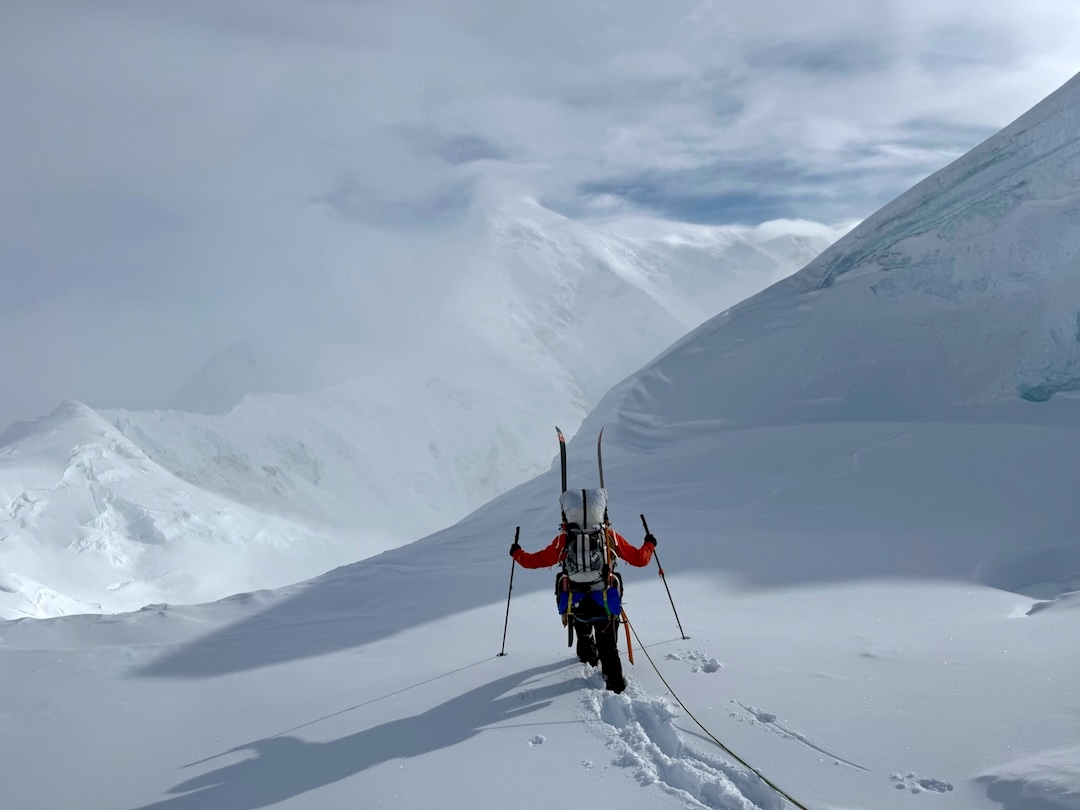
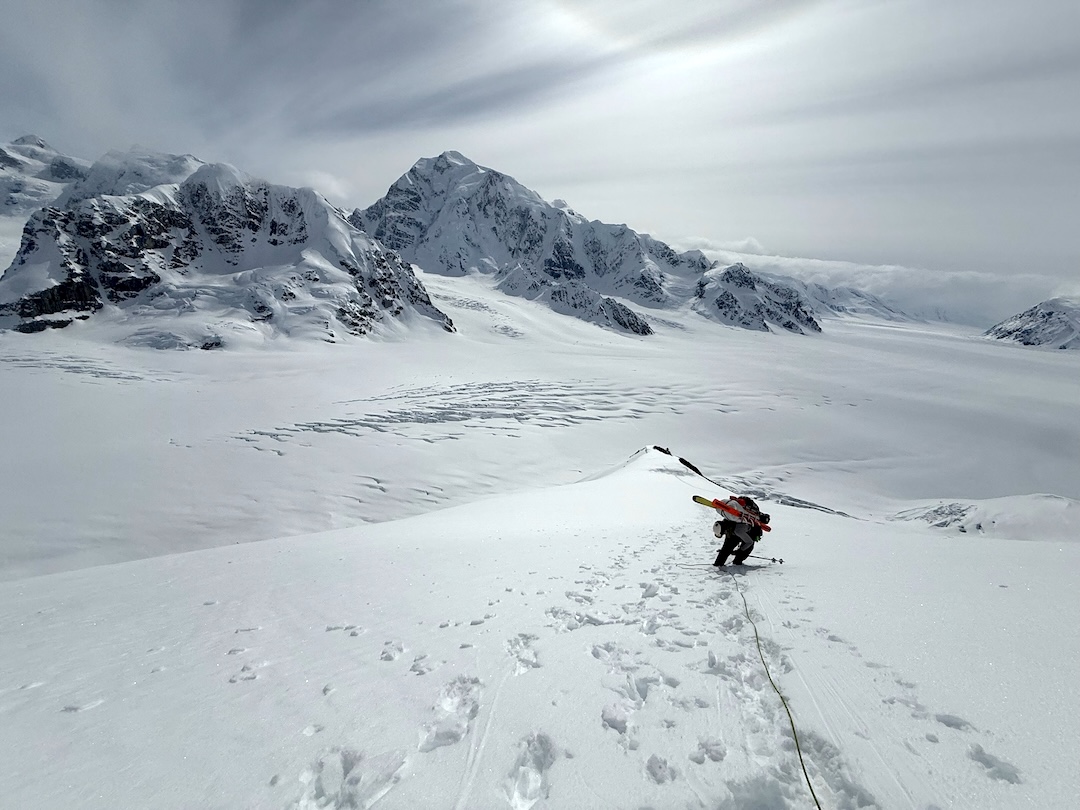
Shawn Jordan setting out for the 12,800-foot summit of Crosson. Mt. Foraker and the Sultana Ridge are in the background. Photo by Roo Streba
Shawn Jordan and I are Tahoe-based skiers who have adventured together throughout the Sierra. The climbing and expedition history of the Alaska Range have interested both of us for much of our lives. During a visit to the north side of the range in 2023, we conceptualized a trip that would marry aspects of old-school expedition-style mountaineering with modern, lightweight gear and skiing techniques, and that we could pull off in the limited time our lives and work allowed. We flew up to Anchorage in May 2025.
After an anxious few days of trip delays in Talkeetna, Shawn and I landed at Kahiltna Base Camp on May 13 and immediately set off across the glacier to start our ascent of the southeast ridge of Mt. Crosson, the 12,800-foot peak’s normal route. The snow conditions were reasonable, but with our heavy packs the going was a slog.
On the second night, we camped below the summit of Crosson in a cold windstorm and discussed our plan. Multiple forecasts seemed to agree—for once—and they showed a poor trend in the weather. With satellite imagery showing our chosen river of egress in the midst of a later-than-normal break-up, we concluded we would not have the time to complete Plan A: traversing to the Sultana Ridge and up Mt. Foraker, with a descent by skiing the north face and packrafting to Lake Minchumina via the Foraker River.
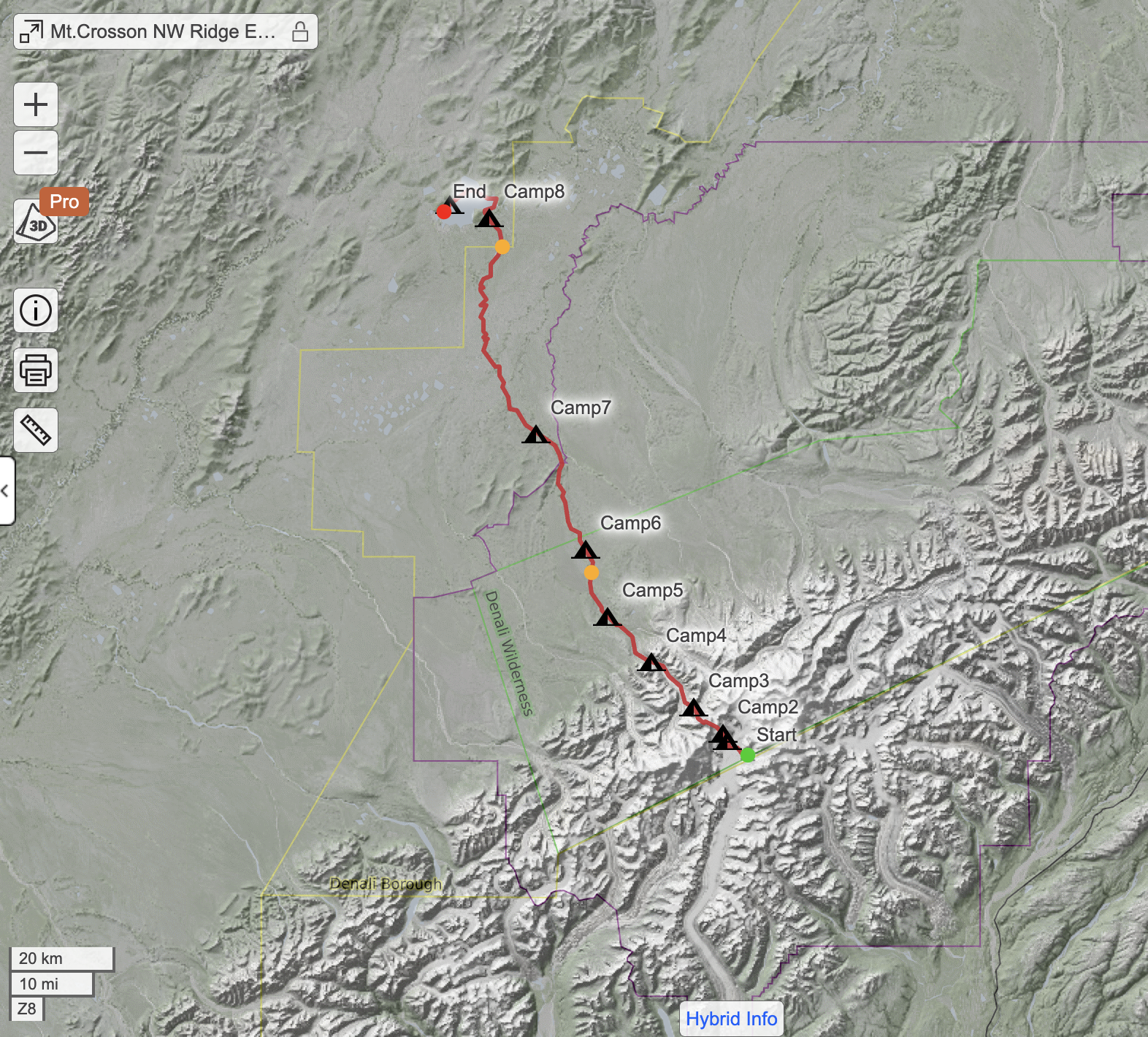
So, we switched to Plan B: climb over the three peaks of the Crosson group, ski down to the northwest to reach the Foraker Glacier, then ski and packraft to the bush village of Lake Minchumina. The full journey would be just under 100 miles.
The next day, we woke to excellent weather, summited Crosson, and continued west over Peak 12,472’ (the peak that marks the start of Foraker’s Sultana Ridge) and Point 11,910’. Although summiting a peak is generally very exciting, three summits did not triple our excitement, and by the third we were very much ready for our final transition.
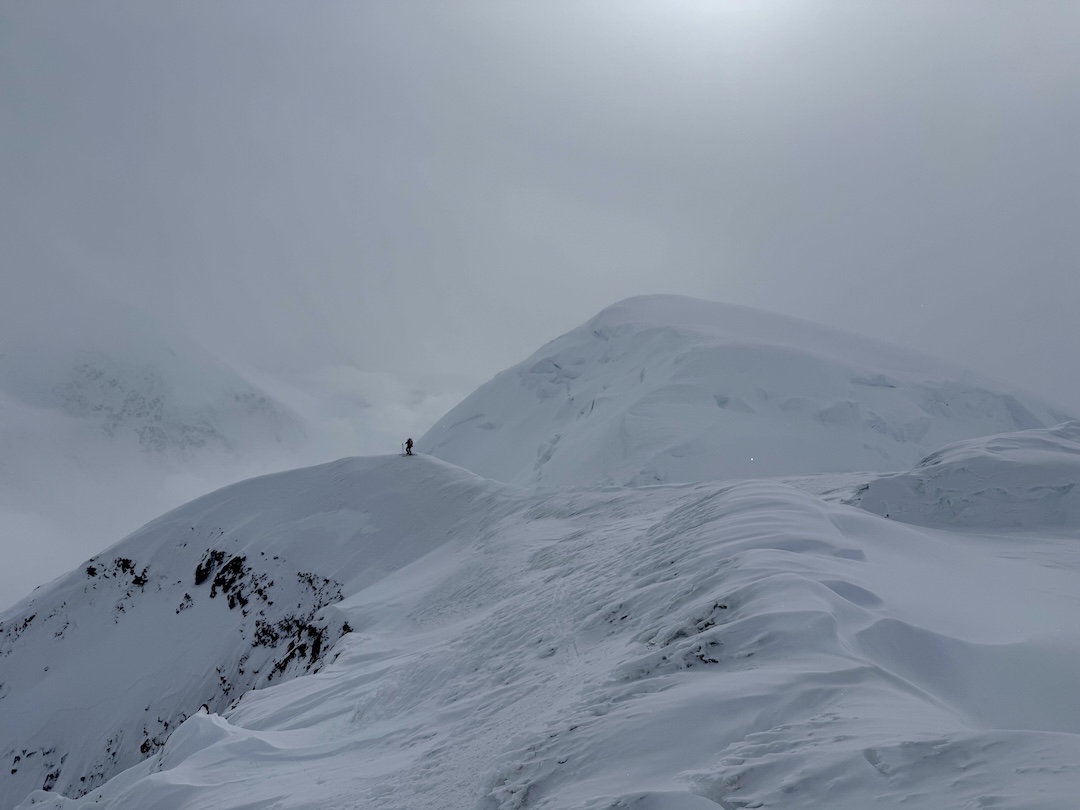
The skiing on the descent varied as much as skiing can. Windswept ice gave way to awkward turns in an upside-down snowpack. The steepness changed dramatically, and at one pinch point in the ridge we rappelled over some suspicious snow.
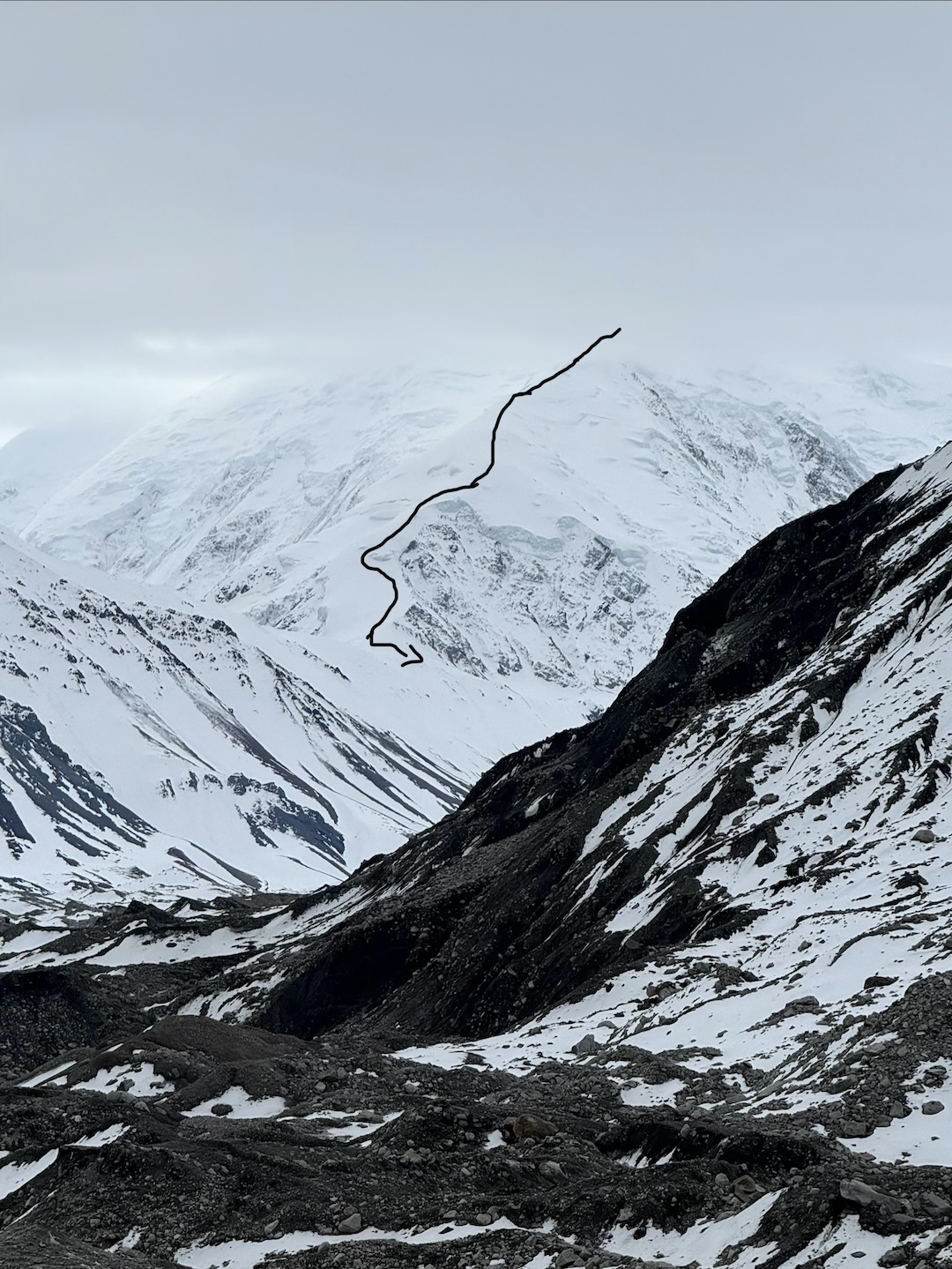
Despite less-than-glamorous skiing, the views couldn’t have been better: Foraker’s great north face to our left, the back side of Kahiltna Dome to our right, and the north side of the Alaska Range giving way to endless tundra before us. Clouds moved in and out, but somehow we managed to keep good visibility. In the gloaming, we navigated the final seracs on the ridge and made it to a pass between the Foraker and Straightaway glaciers, where we spent our third night. Park rangers later told us this was the first ski descent of the northwest ridge of the Crosson group.
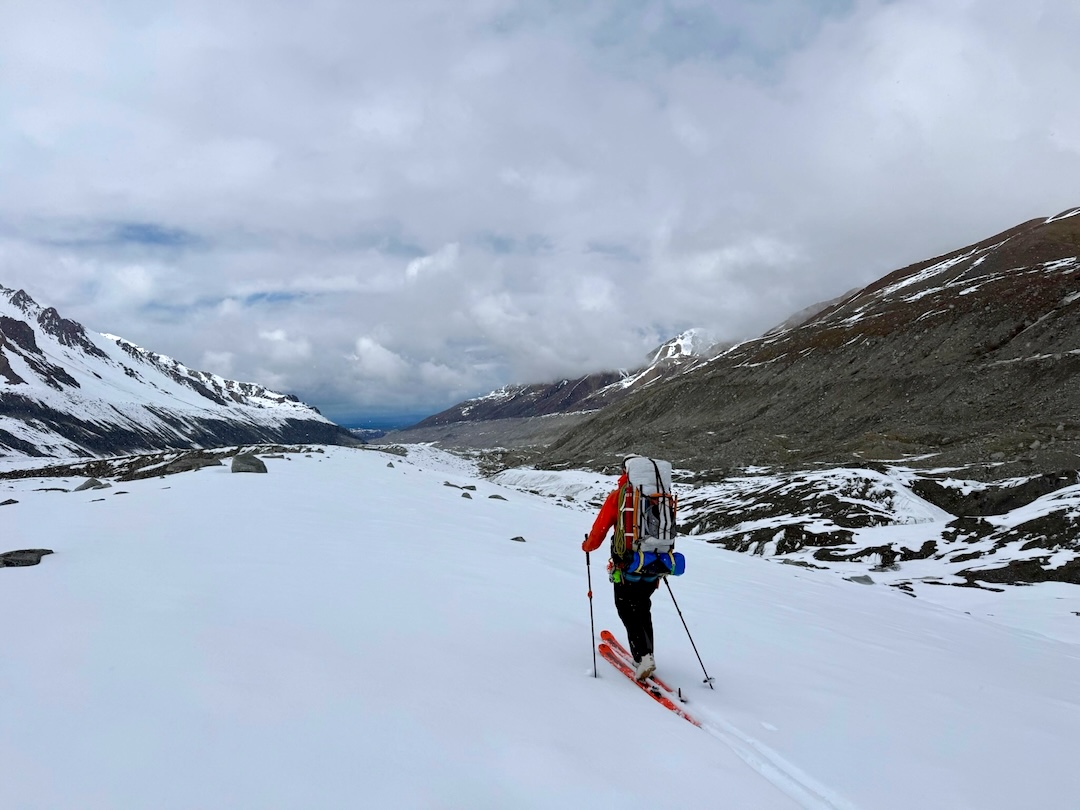
Day four was a dream: We skied the remaining 2,000 feet down to the main Foraker Glacier on a spring snowpack capped with a few inches of powder, easily the best skiing of the trip. (The full descent from Point 11,910’ had been nearly 7,000 vertical feet.) For the rest of that day, we skinned and then walked to exit the Foraker Glacier, appreciating the incredible mountains surrounding us. We passed massive skiable lines on unnamed peaks that would be legendary and coveted in the Lower 48. Signs of life—an occasional bear print, a small plant, and, finally, birds—slowly started to appear as we navigated the moraine.
The next few days provided endless opportunities for character building. The pleasant and efficient travel of the glacier and high tundra gave way to thicker and thicker vegetation, until we found ourselves in all-out brawls with alder thickets. The alders won many of these battles, pulling skis off our packs, testing (and breaking) our patience, and severely hampering our progress, yet we persevered, and on the third afternoon of the descent, we finally found a comfortable location to launch our packrafts.
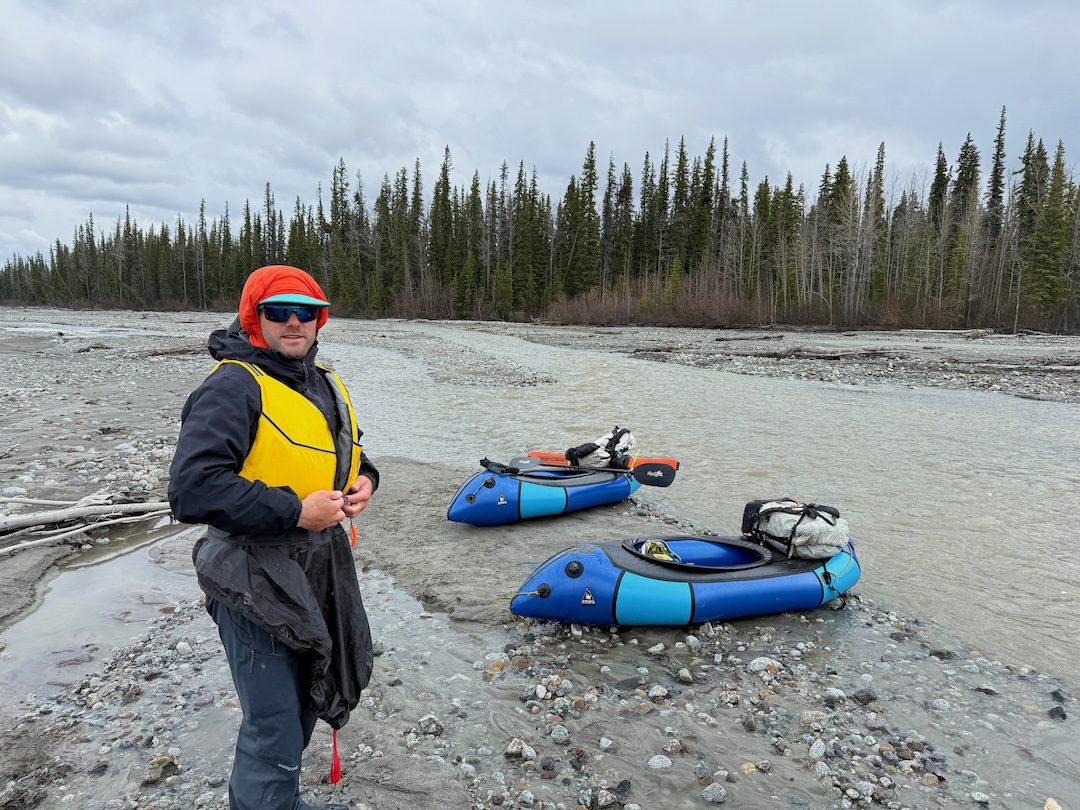
We are skiers a thousand times more than we are packrafters, and, acknowledging this weakness, we had discussed in depth our safety measures, communications, and strategy. We pushed into the fast-moving and turbid glacial river, readying ourselves for epic rafting. Ten yards down the river, my boat scraped bottom and halted. I freed myself, only to notice Shawn stuck ten yards below me. Confused, we continued down, repeatedly getting stuck and unstuck. Finally, with exasperation, we climbed out of rafts and discovered that we were able to walk across the entire river without going more than knee deep.
The following two days were wet. We found ourselves in a cycle of rafting until we hit bottom, walking our boats down the river until it was deep enough to raft again, and repeating. Despite the toil, we made good time and deeply enjoyed our surroundings. Caribou walked past our camp, birds flocked in droves, and planes rarely flew overhead.
We finally reached the confluence of the Foraker River with the White River. In normal years, this confluence is of little consequence, as the White River becomes a trickle by summer. This year, due to the late thaw, the river was running at several times the flow of the Foraker, and the next several miles went by in a flash. By dinnertime, we were beyond satisfied with our progress and entirely exhausted. That night, we found enough dry sticks to make a fire and, for the first time in days, went to sleep dry.
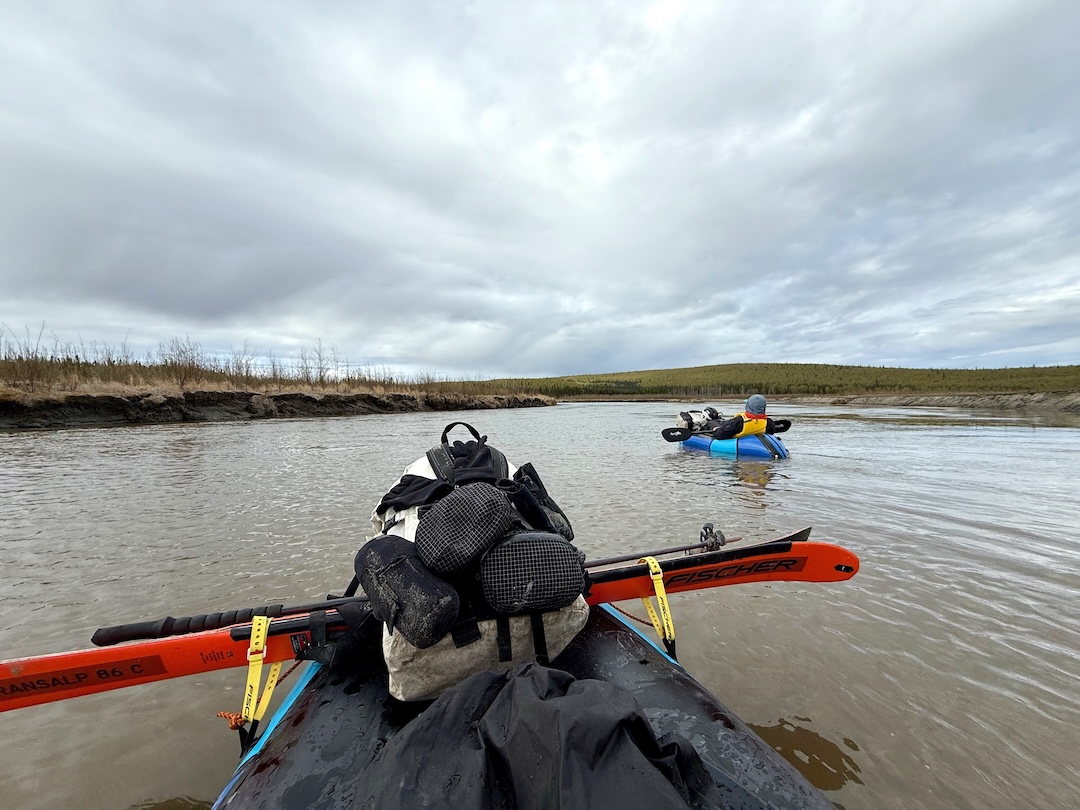
The river flowed hard for several more miles, but as the gradient decreased, it sprawled and slowed. Prior to the trip, we had been advised that the Foraker River no longer terminates in Lake Minchumina, and only a branch still reached it. Soon we noticed the river was rising—not the water in the river, but the riverbed itself, which was now notably higher than the surrounding land. In certain sections, parts of the massive river had broken through and were spilling into the muskeg swamp. (We later learned that glacial rivers carry so much silt that, as the river’s gradient and power decrease, the silt builds up until the river eventually breaches its banks.) As we finally neared the branch allegedly heading for Lake Minchumina, the river simply terminated in mud flats.
We paddled to a sandbar, pulled out our backpacks, and started walking along the dried-up riverbed. In the late-twilight glow, we reminisced on the trip so far—how lucky and grateful we were to see such a wild and remote part of Alaska, to follow the high alpine into the muskeg swamps, to maintain our health and have relatively few hiccups along the way. At one point, a juvenile grizzly false-charged us, and upon realizing we weren’t giving ground, awkwardly sauntered into the brush. At another point that same evening, we both simultaneously fell into quicksand. That night, as we finally went to sleep, we could hear sled dogs howling in the distance.
In the morning, we transitioned for the last time to our packrafts and set off down an inlet of Lake Minchumina (elevation 630 feet). After nine days alone, we were giddy at the prospect of meeting other people. After a few turns, we were greeted by a beautiful house surrounded by well-maintained grass, horses, and a dog team. We had arrived at the home of the Collins twins, Julie and Miki, two women who had spent their entire lives in the bush. They made a living by trapping and had recently started writing books and articles chronicling their adventures. They gave us a tour around their homestead and treated us to a fantastic home-cooked meal.
The Collins twins live across the lake from the town and airstrip. When we casually mentioned our plans to hitch a ride with the postal plane the following morning, the twins both laughed. The late ice-off meant crossing the lake might be a several-day endeavor, depending on which way the winds blew the remaining lake ice. Alarmed at the prospect of missing our plane, we cut lunch short and hurried off.
We prepared ourselves for a final massive push through the night, but at some point the winds shifted and, somewhat biblically, opened a passage between the ice floes. We thanked our lucky stars and cruised across glassy water to a delicious meal of moose stew and pumpkin pie in Lake Minchumina. We met most of the 12 year-round residents and were told we were the third group to raft the river and the first to come from the mountains. We were also told that many members of the previous groups had decided to make Lake Minchumina their home, and we certainly understood why.
The following day, we hitched a ride on the postal plane from Lake Minchumina to Fairbanks, retracing part of our nine-day, 98-mile traverse. With a bird’s-eye view, we could watch the river meander back toward those incredible mountains. The north side of the Alaska Range is wild, rugged, and alluring. It requires a lot of effort to get there, and even more to get out. For those who persist, an excess of adventure and infinite splendor are guaranteed.
—Roo Streba
Media Gallery