
12 First Ascents in Saudi Arabia
Saudi Arabia, Wadi Al Disah, Bajdah and Wadi Dham
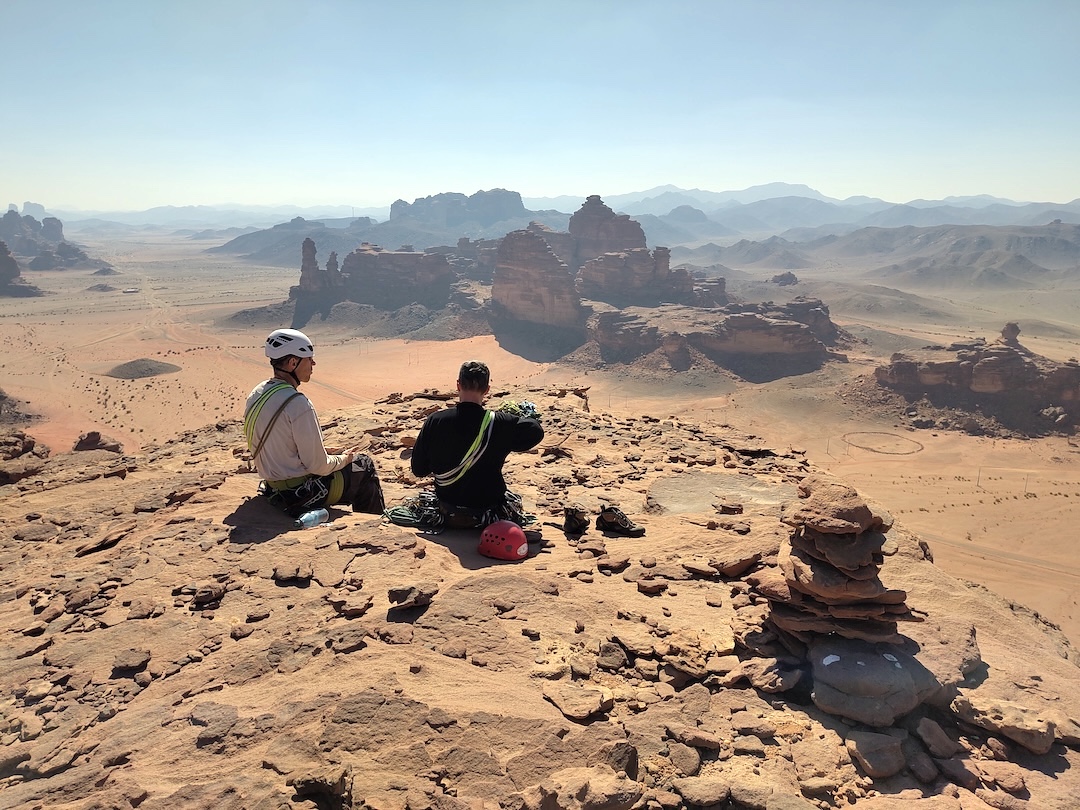
On the summit of Felsenbrüder in the Bajdah area.
Photo by Daniel Hahn
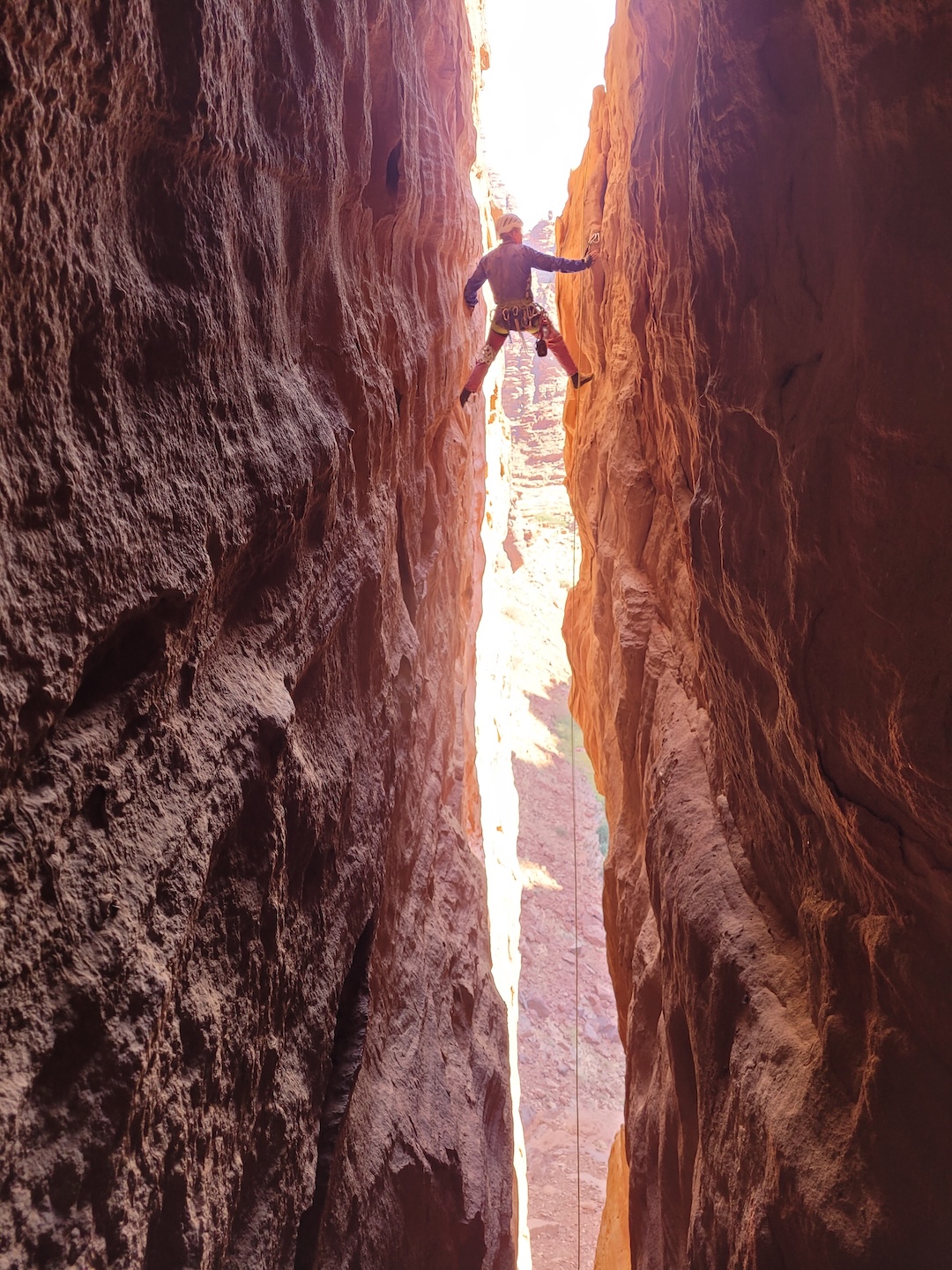
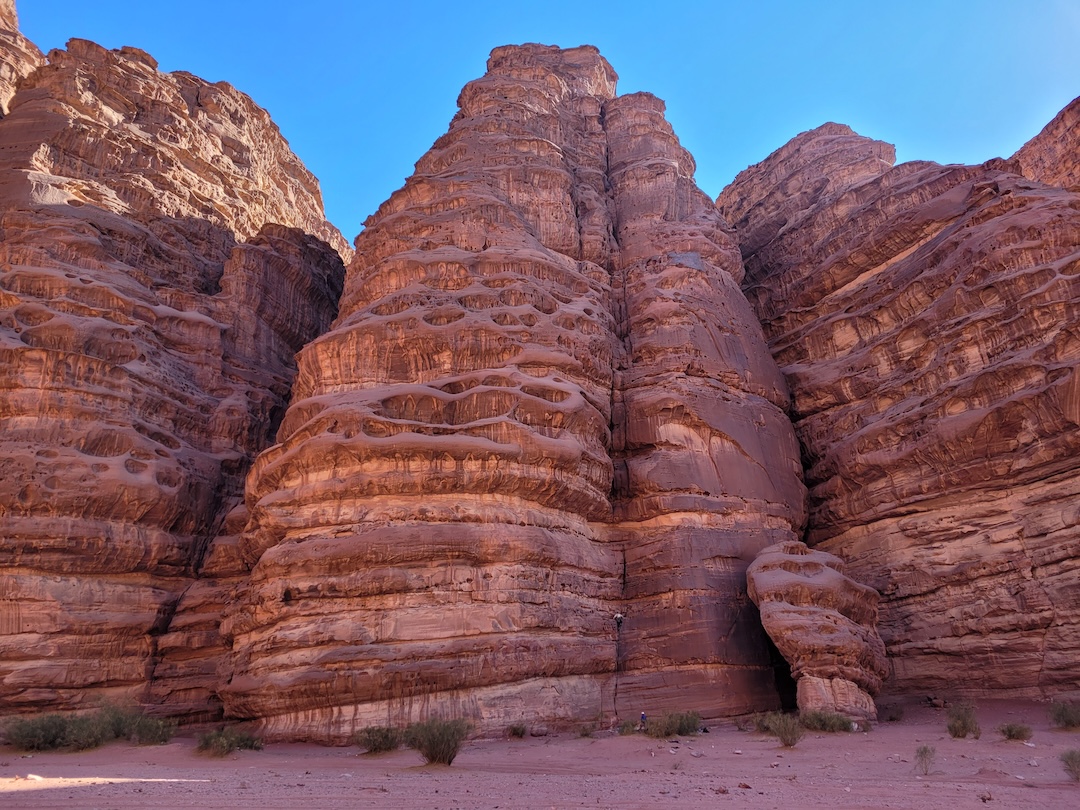
In January 2025, Michael “Michi” Bänsch, Daniel Hahn, and I embarked on an adventurous trip around Saudi Arabia to search for new climbs in a country that has only been open to Western tourism since mid-2019. After waiting a day for a missing bag to arrive at the Riyadh airport, we took a deep breath and set off toward Wadi Al Disah, 1,300 kilometers to the northwest. The closer we got to the Hejaz Mountains, the more fascinating the landscape became. When we entered Wadi Al Disah, our jaws dropped: endless sandstone cliffs, magnificent scenery, and potential for generations of adventurers.
The next morning, we headed straight to Atir, a 350-meter tower and one of the few sandstone formations in the country with documented climbing. It was climbed by a chimney route on the east side in 2013, by a party including Donald Poe, a U.S. oil engineer and Saudi Arabia resident. In 2020, a group led by Leo Houlding from the U.K. found a new line on the west face and named it Astro Arabia (5.11). We climbed the original route (UIAA V or about 5.7), hoping to encounter rock roughly akin to the famous Wadi Rum in Jordan, about 230 kilometers to the north. In fact, the rock turned out to be quite brittle and dirty. But what a summit!
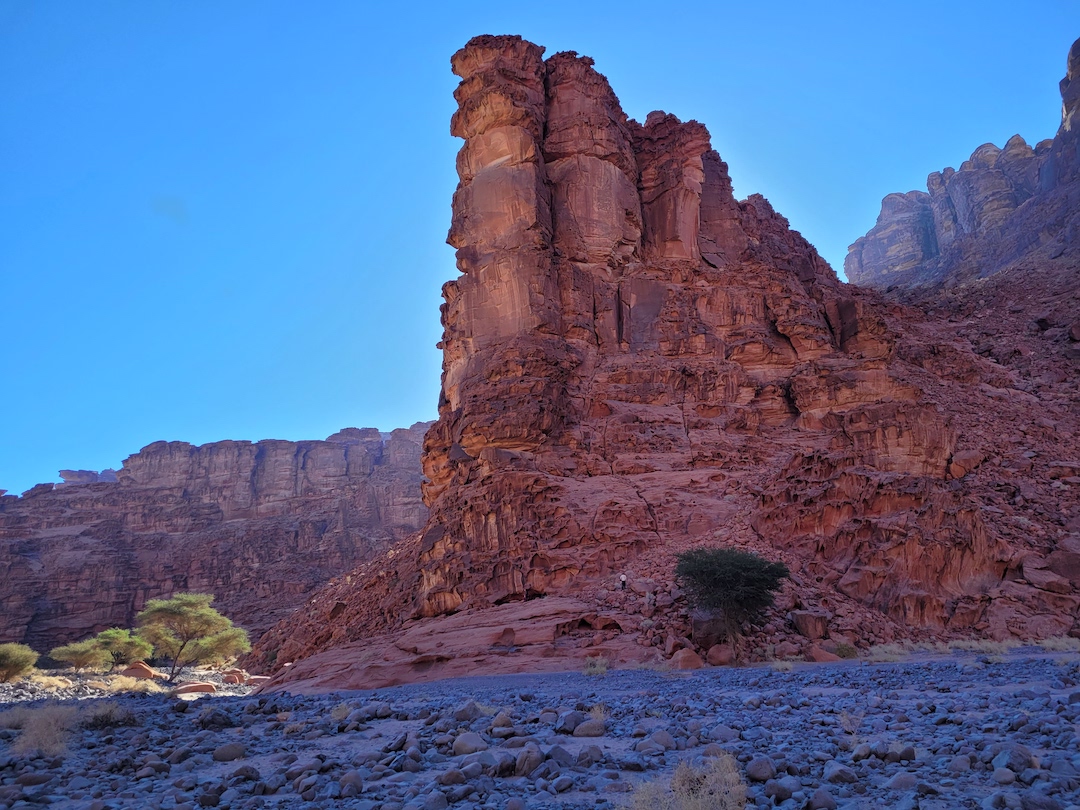
Over the next few days, we searched for more climbable rock, which was harder than we expected: There are endless formations, but upon closer inspection, many turned out to be too difficult, too fragile, or both. The fact that we did not have a drill or bolts didn’t make the search any easier. But we soon made the first ascent of a beautiful tower (which had obviously been climbed by locals up to its forepeak), right at the valley entrance. We called it Burg (“Castle,” 27°38’12.9”N, 36°31’04.6”E) and the route Uralter Weg (“Ancient Route,” 80m, VI/5.10-).
Farther into the valley, another peak tempted us, perhaps 100 meters high. Soon after we started climbing, however, we heard strange noises from below. SFES (Special Forces Environmental Safety) rangers had spotted us and were ordering us back down. After a lengthy but friendly discussion, we were surprised to learn that climbing is prohibited in the entire Wadi Disah.
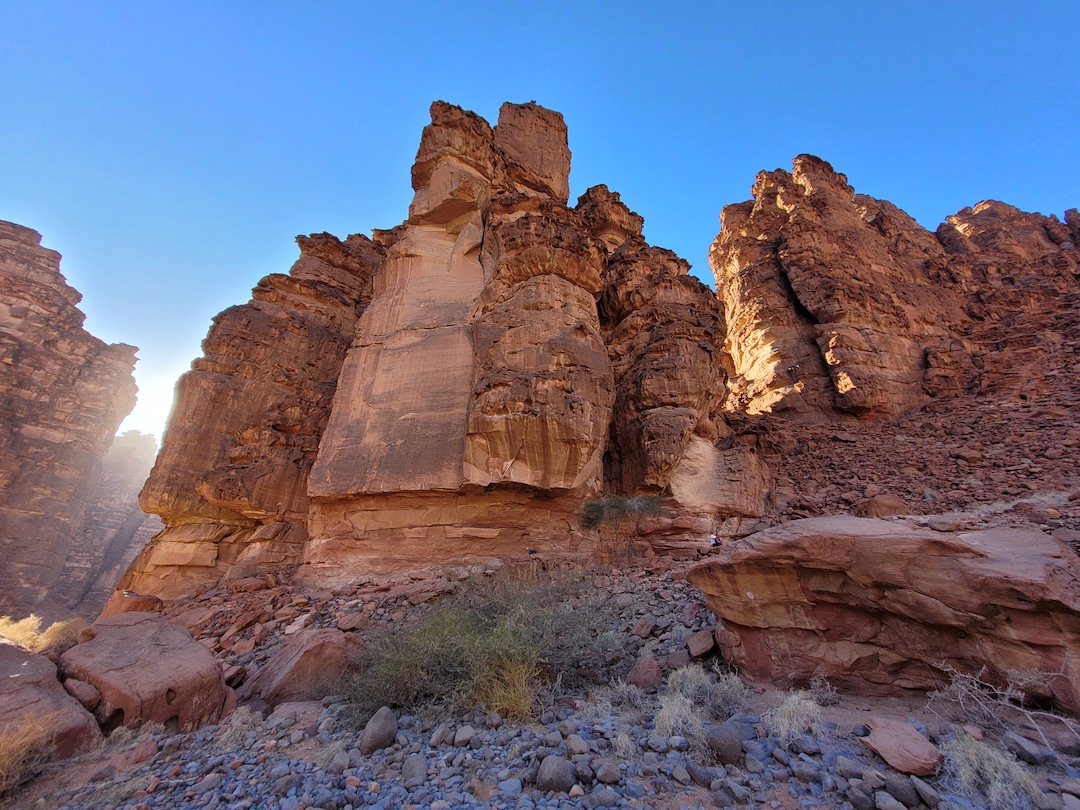
We detoured to a nearby canyon just to the north, Wadi Tarban (Tourpan), where we climbed Gemini Tower (130m, 4 pitches, V+, 27°40’24.5”N, 36°27’16.6”E) and Porcelain Tower (scrambling plus 25m, VI), before being informed by friendly locals that climbing was not allowed there either. We left the Wadi Disah area earlier than planned and continued to Bajdah, a small town farther north, near the city of Tabuk, where we had been told that climbing is officially permitted.
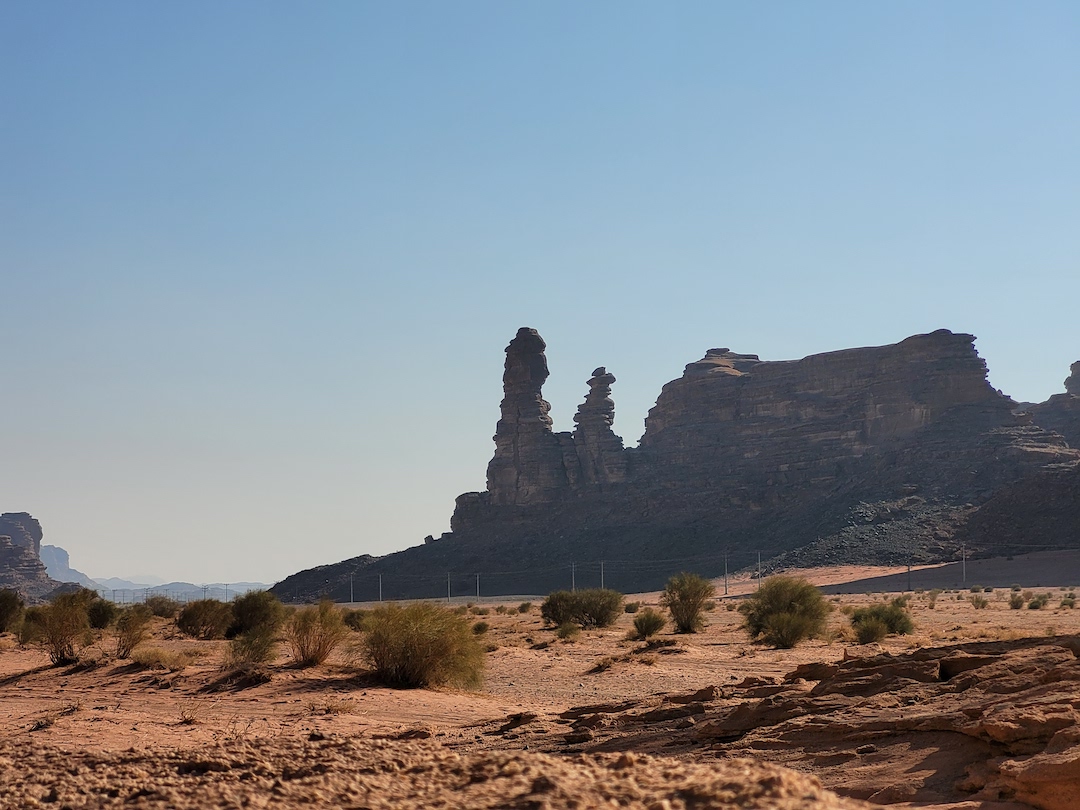
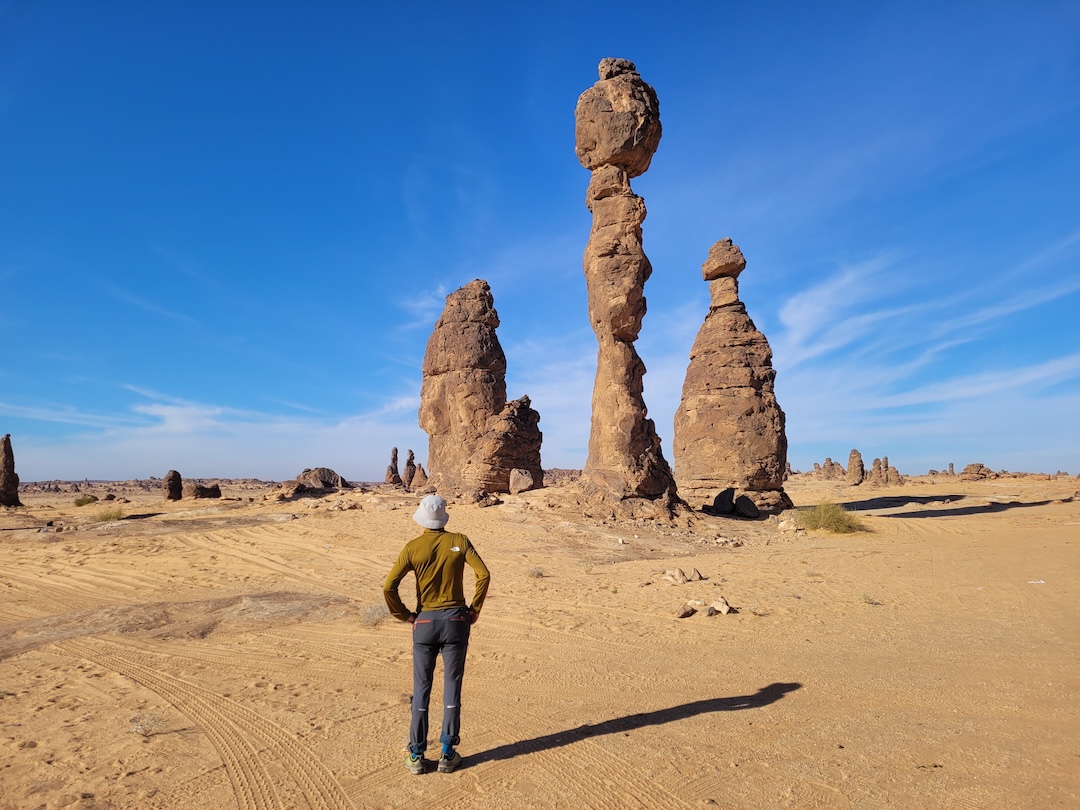
Here, a completely different landscape awaited us: an open plain from which countless rocks rise, some enormous massifs, some picturesque needles. We soon found some nice objectives, including a two-pitch needle that we named Stoneman, climbed by a route called Triumph des Willens (“Willpower,” ca 100m, VII-/5.10, 28°34’40.0”N, 35°39’19.1”E). We also climbed all five summits of a formation we named Felsenbrüder (“Brothers of Stone,” 28°35’17.1”N, 35°39’19.5”E), about 150 meters high, by the route Geschenk der Wüste (“Gift of the Desert,” VII-). The climbing here was challenging, with brittle overhangs that had to be overcome or bypassed.
Next, we visited the nearby Wadi Dham (Damh), where we found a pagoda-like formation we called Hinterhaus. Although generally easy, there were again many small overhangs, one of which required aid: Weg des Willens (VI+ C1, 28°28’30.1”N, 35°44’19.5”E). Two more days here brought us the first ascent of another small tower and some beautiful hikes in an impressive landscape—simply a wonderful time.
On all of our climbs, we only used cams, nuts, and slings. We live in Dresden, near the famed sandstone towers of Elbsandsteingebirge and Adršpach (Czech Republic), and we are very experienced sandstone climbers. Yet even though Saudi Arabia seems to offer endless sandstone climbing, the rock is very unpredictable—sometimes a hold stays put when weighted, sometimes it pops off, even when the rock looks great. With all the dust and coarse sand, the ropes got stiffer every day—all of our gear suffered.
After two weeks, I headed home. Michi and Daniel stayed for another week and visited Al Gharameel Nature Reserve, where they found countless sandstone needles. They climbed five towers, up to about 20 meters high and UIAA VI, without seeing a single trace of previous climbers.
During our travels, we met incredibly friendly people, some of whom offered us water or invited us to share tea or coffee, and shared interesting conversations, sometimes in perfect English, sometimes with gestures and Google Translate. We enjoyed a simple life, sleeping out on the sand. On some mornings, our sleeping bags sparkled with frost. We pushed or dug the car out of the sand twice. In all, we summited 13 formations, probably 12 of them first ascents.
—Stephan “Seppo” Gerber, Germany
SPORT CLIMBING IN SAUDI ARABIA: Of interest to many climbers will be sport routes developed in Saudi Arabia in late 2018 at various sandstone, granite, and limestone crags—some of them quite impressive—by Read Macadam (Oman) and various European climbers, who worked with the Saudi Climbing and Hiking Federation. The federation has published PDF guides to certain crags, and many of these routes have been posted at Mountain Project.
Media Gallery