
Mt. Le Conte, Iridescent Wall, Buns of Steel
California, Sierra Nevada, Mt. Whitney Area
Two weeks before Brandon Adams and I planned to climb the infamous route Valkyrie on Angel Wings, he called me to suggest a change of plans. Brandon, a prolific first ascensionist, had scouted a newish zone between Mt. Whitney and Mt. Langley in the High Sierra. Knowing I have a difficult time saying no to adventure, he felt out my psych for putting up a new route. It didn’t take long for me to agree.
I had signed up for a brutal hike into the Sequoia-Kings backcountry: 13 miles in and 3,500 feet up. We packed 65 pounds each for the eight-day trip and hit the trail from Cottonwood Lakes. As we crested Old Army Pass, joking that our “buns of steel” had gotten us up there, my internal calculations were entirely focused on how much food I could eat to make my enormous haulbag lighter for the second day of the approach.
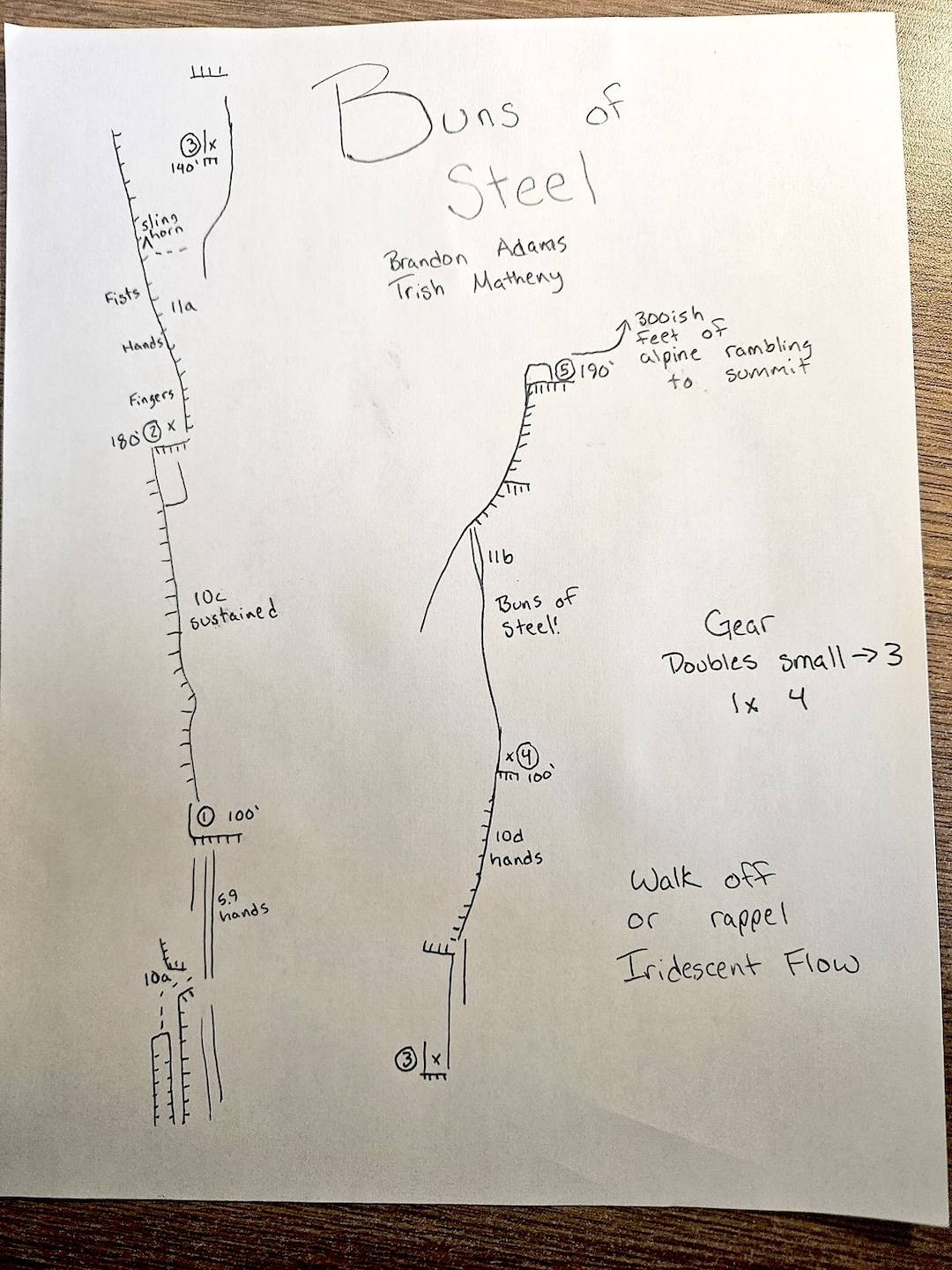
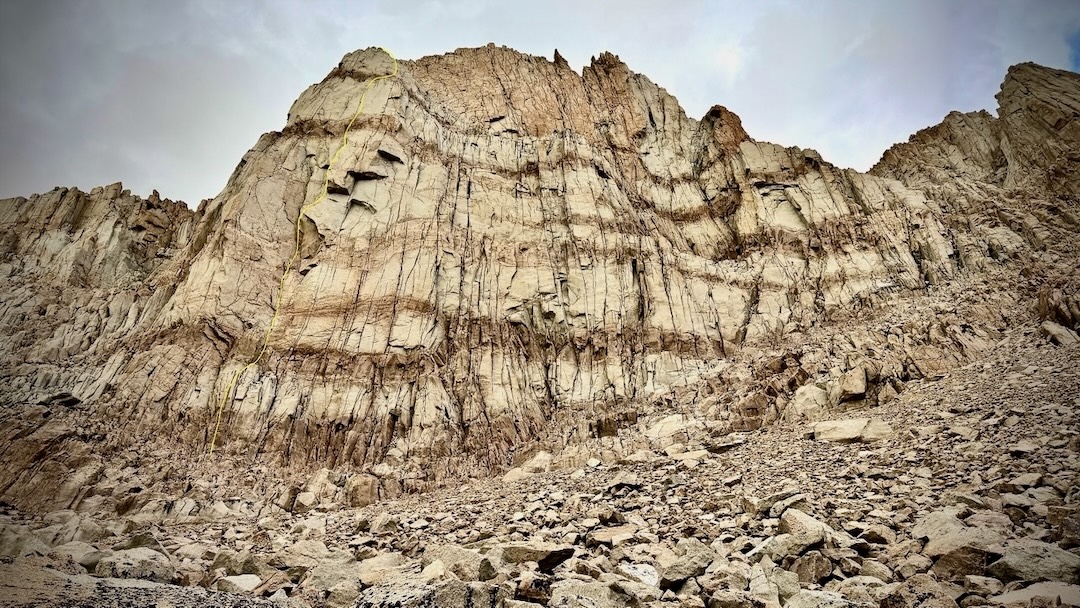
Arriving at Iridescent Lake midday, we set up camp and approached the base of the Iridescent Wall, a south face on a spur of Mt. Le Conte (ca 13,960’). Our goal was a line up the white, pyramidal pillar on the left side. We chose the most obvious corner system that splits the 1,000-foot pillar. I took the first pitch, Brandon the second. Both were 5.10, a mix of fin-like features, laybacking, and face climbing.
Pitch three was a splitter dihedral and required some delicate movement above a large, loose flake in the middle. As I had almost killed us by dislodging a similar feature on Wonder Woman, another first ascent with Brandon a couple of years prior in Little Slide Canyon (AAJ 2024), I approached this flake with a healthy dose of caution; I stopped at a stance and placed a bolt to keep the rope out of the crack if I fell. I gave it several tries but was unable to figure out the best way to gain the next corner system. Brandon took over and, relying on years of intuition, completed this delicate 5.11- pitch. At the top, he drilled a bolt to supplement the belay.
Out of bolts and daylight, we fixed our lines and rappelled to the ground, where we enjoyed supper and the first of several Uno tournaments.
The next day we cleaned the bottom three pitches of loose rock as we ascended fixed lines to our high point. I led the next corner, a fantastic 5.10+ with mostly good rock and no death flakes. Brandon then turned his attention to what we’re confident is one the best “butt cracks” in the High Sierra. Butt cracks—splitters with rounded edges—require deep jams and creative technique. At nearly 13,000 feet, Brandon huffed and puffed his way up. When the climbing finally relented, he was so gassed he could barely speak.
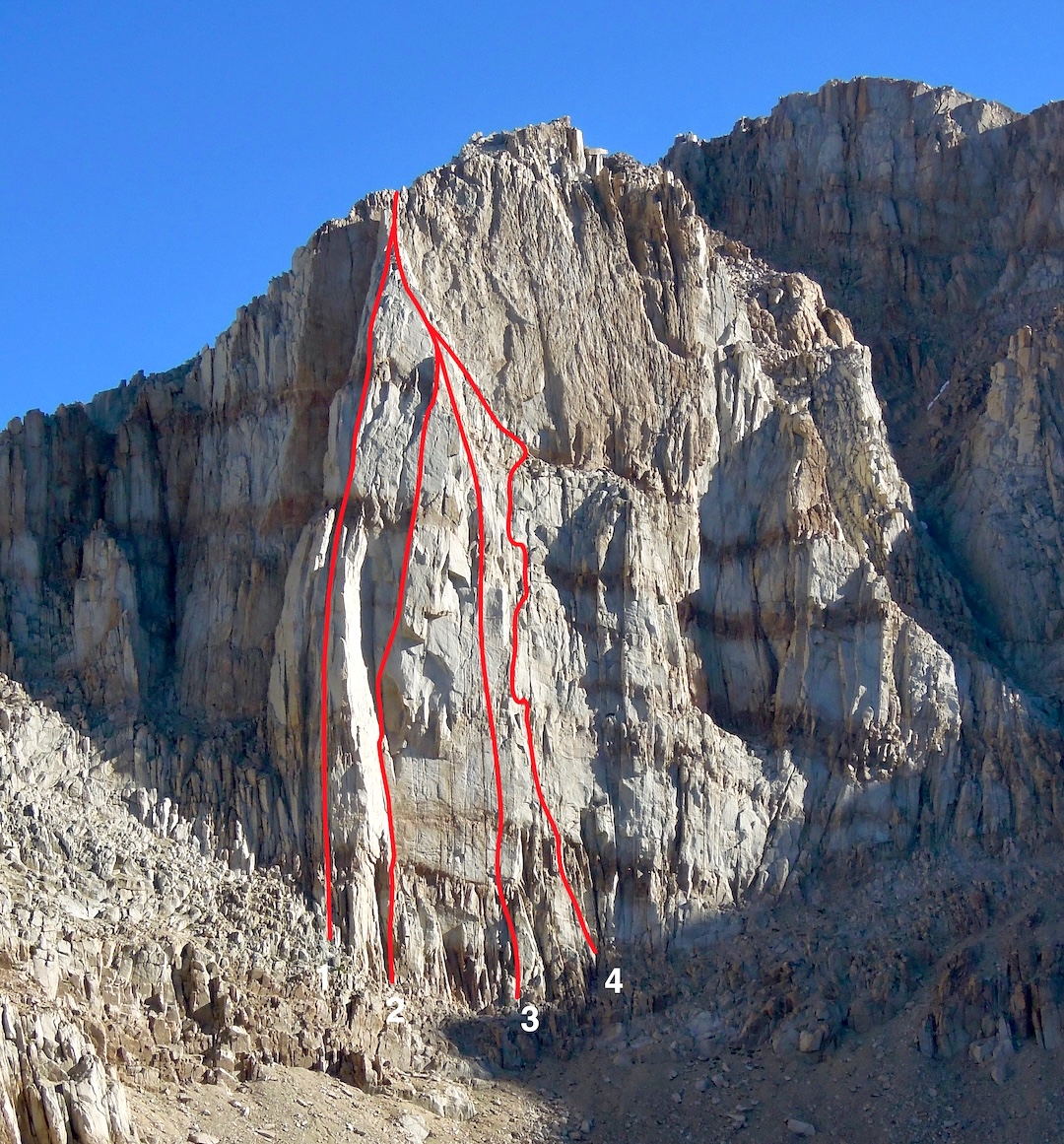
I took us up two easier pitches, at the top of which we intersected with two established lines on the face, Space Force (1,000’, 5.11b, Musiyenko-Putnam, 2018) and Iridescent Flow (9 pitches, 5.10, Nettle-Oesterreicher, 2020). From here, we followed the path of least resistance to the top of the formation.
We walked off to the west, then southwest, hugging the ridgeline above the basin until we found a break in the feature to scramble back to camp. (It is also possible to rappel Iridescent Flow.)
This route is more of an adventure climb than a modern Sierra classic. What with the glute-burning approach and the glorious butt crack, zeroing in on a name felt easy: Buns of Steel (1,000’, 7 pitches, IV 5.11b).
—Trish Matheny
BOOTS ON THE MOON: Previously unreported in the AAJ, Dave Allfrey, Luke Holloway, and Tad McCrea climbed a new line on the Iridescent Wall in July 2020. Boots on the Moon (1,000’, 5.10+) tackles steep cracks and corners on the side of the wall’s prominent pillar, with sustained climbing at 5.9/5.10, and is independent of all other routes until the very top.
Media Gallery