Satling Glacier, Brahmasar Attempt and Point Walkers, West Ridge
India, Western Garhwal, Gangotri
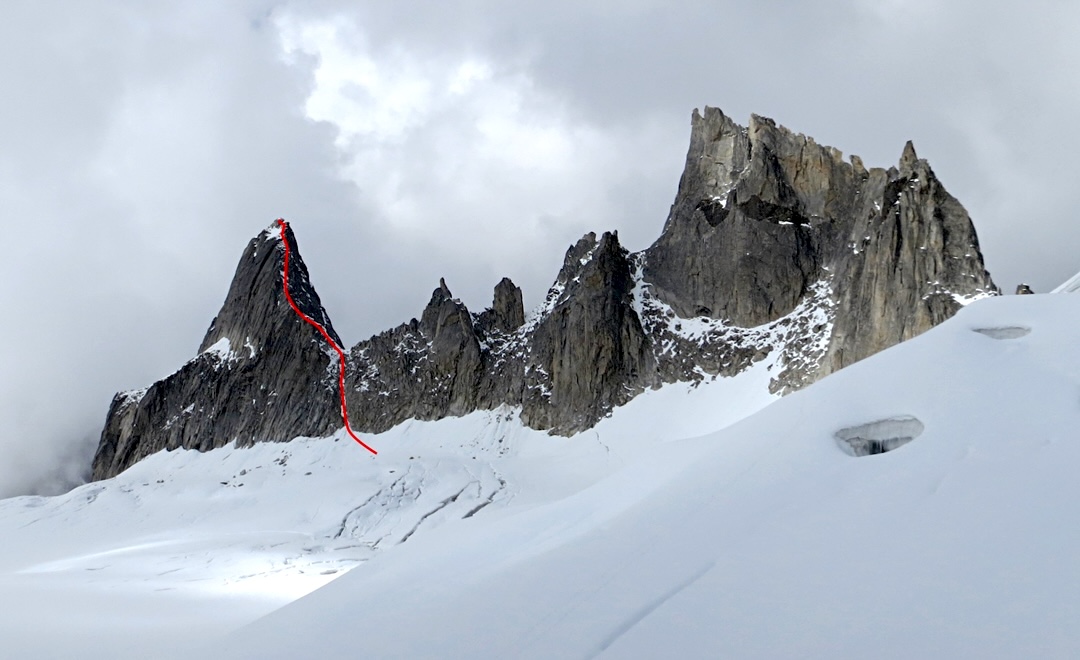
The Satling Glacier, an easterly tributary of the Phatling Glacier, south of Thalay Sagar, was first visited in May 2002 by a British expedition, which climbed a number of sub-6,000-meter summits (AAJ 2003). The dominant peak here is Brahmasar (5,850m, 30°47'29.82"N, 79° 0'17.25"E), which has three tops, the central being the highest. Whereas the north peak, Brahmasar III, and the south peak, Brahmasar II, have been climbed, the central and highest top has resisted several attempts, the last by an American team in 2014 (AAJ 2015). The north ridge of this unclimbed summit caught the eye of the French National Women’s Mountaineering Team (ENAF).
Mathilde Badoual, Sophie Jacob, and Isis Millerioux, all aspirant guides, and their coaches, IFMGA guides Lise Billon and Maud Vanpoulle, arrived in the area during October. Unfortunately, the monsoon was still active, and the area was heavily snow covered. Establishing an advanced base on the upper Satling Glacier required four arduous days of trail breaking, and unstable snow and generally precarious climbing turned back an attempt on Brahmasar’s north ridge.
Attention turned to the opposite side of the glacier, where south faces of excellent granite on lower peaks were relatively clear of snow. Point Walkers (5,260m, approximately 30°48'3.88"N, 78°59'58.52"E) was first climbed by the 2002 expedition via its snowy east ridge at PD+. A second ascent of this peak was made in 2004 by a German party that climbed the central couloir on the west face. The French women made the first ascent of the 300-meter west ridge, just above advanced base, by a line they named Bhālū and the Biscuit (6a), the name referencing the bear (Bhālū or bhaaloo in Hindi) that visited base camp; Walkers is a famed British biscuit brand that had provisioned the British team. The following day they repeated the 250-meter east ridge, which gave good mixed climbing. The group then made a quick descent to the valley to avoid a forecasted storm.
—Lindsay Griffin, AAJ, from a report to the Fédération Française de la Montagne et de l’Escalade (FFME)
Media Gallery