
Mt. Everest: Two Major Ski Descents
Nepal and Tibet
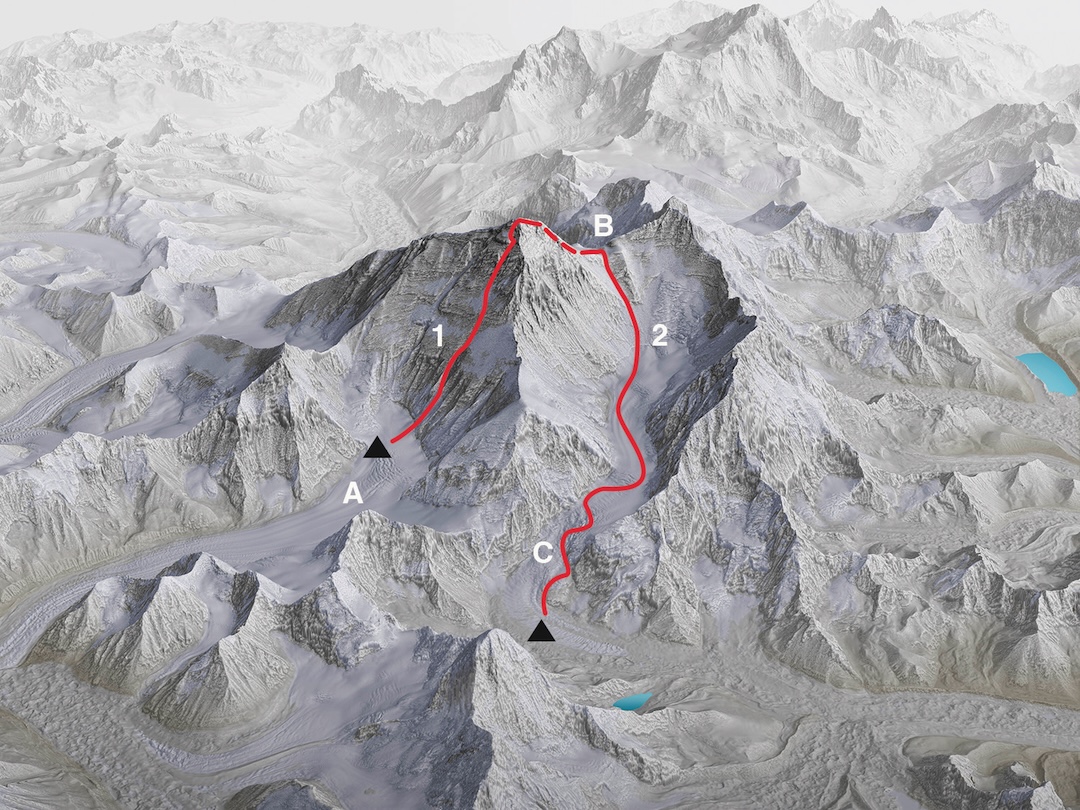
In the post-monsoon season on Mt. Everest (8,849m), two ski mountaineers completed landmark descents of the world’s highest mountain.
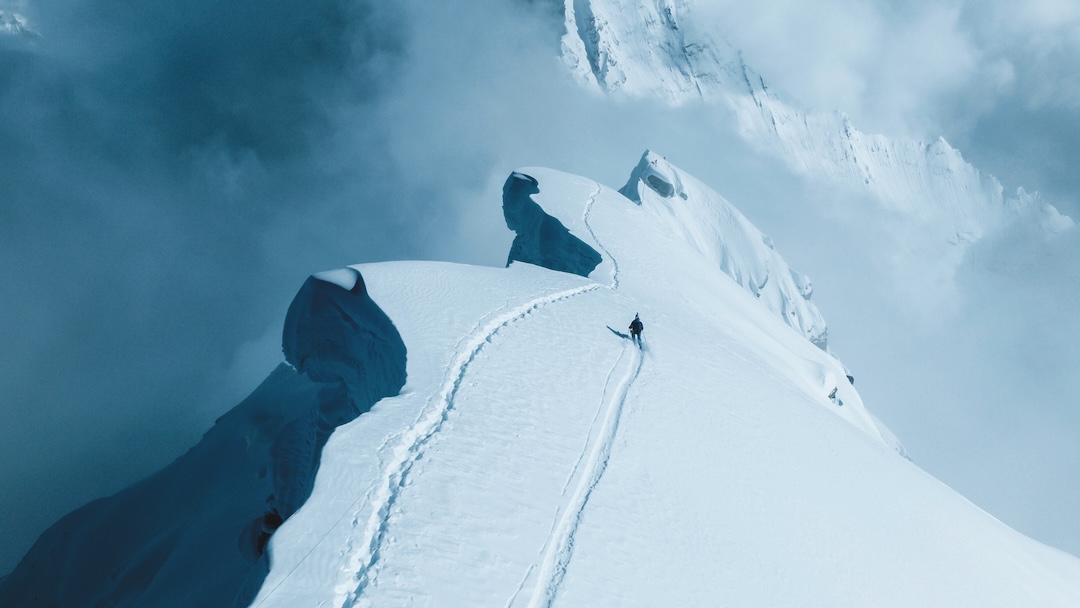
The first was in Nepal, where Polish skier Andrzej Bargiel, then 37, made the first complete descent of Everest without supplemental oxygen, by any route. Bargiel, a former high-level ski mountaineering racer, has focused on no-O2 descents of 8,000-meter peaks for more than a decade, completing ski descents of Xixabangma (Shisha Pangma), Manaslu, Broad Peak, Gasherbrum I and II, and, most famously, the first ski descent of K2 in 2018 (see AAJ 2019). He had previously attempted Everest from the south twice, in 2019 and 2022.
After acclimatizing with a large team, Bargiel started his summit push on September 19. At 11:24 p.m. on September 21, Bargiel and “Speed” Dawa Sherpa left Camp 4 (ca 7,900m) at the South Col and spent nearly 16 hours climbing to the summit, slowed by fresh snow and the lack of bottled oxygen for Bargiel. Dawa Sherpa, using oxygen, broke trail. The two summited shortly after 3:15 p.m., and Bargiel quickly transitioned into skis.
Bargiel skied down the southeast ridge to Camp 4, then continued down into the Western Cwm in evening light, staying to skier’s right of the Geneva Spur and the normal route on the Lhotse Face. He reached Camp 2 (ca 6,500m) at 8:30 p.m., after dark, and stopped for the night there.
Around 7 a.m., Bargiel started down again, passed Camp 1, and threaded a path through the jumbled Khumbu Icefall, without rappels, guided with the aid of an overhead drone operated by his brother, Bartek Bargiel. At 8:45 a.m. he reached the end of the snow near base camp, about 3,500 meters below the top. [Nearly the entire descent was filmed by drone; the extraordinary video is at the AAJ website.]
In 1996, Hans Kammerlander completed an ascent and partial descent of the normal route on the north side of Everest without using supplemental oxygen; he removed his skis for substantial portions of the descent. The first complete ski descent of the Nepal side of Everest was in October 2000, by Slovenian Davorin (Davo) Karničar, using oxygen.
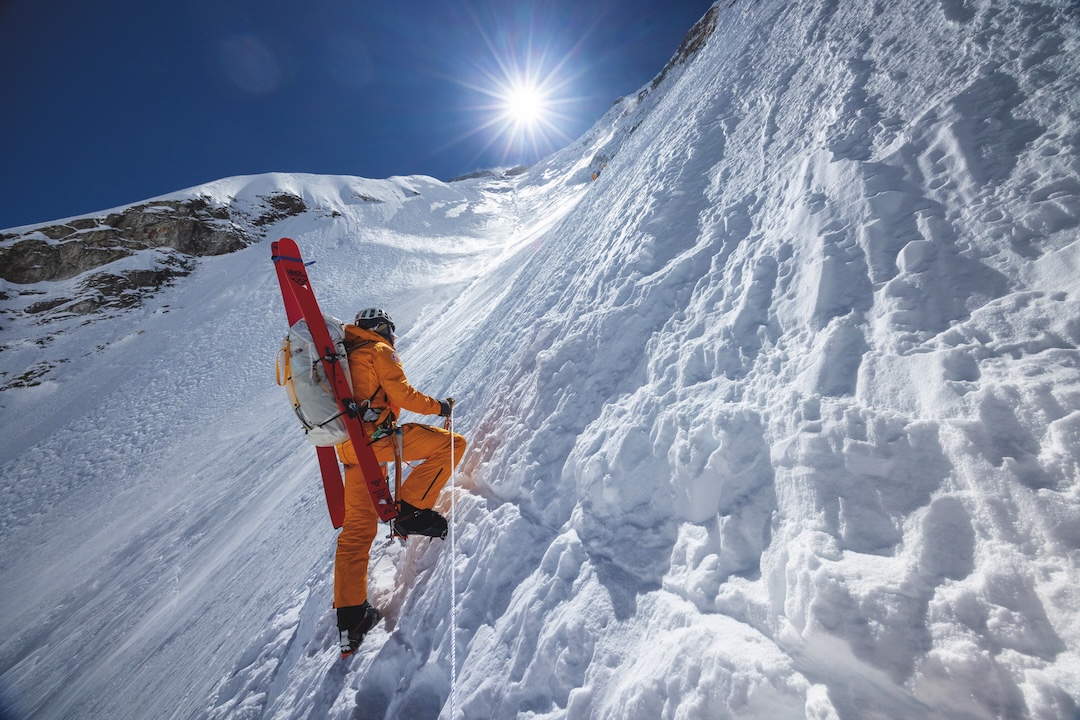
Less than a month after Bargiel’s feat, on the Tibetan side of Everest, American ski mountaineer Jim Morrison, 50, prepared for his own first: a ski descent of the “Super Direct” line down the north face, linking the Hornbein Couloir (the top of Tom Hornbein and Willi Unsoeld’s 1963 West Ridge route) and the Japanese Couloir (1980). It was Morrison’s third expedition to Everest in three years.
After more than six weeks on the mountain, with a large team of Sherpa and Western climbers, Morrison summited Everest via the direct route up the north face, reaching the top at 12:15 p.m. on October 15, using oxygen. Accompanying him were 11 others, including Jimmy Chin, whose own skiing and filmmaking efforts on Everest date back more than two decades.
Morrison started his descent around 2 p.m. The two stacked couloirs drop a total of about 2,600 meters to the bergschrund, at an average angle of more than 40°. In the Hornbein, an extended stretch of rock and mixed terrain required 200 meters of rappelling on ropes the team had fixed. The rest of the descent was on skis, continuing from the base of the Hornbein Couloir down into the Japanese Couloir. He reached Camp 1 on the upper Rongbuk Glacier 4 hours and 5 minutes after leaving the summit.
This same line had been attempted in 2002 by snowboarder Marco Siffredi (France), who disappeared during the descent. One year earlier, using oxygen, Siffredi successfully snowboarded the complete north side of Everest by the Norton (Great) Couloir (1984), after climbing the regular North Col route. In addition to Kammerlander’s partial descent of the normal route in 1996, various other parties have made partial descents of the normal route and the Norton Couloir. In 2006, Martin Letzter and Olof Sundstrom skied about 90 percent of the normal route from the summit to advanced base camp (6,400m), using oxygen.
Morrison and his late partner Hilaree Nelson made the first ski descent of the Lhotse Couloir on the west side of 8,516-meter Lhotse in September 2018 (see AAJ 2019). Four years later, the two were attempting a ski descent of 8,163-meter Manaslu when Nelson triggered a small avalanche just below the top and slid to her death. Morrison carried some of her ashes in 2025 and scattered them at Everest’s summit. A film about Morrison and the Everest descent is in the works.
—Dougald MacDonald, AAJ, with information from Red Bull, National Geographic, Rodolphe Popier, and other sources
Media Gallery