

Spare These Stones: A Journey Through Southern Climbing Culture
By Andrew Kornylak
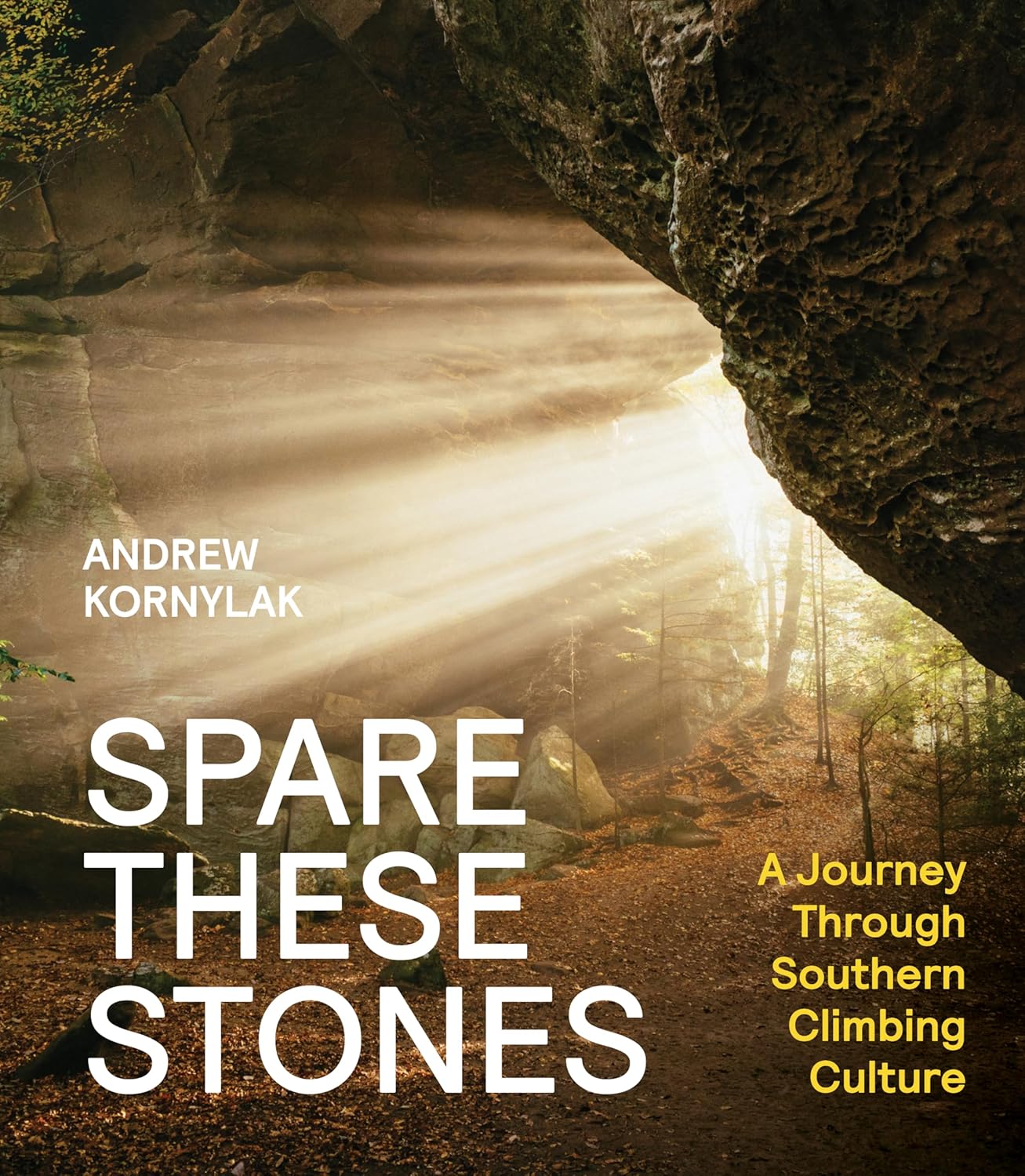 Spare These Stones: A Journey Through Southern Climbing Culture. By Andrew Kornylak (Mountaineers Books).
If us Southern climbers had a nickel for every time we had to explain how rich and diverse the climbing options are down here, we’d all be able to afford one of those fancy Sprinter vans crowding the trailheads these days.
In Spare These Stones, Andrew Kornylak captures Southern climbing’s diversity through his inspired photography and interwoven lore, culture, and history. The Cumberland Plateau spans hundreds of miles along the Appalachian Mountains, from the New and Red rivers through the Obed to northeastern Alabama and northwestern Georgia. This 300-plus-million-year-old sandstone formation provides some of the most climbable stone on the planet, with seemingly infinite walls, dominated by impressive corners and capped by massive overhangs between compelling steep faces. Kornylak describes Chattanooga legend Rob Robinson “driven by the hope” of discovering the next perfect line just around the corner.
In the early days of development, the Cumberland stone’s protectable corners, roofs, and crack systems were ticked off in old-school, bubba-rating style. In the words of another Southern climbing legend, Jeep Gaskin, “Round here, 5.10 still means sumpin!” To be sure, his generation gazed at many steep and parsimoniously protected faces and concluded those were best left to the next generation, which undoubtedly would be stronger and better equipped to bottom-up bolt while sketching on 5.11+ holds. And then Alan Watts returned from his epiphanic trip to Europe and opened everyone’s eyes to the new top-down, rap-bolting ethos.
Parking lot confrontations between the trad and sport folk eventually gave way to a new de rigueur. All of that potential energy morphed exponentially into the highly technical sport routes of today. Still, the bubba-rating ethos permeated. In certain essential ways, Southern sport climbing continued its hardcore trad ethos.
Kornylak has also done a fine job of chronicling the development of Southern bouldering. His narrative of the contrasting nature of the premier boulderers Rob Turan and James Litz particularly struck me. Both climbers of the highest order, Turan was more candid in sharing the rich history, while Litz was more understated and enigmatic. I love how Kornylak ends the piece with this line from the laconic Litz: “Privacy is more important than fame.”
The beauty of the Southern climbing culture is its conviviality and dedication to the maintenance of the sport. All are welcome. As Kornylak observes, “When all the participants’ roles are considered, the network as a whole emerges as a higher-order organism in its own right, fitter than the sum of its parts.” North Wilkesboro locals’ gyms, Vilas barn dances, apple brandy, Doc Watson—a culture like no other for sure!
Kornylak’s power of observation even extends to artificial “gym” developers Jeff Coke and Bill Webster, whose concerted efforts in blending epoxy and stones from all over the South made a unique and palpable art form on the tunnels and overpasses in Chapel Hill and other “backyard wilderness” areas. Kornylak eloquently points out the irony of graffiti-covered climbs artistically providing a medium rather than a scar on the landscape, and his use of artificial lighting contributes to photographs that embrace that mixture rather than scorn it.
Kornylak shows his love for our rich Southern climbing community and magnificent stone through his remarkable photography and concomitant lore. The cameos of open and rugged smiles are compelling.
This certainly ain’t your run-of-the-mill coffee-table climbing book. It’s sumpin!!
—Tom Kimbrell