Shkhara, South Face, Winter attempt and new variation to south-southeast ridge
Georgia, Central Caucasus
Rising along the central ridge of the Caucasus Mountains, Shkhara (5,203m), the highest point of Georgia, stands out not only for its height but also for the complex difficulty of its routes. It is no surprise that it attracts alpinists, yet it is only when one stands at its base that its true wildness reveals itself. The south face, rising over 2,000 vertical meters, is a formidable wall of ice and rock. Winter climbing raises the stakes.
In 2018, Georgians Archil Badriashvili and Giorgi Tepnadze completed the first—and still only—winter ascent of the south face of Shkhara in a 13-day round trip, a bold and visionary achievement.
As a member of the Hungarian National Alpine Team, I first approached the mountain as part of a team of six in early March 2020, hoping for a winter ascent. András Ruskó and I reached 4,300 meters on the southern pillar via the Beknu-Khergiani Route, but had to turn back due to an unfavorable weather front and increasing avalanche risk. In January 2024, three climbers and I returned to complete the unfinished objective, but once again, relentless avalanches denied access to the face, and we only reached a 3,600-meter peak rising in the glacier valley.
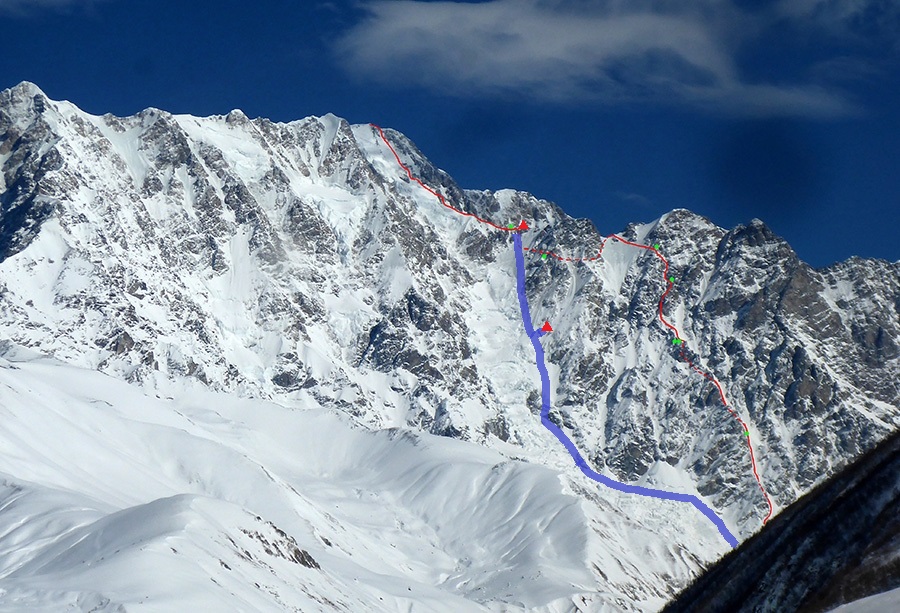
That year I noticed a striking ice couloir on the right side of the hanging glacier nestled between the southern pillar and Ushguli (Shkhara Southeast, ca 4,600m). It led to the ridge that Archil and Giorgi had reached from the opposite side; we could then follow their route to the top. I sketched a line on a photo and sent it to Archil. He warned us of avalanche danger, but agreed it could be a viable route. I went up to the base, but once again, avalanches poured from the southern pillar. Still, I couldn’t stop thinking about that line, as no description mentioned a prior ascent through that ice wall.
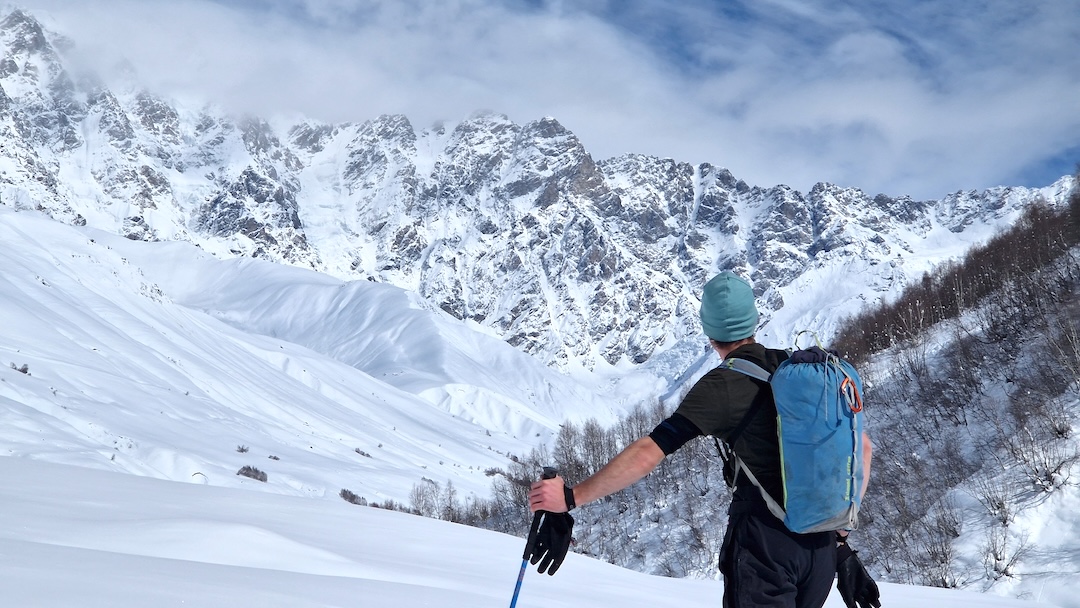
Finding a reliable partner for such an undertaking isn’t easy. Eventually, Márton (Marci) Nagy, one of the first ascenders of Bondit Peak in Pakistan (AAJ 2023), embraced the idea. We would be joined at base camp by Csaba Nagy, who would provide a vital communication link, as a team of young meteorologists at home supported us with weather updates. Early 2025 brought minimal snowfall, until a massive front dropped 150 centimeters of snow on our planned departure day. We delayed our start by nearly a week. On February 21, we reached Ushguli, the last village before the long valley leading to the glacier.
With sleds and then heavy packs, we hauled our gear through deep snow to cache our climbing equipment on the glacier. Another storm chased us back to Ushguli. We returned to the glacier on February 26, re-breaking trail through the snow. By the 28th, an ideal weather window opened. The wall was calm and quiet, so we launched the climb.
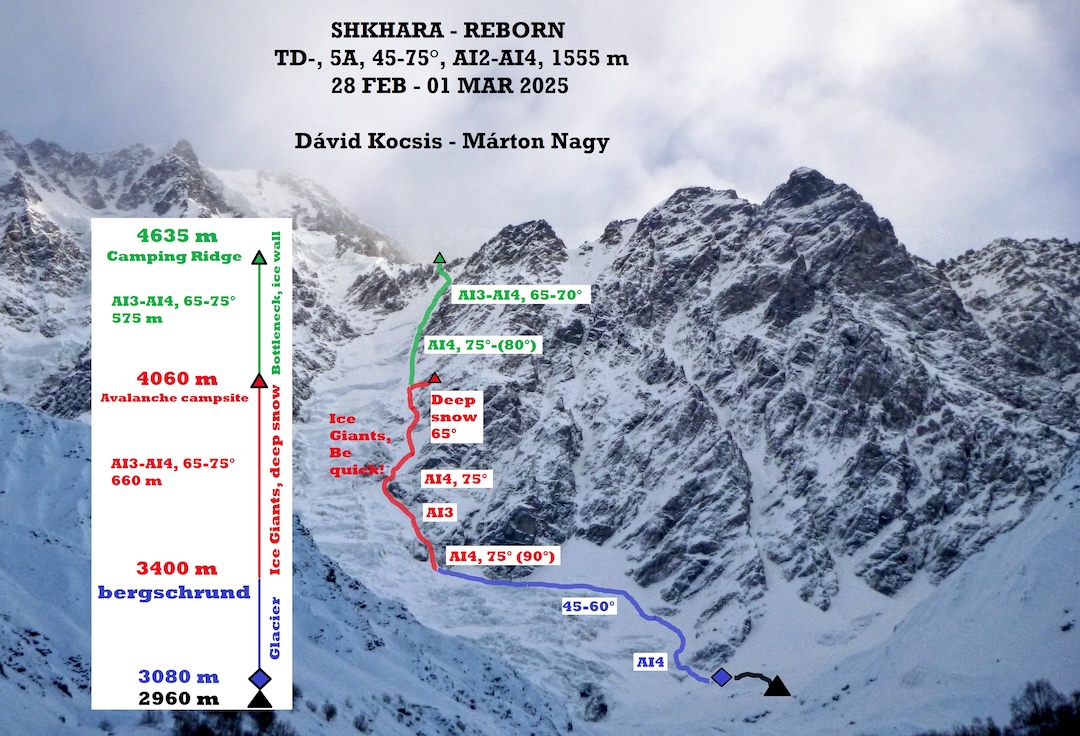
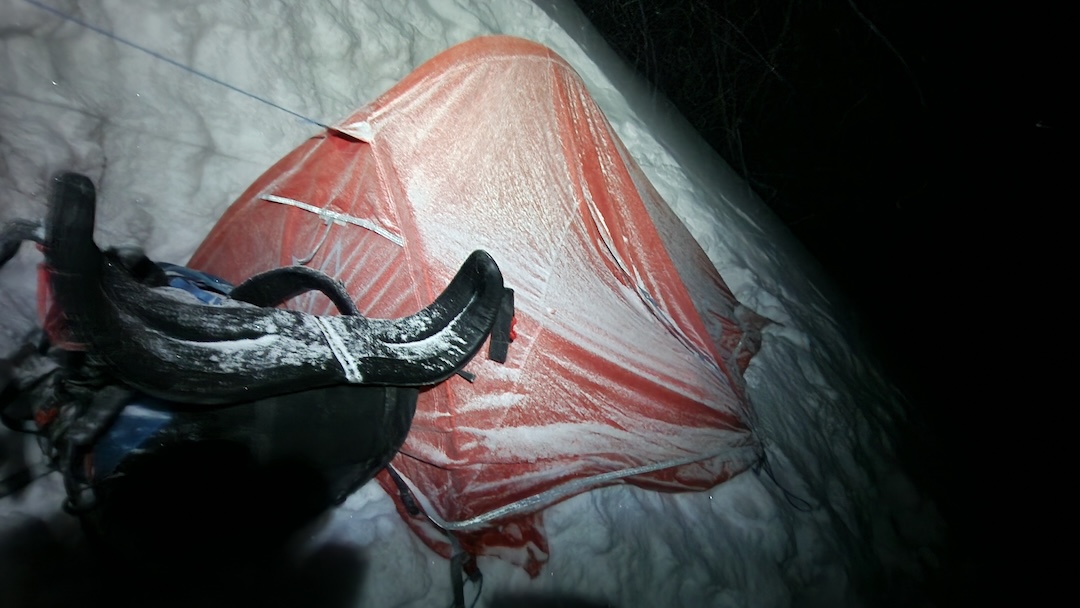
Snowshoes carried us up to 3,400 meters, where the steep, hard-ice couloir began. Eventually, we moved out of the fall line, then encountered human-depth snow. Despite the good forecast, more snow began falling and visibility plummeted. At 4,130 meters, we found a narrow rock rib capped by a 20-meter snow wall, where we dug out a tent site in what seemed to be a safe spot. As we ate and melted water, two waves of avalanches hit us. Marci escaped quickly; I was trapped, my boots pinned beneath the tent. Eventually I wriggled free and we dug out our equipment, then half pitched the tent under a rock band.
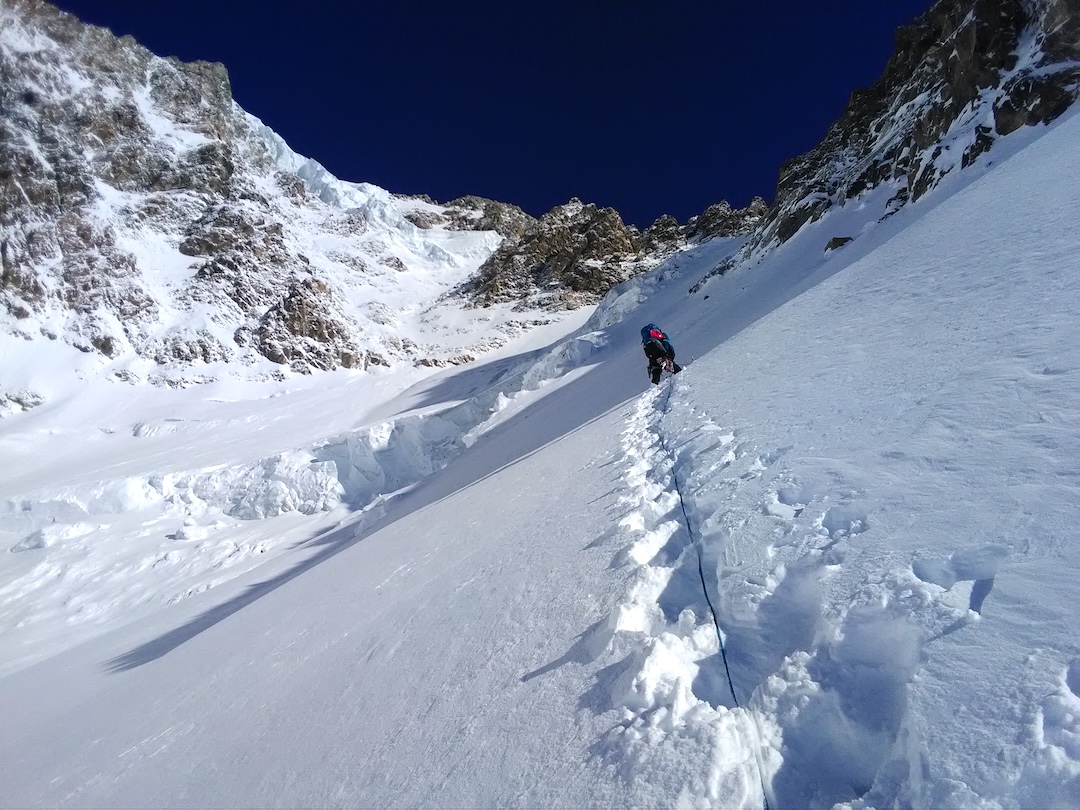
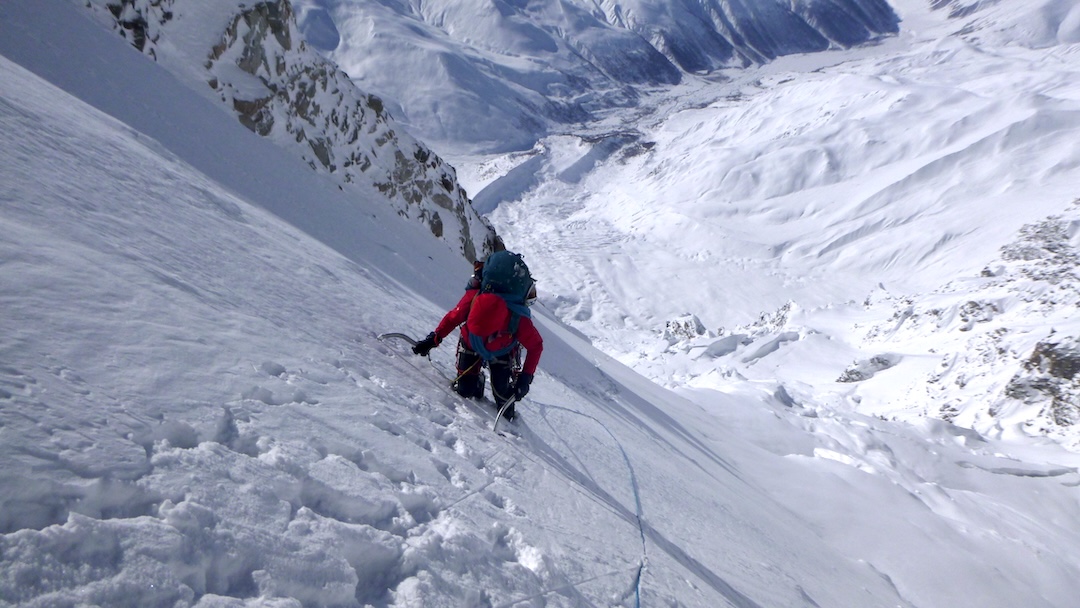
At dawn, it was -26°C inside the tent. The snow had finally stopped. Descending wasn’t an option in fresh snow, so we pushed on. Deep snow gave way to another couloir that led into steep glacial terrain riddled with invisible crevasses. We climbed between rock and glacier again—that was the crux. The upper face, surrounded by panoramic views, was a reward. We were tired from dehydration, having only one liter of water from the night before, but at 3:30 p.m. on March 1, we reached the ridge at 4,635 meters.
We were heartbroken to see that the glacier Archil and Giorgi had crossed en route to the summit had shattered, creating a hazard beyond our risk tolerance. We abandoned the summit and pitched a tent in a safe but uncomfortable spot on the ridge.
One day of good weather remained. We had to downclimb the ascent route—rappelling the 1,200-meter wall was out of the question. We descended intensively. Bitter cold turned my fingers numb, four of them completely. By afternoon, we reached our glacier camp. The fingertips began to discolor. By morning, they were blistered and black. We notified Csaba, who miraculously arranged a helicopter. We descended to the summer base camp site and were evacuated to a hospital in Mestia. Thanks to Csaba’s quick action, I avoided amputation.
The mountain tested us relentlessly. We listened. And ultimately, we got out alive.
Our variation up the southwest side of the south-southeast ridge gained 1,235 meters above the bergschrund. We called it Reborn (TD-/5A AI4 75°).
Later, I received information that in August 2005, Mike Dorse and Peter Everett from Canada may have attempted this same face. They apparently didn’t summit, and Everett was killed by an avalanche during their descent. I could find no details of their exact route.
Their experience reflects the wild nature of Shkhara, and highlights how monumental it was when Archil and Giorgi spent 13 days on the wall during their first winter ascent in 2018. The climbing world lost Archil last year, but despite his young age, he achieved many remarkable and visionary ascents that will continue to inspire.
—Dávid Kocsis, Hungary
Media Gallery