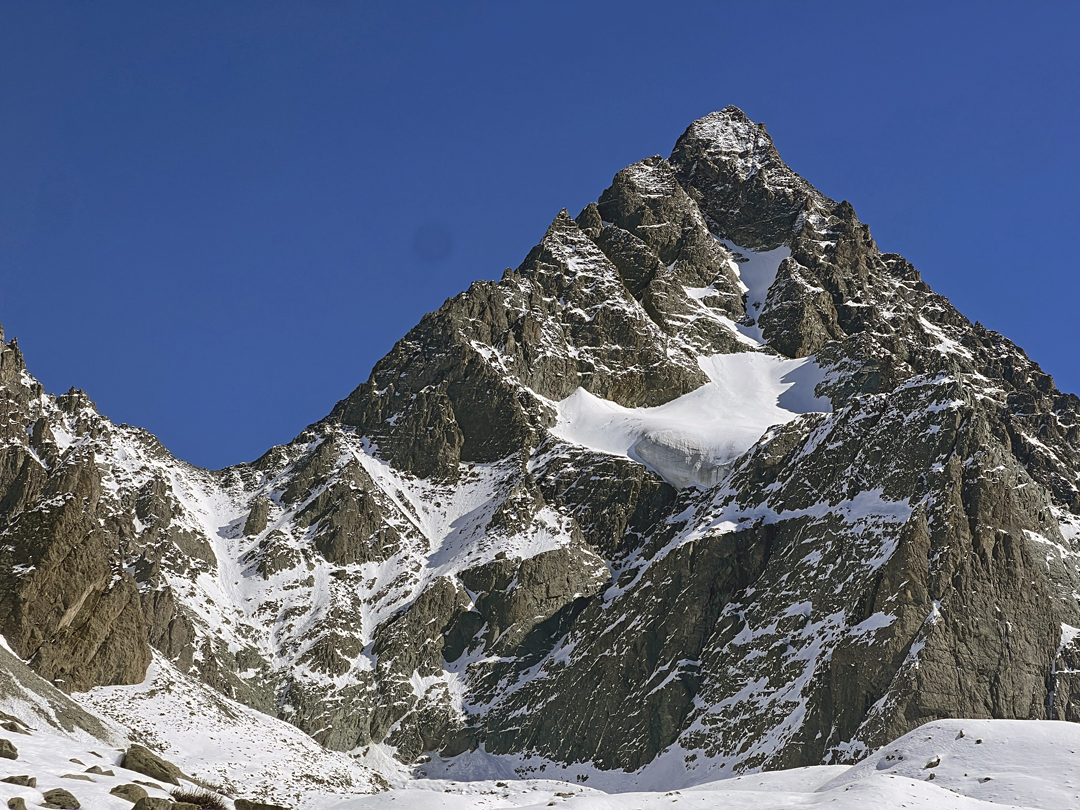

Lotus Flower Mountain, north face
China, Sichuan, Daxue Shan, Lotus Flower Mountain Group
The Lotus Flower Mountain Group, which lies a little over 20 kilometers due north of Kangding in the Garze Tibetan Autonomous Prefecture, reportedly has at least 27 peaks above 5,000 meters. It is thought that only one of these has been climbed. The highest summit, Lian Hua or Lotus Flower Mountain (5,704m PLA map, 30°16’3.96”N, 101°57’36.29”E), lies at the northern end of the range and is approached from the road through the Yala Valley to the west. It was climbed in 1998 by three Japanese alpinists (one of them twice) via the south side (AAJ 1999). Despite easy access, this peak is not believed to have had a second ascent before 2025.
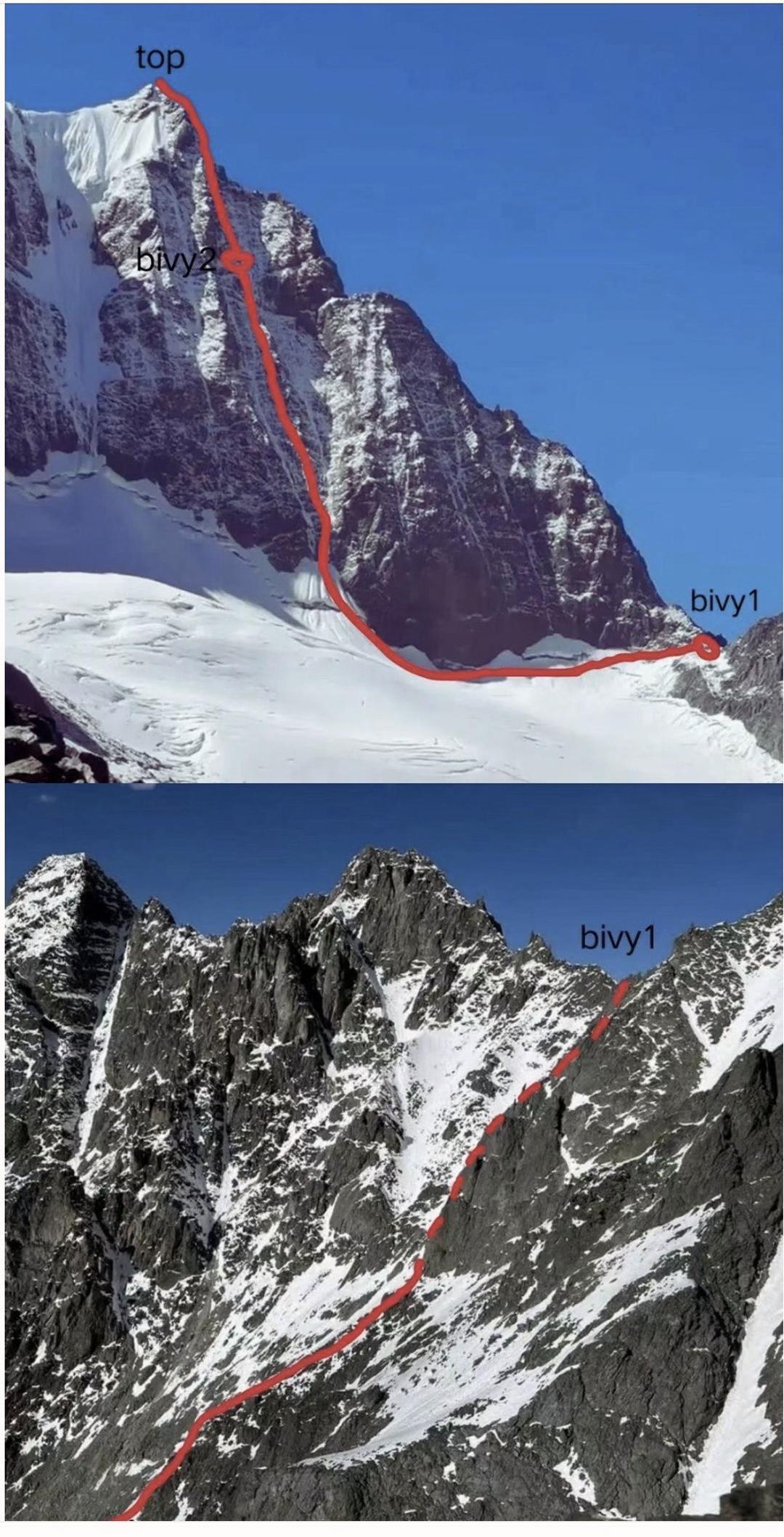
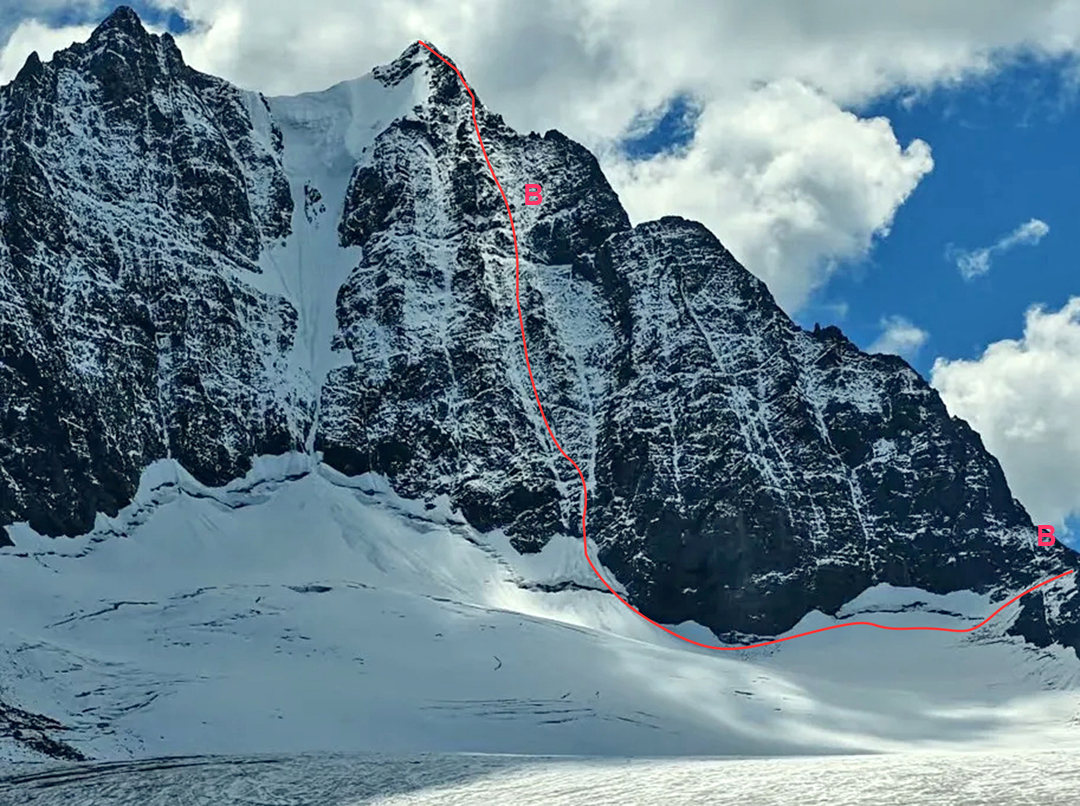
The north side has a large glacier that rises to the start of the north face at around 5,050 meters, but it is difficult to access. Xiang Shuxiang and Wang Kun decided to solve this problem by climbing the west face of the ridge running generally north from Lotus Flower Mountain, crossing the crest, and traversing to the upper glacier immediately below the north face.
The autumn season was characterized by late and heavy snowfall, but when this eventually cleared in November, the two drove from Chengdu to Kangding, and later the same day walked to a campsite at 3,700 meters below the west face of the mountain.
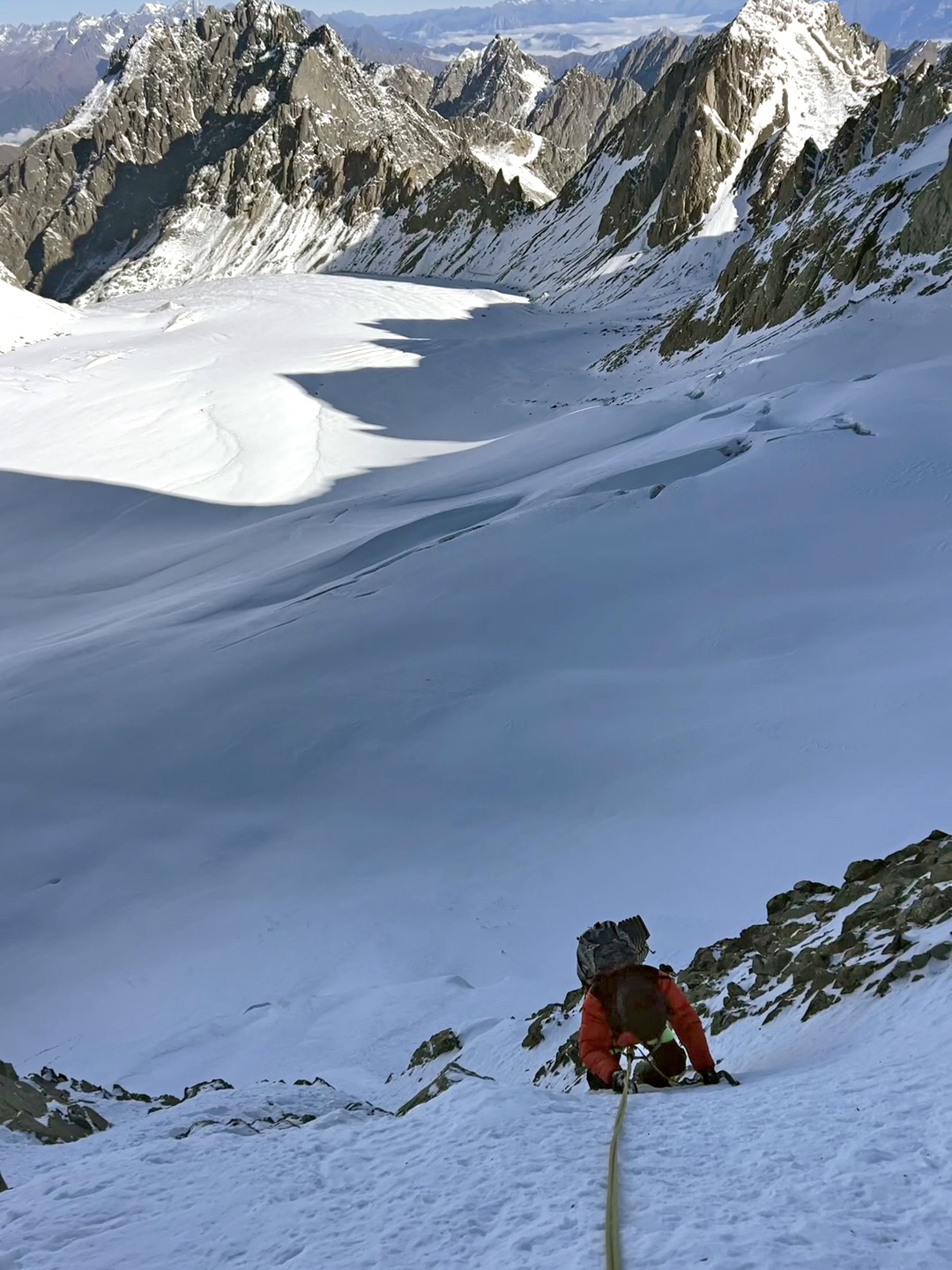
The following day, November 9, they moved up to the foot of the face at around 4,850 meters and climbed to the northern ridge, starting with a narrow section of AI3, then continuing on M3 terrain to reach a notch in the ridge at 5,107 meters. They didn’t arrive here until well after dark, and it was 9:30 p.m. by the time they had cooked and settled down for the night. Unsure of the best line, they waited until first light before dropping onto the glacier and reaching the foot of the north face at 5,050 meters.
The first section of the face went smoothly, with hard snow providing support, but the amount of powder snow increased, as did the angle of the face. To avoid avalanche risk, the two cut up left onto a rocky rib. Continuing over mixed ground until 6 p.m., they eventually made a poor bivouac at 5,500 meters, where they barely managed to sit. The difficulties that day had been M4 75°.
After an uncomfortable night, it was hard to get moving the next morning, and the problems soon continued. The wind, which had previously been minimal, greatly increased in strength, then they met a rock buttress that almost turned them back. They forced this on the left side at M5/6 to reach the upper part of the west ridge, where a final 200 meters of snow and rock took them to the summit. It was 11:40 a.m. on November 11. Now they had to get down.
As they had found anchors tricky to construct during the ascent, the pair elected to descend the west face. Eight rappels led to a hanging glacier, which they followed for several hundred meters before making another six rappels to the base of the mountain, near the start of their route. Unfortunately, on the last rappel the ropes got stuck and had to be abandoned. They named their route Safe Return Home (900m, 1,300m of climbing, TD M5+ AI3 75°).
Perhaps the biggest lesson the two young climbers learned from their experience was that “when fear is faced, dismantled, and transformed into concrete coping strategies, it becomes one of the climber’s most reliable pieces of ‘equipment.’”
—Lindsay Griffin, AAJ, with help from Fang Zhan, China, and Xia Zhongming, Luxembourg
Media Gallery