
Mt. Robson, South Face, Ski Descent
Canada, British Columbia, Rocky Mountains
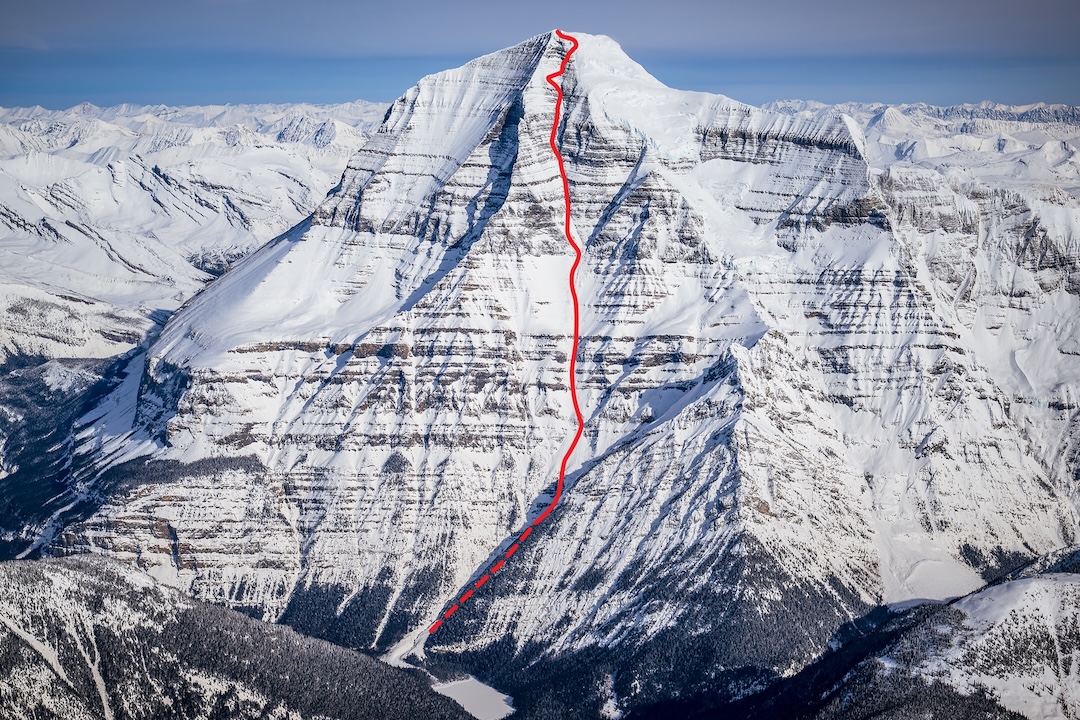
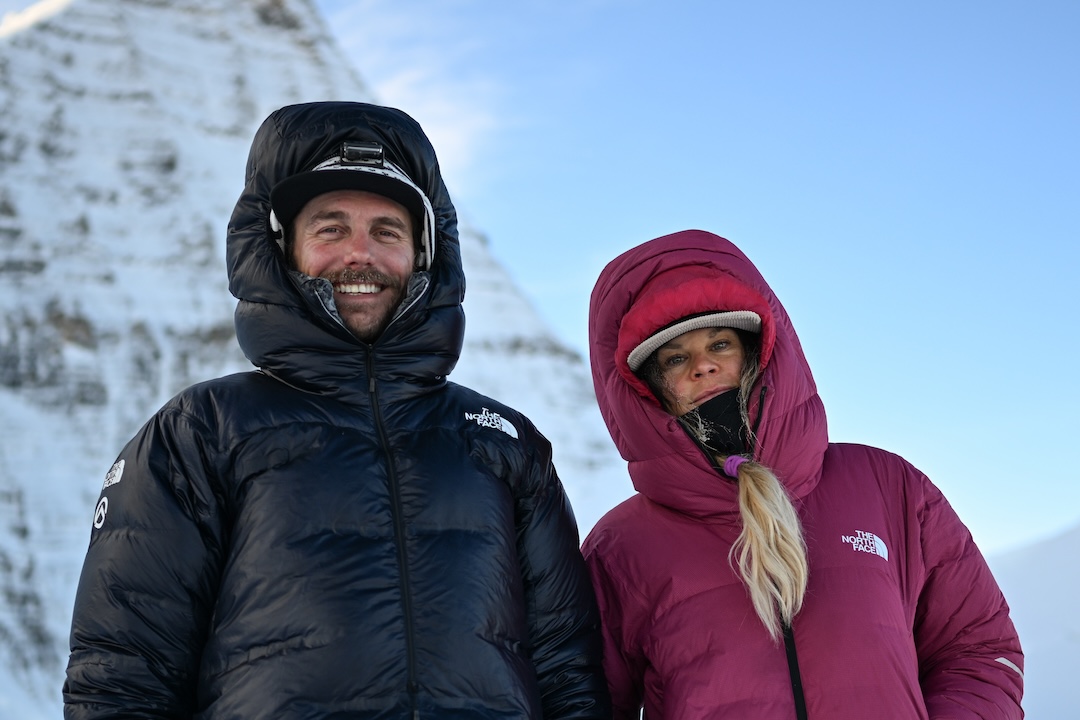
I’m so relieved to be on the other side of this project. Skiing the south face of Mt. Robson (3,959m) had been a dream for years. My ski partner, Guillaume “Gee” Pierrel from France, was a force, and we worked as a team, constantly pushing each other. The severity of this line left no room for hesitation.
On February 11, 2025, we ski-toured about six kilometers to Kinney Lake in the dark, climbed 500 meters of steep, thick forest, and entered The Great Couloir (45°–50°, WI3 M5) via a thin ramp of four-season ice precariously perched over a wild slot canyon.
We continued upward, soloing a 20-meter WI3 pitch, then passing through a series of three constrictions, which we called the Cascade, with WI3 ice. We built anchors at the tops of these ice sections, knowing we would need them for rappelling during the descent.
Above the Cascade, we pushed a bit farther up, then trended right for our first real break since entering the line. As we ate and drank, a blast of snow blew past us. We paused for a moment and decided to climb left, aiming for a large cliffband where we could bivouac safely. We dug a small platform and secured our tent with a V-thread and two cams.
The next morning, we woke at 4:30. It had snowed a few centimeters overnight, but the forecast promised an afternoon clearing. After I struggled for five minutes to get my feet into my ski boots, we started climbing again, traversing back right to continue up The Great Couloir.
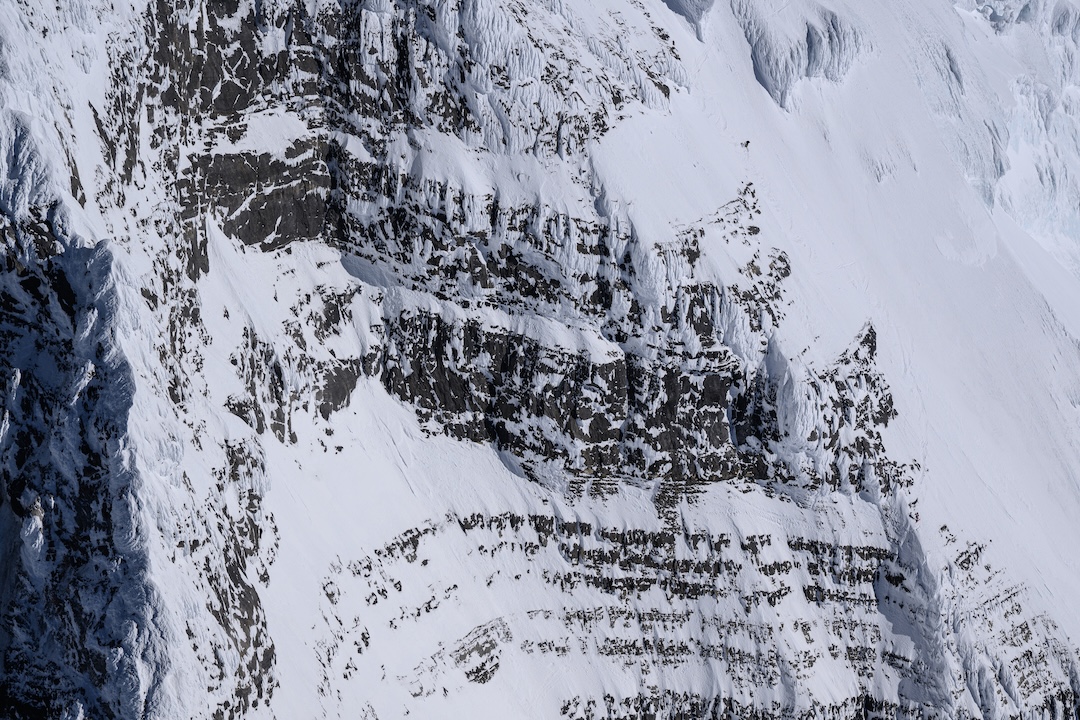
The sky teased us with hints of clearing, but the wind picked up and spindrift rolled over our intended line. We diverted left, and Gee led an M5 rock step. Clouds now engulfed us. Above lay another constriction, just wide enough for our skis. The slope then opened for 100 meters into a layered system of snow and rock. We dubbed this Lusti’s Ledge. Gee and I climbed across the ledge to an exposed stance, roughly 200 meters below the summit. I looked up and saw spindrift, snow, and wind. Looking down, our line disappeared into the cloud. Even if we turned around now, we’d be skiing in the dark. We made the gut-wrenching decision to descend.
We downclimbed off the ledge, then skied in short pitches, one at a time. After one rappel, we continued skiing back to the bivy. As we packed up our gear, I watched spindrift cascade down the bowl beside us. Darkness was quickly approaching.
The skiing below was slow and tedious, punctuated by a tricky downclimb in the Cascade over water ice that had formed since our ascent, along with several rappels. Finally, we made it down to our gear stash and began the slog back to our camper. Tomorrow will be another day, I thought. Knowing myself, I wouldn’t be able to leave those final 200 meters without another attempt.
The next day, with an improving forecast, we decided to try again, but with a different approach to the south face. On February 15, we flew in a heli to establish a base camp on the Dome (3,456m), planning this time to climb the Kain Face (Kain-Foster-McCarthy, 1913) on Robson’s southeast side, then drop into The Great Couloir from the top.
The temperature plunged to -30°C overnight, and we decided to wait for the sun in the morning, boiling water and preparing gear. Once we started ascending, we took a measured pace. We were running on fumes, emotionally and physically exhausted, but determined to finish this.
Nearing the summit area, we ski-toured over to Lusti’s Ledge, then transitioned back to crampons to continue up the final part of The Great Couloir to the summit. We wanted to scout the line we would descend, checking snow conditions.
On top, the winds had calmed and the sky cleared—a far more desirable day than before. We transitioned back to skis, leaving our crampons hanging on our harnesses, knowing we’d need them again.
Skiing carefully off the top, we felt the exposure increase rapidly. Once through the upper section, we transitioned back to climbing to cross Lusti’s Ledge. We decided to build an anchor and rappel to a lower ledge, which connected us to the point where we had transitioned three days earlier.
Though the terrain now felt familiar, the skiing remained demanding, and the exposure held its grip. It took us three and a half hours to descend, with a total of seven rappels. The descent from the summit to Kinney Lake totaled about 2,955 meters. On the long tour back from the lake, we moved faster this time, knowing we had left something significant behind us.
—Christina Lustenberger, Canada
Media Gallery