
The White Ladder: Triumph and Tragedy at the Dawn of Mountaineering
By Daniel Light
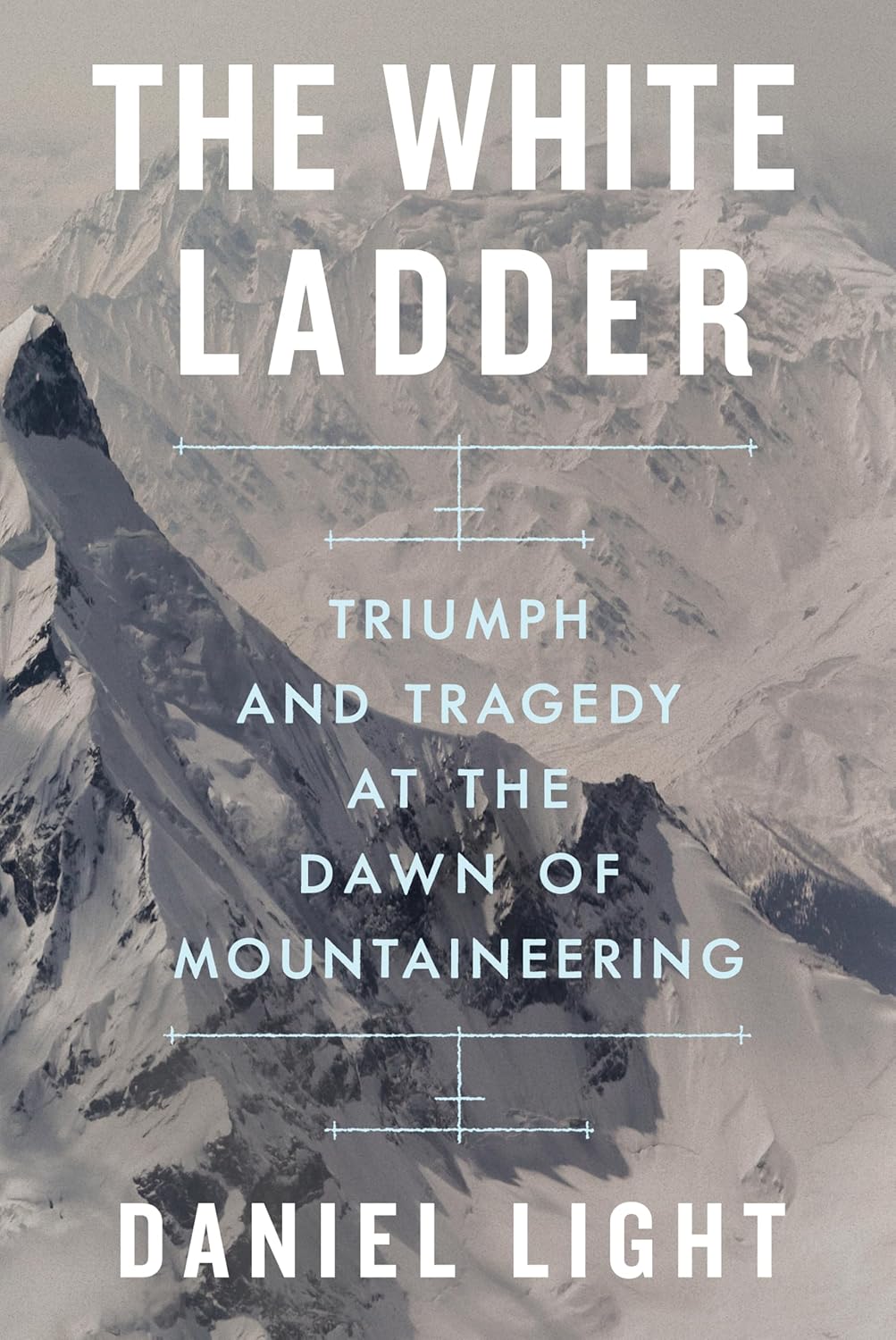 The White Ladder: Triumph and Tragedy at the Dawn of Mountaineering. By Daniel Light (W.W. Norton).
Over the years, I’ve enjoyed many of the original mountaineering stories written by the explorers and athletes. I’ve also been drawn to accounts by biographers and historians who study and interpret the original texts and other sources to create narratives with different viewpoints. The White Ladder describes early climbing history, then extends through the golden age of mountaineering in the Alps to exploration and early mountaineering in the Greater Ranges. Before starting this book, I was concerned it might simply retell those previously documented stories for a new audience, but my concerns were unfounded.
Daniel Light has produced a thoroughly researched book on the exploits of many mountain climbers new to me. These included Baron von Humboldt and his attempt on Chimborazo in Ecuador in 1802, and the brothers Adolph and Roert Schlagintweit, who attempted Kamet in the Himalaya in 1854 and over the next two years conducted a sprawling survey of the Indian subcontinent (including a trip by Adolph a bit too far north into Chinese Turkestan, where he was captured and beheaded). I had not read much about William Graham, who, with his guides, made the first ascent of the Dent du Géant in the Mont Blanc Range and who, in 1883, became one of the first Westerners to go to the Greater Ranges primarily to attempt high mountains.
In the early years of Himalayan exploration, climbers included European guides on the team, as they did in the Alps. But I learned that Alec Kellas was one of the first climbers to hire Sherpas instead, and he provided them with good equipment and clothing on his successful expeditions in 1909 and 1911. The author also includes stories about familiar but troublesome explorers like Fanny Bullock Workman, showing that they were racist and had unreasonable expectations of their poorly equipped and underfed porters.
The author has carefully chosen a limited number of stories representative of each period. He is also concise in the telling, avoiding repetitive accounts. For historically significant stories that many already know, he has included facts that will be new to many readers, and his descriptions of the various personalities go deeper than previous accounts. For example, many of us are familiar with the story of Aleister Crowley, the notorious occultist, who in a feverish hallucination pulled a gun on Guy Knowles in their tent on K2 in 1902. But I didn’t know that the darker side of his personality extended to his Balti partners, whom he would attempt to motivate by grabbing them by the beards and beating them with his belt, claiming, “I had forced them to respect us.”
This book continues the trend in modern climbing histories of naming and crediting indigenous individuals for their contributions to expeditions. Bhop Chand was one such character, a local hunter employed by William Graham’s 1883 expedition on an attempt on Dunagiri. The team had gotten lost, and Chand was able to lead them through a maze of vegetation and gullies onto the slopes of the peak. Such individuals often were given little or no credit in previous versions of these stories.
I also enjoyed Light’s writing. At the end of the book, he includes a description of the discovery of George Mallory’s body on Everest in 1999, lying where he had landed, with a broken leg, after his fall 75 years earlier. Light writes, “For a few weeks of every summer, high on Everest, the Death Zone comes alive. Dots of color appear, inching along its summit ridges, moving up and down. Some days, nowadays, the dots form a line. And, every summer, a few dots are left behind. Hunched, in whatever shelter they could find. Sprawled, at the foot of wherever it was they fell. For the winter to come, they have Everest to themselves. They become part of the mountain, just as it was once part of them. Mallory is still up there, in the shallowest of graves. Lying, good leg folded over as if to shield the break in the bad. In his final moments, he knew what we all know. That the mountain is within. The why is all we have. We die on the slopes of our own ideals.”
—Steve Swenson