Enough: Climbing Toward a True Self on Mount Everest
By Melissa Arnot Reid
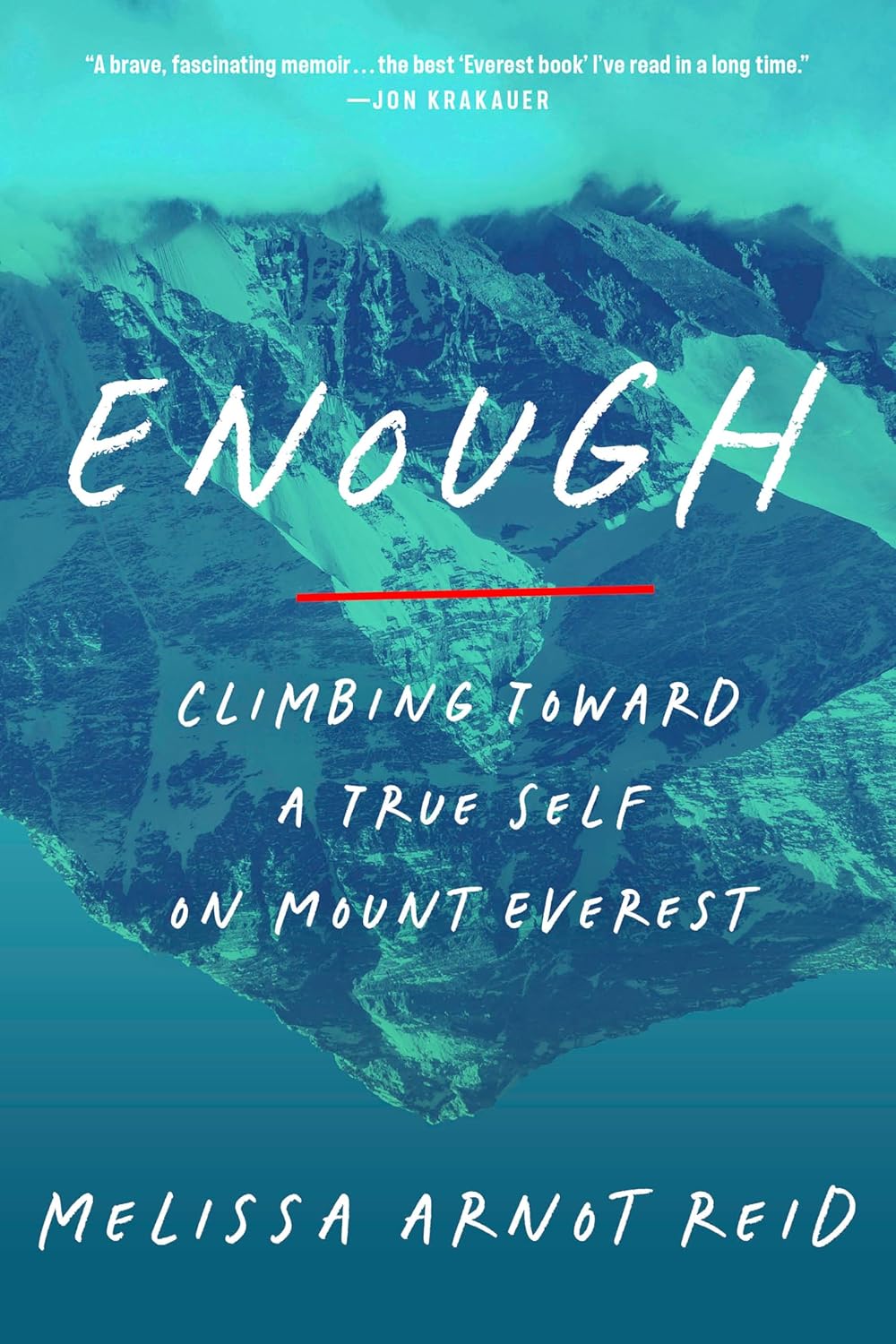 Enough: Climbing Toward a True Self on Mount Everest. By Melissa Arnot Reid (Crown).
Ten years ago, Melissa Arnot Reid, a Rainier guide who’d clocked over 100 ascents of that peak as well as five previous Everest summits, became the first American woman to climb Everest without supplemental oxygen. The distinction gave her a hook to hang a memoir on, and Enough: Climbing Toward a True Self on Mount Everest is a banger. Amazingly honest, especially about her own mistakes in life, it jumps from introspective passages to accounts of failed relationships and riveting life-and-death mountain scenarios.
Climbing Everest without oxygen, Reid explains, “tests the human capacity to endure pain and challenges the rules of physiology, and so would, I hoped, answer the question of whether or not I was good enough. If I could answer that, maybe I could put down the weight of all the other questions I was carrying.”
There we have it—the book is courageously confessional. When Melissa is age 11, a young policeman with the D.A.R.E. school program takes an interest in her. While she as author stops shy of details, I know enough to feel sick when the cop, age 26, touches her knee. Promised an escape, turning 12 and believing she is in love, Melissa tells the police everything about her parents’ weed-growing and smoking. She lands in foster care, the ardent cop disappears, and her torn-up family moves to Montana to start over.
Ascending her first peak, in Montana’s Flathead Range, Reid feels a thunderbolt of transformation: “I was changing the story of who I was.… As we jogged and hopped along the ridge toward the summit, I looked out at the glacier peaks and ridges and saw the promise of unending possibility. I was here, and the rewards I was getting were all because of my own work.”
She soon meets a mountain guide, who leads her up Rainier without condescension. The relationship, however, is emblematic. Reid is candid about, in that era, viewing people as stepping stones. The professional encourages her to become, like him, a Rainier guide, a notion that awes her. She puts everything into readying herself for the tryouts, minutely practicing anchor and crevasse-rescue systems. Just five or six will be chosen from among 60 aspirants. An EMT and wilderness-med instructor, she is hired.
She breaks with the guide. Plenty of boyfriends follow, and she comes clean about errors. I appreciate that she is forthright about two unplanned pregnancies, one terminated and one that ends in a miscarriage, common experiences not commonly discussed.
Reid eventually becomes a guide on Everest, a triumph and also a tough lifestyle. She experiences great sorrow in the death of a dear Nepali friend, the funny and kind Chhewang Nima, 19-time Everest summiter, killed in a cornice collapse while working in Nepal.
Occasional omissions appear: In noting about the aftermath of the 1996 Everest disaster that she “wondered if the story of a woman’s climb would ever be told,” Reid appears unaware of (nor does she circle back to) Beyond the Limits: A Woman’s Triumph on Everest, by Stacy Allison with Peter Carlin, to name one book.
While Enough can be redundant on personal issues, the last hundred pages accelerate. Reid develops deep friendships, particularly with the Europeans Simone Moro and Ueli Steck, feeling truly accepted by them. We reach the well-known Camp 2 conflict in 2013, in which rocks and blows fly, and Reid bodily stands between both of the above climbers and a crowd. She writes with admirable simplicity of how she and her friend Phunuru Sherpa faced the assemblage, and while she says she is not sure why those in the crowd heeded her words, I think I know: out of respect.
Reid’s big no-O summit bid is exciting from the moment it is clear, through her friend Tshering Dorje’s observation, that she seems ready. “What happened to you, Didi?” he says. “You are so fast now!”
While the book’s overriding message is that damaged people can heal and overcome, and the oxygenless Everest ascent is the signature event, Enough most moved me in showing the author’s closeness with the tragic climber Ueli Steck, who became the Everest mentor she’d long wanted. The only thing I’d have liked to hear more about is the Juniper Fund, the nonprofit Reid co-founded with another friend, David Morton, to support the families of high-altitude workers lost in the mountains. She runs it today. [A more in-depth version of this review appeared in Gripped (August/September 2025).]
—Alison Osius