
Karambony, Tsofa Dombo
Madagascar, Tsaranoro Massif
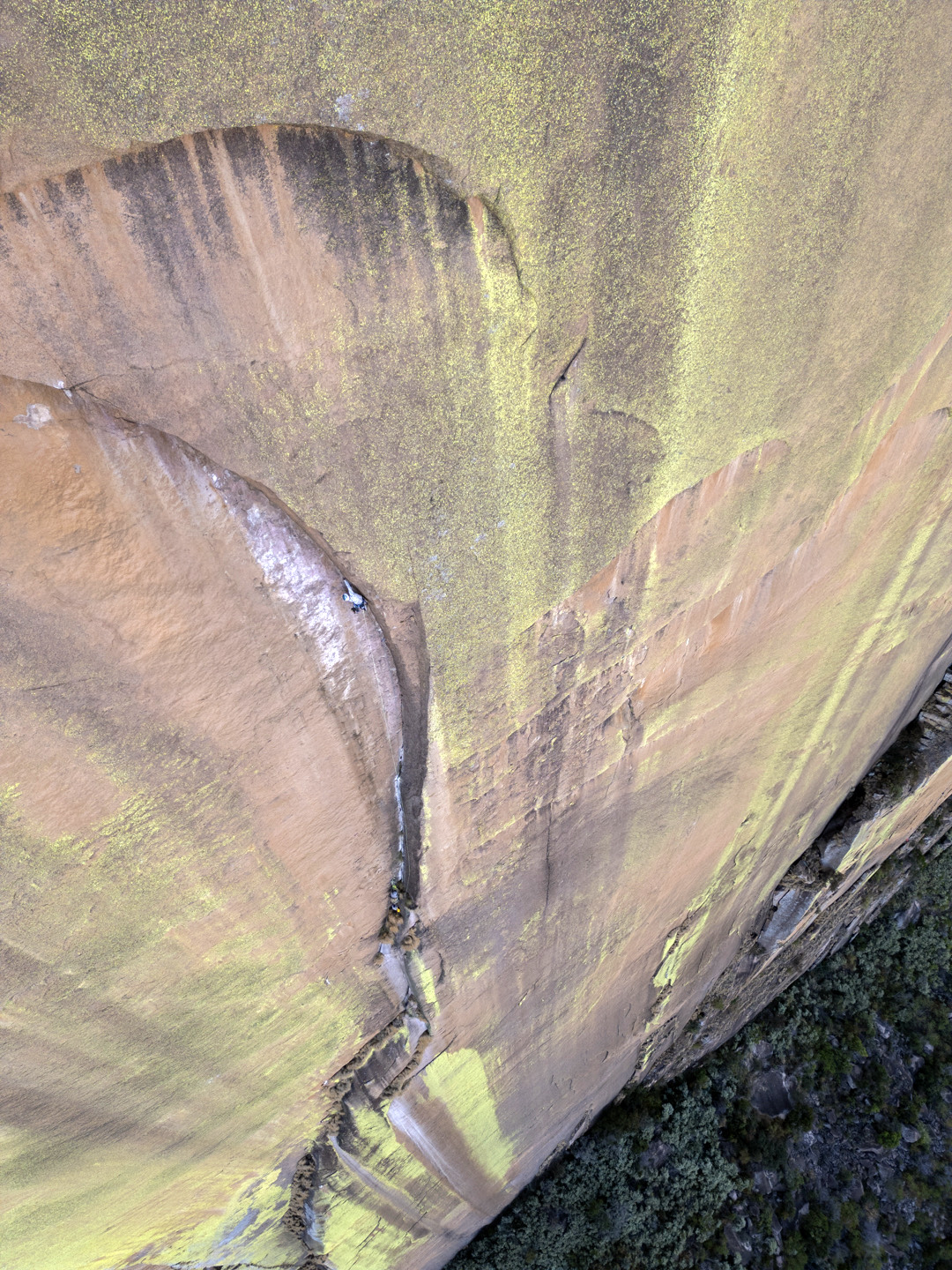
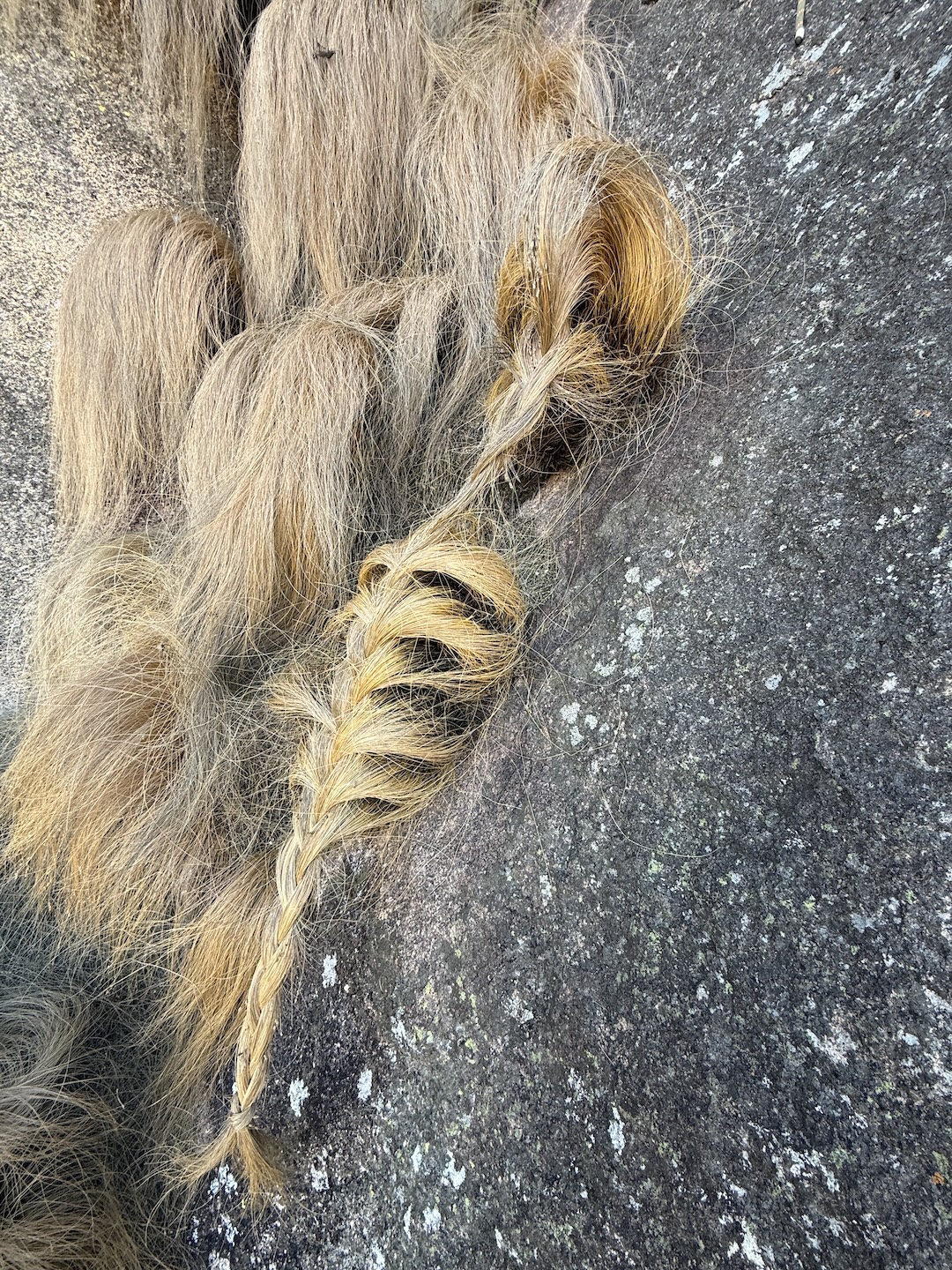
Say “tsofa dombo” to any Bara person native to the Tsaranoro Valley, and you will most certainly get a laugh. The phrase translates to “the dull sickle,” and it’s no honor in the valley to have a sickle blade that can’t cut rice or grass. We had only our hands, a small knife, and a nut tool to battle the long, luxurious grass tufts that sprouted from the nooks, cracks, and crannies of the otherwise uniform granite walls on the line we were attempting.
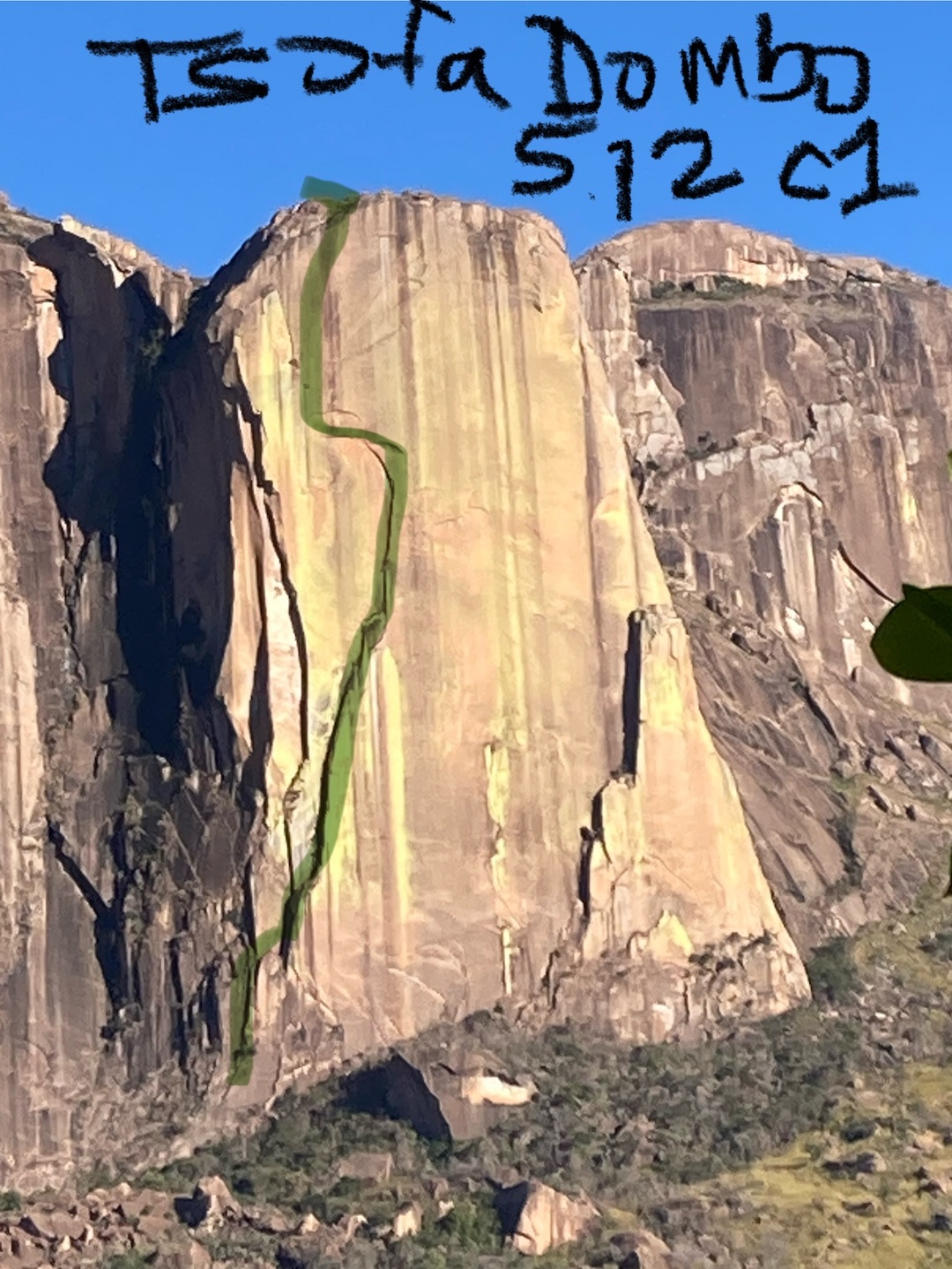
In the end, the grass, impenetrable to our dull blades, was best French braided, ponytailed, or otherwise cleverly styled out of the way, rather than cut. Why were we blazing new ground on such a grassy route? Because the line was stunning. Karambony (22°05'08.3"S, 46°45'57.3"E) is a gorgeous 400-meter tombstone monolith to the right of Tsaranoro Be, with a bright green, dead-vertical east face broken only by one long dihedral, culminating in a sickle-shaped roof. This line, though quite obvious, had never been climbed until this season.
Twenty years ago, German climber Daniel Gebel and a small group of friends came to Madagascar to establish a route up the obvious sickle-shaped crack line they’d seen in photos. Sadly, on the second day of their trip, Gebel’s partner broke her ankle while slacklining. He then made the excellent decision to instead bolt a futuristic, vertical route just to the right of the dihedral, calling it Tough Enough.
A few years later, in 2008, Arnaud Petit and a team of friends made the first free ascent of Tough Enough (380m, 8b+). During one of his expeditions to the valley to work on the route, Arnaud explored the last three pitches of what later became our route, Tsofa Dombo, on rappel. He bolted two pitches leading to the summit, and since these were nice, we eventually assimilated them into Tsofa Dombo, rather than continue up a dirty, bird-filled crack system that would have been the obvious line to take.
In 2022, Cam Smith (Australia) and I were awarded an AAC Live Your Dream grant and decided to tackle the unclimbed route up Karambony. We were definitely in over our heads. The route required an ungodly amount of cleaning, bolting, and landscaping. After a month of work, we left the route un-redpointed, but we had climbed every pitch. I vowed to return with a crew to complete the free route.
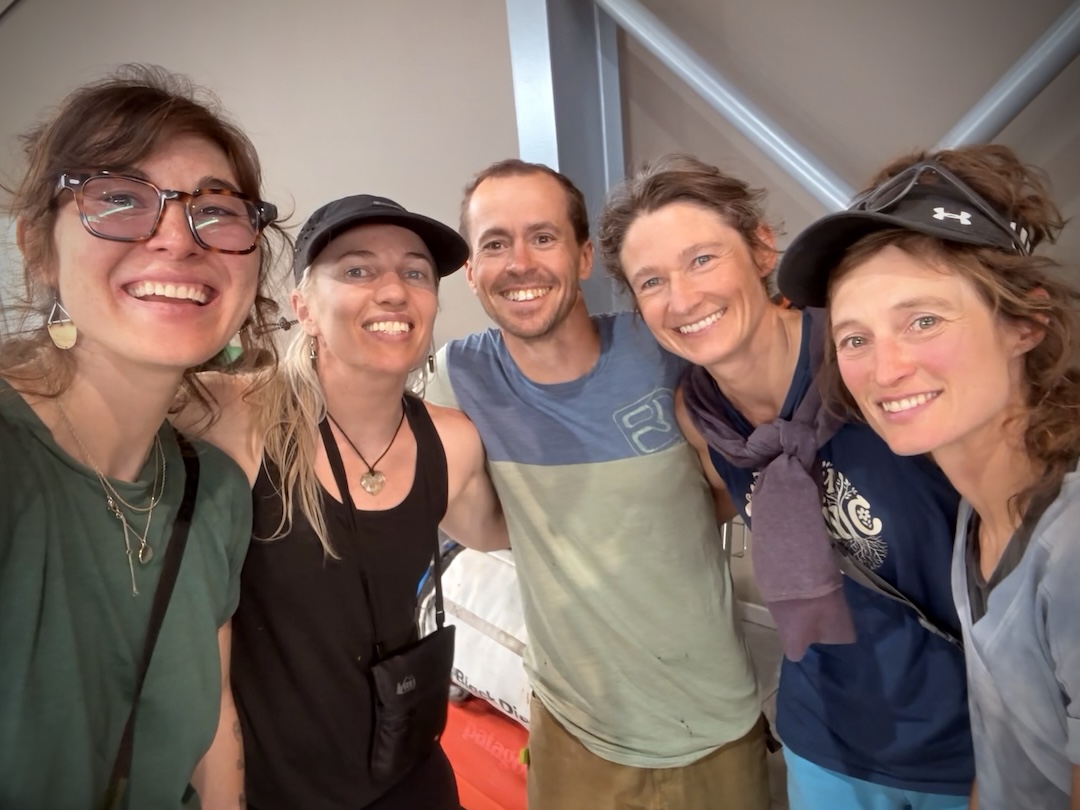
In June, I assembled my dream team: Elise Ebner (USA), one of the most talented climbers I’ve ever known and one of my best friends; Dörte Pietron, a legendary German alpinist and big-wall and sport climber; and Dörte’s husband, Daniel Gebel, the same all-around climbing machine who had eyes on this route 20 years earlier. Miya Tsudome (USA) and Jan Novak (Czech Republic), who had asked me about this route before, joined us to document the trip and galavant on classic day climbs. The plan was for Elise and me to ground-up climb the route with some aid, and for Dörte and Daniel to rappel in and look for a free variation.
By day two of our expedition, it became obvious to the Germans that the route wouldn’t go free at under 8c or 8c+, and that the result wouldn’t be as sustained or aesthetic as Tough Enough, so they decided to pursue other objectives. [They subsequently made free ascents of Lalan’i Mpanjaka (600m, 8a+) on Tsaranoro Be and Bravo Les Filles (600m, 8b) on Tsaranoro Kely.] That left Elise and me to climb the route alone, which we did mostly free, with two aid pitches.
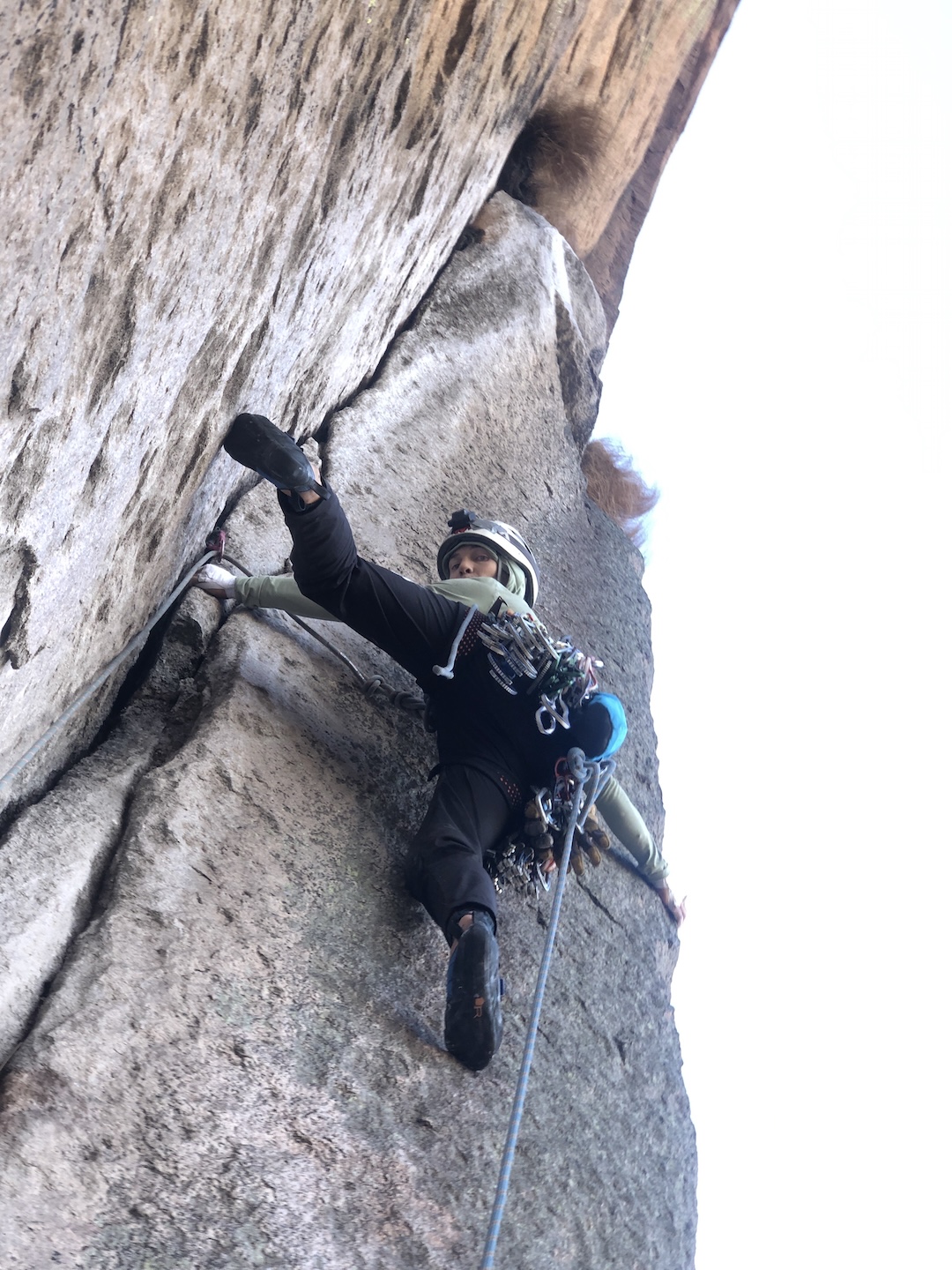
Luckily, the finger cracks I had excavated previously were still clear, but much grass, moss, and bird poo had resurfaced, hobbling our speed to a crawl. After three days at four pitches a day, we topped out the 12th pitch of Tsofa Dombo, dirty and tired. We camped on the summit under a sky blazing with stars and a fingernail clipping of a moon.
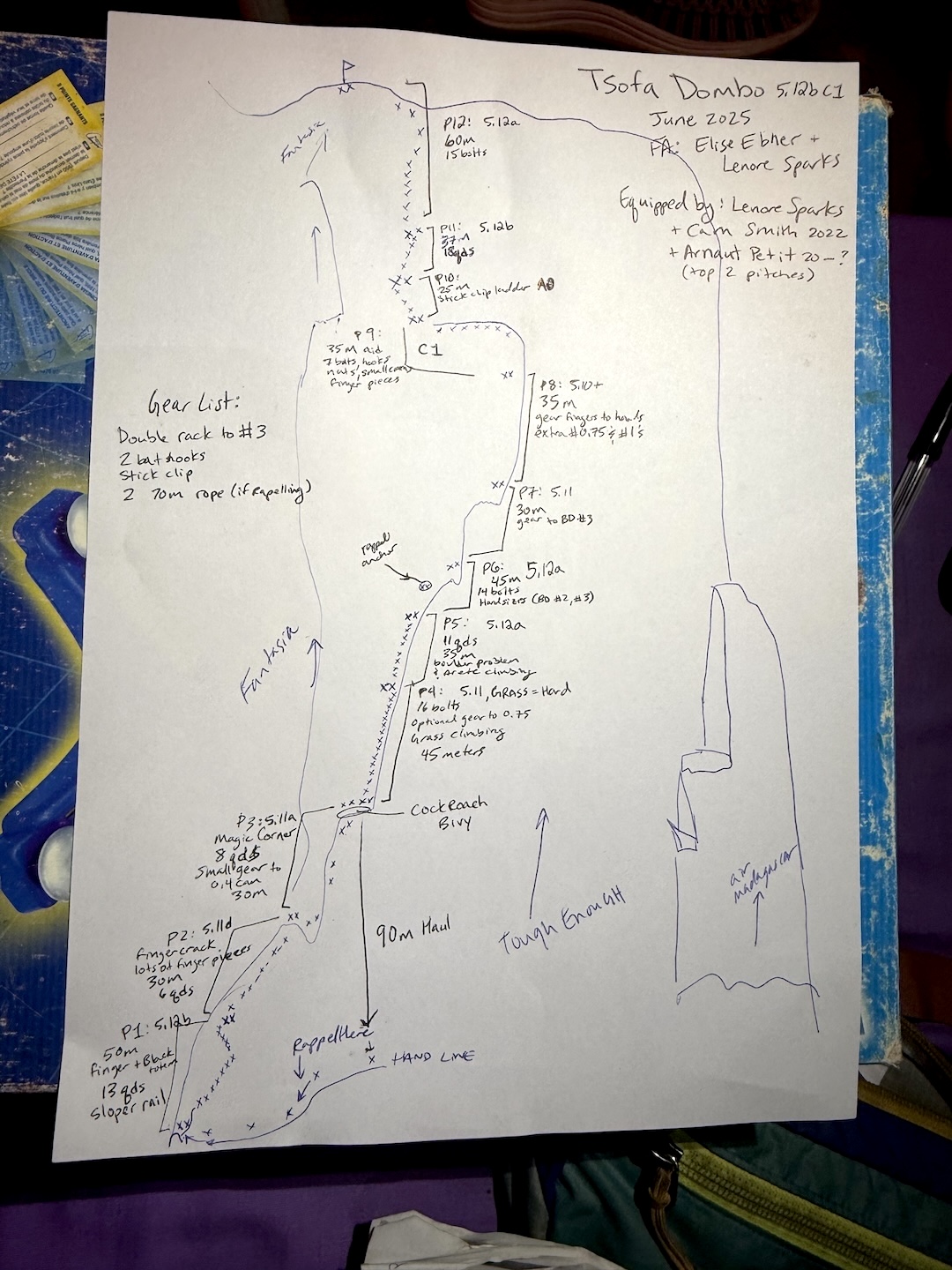
Tsofa Dombo (400m, 12 pitches, 7b C1) has two fully trad-protected pitches, four pitches of mixed trad and bolts, four pitches fully bolted, and two aid pitches. The roof traverse on pitch nine was aided with hooks, small pieces, and bolts, and a stick-clip was used on pitch ten rather than add more bolts to that pitch, which I had established with Cam in 2022.
During our visit, we also helped a family rebuild a kitchen that burned—the best part of our trip. For climbers interested in helping out locally in other ways, the most urgent need is to replace rusty bolts (many routes are becoming unclimbable); climbers also can bring supplies for the local clinic and gently used climbing gear and shoes for the locals, and help with tree planting efforts.
—Lenore Sparks, USA
BRAVO LES FILLES, FIRST FEMALE FREE ASCENT: Shortly before the free ascent of Bravo Les Filles by Daniel Gebel and Dörte Pietron mentioned in the report above, Sasha DiGiulian (USA) and Marianna Ordóñez (Mexico) climbed the route, and DiGiulian completed the first female free ascent. Bravo Les Filles was established in 1999 by a four-woman team led by Lynn Hill, who didn’t quite free the crux pitch; the full line was freed in 2004, at 8b (5.13d), by Eneko and Iker Pou (Spain). A story on DiGiulian’s ascent is in the inaugural American Climbing Journal (ACJ).
Media Gallery