
Mitsinjoarivo, East Face, Famadihana
Madagascar, Tsaranoro Massif
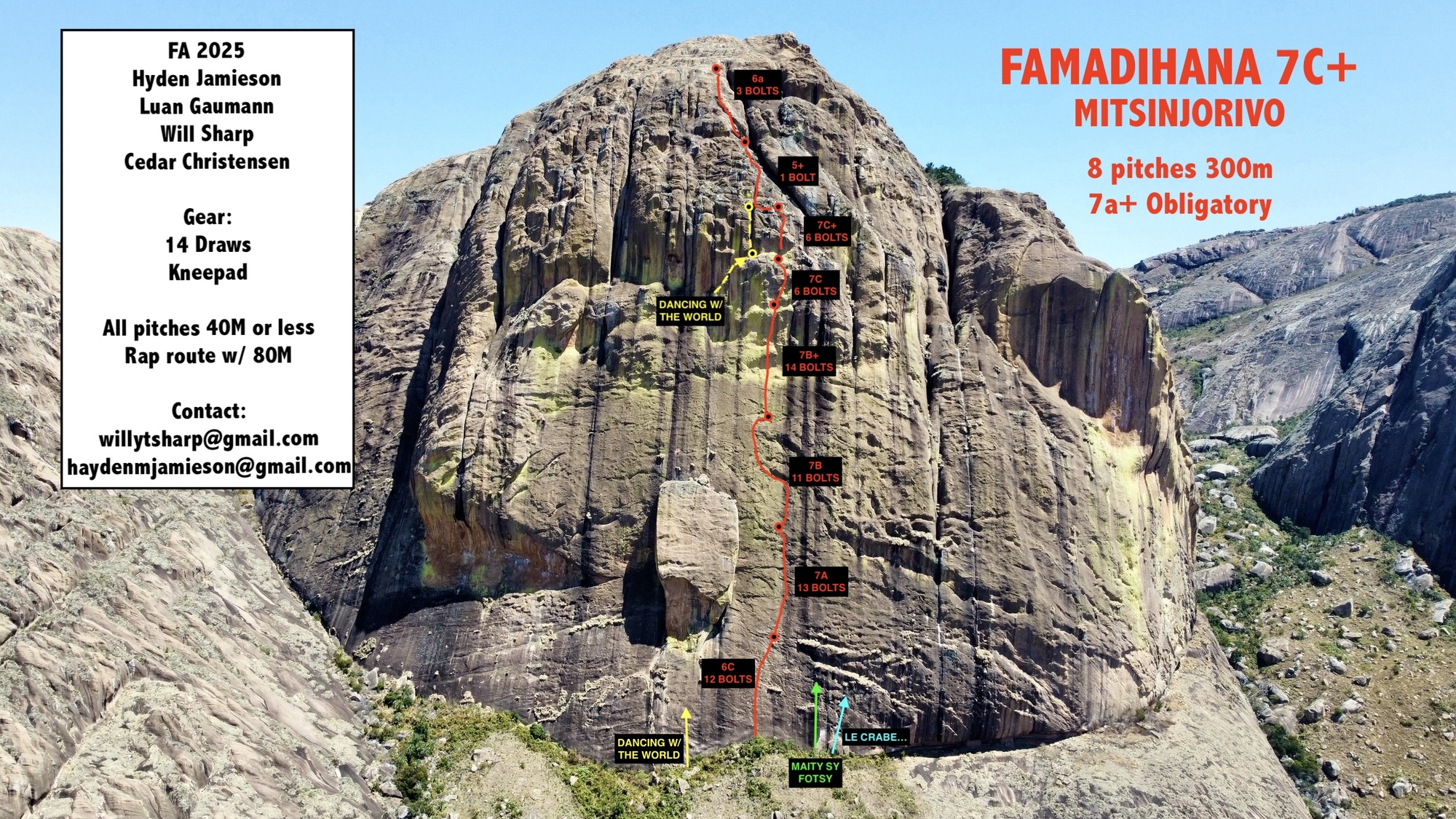
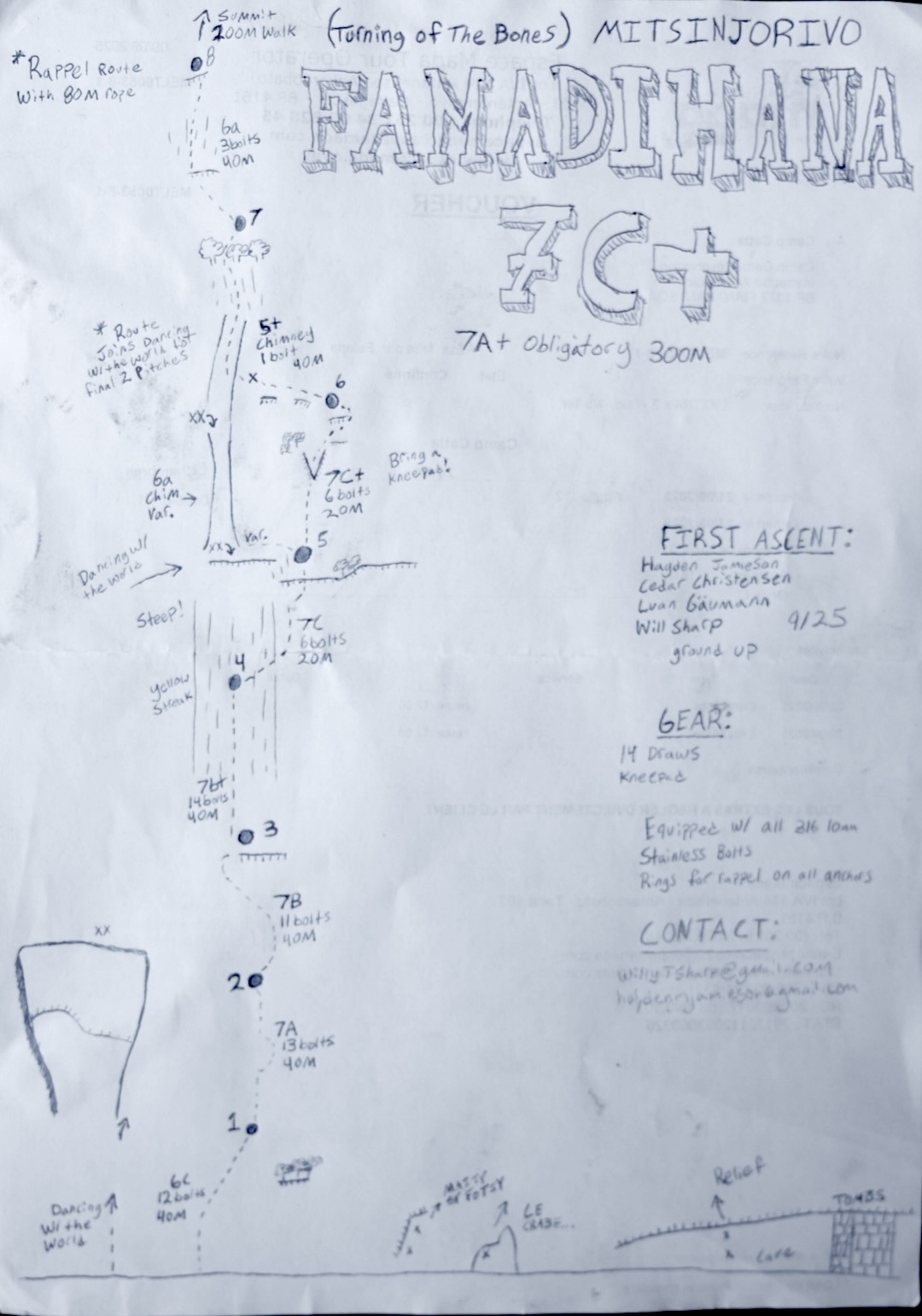
In September 2025, Cedar Christensen (USA), Luan Gäumann (Switzerland), Will Sharp (USA), and I spent 25 days in Madagascar’s Tsaranoro Valley, aiming to learn the craft of ground-up bolting on the region’s immense granite faces. We chose the steep, lichen-streaked, east-facing wall of Mitsinjoarivo (1,700m, 22°05’43.1”S, 46°45’52.2”E) as our objective. The wall is home to several other routes, the first of which was Le Crabe aux Pinces d’Or (“The Crab with the Golden Claws”), a 320-meter 7b+ established by Michel Piola and Benoit Robert in 1998 (AAJ 1999).
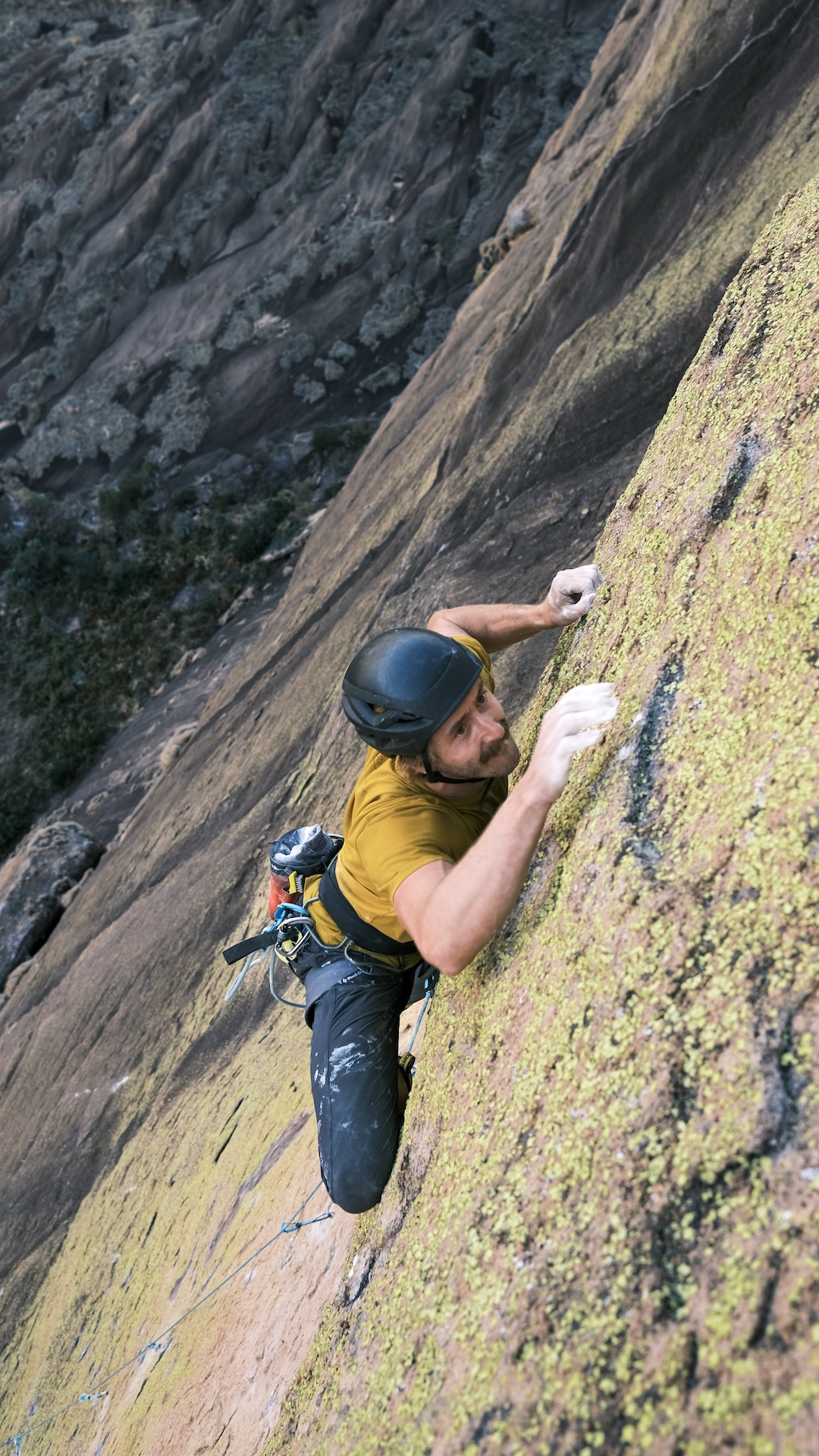
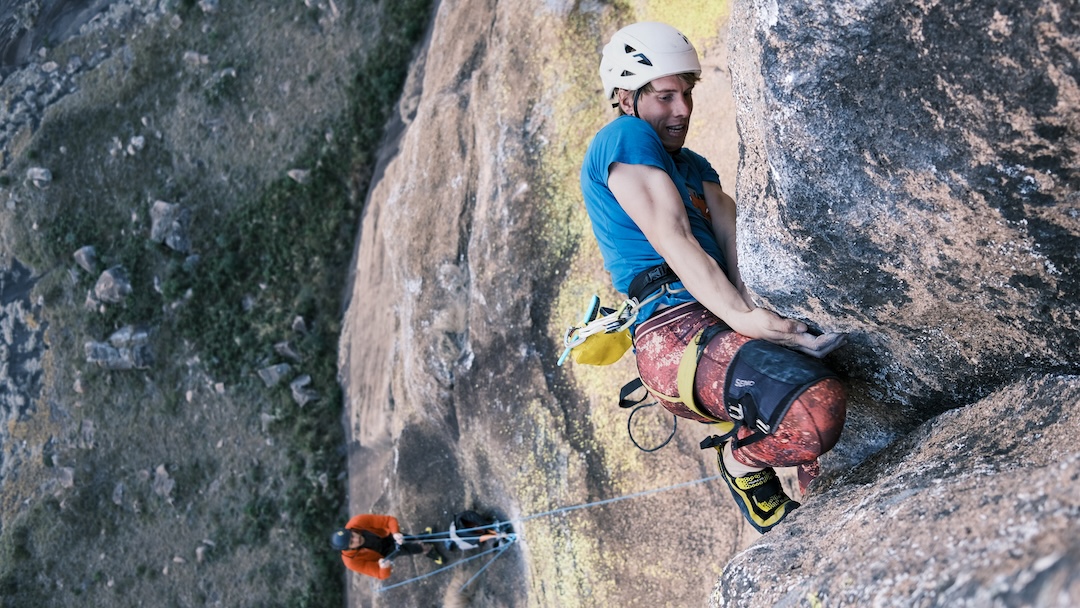
Tsaranoro’s nearly crackless rock is covered in tiny edges, knobs, and flakes—perfect for delicate footwork, improbable stances, and the slow, methodical process of placing bolts from hooks. We worked in two teams on separate days to avoid knocking rocks onto one another: While Luan and I rested, Will and Cedar took the sharp end, often climbing far above their last bolt to test sequences before jumping off at their high point and climbing back up with the drill. Our intention was to free the route ground-up and not rely on aid, though a single temporary bolt proved necessary on a crux too blank to bolt from a stance. Balancing our desire for good style with the responsibility to create a safe, repeatable line became central to the experience and shaped our decisions on the wall.
For four days, we traced a natural path up the face, linking subtle features and refining our vision for the line. The climbing steepened toward a blank-looking headwall, and with it the complexity of each bolt placement. Still, the route unfolded until we had established seven independent pitches, leading into an easier two-pitch finish shared with Dancing with the World (350m, 6c+), a neighboring line to the left (AAJ 2014).
During our final day on the wall, all four of us redpointed the 300-meter route at 7c+ (7a+ obl.). Each of the nine pitches flowed with a clarity that made us grateful for the care we’d invested in the process. We named the route Famadihana, after a traditional Malagasy ceremony celebrating renewal and remembrance. For us, the climb marked a celebration as well—of curiosity, trust, and the simple joy of creating something others might one day experience for themselves.
—Hayden Jamieson, USA
Media Gallery