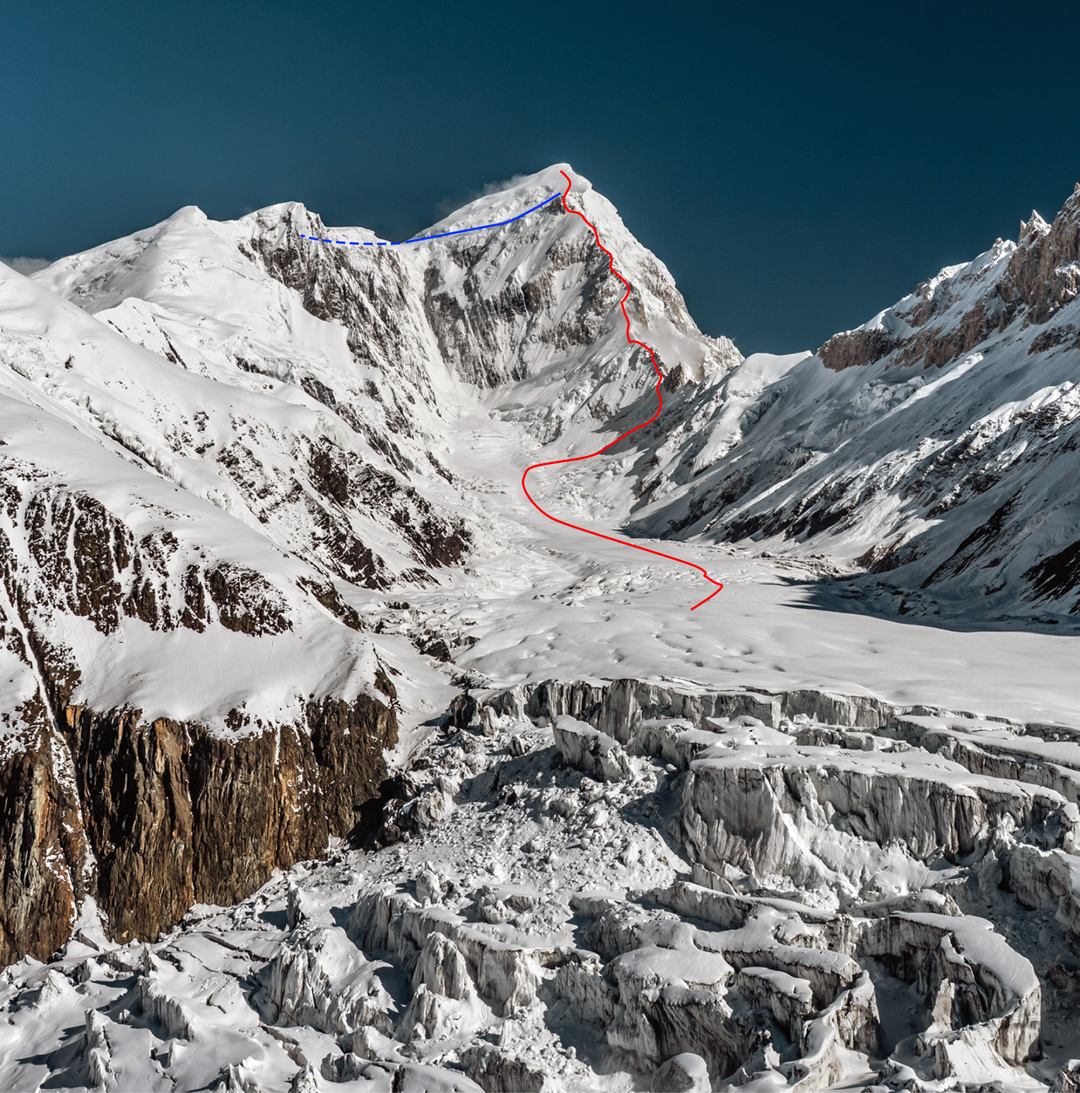
Spantik, east ridge to just below summit
Pakistan, Karakoram, Spantik–Sosbun Range
In June, I experienced one of the defining moments of my climbing life: opening a new line, in alpine style, on Spantik (7,027m). For a child from the Hunza Valley, Spantik is not only a majestic mountain but also a source of inspiration and the place where my dream of becoming a mountain guide took root. Having looked at the summit all my life, reaching it has been one of my main goals. Sharing the rope with Mathieu Maynadier from France, with his extensive experience in the Alps and Himalaya, was a real privilege.
Approaching via the village of Arandu, we arrived at base camp (4,200m) on May 26. We then made two acclimatization ascents on the normal route up the southeast ridge, spending our highest night at 5,800 meters. When a reasonable weather window appeared, we were still not well acclimatized, but we were unsure if there would be another opportunity. In the end, Mathieu recommended we go for it without further acclimatization.
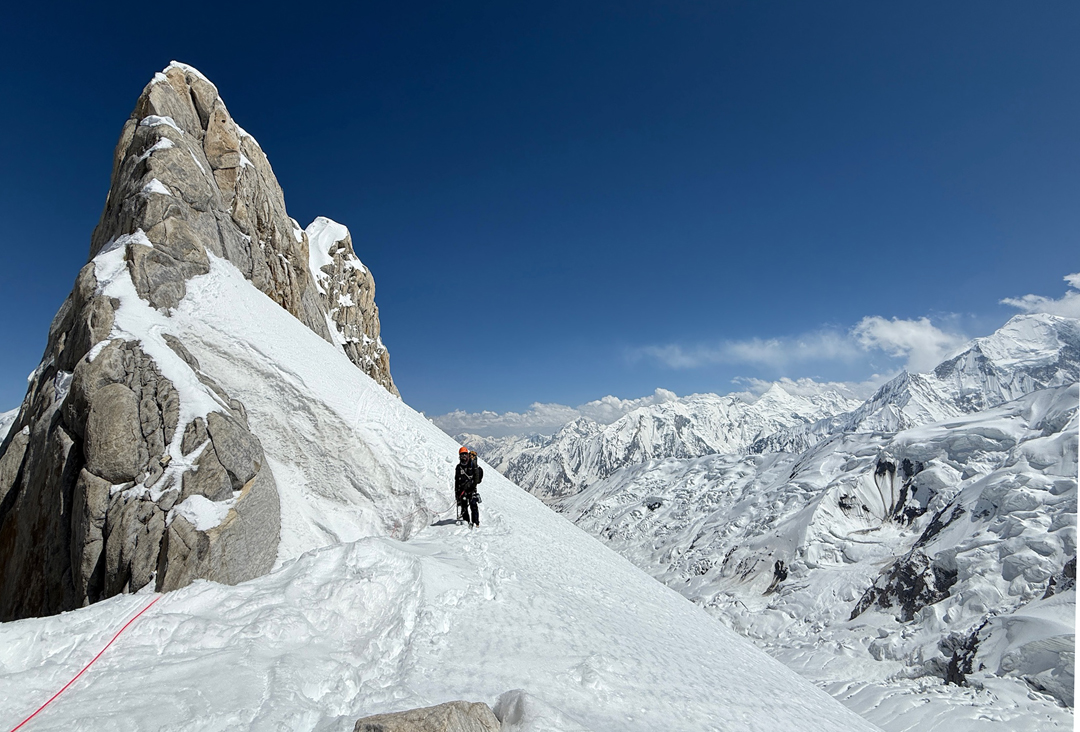
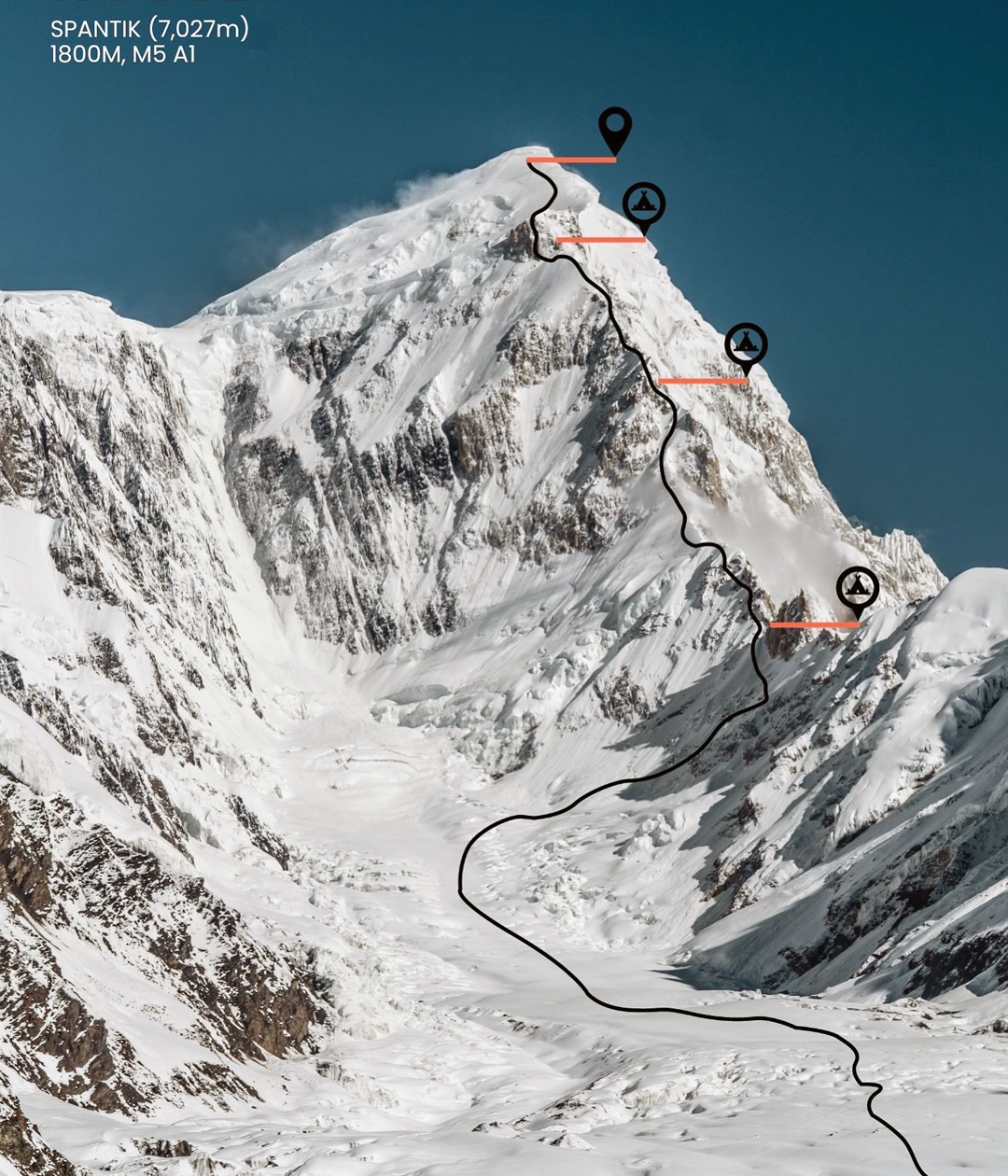
We moved up the Basin Glacier (the name given to this feature by American explorers Fanny Bullock Workman and William Hunter Workman at the beginning of the 20th century) to the east of the southeast ridge, and on June 9 crossed the bergschrund below the east ridge at 5,200 meters. That day, we found unexpected heat but relatively straightforward climbing and reached a three-star bivouac on the crest, where we could unrope and dry equipment in the afternoon warmth.
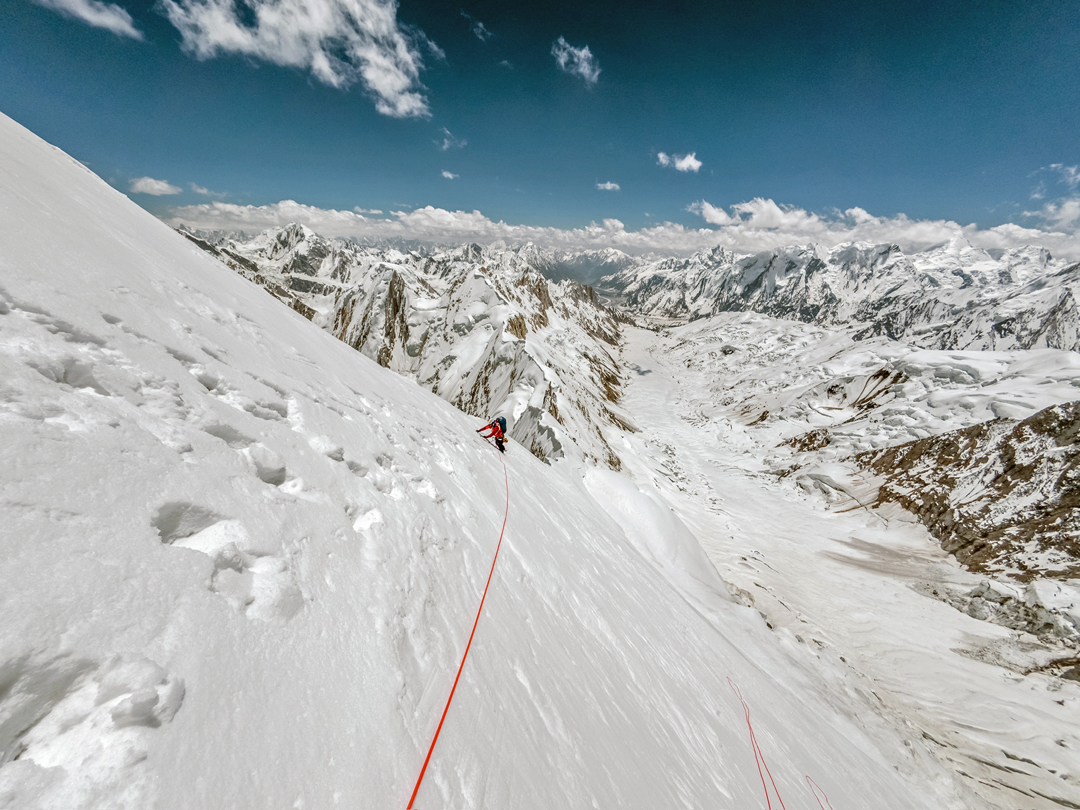
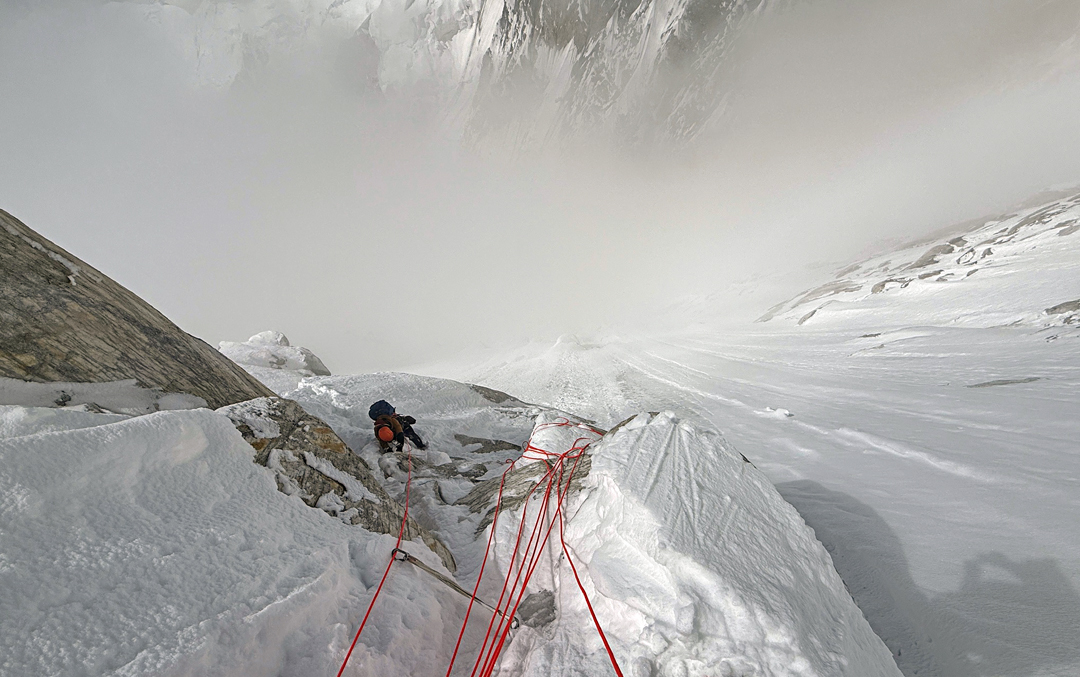
The second day took us into more complex terrain, with mixed sections and large ramps of deep snow that pushed our cardio to the limit. A final steep mixed step, where we had to haul packs, led to a bivouac site sheltered by a large boulder, a place where we could not unrope for the night.
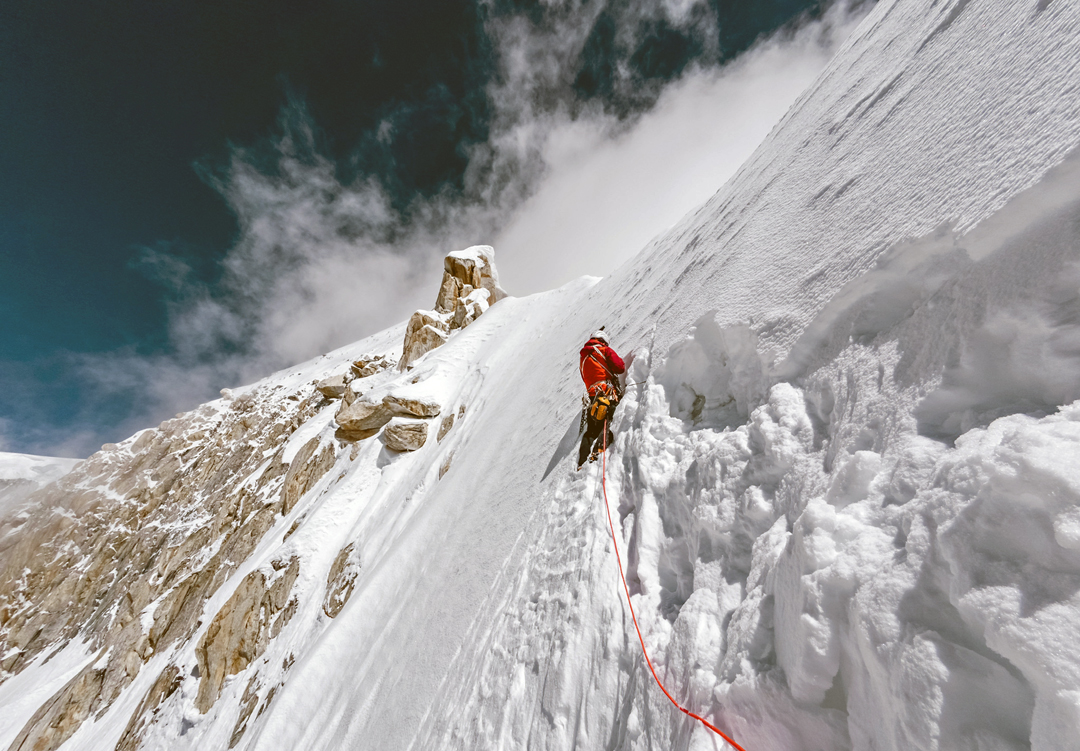
The third day was long, and a mixed section that we anticipated climbing in just a few pitches took much of the day. Above this, we followed snow slopes to the final mixed buttress, arriving at nightfall. By then it was snowing, spindrift was increasing, and finding a sheltered spot for the night became urgent. The forecast had promised only a few snowflakes, but the weather was far more intense. Mathieu, unable to sleep, called our forecaster several times to check conditions. Fortunately, by morning the weather was clear. However, there had been considerable snowfall, and spindrift swept the buttress above.
We were forced to climb a steeper-than-planned—but more sheltered—line on the buttress. There was difficult mixed climbing (a couple of pitches of M5) and some A1 at around 6,600 meters.
The east ridge ends at a plateau, followed by about 200 meters of snow slopes on the summit pyramid. The weather was good, and I was looking forward to seeing my home from the top.
It was not to be. At 6,999 meters on the GPS, 28 vertical meters below the top and around a rope length in distance, we found unstable wind slab that had partially avalanched. We agreed it was too dangerous to continue. Our 1,800-meter route to just below the summit was graded M5 AI 80°.
We reversed our route for a couple of hundred meters to the plateau, then headed south below seracs along the large, glacial terrace that leads to the normal route, which we reached at around 6,400 meters. Just before dark, and after several crevasse falls, we found the gas canister and freeze-dried meals we had cached at 5,800 meters. As the tent had been damaged during the ascent, and we had lost the poles, I lay underneath it while Mathieu slept close by. Twice during the night, he woke me to check if I was still breathing!
We eventually reached the Basin Glacier, and after collecting the skis we had used on the approach, we slid down to base camp.
Pakistan has many high mountains and hundreds of untouched peaks, yet no recognized guide school. This means foreign guides are systematically favored, safety standards stagnate, local talent remains in the shadows, and the profession cannot develop. I have chosen to train in Europe, with the ambition to become an IFMGA guide. I will then return to Pakistan with these skills, build a training system that will offer young climbers the opportunities that weren’t available to me, and lay the foundations for a professional rescue service. Pakistan will be able to carve its own path in the world of alpinism.
—Mueez Ud Din, Pakistan
Media Gallery